
Burstiness - Variation in Sentence Structure and Complexity
Burstiness measures sentence structure variation in writing. Learn how this key metric distinguishes human from AI-generated content and impacts readability.
11 min read

Learn what burstiness means in AI-generated content, how it differs from human writing patterns, and why it matters for AI detection and content authenticity.
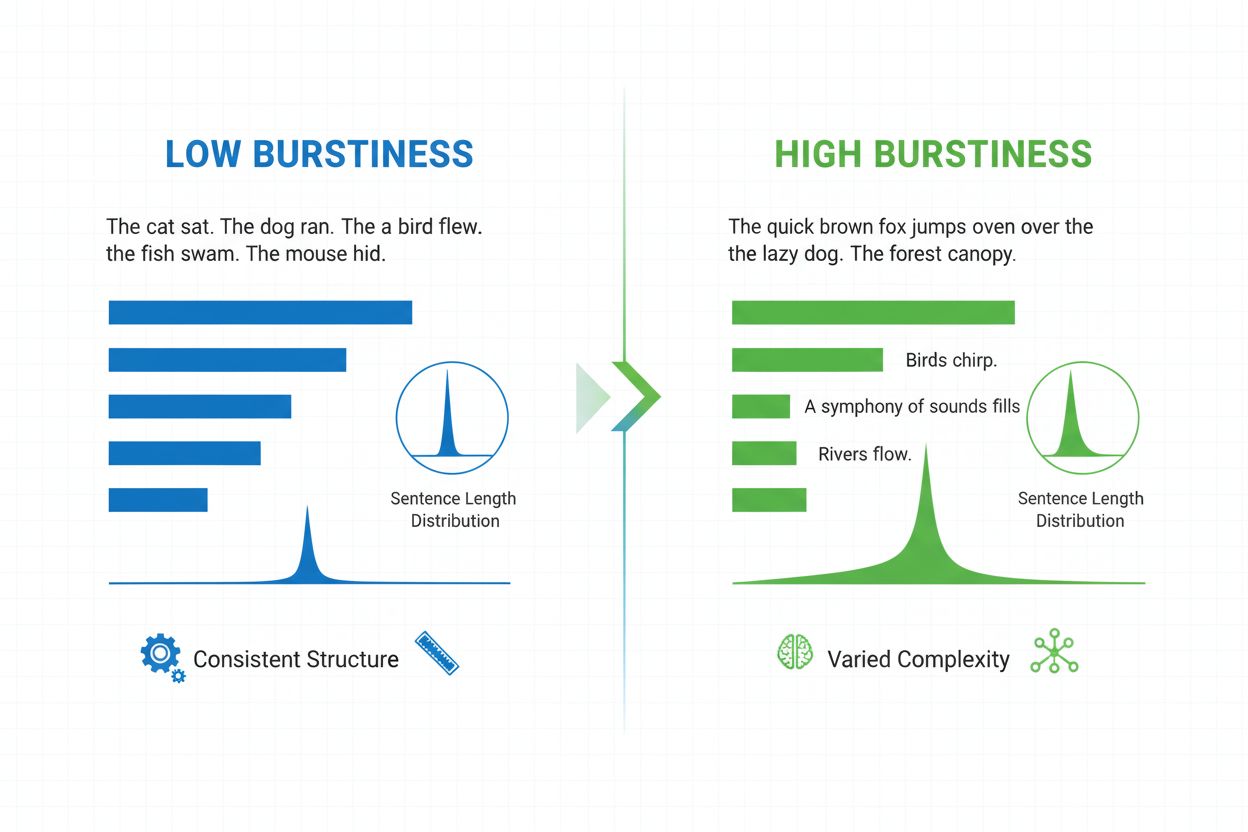
Burstiness in AI content refers to the variation in sentence structure, length, and word distribution patterns within text. It measures how predictable or uniform content is, with human writing typically showing natural bursts of varied sentence lengths and word usage, while AI-generated content may appear more uniform and less bursty.
Burstiness is a linguistic concept that measures the variation and distribution of words, sentence structures, and patterns throughout a piece of text. In the context of AI-generated content, burstiness has become an important metric for understanding how natural or artificial writing appears to both humans and detection systems. The term essentially describes how concentrated or dispersed specific linguistic elements are within a document, and it plays a crucial role in distinguishing between human-written and machine-generated text.
Burstiness refers to the irregular yet concentrated activity or variation in content distribution within a text. Imagine writing about a birthday party where you mention the word “cake” repeatedly in the opening paragraphs, but then rarely mention it again as you move to other topics. This clustering of specific words or phrases in certain sections, followed by their absence in others, is what linguists call burstiness. The concept applies not just to individual word frequency, but to broader patterns including sentence length variation, structural complexity, and stylistic choices throughout a document.
In practical terms, burstiness measures how predictable or uniform a piece of content is. When analyzing text, researchers look for the presence of sudden spikes or concentrations of specific words, phrases, or sentence structures within the text. Human writers naturally employ burstiness as part of their writing style—they vary their sentence lengths, switch between simple and complex structures, and adjust their vocabulary based on context and emphasis. This natural variation creates a pattern that is distinctly human.
The fundamental difference between human and AI-generated content lies in how burstiness patterns manifest. Human writing typically exhibits high burstiness, meaning there are noticeable variations in sentence length, vocabulary complexity, and structural patterns throughout the text. A human writer might write a short, punchy sentence followed by a longer, more complex one, then return to brevity for emphasis. This creates a natural rhythm and flow that readers find engaging.
AI-generated content, particularly from earlier language models, tends to exhibit lower burstiness. This means the text often appears more uniform and predictable, with sentences of similar length and structure repeated throughout. The vocabulary choices are more consistent, and there are fewer dramatic shifts in tone or complexity. Modern AI systems have been trained to better replicate human burstiness patterns, but the underlying tendency toward uniformity remains a distinguishing characteristic. This uniformity, while sometimes making AI text easier to read, can also make it feel robotic or less engaging to readers.
| Characteristic | Human Writing | AI-Generated Content |
|---|---|---|
| Sentence Length Variation | High variation (short to long) | More uniform lengths |
| Vocabulary Complexity | Shifts based on context and emphasis | Consistent complexity levels |
| Word Repetition Patterns | Natural clustering around topics | More evenly distributed |
| Structural Diversity | Varied sentence structures | Repetitive patterns |
| Tone Shifts | Deliberate and contextual | Subtle or absent |
| Predictability | Lower (harder to guess next word) | Higher (easier to predict) |
Perplexity and burstiness are closely related concepts that work together in AI detection systems. Perplexity measures how unexpected or surprising each word is in a piece of text from the perspective of a language model. If you can easily guess the next word in a sentence, that indicates low perplexity. If the word choice is surprising or unusual, that indicates high perplexity. For example, “For lunch today, I ate a bowl of soup” has low perplexity because “soup” is a predictable word choice, while “For lunch today, I ate a bowl of spiders” has high perplexity because the word choice is unexpected.
Burstiness, on the other hand, measures how perplexity changes throughout a document. If surprising words and phrases are interspersed throughout the text, creating variation in how predictable the content is, the text has high burstiness. Human writing naturally contains these variations—some sections are more predictable while others contain unexpected word choices or structural shifts. AI-generated text, being optimized for consistency and coherence, often shows lower burstiness because the perplexity remains more uniform throughout.
Early AI detection systems relied heavily on these metrics, assuming that human text would show higher perplexity and higher burstiness compared to AI-generated text. However, this approach has significant limitations. Text that appears frequently in AI training datasets—such as the Declaration of Independence or Wikipedia articles—shows artificially low perplexity and burstiness because the language models have been optimized to minimize perplexity on their training data. This creates false positives where genuinely human-written, well-known texts are flagged as AI-generated.
For content creators and marketers, understanding burstiness is essential for several reasons. First, burstiness directly affects how engaging and natural your content feels to readers. Content with appropriate burstiness maintains reader interest through varied pacing and structure, while overly uniform content can feel monotonous or artificial. Second, burstiness influences how AI detection systems evaluate your content. If you’re using AI tools to assist with content creation, understanding burstiness helps you ensure the final output maintains human-like characteristics.
Third, burstiness plays a role in how search engines and AI systems interpret your content. When monitoring your brand’s appearance in AI-generated answers across platforms like ChatGPT, Perplexity, and other AI search engines, understanding how your content’s burstiness patterns affect its citation and representation is valuable. Content with natural burstiness patterns is more likely to be recognized as authoritative and human-written, which can influence how it’s used and cited by AI systems.
Different genres and content types naturally exhibit varying levels of burstiness. Scientific and academic texts frequently use specific technical terms in concentrated sections, creating bursty patterns around particular topics. When discussing a specific methodology, for example, related terminology clusters together, then disperses as the text moves to other sections. This is a natural and expected pattern in academic writing.
Fiction and narrative content also employ burstiness strategically. When introducing a new character, their name appears frequently in the opening sections, then less often as readers become familiar with them. Similarly, when describing a specific scene or event, related vocabulary clusters together. Marketing and promotional content often uses burstiness deliberately, concentrating key selling points and benefits in specific sections while maintaining variety in how these points are presented.
News articles and journalistic writing demonstrate burstiness through the concentration of specific facts, quotes, and related information in particular paragraphs, with shifts in focus as the article progresses. Even conversational and informal writing shows natural burstiness through the clustering of related ideas and the variation in sentence structure based on emotional emphasis or importance.
Understanding burstiness is crucial for AI developers because language models learn from vast amounts of text while trying to predict what word comes next based on the words they have seen so far. During training, AI systems are directly incentivized to minimize perplexity on their training datasets, which means they learn to recognize and reproduce patterns they encounter frequently. This creates a challenge: if a text appears often in the training data, the model will assign it low perplexity, which also results in low burstiness.
AI developers must find a balance when training language models. They want the AI to recognize and reproduce natural burstiness patterns—understanding that if a new character is introduced in fiction, their name will appear frequently in a short period. At the same time, they don’t want the AI to overuse words or get stuck in repetitive loops. This requires training AI on diverse types of text, not just one specific genre or content type. By exposing the model to different writing styles and patterns, developers teach the AI to recognize and generate different levels of burstiness appropriate to different contexts.
Modern AI systems have become increasingly sophisticated at replicating human burstiness patterns. However, the underlying architecture of language models still tends toward uniformity and predictability. This is why even advanced AI-generated content can sometimes feel slightly different from human writing—the burstiness patterns, while improved, may not perfectly match the natural variation found in human text.
For brands and content creators using AI monitoring platforms, burstiness analysis provides valuable insights into how your content is being used and represented in AI-generated answers. When your content appears in AI responses across different platforms, the burstiness patterns in how your information is presented can indicate whether it’s being directly cited, paraphrased, or synthesized with other sources. Content with distinctive burstiness patterns is easier to track and identify within AI-generated responses.
Additionally, understanding burstiness helps you evaluate the quality of AI-generated content that uses your information. If your brand’s content is being incorporated into AI answers with appropriate burstiness and natural variation, it suggests the AI system is treating your content as authoritative and integrating it meaningfully. Conversely, if your content appears in AI responses with reduced burstiness or excessive uniformity, it might indicate the information is being over-simplified or losing important nuance in the AI generation process.
Human writers can also use burstiness principles to improve their content. By deliberately varying sentence length, adjusting vocabulary complexity, and shifting between simple and complex ideas, writers can create more engaging and natural-sounding content. This is particularly important for content creators who want their work to be recognized as authoritative and human-written by both readers and AI systems that analyze content authenticity.
Track how your content appears in AI-generated answers across ChatGPT, Perplexity, and other AI search engines. Understand content patterns and ensure your brand visibility.
Burstiness measures sentence structure variation in writing. Learn how this key metric distinguishes human from AI-generated content and impacts readability.

Community discussion on burstiness in AI content detection - what it means, how it affects AI visibility, and whether content creators should optimize for it.

Learn how content velocity optimized for AI systems drives citations, visibility in AI Overviews, and competitive advantage. Discover publishing cadences, fresh...