

How to Optimize for Purchase Decisions in AI Search Engines
Learn how to optimize your brand for AI purchase decisions. Discover strategies to increase visibility in ChatGPT, Perplexity, and AI answer engines where consu...
10 min read

Explore how AI search transforms the buyer journey across ChatGPT, Perplexity, and Google AI. Learn the stages, platform differences, and strategies for visibility.
The buyer journey in AI search is a dynamic, non-linear process where customers discover, evaluate, and purchase solutions through AI-powered search engines like ChatGPT, Perplexity, and Google AI Overviews. Unlike traditional funnels, AI search journeys involve continuous looping between exploration, validation, and decision stages, with 68% of the buyer journey now digital and 62% of demand generation predicted to be AI-led by 2028.
The buyer journey in AI search represents a fundamental shift in how customers discover, evaluate, and purchase products and services. Unlike the traditional linear funnel model that progressed from awareness to consideration to decision, the AI-powered buyer journey is dynamic, non-linear, and continuously evolving. This journey encompasses interactions across multiple AI search platforms including ChatGPT, Perplexity, Google AI Overviews, and Claude, where buyers now receive synthesized answers, recommendations, and comparisons without visiting individual websites. According to recent research, 68% of the buyer journey is now digital, and 62% of traditional demand generation will be AI-led by 2028, making this transformation critical for businesses to understand and adapt to. The shift matters because buyers are increasingly relying on AI to answer questions, compare options, and validate decisions before ever engaging with sales teams, fundamentally changing where and how brands achieve visibility.
The traditional marketing funnel operated on a predictable, linear model: awareness led to consideration, which led to decision. This structure worked well when buyers had limited information sources and followed relatively predictable paths. However, AI search has disrupted this neat structure by introducing multiple entry points, non-sequential progression, and continuous looping between stages. Modern buyers now move between exploration, validation, and decision at their own pace, sometimes returning to earlier stages for additional research, sometimes skipping ahead when they find sufficient information. Research from McKinsey indicates that 50% of consumers are already using AI-powered search today, and this could impact $750 billion in revenue by 2028. The Bain & Company research reveals that 80% of consumers now rely on AI-written results for at least 40% of their searches, fundamentally changing how information flows to buyers. Additionally, 24%-41% of search behavior is now being reshaped by generative AI, with 6% of search traffic flowing directly through AI tools like ChatGPT and Perplexity, while 20%-35% of Google search results now include AI-generated overviews. This evolution means that SEO alone is no longer sufficient—brands must now ensure they are cited, discussed positively, and visible across AI-powered discovery channels.
| Journey Stage | Traditional Funnel | AI Search Journey | Key Characteristics |
|---|---|---|---|
| Exploration | Awareness | Continuous discovery | Buyers ask open-ended questions to AI; multiple entry points; non-linear progression |
| Validation | Consideration | Iterative evaluation | AI provides comparisons, summaries, and recommendations; buyers loop back for deeper research |
| Decision | Decision | Dynamic selection | AI influences final choice through citations and recommendations; conversion may happen off-platform |
| Engagement Model | One-way messaging | Two-way conversation | Interactive dialogue with AI; follow-up questions; real-time personalization |
| Information Source | Website visits required | AI-synthesized answers | Buyers get answers without visiting brand websites; citations matter more than traffic |
| Timeline | Predictable progression | Variable and looping | Buyers may skip stages or return multiple times; no fixed duration |
ChatGPT has become a primary discovery tool for over 25% of user journeys, with users asking questions at the top of the funnel to understand problems, explore solutions, and compare options. The platform’s conversational interface allows buyers to ask follow-up questions, refine their search, and validate information in real time. Perplexity specializes in providing cited, research-backed answers that help buyers understand complex topics and evaluate multiple perspectives simultaneously. Google AI Overviews integrate AI-generated summaries directly into search results, appearing in 74% of problem-solving queries, making them a critical touchpoint for buyers who start their journey with traditional search. Claude offers detailed, nuanced responses that appeal to buyers seeking comprehensive analysis and thoughtful evaluation. Each platform influences the buyer journey differently: ChatGPT drives early-stage exploration and problem definition, Perplexity supports validation and comparison, Google AI Overviews capture intent at the moment of search, and Claude enables deep-dive research and decision validation. The critical insight is that 60% of searches now end without the user progressing to a website, meaning brands that aren’t cited in AI answers are missing opportunities to influence buyers at crucial decision moments.
Exploration Phase: Buyers begin their journey by asking AI tools open-ended questions about problems, trends, or solutions. This phase is characterized by information gathering, problem definition, and initial solution awareness. Unlike traditional awareness campaigns that push messaging to buyers, AI search exploration is pull-driven—buyers actively seek information and AI provides synthesized answers from multiple sources. During this phase, 73% of decision makers expect to rely more on AI chatbots in the future, with that number rising to 85% among IT buyers. Brands that appear in AI-generated answers during this phase establish early credibility and influence how buyers frame their problem.
Validation Phase: Once buyers understand their problem, they move into validation, where they compare solutions, evaluate fit, and assess vendor credibility. This phase involves looping—buyers may ask AI multiple follow-up questions, request comparisons between specific vendors, or seek validation of their emerging preferences. Application-based searches like YouTube and Reddit now surpass traditional internet search for vendor discovery, indicating that buyers are seeking peer validation and real-world use cases. AI tools synthesize this information, presenting buyers with balanced comparisons and highlighting key differentiators. Brands that are frequently cited in validation-phase queries and appear in AI-generated comparisons gain significant advantage.
Decision Phase: The final phase involves making the purchase decision, but this phase has fundamentally changed in the AI search era. Rather than visiting a brand’s website to make a final decision, buyers may make their choice based entirely on AI-synthesized information and recommendations. 69% of buyers engage only with content that feels personalized, meaning AI’s ability to tailor recommendations to individual needs significantly influences final decisions. However, conversion patterns are shifting—traffic from generative AI sources was 23% less likely to convert in July 2025, down from 49% in January, suggesting that while AI drives awareness and consideration, the conversion journey requires additional touchpoints and personalization.
ChatGPT’s Conversational Journey: ChatGPT enables a dialogue-based buyer journey where customers ask questions, receive answers, and ask follow-ups in a single conversation. This creates opportunities for brands to influence multiple decision points within one session. Buyers using ChatGPT often start with broad questions (“What are the best project management tools?”) and progressively narrow their focus based on AI responses. Brands that are frequently cited in ChatGPT’s training data and appear in multiple follow-up responses gain compounding visibility advantages.
Perplexity’s Research-Backed Journey: Perplexity’s emphasis on citations and source attribution creates a journey where buyers can verify information and explore original sources. This platform appeals to research-oriented buyers who want to validate AI recommendations against primary sources. The buyer journey on Perplexity involves more deliberate evaluation, with buyers clicking through to cited sources to verify claims and assess vendor credibility directly.
Google AI Overviews’ Integrated Journey: Google AI Overviews appear directly in search results, creating a journey where buyers encounter AI-synthesized information at the moment of search intent. This integration means that buyers may never leave Google’s ecosystem, making visibility in AI Overviews critical for capturing intent. The journey is faster and more immediate than other platforms, with buyers making quick assessments based on AI summaries before deciding whether to visit websites.
Claude’s Deep-Dive Journey: Claude’s strength in nuanced, detailed analysis makes it valuable for buyers conducting thorough research and seeking comprehensive evaluations. The buyer journey on Claude often involves longer conversations, more detailed follow-ups, and deeper exploration of complex topics. Brands that can provide detailed, well-structured information that Claude can synthesize and present effectively gain advantage on this platform.
The buyer journey in AI search has direct implications for revenue and conversion. Research from Bain & Company shows that 80% of consumers rely on AI-written results for at least 40% of their searches, and this reliance is reducing organic web traffic by 15%. However, the relationship between AI visibility and conversion is complex. While AI search is impacting over 25% of user journeys, conversion rates from AI sources are evolving. Traffic from generative AI sources was 23% less likely to convert in July 2025, suggesting that while AI drives awareness and consideration, additional touchpoints are needed for conversion. This indicates that the buyer journey in AI search requires a different conversion strategy than traditional digital marketing. Brands must focus on being cited and recommended by AI systems during exploration and validation phases, then ensure they have effective conversion mechanisms when buyers finally visit their websites or contact sales teams.
The transformation of the buyer journey in AI search requires fundamental changes to how organizations approach marketing and sales. IDC research shows that 62% of traditional demand generation will be AI-led by 2028, meaning organizations must adapt their strategies now. Marketing’s role has expanded from awareness generation to full journey orchestration, connecting product, sales, and customer experience through buyer intelligence. This requires new capabilities: AI fluency, from prompt engineering to agentic workflows, is becoming a core requirement for marketing teams. Sales teams must adapt to buyers who arrive with significant pre-research, having already explored options and formed preliminary preferences through AI interactions. The traditional sales funnel of lead generation, qualification, and closing is being replaced by a model where sales focuses on validation, customization, and relationship building with buyers who are already well-informed. Organizations that understand and optimize for the AI search buyer journey will capture demand earlier, influence decisions more effectively, and convert more efficiently than competitors still operating under traditional funnel models.
Understanding where your brand appears in the buyer journey in AI search is essential for modern marketing strategy. AmICited provides visibility into how your brand is cited, discussed, and recommended across ChatGPT, Perplexity, Google AI Overviews, and Claude. By monitoring your brand’s presence across these platforms, you can identify which stages of the buyer journey you’re influencing, where competitors are gaining advantage, and how to optimize your content for AI citation. This monitoring reveals whether your brand is appearing during exploration phases (problem definition), validation phases (comparison and evaluation), or decision phases (final recommendations). With this intelligence, you can adjust your content strategy, improve your semantic relevance, and ensure you’re visible at the moments that matter most in the AI-driven buyer journey. Organizations using AI search monitoring report better understanding of buyer behavior, more effective content strategies, and improved ability to compete in the AI-first marketplace.
The buyer journey in AI search will continue to evolve as AI technology advances and buyer expectations shift. IDC predicts that 62% of traditional demand generation will be AI-led by 2028, indicating accelerating adoption and integration of AI into buyer discovery processes. Future developments will likely include more sophisticated personalization, where AI systems learn individual buyer preferences and tailor recommendations with increasing precision. Agentic AI workflows will enable AI systems to take autonomous actions on behalf of buyers—researching options, requesting proposals, and even negotiating terms—further compressing the buyer journey and reducing human touchpoints. Multi-modal AI will integrate video, audio, and interactive content into buyer journeys, creating richer, more engaging discovery experiences. The role of digital trust will become increasingly important, with buyers expecting transparency about how AI uses their data and makes recommendations. Organizations that build trust through transparent AI practices and ethical data handling will gain competitive advantage. Additionally, the integration of AI across the entire customer lifecycle—from discovery through support—will create continuous journeys rather than discrete stages, requiring organizations to think about buyer engagement as an ongoing, evolving relationship rather than a linear progression toward purchase.
Track where your brand appears in AI-generated answers across ChatGPT, Perplexity, Google AI Overviews, and Claude. Understand your visibility in the new AI-driven buyer journey.
Learn how to optimize your brand for AI purchase decisions. Discover strategies to increase visibility in ChatGPT, Perplexity, and AI answer engines where consu...
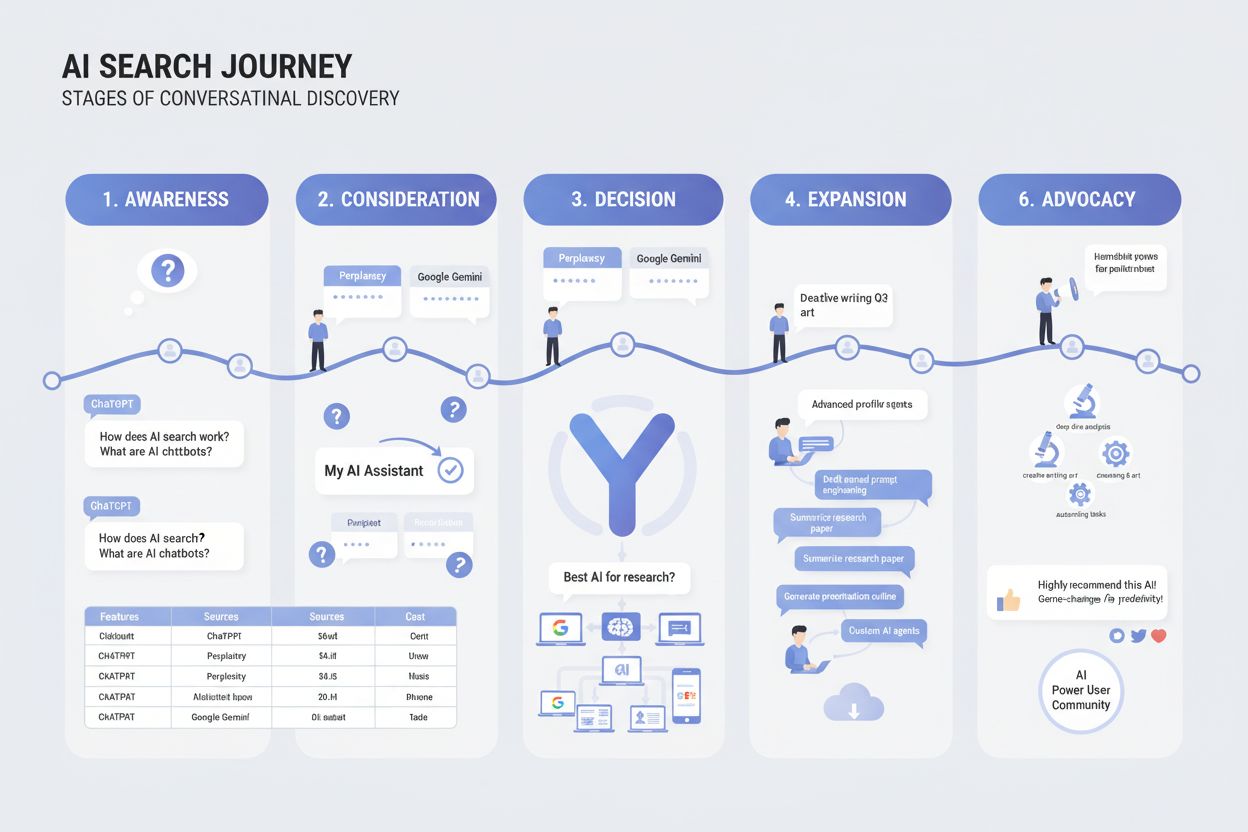
Understand the AI Search Journey—the multi-turn conversational path users take through AI search systems. Learn how awareness, consideration, decision, and adop...
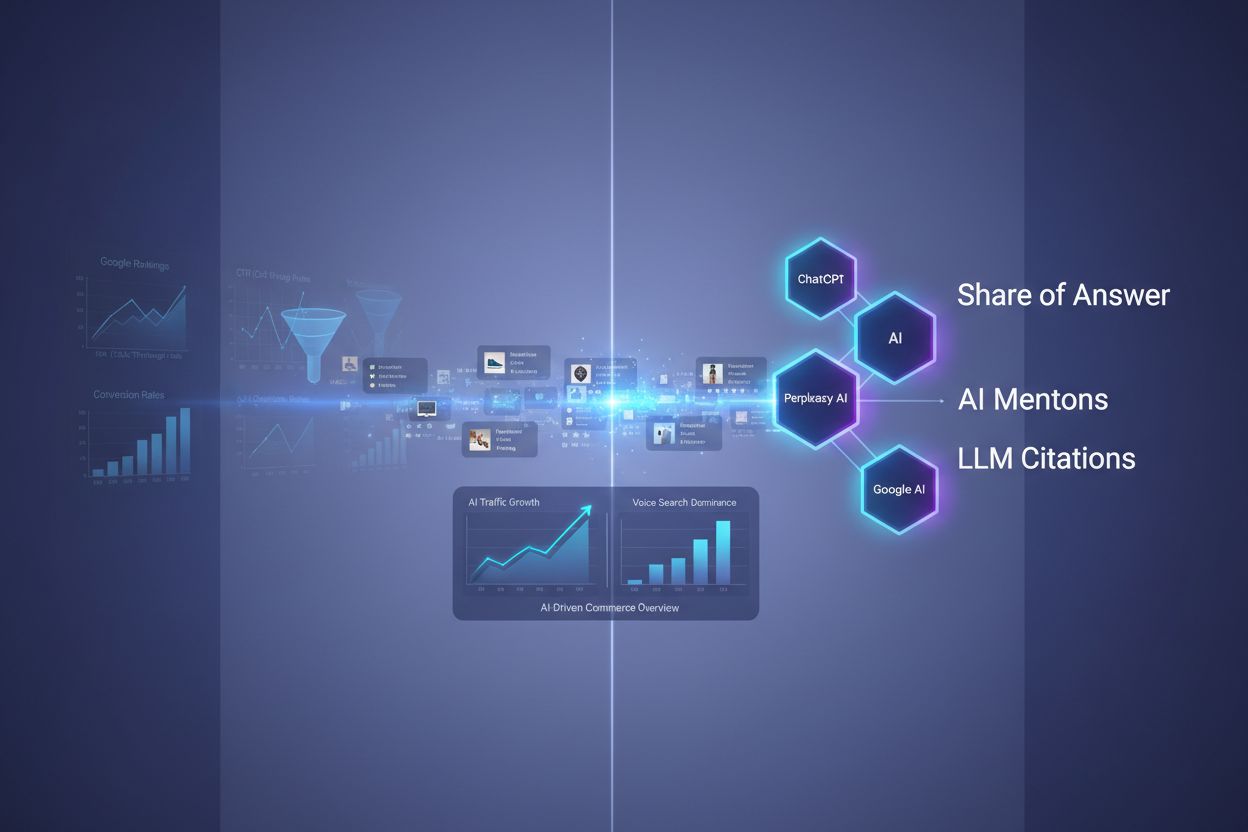
Learn how AI is transforming product discovery. Discover strategies for optimizing your brand's visibility in ChatGPT, Perplexity, and Google AI Overviews with ...