

How to Fix Keyword Cannibalization for AI Search Engines
Learn how to identify and fix keyword cannibalization issues affecting your visibility in AI search engines like ChatGPT, Perplexity, and Gemini. Discover conso...
14 min read

Learn what content cannibalization in AI search means, how it affects your brand visibility in AI answers, and why monitoring your content overlap matters for AI search optimization and brand citations.
Content cannibalization in AI search occurs when multiple pages on your website target the same keywords or topics, causing search engines and AI systems to split ranking signals between competing URLs. This dilutes your authority, reduces visibility in AI-generated answers, and weakens your brand's appearance in AI search engines like ChatGPT, Perplexity, and other AI answer generators.
Content cannibalization is a critical SEO challenge that has evolved significantly with the rise of AI search engines and AI answer generators. Unlike traditional search where Google displays multiple results, AI systems like ChatGPT, Perplexity, and other AI search platforms synthesize information from multiple sources into single, cohesive answers. When your website has multiple pages targeting the same keywords or topics, these AI systems struggle to determine which page is most authoritative, resulting in diluted citations and weakened brand visibility in AI-generated responses.
The problem becomes particularly acute in the context of AI search monitoring because these systems don’t just rank pages—they extract and synthesize content. If your brand has competing pages on the same topic, AI answer generators may cite neither page prominently, or worse, they may cite a competitor’s content instead. This represents a fundamental shift from traditional SEO cannibalization, where the issue was primarily about ranking dilution within Google’s search results.
In traditional Google search, cannibalization means multiple pages compete for the same keyword, and Google limits how many results from your domain appear for a single query. The impact is visible—you see your pages fighting for position in the search results. However, in AI search engines, the problem is more insidious because AI systems don’t display multiple results from the same domain. Instead, they synthesize information and may cite your content only once, or not at all if they find clearer, more authoritative sources elsewhere.
| Aspect | Traditional Search Cannibalization | AI Search Cannibalization |
|---|---|---|
| Visibility | Multiple pages rank for same keyword | AI selects one source or none for synthesis |
| Citation Pattern | Ranking dilution across URLs | Reduced or inconsistent brand attribution |
| User Experience | Users see multiple similar results | Users see single synthesized answer |
| Detection | Visible in SERP rankings | Requires AI monitoring tools |
| Impact on Brand | Lower click-through rates | Reduced brand mentions in AI answers |
| Authority Signal | Split between competing pages | Concentrated on single source (possibly competitor) |
When AI answer generators like Perplexity or ChatGPT encounter multiple pages from your domain covering the same topic, they face a decision: which source is most authoritative? If your pages are too similar in content quality and depth, the AI system may default to citing a competitor’s more clearly differentiated content instead. This is why monitoring your brand’s appearance in AI answers has become essential for modern SEO strategy.
Content cannibalization in AI search operates through semantic similarity detection. Modern AI language models don’t just match keywords—they understand meaning and intent. When your website has two articles about “best project management tools,” even if they use slightly different keywords, the AI system recognizes them as semantically similar. This creates several problems:
First, AI systems may struggle to determine topical authority. If both pages have similar content depth, structure, and backlink profiles, the AI cannot easily identify which one should be cited as the authoritative source. This uncertainty leads to inconsistent citations across different AI platforms. One day, ChatGPT might cite your first article; the next day, Perplexity might cite your second article. This inconsistency weakens your brand’s presence in AI-generated answers.
Second, cannibalization dilutes your topical authority signals. Search engines and AI systems use topical authority as a ranking factor. When you have multiple pages on the same topic, you’re essentially telling these systems that you don’t have a clear, authoritative perspective on the subject. Instead of one comprehensive, authoritative page that dominates AI citations, you have fragmented authority spread across multiple URLs. This makes it harder for AI answer generators to confidently cite your content as the definitive source.
Third, AI content cannibalization creates citation leakage. Even if your pages are cited, the citations may be distributed across multiple URLs rather than concentrated on your strongest, most authoritative page. This means your brand doesn’t receive the full benefit of being cited as the primary source. In AI search monitoring, this appears as reduced brand visibility and fewer consolidated citations.
The stakes for content cannibalization are higher in the AI search era than they were in traditional SEO. Here’s why:
AI systems prioritize source clarity and authority. When ChatGPT, Perplexity, or other AI answer generators synthesize information, they’re trained to identify authoritative sources. If your website presents conflicting or overlapping content, the AI system may view your domain as less authoritative overall. This can result in your content being cited less frequently, or being passed over entirely in favor of competitors with clearer, more differentiated content strategies.
Brand mentions in AI answers drive awareness and trust. Unlike traditional search where users click through to your website, AI-generated answers often provide direct answers without requiring users to visit your site. However, being cited as a source in these answers builds brand authority and trust. When content cannibalization reduces your citation frequency in AI search engines, you lose this valuable brand-building opportunity.
AI search is becoming a primary discovery channel. Recent data shows that AI search engines like Perplexity are capturing significant search traffic, with some studies indicating that ChatGPT alone captures approximately 4% of all search traffic. As users increasingly turn to AI answer generators for information, appearing prominently in these systems becomes critical for brand visibility. Content cannibalization directly undermines this visibility.
Detecting content cannibalization requires a different approach than traditional SEO audits. You need to focus on semantic similarity rather than just keyword overlap. Here are the key indicators:
Multiple pages ranking for similar AI queries: Use AI search monitoring tools to track which of your pages appear in AI-generated answers for your target topics. If multiple pages from your domain are cited for the same query, you likely have cannibalization. This is particularly important for brand monitoring because it shows how your content competes internally in AI systems.
Inconsistent brand citations across AI platforms: Monitor your brand mentions across different AI search engines. If different pages are cited by ChatGPT, Perplexity, and other platforms for the same topic, you have cannibalization. Ideally, one authoritative page should be consistently cited across all platforms.
Reduced overall citation frequency: Compare your citation count in AI answers to your content volume. If you have ten articles on a topic but receive citations for only two or three, cannibalization may be reducing your visibility. Use AI search monitoring to track this metric over time.
Lower topical authority scores: Tools that measure topical authority will show lower scores when you have cannibalized content. This is because authority is spread across multiple pages rather than concentrated on one authoritative resource.
The solution to content cannibalization in AI search involves consolidation and differentiation:
Consolidate overlapping content: If you have multiple pages covering essentially the same topic, merge them into one comprehensive, authoritative resource. This concentrates your topical authority and makes it easier for AI systems to identify your page as the definitive source. When you consolidate, ensure the merged page is more comprehensive and valuable than either original page.
Differentiate by search intent: If you have multiple pages on similar topics, ensure each targets a distinctly different search intent. For example, one page might target informational intent (“What is project management?”), while another targets commercial intent (“Best project management tools to buy”). This clear differentiation helps AI systems understand that your pages serve different purposes and aren’t competing.
Implement strategic internal linking: Use internal links to establish a clear hierarchy and signal which page is most authoritative for a given topic. Link supporting pages back to your main pillar page, helping AI systems understand your content structure and topical authority.
Use structured data markup: Implement schema markup (FAQ, How-To, Article schema) to help AI systems better understand your content’s purpose and authority. This is particularly important for AI search optimization because it provides explicit signals about content relationships.
Create unique, defensible content: Add proprietary data, original research, unique frameworks, or first-party insights that competitors cannot easily replicate. This makes your content more valuable to AI systems and less likely to be overshadowed by cannibalized versions or competitor content.
The best approach to content cannibalization is prevention. Implement these practices:
Maintain a content inventory: Keep a detailed map of all your content, including target keywords, search intent, and topic coverage. Before creating new content, check this inventory to ensure you’re not duplicating existing coverage. This is essential for AI search strategy because it prevents the creation of cannibalized content in the first place.
Develop topic clusters: Organize your content around pillar pages and supporting cluster content. This structure makes it clear to AI systems which page is authoritative for a given topic and how supporting pages relate to it. Topic clusters are particularly effective for AI search optimization because they create clear topical boundaries.
Use keyword clustering tools: Before targeting a keyword, use tools that identify semantic relationships between keywords. This helps you understand which keywords are truly distinct and which are variations of the same intent. This prevents you from accidentally creating cannibalized content.
Establish a content governance process: Require content creators to check for existing coverage before writing new articles. Include a review step that specifically looks for potential cannibalization with existing content. This is critical for growing websites where multiple team members create content.
Monitor AI search visibility regularly: Use AI search monitoring tools to track how your content appears in AI-generated answers. Set up alerts for changes in citation patterns, and investigate any drops in brand mentions. This proactive monitoring helps you catch cannibalization issues before they significantly impact your visibility.
AI search monitoring platforms have become essential tools for identifying and managing content cannibalization in the age of AI answer generators. These platforms track:
By monitoring these metrics, you can identify cannibalization issues that would be invisible in traditional SEO analytics. You can see exactly which pages are being cited, how often, and whether your content is being overshadowed by internal competition or external competitors.
Content cannibalization represents a significant threat to your brand’s visibility in AI search engines. Unlike traditional SEO where the impact is primarily on rankings, cannibalization in AI search directly affects how often your brand is cited and how prominently your content appears in AI-generated answers. By understanding the mechanics of content cannibalization, implementing consolidation and differentiation strategies, and using AI search monitoring tools to track your progress, you can ensure that your content maintains maximum authority and visibility in this new search landscape.
The key is to think strategically about your content from the perspective of AI systems. These systems don’t just rank pages—they synthesize information and attribute sources. By eliminating internal competition through consolidation and differentiation, you make it easier for AI answer generators to confidently cite your content as authoritative. This not only improves your visibility in AI search but also strengthens your overall brand authority in the eyes of both AI systems and human users.
Discover how your content appears in AI-generated answers and detect cannibalization issues before they impact your rankings. Track your brand mentions, domain citations, and content visibility across ChatGPT, Perplexity, and other AI search engines.
Learn how to identify and fix keyword cannibalization issues affecting your visibility in AI search engines like ChatGPT, Perplexity, and Gemini. Discover conso...
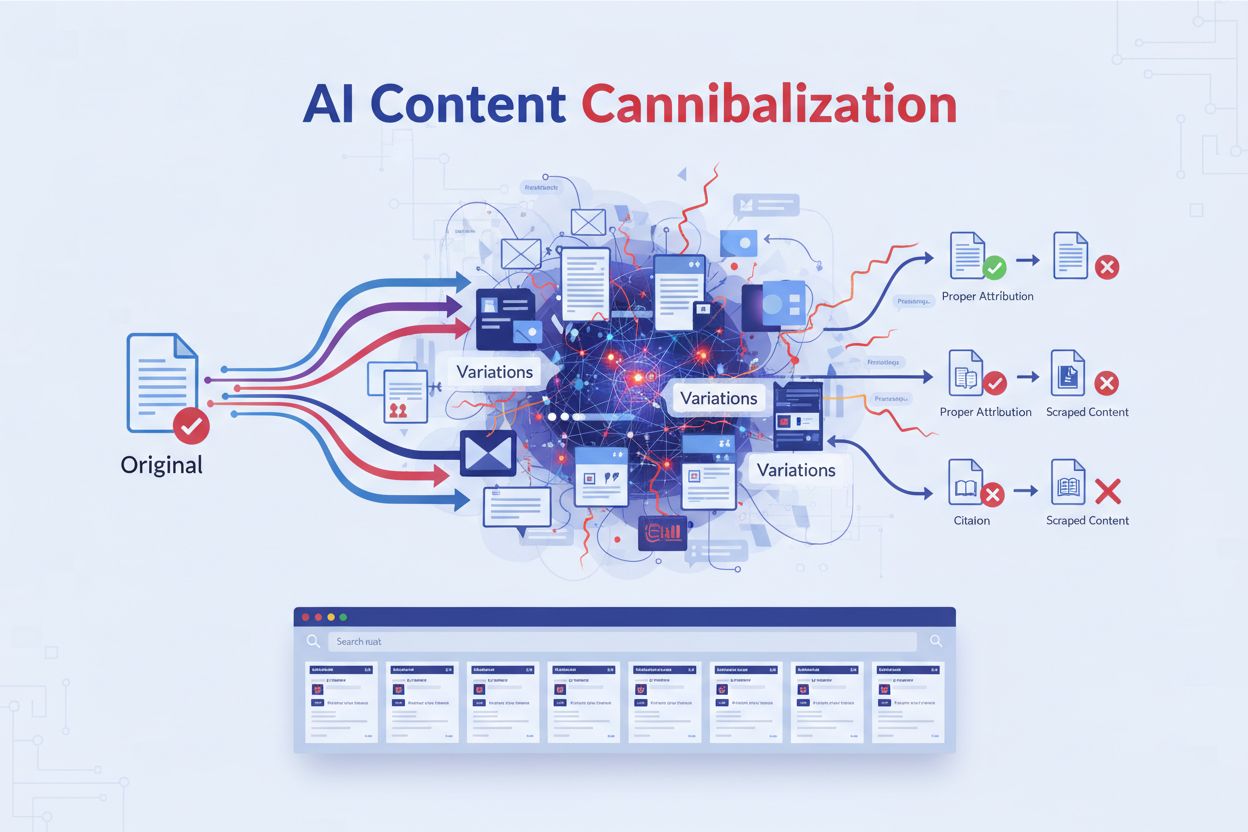
Learn what AI content cannibalization is, how it differs from duplicate content, why it hurts rankings, and strategies to protect your content from being scrape...
Community discussion on fixing keyword cannibalization for AI search visibility. Real experiences from SEO specialists on consolidating competing pages to impro...