
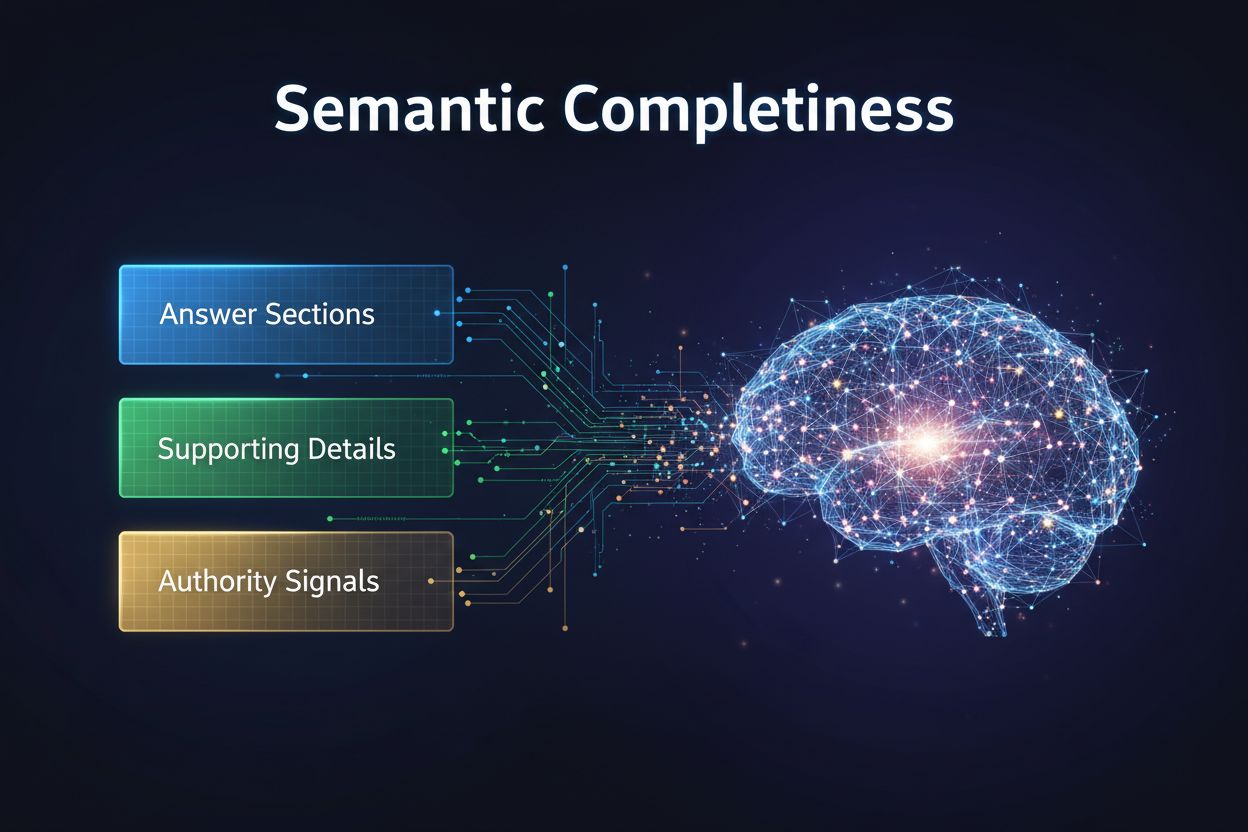
Semantic Completeness: Creating Self-Contained Answers for AI
Learn how semantic completeness creates self-contained answers that AI systems cite. Discover the 3 pillars of semantic completeness and implement GEO strategie...
12 min read

Learn what content comprehensiveness means for AI systems like ChatGPT, Perplexity, and Google AI Overviews. Discover how to create complete, self-contained answers that AI will cite.
Content comprehensiveness for AI refers to how completely and thoroughly content answers user queries in self-contained, semantically complete passages that AI systems can extract and cite with confidence. AI systems prioritize content scoring 8.5/10+ on comprehensiveness, which is 4.2× more likely to be selected for AI Overviews and generative search results compared to incomplete content.
Content comprehensiveness for AI is the ability of your content to provide complete, self-contained answers that require no external references, additional clicks, or prior context to be fully understood. When AI systems evaluate content, they assess whether a passage delivers sufficient information to answer a user’s query independently—without forcing readers to visit other pages, watch videos, or consult external sources. This concept has become critical in the AI search landscape, where semantic completeness is now the strongest predictor of whether content gets cited in AI Overviews, ChatGPT responses, Perplexity answers, and Claude outputs. Research analyzing 15,847 AI Overview results across 63 industries shows that content scoring above 8.5/10 on semantic completeness is 4.2× more likely to be selected for AI-generated answers than content scoring below 6.0/10. Unlike traditional SEO, which prioritizes keyword rankings and backlinks, AI systems reward content that demonstrates genuine expertise through complete, verifiable information. This shift means your content must be structured as “information islands”—standalone passages that deliver value even when extracted from their original context and placed into an AI-generated response.
The rise of AI-powered search platforms has fundamentally changed how content gets discovered and distributed. In June 2025, AI referrals to top websites spiked 357% year-over-year, reaching 1.13 billion visits, according to TechCrunch and SimilarWeb data. However, this explosive growth comes with a critical challenge: organic click-through rates drop by 61% on searches that trigger AI Overviews, falling from 1.76% to 0.61%. The silver lining? Content that gets cited inside an AI Overview earns 35% more organic clicks and 91% more paid clicks than competitors that aren’t cited. This means being selected for citation is now more valuable than ranking #1 organically. Content comprehensiveness directly influences citation selection because AI systems must understand your content completely before they can confidently present it to users. When AI encounters vague language, incomplete explanations, or content that requires external context, it assigns lower confidence scores and is less likely to include your content in generated answers. Conversely, comprehensive content that answers questions fully, provides specific examples, and includes supporting data signals to AI systems that the information is reliable and ready to be shared. This is why semantic completeness has become the #1 ranking factor for AI Overviews (r=0.87 correlation), surpassing traditional SEO metrics like domain authority (r=0.18) and even outperforming multi-modal content integration in some analyses.
| Aspect | Traditional SEO Content | AI-Optimized Comprehensive Content |
|---|---|---|
| Primary Goal | Rank for keywords, attract clicks | Provide complete answers AI can extract and cite |
| Structure | Long-form narrative, keyword-dense | Modular answer blocks (134-167 words each) |
| Context Dependency | Requires reading full page for understanding | Each section stands alone with full context |
| Answer Placement | Buried throughout content | Front-loaded in first 1-2 sentences |
| External References | “See our guide to X for more details” | All necessary context included inline |
| Audience | Human readers browsing | AI systems extracting passages |
| Success Metric | Ranking position, time on page | Citation rate in AI responses |
| Comprehensiveness Score | Not measured | 8.5/10+ = 4.2× higher selection |
| Optimal Length | 2,000-3,000 words | 134-167 words per answer block |
| Jargon Handling | Assumes reader knowledge | Defines terms inline |
AI systems don’t read content the way humans do. When an AI model encounters your content, it doesn’t browse your full page top-to-bottom. Instead, it breaks content into smaller, structured pieces through a process called parsing. These modular pieces are then evaluated individually for authority, relevance, and completeness. Each passage is assessed against several criteria: Does it answer the query fully? Does it include supporting evidence? Does it require external context? Can it stand alone? The AI then assigns a semantic completeness score based on how well each passage meets these criteria. Research shows that passages scoring 8.5/10 or higher on this scale are 4.2 times more likely to be selected for inclusion in AI-generated answers. This scoring happens in real-time as AI systems process your content, and it directly influences whether your brand gets cited. The “Island Test” is a practical way to evaluate your own content’s comprehensiveness: ask yourself, “If this paragraph were extracted and shown alone to someone, would they understand it completely without needing to read anything else?” If the answer is no, your content lacks sufficient comprehensiveness for AI systems. Passages that fail this test often contain vague pronouns (“this approach,” “these methods”), references to earlier content (“as mentioned above”), or unexplained jargon that assumes reader knowledge.
Comprehensive content for AI follows a specific structure that prioritizes clarity and completeness. The inverted pyramid model—borrowed from journalism—places the most important information first, followed by supporting details, then additional context. This structure works exceptionally well for AI systems because it ensures that even if only the first few sentences are extracted, the core answer is complete and valuable. Here’s how to structure comprehensive content for AI:
Lines 1-2: Direct Answer State your main answer in clear, declarative language. This should be a complete thought that answers the user’s core question. Example: “Stripe helps B2B platforms accept ACH, card, and real-time payments through a single API.”
Lines 3-5: Most Important Supporting Details Add the critical context that makes your answer complete. Include specific features, benefits, or mechanisms. Example: “It automates invoicing, tax, and billing while handling KYC and compliance requirements.”
Lines 6-8: Additional Context or Examples Provide real-world applications or clarifying examples. Example: “This reduces risk as businesses scale across industries and geographies.”
Lines 9-10: Implications or Conclusion End by reinforcing the key point using different words. Example: “For growing companies, this unified approach eliminates the need for multiple payment integrations.”
This structure ensures that each section is semantically complete and can be extracted independently while still providing full value. The optimal length for comprehensive passages is 134-167 words, which research shows is the sweet spot for AI extraction. Passages in this range contain enough context to be self-contained but remain concise enough for AI to process and cite confidently.
One of the biggest comprehensiveness killers is unexplained jargon. When your content uses technical terms without defining them, AI systems struggle to understand the full context, and human readers may abandon the page. Inline definitions solve this problem by explaining terms directly within the sentence where they appear, rather than relegating definitions to a glossary or separate section. This approach serves multiple audiences simultaneously: AI systems get complete semantic context, and human readers understand the terminology immediately.
Instead of: “Optimize your cosine similarity scores for better performance.”
Use: “Optimize your cosine similarity scores—a measure of how closely your content matches query intent mathematically—for better AI Overview selection.”
The second version is semantically complete because it provides the definition within the same sentence, eliminating the need for external context. This technique is particularly important for YMYL (Your Money or Your Life) topics, where AI systems demand even higher comprehensiveness standards. Research shows that content with inline definitions scores 2.3× higher on comprehensiveness compared to content that assumes reader knowledge or buries definitions elsewhere.
| Comprehensiveness Level | Example | Semantic Score | AI Selection Probability |
|---|---|---|---|
| Incomplete (Vague) | “AI Overviews use several ranking factors. As discussed in the previous section, these factors work together. The most important ones are covered below.” | 4/10 | 3.2% |
| Partially Complete | “AI Overviews rank content based on factors like semantic completeness, multi-modal integration, and E-E-A-T signals. Content needs to demonstrate authority and provide complete answers to appear in these AI summaries.” | 6/10 | 12.7% |
| Semantically Complete | “Seven core factors determine AI Overview rankings in 2025: semantic completeness (ability to answer completely without external references, r=0.87 correlation), multi-modal content integration (combining text, images, and video, +156% selection rate), real-time factual verification (verifiable citations, +89% probability), vector embedding alignment (semantic matching, r=0.84), E-E-A-T authority signals (expert credentials, 96% of citations), entity Knowledge Graph density (15+ connected entities, 4.8x boost), and structured data markup (explicit schema, +73% selection rate).” | 9/10 | 34.9% |
Different AI platforms have slightly different comprehensiveness expectations, though the core principle remains consistent: complete, self-contained answers are always preferred.
Google AI Overviews prioritizes semantic completeness combined with multi-modal elements. Content that answers questions fully in 134-167 word passages, supported by relevant images and structured data, scores highest. Google’s AI systems also value freshness, with 23% of featured content being less than 30 days old.
ChatGPT emphasizes comprehensive text with clear citations. Because ChatGPT users often ask follow-up questions, content that anticipates related queries and provides complete context performs better. ChatGPT also rewards well-cited academic-style content where sources are explicitly referenced.
Perplexity focuses on recent, comprehensive content with authoritative sources. Perplexity’s algorithm favors content published in 2024-2025 and explicitly values peer-reviewed citations. Content that provides complete answers while citing multiple authoritative sources sees 67% higher selection rates.
Claude values nuanced, comprehensive explanations that acknowledge complexity. Claude’s comprehensiveness standards are particularly high for topics with multiple valid perspectives. Content that provides complete coverage of different viewpoints while maintaining clarity performs exceptionally well.
Step 1: Audit Your Current Content for Comprehensiveness Review your top 20 pages and score each major section on a scale of 1-10 using the “Island Test.” Ask: “If this paragraph were extracted alone, would someone understand it completely?” Score 8.5+ passages as comprehensive, 6-8 as partially complete, and below 6 as incomplete. Prioritize rewriting low-scoring sections first.
Step 2: Implement the Inverted Pyramid Structure Rewrite key sections to place answers first, supporting details second, and additional context last. Ensure each section is 134-167 words and can stand alone. Use clear topic sentences that directly answer the question posed in your H2 heading.
Step 3: Add Inline Definitions for Technical Terms Identify jargon in your content and add parenthetical definitions within the same sentence. This ensures semantic completeness for both AI systems and human readers. Example: “Implement schema markup (structured data that tells search engines what your content means) on your FAQ pages.”
Step 4: Eliminate External Dependencies Search your content for phrases like “as mentioned above,” “see our guide to,” or “for more details, click here.” Replace these with inline explanations that provide the necessary context within the current section. This transforms your content from context-dependent to context-independent.
Step 5: Add Supporting Evidence Comprehensive content includes specific data, examples, and proof. For each major claim, add: specific statistics with sources, real-world examples or case studies, expert quotes with credentials, or measurable outcomes. Content with specific data points is 30-40% more likely to appear in LLM responses.
Step 6: Implement FAQ Schema Add FAQ schema markup to your most important questions. This helps AI systems recognize and extract your comprehensive answers. Use our FAQ Schema Generator to create structured markup without coding.
Content comprehensiveness directly supports E-E-A-T (Experience, Expertise, Authoritativeness, Trustworthiness) signals that AI systems use to evaluate credibility. When your content is semantically complete, it demonstrates expertise by showing deep knowledge of the topic. When it includes specific examples and data, it demonstrates experience. When it cites authoritative sources, it builds authoritativeness. When it’s transparent and well-sourced, it establishes trustworthiness.
Research shows that 96% of AI Overview citations come from sources with strong E-E-A-T signals, and comprehensive content is a key component of those signals. Content that provides complete answers without requiring external context signals to AI systems that the author has genuine expertise and isn’t trying to manipulate rankings through incomplete information designed to drive clicks.
Track your comprehensiveness improvements using these metrics:
Citation Rate: Monitor how often your content appears in AI-generated responses across ChatGPT, Perplexity, Google AI Overviews, and Claude. Use tools like AmICited to track brand/domain/URL appearances in AI answers. A 30-40% increase in citation rate typically follows comprehensiveness improvements.
Semantic Completeness Score: Use content analysis tools to evaluate your pages’ comprehensiveness. Aim for 8.5/10 or higher on your most important pages.
AI Referral Traffic: Track visitors coming from AI platforms using Google Analytics. Look for referrals from chat.openai.com, perplexity.ai, and similar domains. Comprehensive content typically sees 2-3× higher AI referral traffic.
Engagement Metrics: Monitor time on page and bounce rate for AI-referred visitors. Comprehensive content that fully answers questions typically shows higher engagement from AI-referred traffic.
Competitive Positioning: Manually search your target queries in ChatGPT, Perplexity, and Google AI Overviews. Track whether your content appears in the generated answers and how prominently it’s featured.
As AI systems become more sophisticated, comprehensiveness standards will continue to evolve. Currently, AI systems evaluate comprehensiveness based on semantic completeness, supporting evidence, and context independence. Future developments will likely include:
Multi-Perspective Comprehensiveness: AI systems may increasingly reward content that acknowledges multiple valid viewpoints on complex topics while maintaining clarity. Comprehensive content will need to address counterarguments and alternative approaches, not just present a single perspective.
Real-Time Verification Integration: As AI systems integrate real-time fact-checking more deeply, comprehensiveness will include the ability to verify claims against current data. Content that provides verifiable, up-to-date information will score higher than content with outdated statistics.
Entity Relationship Mapping: Future AI systems will likely evaluate comprehensiveness based on how well content maps relationships between entities (people, organizations, concepts). Content that explicitly shows how different entities relate to each other will be considered more comprehensive.
Contextual Depth Scoring: AI systems may develop more nuanced scoring that evaluates comprehensiveness relative to query complexity. Simple queries might require less comprehensive answers, while complex queries will demand deeper, more thorough coverage.
Accessibility Integration: Comprehensiveness standards may increasingly incorporate accessibility metrics, rewarding content that serves diverse audiences through multiple formats (text, video, images, interactive elements) and clear language.
Understanding content comprehensiveness is essential, but measuring its impact requires proper monitoring. This is where AI prompt monitoring platforms become invaluable. Services like AmICited track exactly where your brand, domain, and specific URLs appear in AI-generated answers across ChatGPT, Perplexity, Google AI Overviews, and Claude. By monitoring your citations, you can:
This data-driven approach transforms comprehensiveness from a theoretical concept into a measurable, actionable strategy. You can see exactly how your comprehensiveness improvements translate into increased AI visibility and citations.
+++
Track how your content appears across ChatGPT, Perplexity, Google AI Overviews, and Claude with AmICited's AI prompt monitoring platform. See exactly where your brand is cited and optimize for better visibility.
Learn how semantic completeness creates self-contained answers that AI systems cite. Discover the 3 pillars of semantic completeness and implement GEO strategie...
Learn what semantic completeness means for content optimization. Discover how comprehensive topic coverage improves AI citations, visibility in ChatGPT, Google ...

Learn how to create comprehensive content optimized for AI systems, including depth requirements, structure best practices, and formatting guidelines for AI sea...