
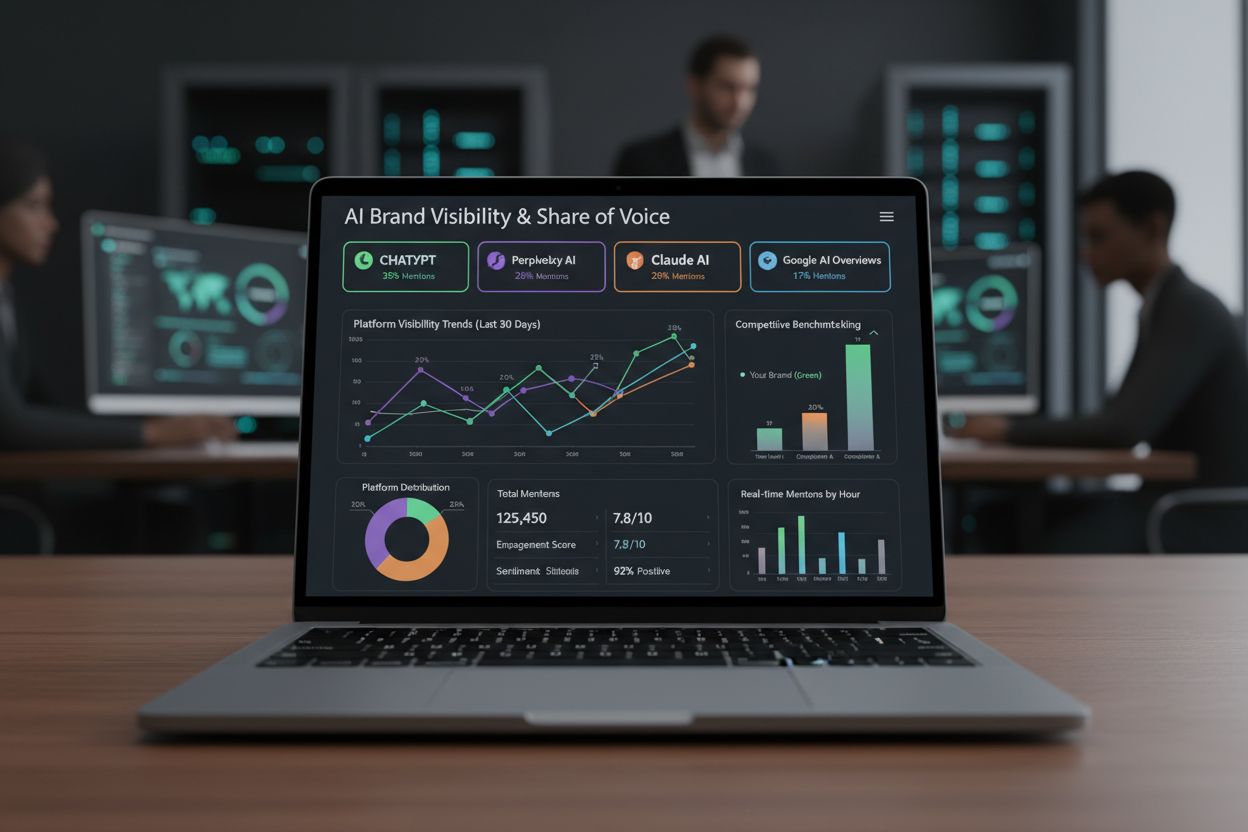
Top GEO and AEO Agencies: Industry Leaders Compared
Compare leading GEO and AEO agencies. Find the best AI visibility partner with our comprehensive guide to industry leaders, pricing, and selection criteria.
7 min read

Learn the key differences between GEO and AEO optimization strategies for AI search visibility. Understand how ChatGPT, Perplexity, Google AI Overviews, and Claude differ in content requirements.
GEO (Generative Engine Optimization) and AEO (Answer Engine Optimization) are closely related but distinct strategies for AI-powered search visibility. GEO focuses on optimizing content for generative AI systems like ChatGPT and Claude that synthesize information into original responses, while AEO targets answer engines that extract and display direct answers from sources. Both prioritize E-E-A-T signals and structured content, but GEO emphasizes citation-worthiness for LLM synthesis, whereas AEO emphasizes snippet extraction for featured results.
Generative Engine Optimization (GEO) and Answer Engine Optimization (AEO) represent two complementary but fundamentally different approaches to achieving visibility in AI-powered search systems. While both strategies aim to increase your content’s presence in AI-generated responses, they target different types of AI systems and require distinct optimization approaches. GEO focuses on making your content attractive to large language models (LLMs) like ChatGPT, Claude, and Perplexity, which synthesize information from multiple sources to generate original, conversational responses. AEO, by contrast, targets answer engines that extract and display direct answers from authoritative sources, similar to how Google AI Overviews and featured snippets work. Understanding these differences is critical for brands seeking to maintain visibility as search behavior fundamentally shifts toward AI-driven discovery. The distinction matters because the optimization tactics that work for one system may not work equally well for the other, requiring a nuanced, dual-strategy approach to maximize your presence across the entire AI search landscape.
The digital search landscape has undergone three distinct evolutionary phases, each requiring different optimization strategies. Traditional SEO emerged in the 1990s and focused on ranking individual web pages in search engine results pages (SERPs) through keyword optimization, backlinks, and technical excellence. This approach dominated for nearly three decades, with 87.3% of search traffic in North America still flowing through Google’s traditional ranking system. However, the introduction of featured snippets and knowledge panels created a new optimization challenge, leading to the development of Answer Engine Optimization (AEO). AEO strategies emerged around 2015-2016 as Google began displaying direct answers to user queries without requiring clicks to websites. Today, featured snippets and AI Overviews appear in nearly 47% of all Google searches, fundamentally changing how content visibility is measured. The most recent evolution came with the rise of generative AI systems in 2022-2023, which introduced Generative Engine Optimization (GEO) as a distinct discipline. According to Gartner’s 2024 research, traditional search engine volume is projected to drop 25% by 2026, with 79% of consumers expected to use AI-enhanced search within the next year. This convergence of three optimization approaches—SEO, AEO, and GEO—means that modern content strategies must address all three systems simultaneously to maintain competitive visibility.
| Aspect | GEO (Generative Engine Optimization) | AEO (Answer Engine Optimization) |
|---|---|---|
| Primary Target | Large Language Models (ChatGPT, Claude, Perplexity) | Answer Engines (Google AI Overviews, featured snippets) |
| Content Goal | Become a trusted source for LLM synthesis and citation | Provide extractable answers for direct display |
| Success Metric | Brand mentions, citations, and inclusion in AI responses | Featured snippet placement, answer extraction, click-through |
| Response Type | Conversational, synthesized answers from multiple sources | Direct, extracted answers from single authoritative source |
| Citation Importance | Critical—LLMs cite sources explicitly | Variable—not all extracted content receives attribution |
| Content Structure | Modular, citation-ready statements; conversational flow | Concise, snippet-optimized answers; clear hierarchies |
| Key Ranking Factor | Authority, trustworthiness, semantic relevance | Structured data, answer clarity, source credibility |
| Platform Examples | ChatGPT Search, Claude, Perplexity, Google Gemini | Google AI Overviews, Bing Chat, featured snippets |
| Optimization Focus | Building topical authority and brand credibility | Formatting for extraction and featured placement |
| Traffic Impact | Higher-quality conversions (4.4x better than organic) | Reduced clicks but increased qualified traffic |
Generative Engine Optimization operates on fundamentally different principles than traditional SEO because large language models don’t rank pages—they retrieve and synthesize information. When a user asks a question in ChatGPT, Claude, or Perplexity, the system uses retrieval-augmented generation (RAG) to search its training data and indexed web content, then synthesizes multiple sources into a coherent, conversational response. Your content’s visibility in this process depends on whether the LLM considers it relevant, authoritative, and citation-worthy. According to research from Princeton, Georgia Tech, and the Allen Institute of AI, adding citations, statistics, and quotations improved source visibility in generative responses by 30-40%. This means GEO success requires creating content that LLMs can easily extract, understand, and cite. The optimization process involves several key elements: first, semantic relevance—ensuring your content directly addresses the topics and questions users ask in conversational language; second, authority signals—demonstrating expertise through credentials, original research, and citations from reputable sources; third, content modularity—structuring information so individual sections can stand alone as quotable statements; and fourth, brand consistency—maintaining uniform messaging across your website, social media, and other platforms so LLMs recognize your brand as a coherent authority. Unlike traditional SEO, where backlinks remain a primary ranking factor, GEO prioritizes brand mentions and topical authority. Research shows that brand web mentions have a 0.664 correlation with appearing in AI Overviews, significantly stronger than the 0.255 correlation between referring domains and organic rankings.
Answer Engine Optimization focuses on making your content the preferred source for direct answer extraction by systems like Google AI Overviews and featured snippets. Unlike GEO, which targets conversational synthesis, AEO targets zero-click answers—situations where users get their answer directly from the search interface without clicking through to your website. This requires a different optimization approach centered on clarity, conciseness, and structured formatting. When optimizing for AEO, the primary goal is to make your answer so clear and authoritative that the search engine selects it as the featured response. This involves several tactical elements: first, answer positioning—placing your most direct, concise answer in the first 40-60 words of your content; second, structured data markup—using schema.org vocabulary to explicitly label questions, answers, and key information; third, format optimization—presenting information in tables, lists, and definitions that are easy to extract; and fourth, source credibility—establishing yourself as an authoritative voice through author credentials, citations, and trust signals. According to Aleyda Solis’s AEO optimization checklist, successful AEO strategies focus on chunk-level retrieval optimization, ensuring each section of your content can function as a standalone answer. This differs from GEO, where content should flow conversationally and encourage deeper engagement. AEO also emphasizes answer synthesis optimization—making sure your content fits naturally into multi-source answers that combine information from several websites. The distinction is crucial: while GEO content should be citation-ready and authority-focused, AEO content should be extraction-optimized and snippet-friendly.
Each major AI platform has distinct characteristics that influence how content is retrieved, synthesized, and cited, requiring platform-specific optimization strategies. ChatGPT Search, launched in 2024, retrieves real-time web content and explicitly cites sources in its responses, making it highly relevant for GEO strategies. ChatGPT processes 2.5 billion prompts daily, making it a critical platform for brand visibility. To optimize for ChatGPT, focus on creating authoritative, well-structured content that clearly establishes your expertise and provides original insights. ChatGPT’s citation patterns favor recent, high-authority content with clear author credentials and transparent sourcing. Perplexity AI, which has grown 858% in search volume over the past year and now has approximately 10 million active monthly users, uses a different retrieval model that emphasizes topical breadth and depth. Perplexity’s responses often include multiple perspectives and sources, rewarding websites that cover topics comprehensively from multiple angles. To optimize for Perplexity, create interconnected content clusters that address different facets of your topic, and ensure your content is easily scannable with clear headers and bullet points. Google AI Overviews, which now appear in 16% of all US searches, represent a hybrid approach between traditional featured snippets and generative synthesis. Google’s system prioritizes E-E-A-T signals (Expertise, Experience, Authoritativeness, Trustworthiness) and rewards content that demonstrates firsthand experience and verifiable credentials. To optimize for Google AI Overviews, combine traditional SEO best practices with AEO formatting—ensure your content ranks well in traditional search while also being optimized for snippet extraction. Claude, Anthropic’s LLM, emphasizes accuracy and nuance in its responses and tends to cite sources that provide comprehensive, well-reasoned explanations. Claude’s users often ask more complex, research-oriented questions, so content that addresses nuanced topics with original analysis and data performs well. The key insight is that no single optimization strategy works equally well across all platforms—successful AI visibility requires understanding each platform’s unique characteristics and adjusting your content strategy accordingly.
While GEO and AEO differ in their specific tactics, both strategies depend fundamentally on E-E-A-T signals—a framework that Google and AI systems use to evaluate content quality and trustworthiness. Expertise requires demonstrating deep knowledge through accurate, comprehensive content created by subject matter experts. For a healthcare article, this means having medical professionals write or review the content, not general copywriters. Experience involves showing firsthand practical knowledge—case studies, personal accounts, and real-world applications that prove you’ve “been there, done that.” Authoritativeness comes from establishing your brand as a recognized authority through credentials, citations from reputable sources, media mentions, and consistent quality publication. Trustworthiness builds through transparent practices, accurate information, clear sourcing, visible author bios, and quick error correction. Research shows that 70% of consumers already trust generative AI search results, but this trust is conditional—it depends on the sources AI systems cite. When an LLM cites your content, it’s implicitly endorsing your expertise and trustworthiness. This means E-E-A-T signals are not just nice-to-have elements; they’re essential for both GEO and AEO success. The difference lies in emphasis: GEO prioritizes authoritativeness and trustworthiness at the brand level, rewarding consistent messaging and topical authority across multiple platforms. AEO prioritizes expertise and experience at the content level, rewarding individual pieces that demonstrate clear, authoritative answers. Both approaches benefit from the same foundational E-E-A-T work, but they apply it differently.
The most efficient approach to AI optimization is creating content that performs well for both GEO and AEO simultaneously, rather than developing separate strategies. This requires a specific content architecture that balances conversational depth (for GEO) with snippet clarity (for AEO). The optimal structure begins with a clear, concise opening statement that directly answers the user’s primary question in 40-60 words—this serves as your AEO snippet while also establishing context for LLM synthesis. Follow this with question-based H2 headings that mirror how users actually ask questions, making your content naturally aligned with both search intent and LLM query patterns. Within each section, use modular paragraphs where the first sentence contains a complete, standalone statement that could be cited independently. This structure allows LLMs to extract individual sentences for citation while maintaining conversational flow for human readers. Incorporate structured data markup (schema.org) to explicitly label questions, answers, and key information, helping both answer engines and LLMs understand your content’s structure. Use tables, lists, and definitions to present complex information in multiple formats—this serves AEO by making content extraction-friendly while also helping LLMs understand information relationships. Include original data, statistics, and research prominently, as both GEO and AEO systems reward content that provides unique, verifiable information. Finally, ensure your content demonstrates topical authority by linking to related content on your site and addressing multiple facets of your topic, which helps LLMs understand your expertise breadth. This unified approach means you’re not optimizing for two separate systems—you’re creating content that naturally performs well across the entire AI search landscape.
One of the most significant differences between GEO and AEO is the explicit citation of sources in generative AI responses. When ChatGPT, Claude, or Perplexity generate answers, they typically cite the sources they used, creating a direct attribution pathway that drives qualified traffic. This is fundamentally different from traditional search, where ranking position determines visibility, or from AEO, where featured snippets may or may not credit the original source. According to research from Profound, early AEO adopters are capturing 3.4x more traffic from AI search engine adoption rates, but the quality of this traffic varies significantly based on citation patterns. When your content is cited by an LLM, it receives a trust endorsement—the AI system is explicitly telling users that your content is authoritative enough to quote. This creates a powerful brand visibility and credibility signal that extends beyond the immediate traffic. Users who see your brand cited in AI responses develop stronger brand recognition and trust, leading to higher conversion rates. Research shows that traffic from AI assistants converts 4.4x better than traditional organic search, despite representing only 0.5% of overall traffic. This conversion advantage exists precisely because cited content carries implicit authority—users trust information that AI systems have vetted and attributed. For GEO success, this means your optimization strategy should explicitly target citation-worthiness. Create content that LLMs want to quote: provide original research and data, include expert quotes and perspectives, cite authoritative sources, and structure information so individual statements can stand alone as quotable content. The goal is not just to be included in AI responses, but to be cited and attributed, which drives both traffic and brand authority.
Traditional SEO metrics—rankings, clicks, and organic traffic—don’t fully capture success in the GEO and AEO landscape. Instead, you need to track AI-specific metrics that measure visibility and impact across generative and answer engines. For GEO, the primary metrics are citation frequency (how often your content is cited in AI responses), brand mention rate (how frequently your brand appears in AI-generated answers), share of voice (your visibility relative to competitors in AI responses), and AI referral traffic quality (conversion rates from AI-sourced visitors). Tools like Profound, Semrush’s AI Toolkit, and AmICited now provide visibility into these metrics, allowing you to track how your content performs across ChatGPT, Perplexity, Google AI Overviews, and Claude. For AEO, track featured snippet acquisition (how many keywords trigger your content in featured snippets), AI Overview placement (appearance in Google’s AI-generated summaries), zero-click traffic (visits from users who get answers without clicking), and snippet-to-click conversion (percentage of featured snippet impressions that convert to clicks). The key insight is that GEO and AEO success require different measurement approaches. GEO success is measured by brand authority and citation, while AEO success is measured by answer extraction and featured placement. However, both ultimately drive qualified traffic and conversions, which should remain your north star metric. According to the GEO Industry Report 2025, the AI marketing industry is projected to grow from $20.4 billion in 2024 to $82.2 billion by 2030, with GenAI search ad spending doubling between 2025 and 2026. This explosive growth means that tracking and optimizing for AI visibility is no longer optional—it’s essential for maintaining competitive advantage.
The distinction between GEO and AEO will likely blur as AI systems become more sophisticated and search platforms integrate multiple optimization approaches. Google’s AI Mode, which is currently in public testing, represents a hybrid approach that combines traditional search ranking, featured snippet extraction, and generative synthesis into a single interface. This convergence suggests that future optimization strategies will need to address all three systems simultaneously, rather than treating them as separate disciplines. Industry experts predict that by 2028, AI-driven search could dominate, with LLM-sourced visits potentially overtaking traditional organic search. This shift will accelerate the importance of brand authority, topical expertise, and content quality—the foundational elements that both GEO and AEO reward. The future will also bring multimodal search evolution, where AI systems integrate text, images, audio, and video seamlessly. Content creators will need to optimize across multiple formats to ensure visibility in these enhanced search environments. Additionally, real-time retrieval will become standard, meaning content freshness and update frequency will matter more than ever. The regulatory landscape is also evolving, with discussions about fair compensation for publishers whose content feeds AI training and retrieval systems. Some industry observers predict that AI licensing deals and citation monetization will become standard business models, creating new revenue opportunities for content creators who achieve high visibility in AI responses. The brands that succeed in this future will be those that invest in content quality over quantity, build authentic expertise and authority, experiment with new AI platforms early, and develop AI-first content workflows that prioritize clarity, structure, and citation-readiness.
Track where your content appears in ChatGPT, Perplexity, Google AI Overviews, and Claude. Understand your AI visibility and optimize your content strategy with AmICited's comprehensive monitoring platform.
Compare leading GEO and AEO agencies. Find the best AI visibility partner with our comprehensive guide to industry leaders, pricing, and selection criteria.

Community discussion on the difference between GEO and AEO. Understanding Generative Engine Optimization vs Answer Engine Optimization.

Discover the best GEO and AEO webinars featuring expert strategies for AI visibility. Learn from industry leaders on optimizing for ChatGPT, Google AI, and Perp...