
GEO vs SEO: Key Differences Every Marketer Must Know
Understand the critical differences between Generative Engine Optimization (GEO) and traditional SEO. Learn how to optimize for AI search engines like ChatGPT, ...
9 min read

Understand the critical differences between GEO (Generative Engine Optimization) and SEO (Search Engine Optimization). Learn how AI search differs from traditional search and why you need both strategies for complete online visibility.
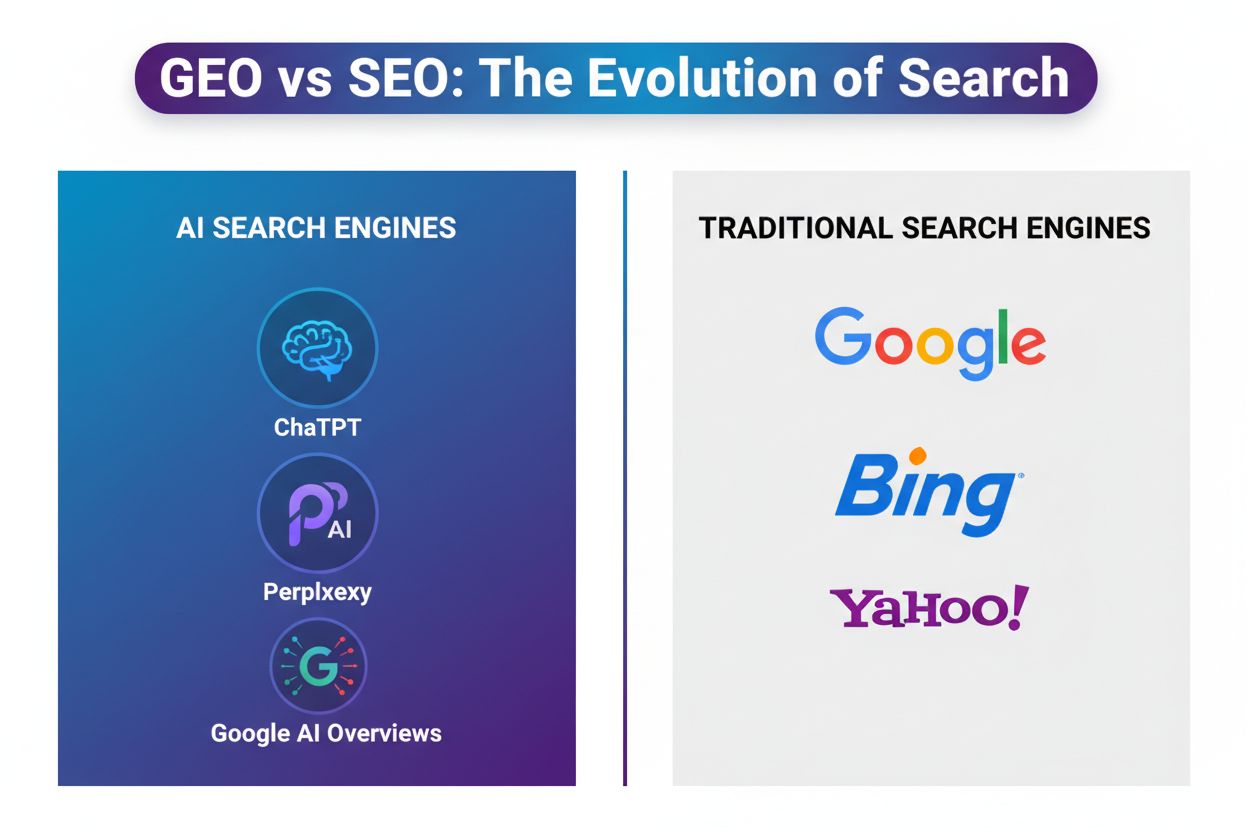
SEO (Search Engine Optimization) focuses on ranking your website higher in traditional search engines like Google, while GEO (Generative Engine Optimization) focuses on getting your brand cited or mentioned inside AI-generated answers from tools like ChatGPT, Perplexity, and Gemini. Both strategies aim to increase visibility, but they target different platforms and use different ranking factors.
GEO (Generative Engine Optimization) and SEO (Search Engine Optimization) are two distinct but complementary strategies for improving your online visibility. While they share similar foundational principles, they target different search platforms and use different mechanisms to determine visibility. Understanding the differences between these two approaches is essential for any organization looking to maintain a strong presence across both traditional and AI-powered search environments.
Search Engine Optimization (SEO) is the practice of optimizing your website and content to rank higher in traditional search engines like Google, Bing, and Yahoo. This strategy has been the cornerstone of digital marketing for decades and remains the primary driver of organic web traffic for most businesses. SEO involves multiple interconnected components that work together to improve your website’s visibility in search results.
The core components of SEO include keyword research and targeting, where marketers identify the specific terms and phrases their audience searches for. On-page optimization involves strategically placing these keywords in titles, meta descriptions, headings, and content while ensuring the content is well-structured and valuable. Technical SEO ensures your website is fast, mobile-friendly, properly indexed, and easy for search engine crawlers to navigate. Off-page SEO and link building involve acquiring high-quality backlinks from reputable websites, which serve as authority signals to search engines. Finally, performance tracking through metrics like click-through rates, rankings, and conversions helps measure the effectiveness of your SEO efforts.
The primary goal of traditional SEO is to drive organic traffic by getting your website to appear as clickable links in search engine results pages (SERPs). When someone searches for a relevant query, they see a list of blue links, and your goal is to rank as high as possible so users click through to your website.
Generative Engine Optimization (GEO), also referred to as Answer Engine Optimization (AEO) or LLM Optimization, is the practice of optimizing your content and brand to be cited or mentioned directly within AI-generated answers. This emerging strategy targets AI-powered search tools like ChatGPT, Google’s AI Overviews, Gemini, Perplexity, and similar platforms that synthesize intelligent answers from multiple sources rather than simply returning a ranked list of webpages.
Unlike traditional SEO, which aims to drive clicks to your website, GEO focuses on ensuring your brand becomes part of the conversation within AI-generated responses. When someone asks an AI search engine a question, the system synthesizes information from multiple sources and presents a single comprehensive answer. GEO optimization ensures your content, data, or brand is among the sources the AI selects and cites in that answer.
Key GEO best practices include using specific facts, statistics, quotes, and data points that AI systems can confidently cite and attribute. Content structure is critical—clear headings, Q&A sections, bulleted lists, and precise statements make it easier for AI to extract relevant information. Third-party mentions often carry significant weight in GEO, as AI engines pull information from across the entire web, not just your owned properties. Additionally, content freshness matters, as AI systems tend to prefer more recent sources when deciding what to cite.
| Aspect | SEO | GEO |
|---|---|---|
| Primary Goal | Drive organic traffic through clicks to your website | Earn citations and mentions in AI-generated answers |
| Target Platforms | Traditional search engines (Google, Bing, Yahoo) | AI-powered search engines (ChatGPT, Perplexity, Gemini) |
| Type of Results | Multiple search results pages with clickable links | Single synthesized answer with embedded citations |
| Content Focus | Keyword-optimized, link-building focused | Conversational, contextually relevant, citation-ready |
| Ranking Factors | Keywords, backlinks, domain authority, user engagement | Content quality, structure, entity recognition, third-party mentions |
| Traffic Generation | Users click through to your website | Many users get answers without clicking (zero-click) |
| Source of Authority | Your own domain plus backlinks pointing to you | Third-party mentions and citations across the web |
| Key Metric | Click-through rate, organic traffic, conversions | Citation frequency, share of voice in AI answers |
The fundamental difference between AI search and traditional search lies in how results are presented and sourced. Traditional search engines like Google present users with a list of ranked webpages, typically showing 10 results on the first page. Users must evaluate these options and click on the links they believe will answer their question. This approach gives users choice and control but requires them to do the work of finding the best answer.
AI search engines take a different approach. When you ask a question, the AI system analyzes multiple sources across the web, synthesizes the information, and presents a single comprehensive answer directly to the user. For example, if you ask “What’s the best chocolate cake recipe?” an AI search engine will provide a complete recipe with instructions, rather than showing you 10 different recipe websites to choose from. This zero-click approach means users often get their answer without ever visiting a website.
This fundamental difference has major implications for visibility. In traditional SEO, ranking in the top 10 results is crucial because users will see and potentially click on your link. In GEO, being cited as a source within the AI’s answer is what matters, regardless of whether the user clicks through to your site.
One of the most significant technical differences between SEO and GEO is how they determine authority and relevance. Traditional SEO relies heavily on backlinks as the primary authority signal. A link from a trusted domain tells Google that your content is credible and worth ranking. Search algorithms analyze link quantity, quality, and relevance to determine your site’s authority.
GEO, by contrast, relies on entity recognition. AI engines recognize and track entities—people, brands, products, concepts—by how consistently they appear across multiple sources. Even an unlinked mention can influence your visibility in AI search if it reinforces your brand’s association with a specific topic or use case. For example, if ten high-authority articles mention your brand in the context of a particular solution, AI engines start associating your entity with that topic, even if half those mentions don’t include a backlink.
This shift means that explicit entity mentions carry significant weight in GEO. Instead of writing “It’s a popular project management tool,” you should write “Asana is a popular project management tool.” The clearer and more consistent your entity naming across the web, the easier it is for AI to understand and cite you correctly.
Despite their differences, GEO and SEO share important foundational principles. Both strategies ultimately aim to satisfy user intent with the best possible answer. Whether that answer appears in a traditional search result or an AI-generated response, it must be clear, accurate, and credible.
Both GEO and SEO prioritize E-E-A-T (Experience, Expertise, Authoritativeness, and Trustworthiness). AI engines, like search algorithms, elevate credible sources that demonstrate real expertise and factual accuracy. This means original research, expert quotes, author credentials, and verifiable information perform well in both channels. Additionally, content structure, keywords, and authority signals remain relevant across both disciplines. Clear heading hierarchies help both search engines and AI systems understand topic relationships, keywords still signal relevance, and authority signals like backlinks and consistent brand positioning strengthen visibility in both traditional and AI search.
A common misconception is that GEO will replace SEO, making traditional search optimization obsolete. This is not the case. GEO is an evolution of SEO, not a replacement for it. Traditional search engines still generate significantly more web traffic for most businesses than AI search currently does. Google, Bing, and other traditional search engines remain the primary way people discover websites and information online.
Furthermore, most AI search engines currently rely on existing search indexes, primarily Google and Bing. This means the results overlap significantly. Research shows that approximately 40% of AI citations come from Google’s top 10 search results, indicating that strong SEO performance gives you a head start in AI visibility. However, ranking well in traditional search alone doesn’t guarantee citations in AI answers, because AI engines look for different signals than traditional search algorithms.
The most effective approach is to view GEO and SEO as complementary strategies that work together. Strong SEO provides a foundation of quality content and authority signals. GEO then enhances that foundation by making your content more machine-readable, entity-rich, and contextually authoritative for AI systems.
A critical difference between SEO and GEO is scope. Traditional SEO focuses primarily on your owned assets—your website, blog, landing pages, and content that you directly control. You optimize these pages for keywords, build backlinks to them, and track their performance.
GEO expands far beyond your owned properties. AI engines pull information from across the entire web, including places you don’t own or directly control. User-generated content platforms like Reddit and Quora are frequently cited in AI answers. Third-party mentions in news articles, reviews, industry blogs, and community forums shape how AI describes your brand. Social media discussions and archived content on sites you’ve never heard of can influence AI’s understanding of your company.
This means your brand’s reputation across the entire web shapes how, and whether, you get cited in AI responses. A single negative thread on Reddit or an outdated review on a third-party site can influence how AI describes your brand, even if your own website is perfectly optimized. This requires a broader content and reputation strategy that includes monitoring and outreach toward third-party content.
The way you measure success differs significantly between SEO and GEO. SEO success is measured by clicks and last-touch conversions. You rank high, users click through to your site, and ideally, they convert. It’s a direct, measurable action with clear ROI.
GEO success is measured by brand visibility inside AI conversations. Users may first encounter your brand in an AI summary, then later return through traditional search, making GEO a powerful top-of-funnel driver that influences decisions before clicks even happen. In many cases, users discover your brand in an AI-generated answer, build initial trust and awareness, then search for you directly when they’re ready to act.
This difference also changes how you think about content ROI. A page that ranks #1 in Google but never gets cited in AI answers might drive short-term traffic but miss long-term brand building. Conversely, a page that consistently gets cited by ChatGPT and Perplexity might generate less direct traffic but significantly boost brand recognition and consideration.
The good news is that you don’t need completely separate strategies for GEO and SEO. Many tactics work effectively for both channels. Start with solid SEO fundamentals—ensure your site is fast, mobile-friendly, well-structured, and contains high-quality content. Fix any technical issues that prevent proper crawling and indexing.
Create content that answers questions directly and explicitly. Instead of vague statements, use specific facts, statistics, and data points. Structure your content with clear headings, Q&A sections, and bulleted lists that make it easy for both search engines and AI systems to understand and extract information. Use schema markup and structured data like FAQ schema, LocalBusiness schema, and Article schema to help both traditional search engines and AI platforms better understand your content.
Expand your mention strategy beyond your website. Secure mentions in local media, industry publications, directories, and reputable third-party sites. The more consistently your brand appears across authoritative sources, the more likely AI systems will cite you. Monitor your AI visibility alongside traditional SEO metrics. Track how often your brand and content are being cited in AI overviews and generative answers, and compare that to your traditional SEO performance to identify gaps and opportunities.
The search landscape is evolving, but it’s not a simple replacement of one technology with another. Instead, we’re seeing a diversification of search journeys. Some users start their research on ChatGPT and complete their journey through Google. Others go back and forth between different AI search platforms and traditional search engines. This means you need to optimize for both channels to reach people wherever they search for information.
The brands that will thrive in this new environment are those that recognize GEO and SEO as complementary strategies. By combining strong traditional SEO practices with emerging GEO tactics, you position your business to get found and cited wherever your customers are searching—whether that’s Google, ChatGPT, Perplexity, or any other search platform that emerges in the future.
Track how your brand appears in AI-generated answers from ChatGPT, Perplexity, and other AI search engines. Get real-time insights into your AI visibility and stay ahead of competitors.
Understand the critical differences between Generative Engine Optimization (GEO) and traditional SEO. Learn how to optimize for AI search engines like ChatGPT, ...

Learn how to effectively balance SEO and GEO efforts to maximize visibility in both traditional search results and AI-generated answers. Discover unified strate...
Learn how to allocate marketing budget between SEO and GEO. Discover the optimal split, ROI benchmarks, and strategic framework for balancing traditional search...