
E-E-A-T (Experience, Expertise, Authoritativeness, Trustworthiness)
E-E-A-T (Experience, Expertise, Authoritativeness, Trustworthiness) is Google's framework for evaluating content quality. Learn how it impacts SEO, AI citations...
15 min read

Understand E-E-A-T (Experience, Expertise, Authoritativeness, Trustworthiness) and its critical importance for visibility in AI search engines like ChatGPT, Perplexity, and Google AI Overviews.
E-E-A-T stands for Experience, Expertise, Authoritativeness, and Trustworthiness. It's Google's quality framework that determines how AI systems evaluate and cite web content. As AI search engines become dominant, E-E-A-T signals directly influence whether your brand appears in AI-generated answers and recommendations.
E-E-A-T stands for Experience, Expertise, Authoritativeness, and Trustworthiness. Originally introduced as E-A-T in Google’s Search Quality Rater Guidelines, the framework was expanded in 2022 to include “Experience” as a critical component. This evolution reflects the growing importance of first-hand knowledge and real-world application in content evaluation. E-E-A-T is not a single ranking algorithm or direct ranking factor, but rather a comprehensive quality framework that influences how both traditional search engines and AI systems evaluate, prioritize, and cite content. Google’s automated ranking systems use a mix of signals aligned with E-E-A-T concepts to determine which content deserves visibility and trust.
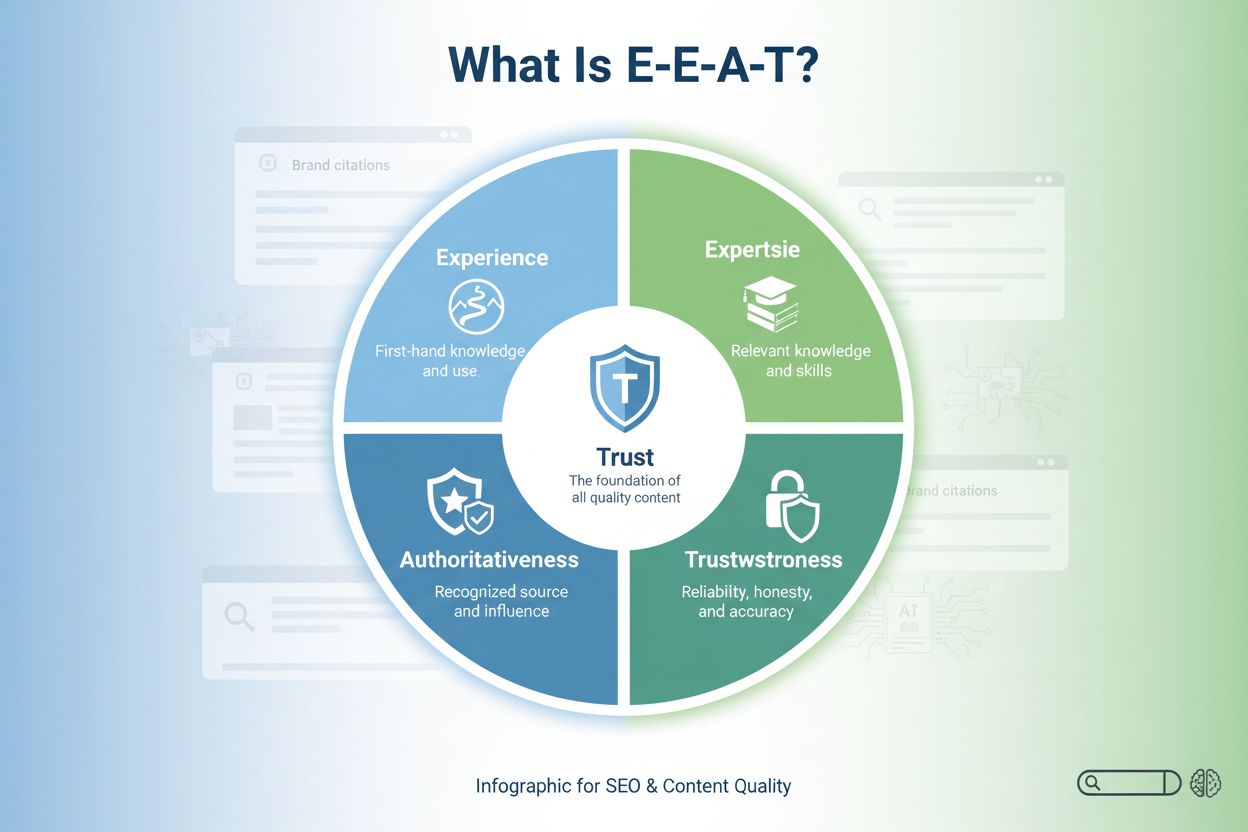
The four pillars of E-E-A-T work together to create a complete picture of content credibility. Experience means you’ve actually done what you’re writing about—used the product, visited the location, or worked in the field. Expertise is demonstrable knowledge through credentials, education, or proven track record in the subject matter. Authoritativeness comes from external recognition where other credible sources cite you, link to you, or mention you as a go-to source. Trustworthiness is about accuracy, transparency, and reliability, including clear authorship, contact information, factual content, and secure site infrastructure. Of these four elements, Google explicitly states that trust is the most important member of the E-E-A-T family because untrustworthy pages have low E-E-A-T no matter how experienced, expert, or authoritative they may seem.
| E-E-A-T Component | Definition | Key Signals |
|---|---|---|
| Experience | First-hand knowledge and direct involvement | Personal use, case studies, real-world examples, professional involvement |
| Expertise | Demonstrable subject matter knowledge | Credentials, education, certifications, proven track record |
| Authoritativeness | External recognition and credibility | Citations, backlinks, media mentions, industry recognition |
| Trustworthiness | Accuracy, transparency, and reliability | Author bios, clear sourcing, factual accuracy, HTTPS security, contact info |
The emergence of AI search engines like ChatGPT with Search, Perplexity AI, and Google’s AI Overviews has fundamentally changed how content visibility works. Unlike traditional search engines that rank web pages based on hundreds of signals, AI search systems generate answers in real-time by retrieving relevant information from trusted sources and synthesizing it into conversational responses. This shift means that E-E-A-T signals now directly determine whether your content gets cited, referenced, or recommended by AI systems. When users ask questions to ChatGPT, Perplexity, or interact with Google’s AI Overviews, the AI systems evaluate content quality through E-E-A-T lenses to decide which sources to trust and cite.
Research shows that 52% of AI Overview sources come from the top 10 search results, indicating that traditional SEO and AI visibility are interconnected. However, the selection process for AI citations goes beyond simple ranking position. AI systems actively scan for E-E-A-T signals to determine citation-worthiness. Content that demonstrates strong experience, clear expertise, recognized authority, and transparent trustworthiness is significantly more likely to be selected for inclusion in AI-generated answers. This creates a new optimization paradigm where brand authority and content quality matter more than keyword density or technical SEO alone. The stakes are particularly high because AI Overviews can occupy up to 48% of mobile screen real estate, pushing traditional search results below the fold and potentially driving zero-click searches where users get answers without visiting your website.
Experience has become increasingly critical in the AI search era because large language models are trained to recognize and value content that shows genuine, first-hand involvement with a topic. This means your content should clearly demonstrate that you or your team have actually used the product, visited the location, worked in the industry, or directly engaged with the subject matter. AI systems analyze language patterns and contextual clues to identify whether content comes from someone with real experience or merely theoretical knowledge. For example, a product review that includes specific details about how a product performed over time, what problems it solved, and how it compares to alternatives based on actual use is far more valuable to AI systems than generic product descriptions.
To strengthen experience signals, incorporate case studies, personal anecdotes, real-world examples, and data analysis that only knowledgeable professionals could provide. If you’re a SaaS company, share specific implementation stories from your clients. If you’re a healthcare provider, discuss actual patient outcomes and treatment approaches. If you’re a restaurant, describe your sourcing practices and cooking methods in detail. The key is making it obvious that your content comes from someone who has genuinely engaged with the subject matter. This is particularly important for “Your Money or Your Life” (YMYL) topics that could impact health, finances, or safety, where AI systems apply even stricter evaluation standards.
Expertise refers to your demonstrated knowledge and qualifications in your field. This goes beyond simply having credentials—it means consistently showing deep understanding across multiple pieces of content and maintaining topical authority. AI systems evaluate expertise by analyzing knowledge consistency across your entire content portfolio, not just individual pages. If you publish one article about a topic, it shows some knowledge. If you publish a comprehensive cluster of related articles that build on each other and demonstrate progressive understanding, you’re building topical authority that AI systems recognize and reward.
To demonstrate expertise effectively, include author bios with relevant qualifications, link to professional profiles, and maintain consistent terminology and concept usage across your content. Publish content that goes beyond surface-level explanations—provide insightful analysis, original research, and perspectives that only someone with deep knowledge could offer. Use structured content with clear headings, definitions, and explanations that show you understand the nuances of your topic. When AI systems encounter content that demonstrates consistent expertise across multiple pieces, they’re more confident in citing that content as authoritative.
Authoritativeness is perhaps the most challenging E-E-A-T pillar to build because it depends on external validation and recognition from other credible sources. This includes citations from other authoritative websites, backlinks from reputable domains, mentions in industry publications, speaking engagements, media coverage, and professional network visibility. AI systems use entity resolution—a process that connects your professional profiles across platforms—to build a comprehensive picture of your authority. If “John Smith on LinkedIn” is the same person as “John Smith who wrote this article” and “John Smith speaking at this conference,” AI systems can understand that these profiles represent the same authoritative figure.
Building authoritativeness requires a long-term strategy of earning mentions, citations, and backlinks from reputable sources. Contribute to industry publications, participate in expert roundups, seek media coverage, speak at conferences, and build relationships with other authoritative figures in your field. Implement schema markup to make your authority signals machine-readable. Create content that’s so valuable and original that other sites naturally want to cite it. The more your brand is mentioned and recognized by other trusted sources, the more authoritative AI systems will consider you.
Trustworthiness is the foundation upon which all other E-E-A-T elements rest. Google explicitly states that trust is the most important member of the E-E-A-T family because without it, experience, expertise, and authoritativeness become less relevant. Trustworthiness encompasses accuracy, transparency, security, and reliability. It includes having clear authorship with verifiable credentials, transparent contact information and business verification, regular content accuracy audits and correction processes, and security infrastructure like HTTPS. It also means being honest about limitations, disclosing conflicts of interest, and providing proper citations and sourcing.
To build trustworthiness, ensure your website has comprehensive author attribution with verifiable credentials, transparent contact information, clear privacy policies, and secure HTTPS infrastructure. Fact-check all content and remove unsupported claims. When you make mistakes, correct them promptly and transparently. Include customer reviews and testimonials that demonstrate real user satisfaction. Be transparent about your business model and how you make money. If you use AI to assist with content creation, disclose this while emphasizing human oversight. The more transparent and honest you are about who you are, what you do, and how you operate, the more trustworthy AI systems will consider you.
Different AI search platforms weight E-E-A-T signals differently based on their underlying architecture and training data. Perplexity AI emphasizes source quality, entity precision, freshness, and clear citations. It publicly displays its references, so earning a citation depends on having semantically rich, well-structured, and authoritative content. ChatGPT with Search prioritizes topical authority, citation relevance, content density, and structured clarity. It strongly weights high-credibility sources like research institutions, government agencies, and recognized experts. Google’s AI Overviews integrate with Google’s core ranking systems, so traditional SEO signals combined with E-E-A-T factors determine citation eligibility.
The common thread across all platforms is that E-E-A-T signals determine eligibility for citation, while platform-specific optimization determines selection within eligible content. This means your foundational strategy should focus on building genuine E-E-A-T across all four pillars, then adapt your content structure and optimization approach based on which AI platforms are most important for your business.
Building strong E-E-A-T signals requires a systematic, long-term approach that goes beyond traditional SEO. Start by auditing your existing online presence across all platforms where your brand appears—your website, Google Business Profile, industry directories, review sites, social media, and professional networks. Ensure your business information is accurate and consistent everywhere. Look for external mentions and citations of your brand by searching on Google and AI tools like ChatGPT and Perplexity.
Next, create high-quality, comprehensive content that covers your specialist topics deeply. Move beyond surface-level explanations to provide original insights, case studies, and data analysis that only someone with real expertise could offer. Fact-check everything and cite trustworthy sources. Include rich, informative guides related to your offerings. Highlight your brand’s uniqueness through About Us and Story pages that emphasize your mission, values, and what makes you different. Include information about your team or founders if it adds to your brand story and expertise.
Add conversational and structured elements to your website including schema markup and structured data, clear formatting with logical headings and lists, FAQ sections that answer common questions, natural language that matches user search queries, and store locators or clear location displays. Expand your presence across top AI data sources by getting your brand mentioned on platforms that AI systems frequently ingest, such as Wikipedia, Quora, Reddit, GitHub, news outlets, and industry blogs. Seek coverage from industry publications and influencers. Build your authority over time through incremental optimizations rather than expecting immediate results.
Measuring E-E-A-T effectiveness requires different metrics than traditional SEO because the impact is often indirect and long-term. Track AI feature inclusion by monitoring how often your content appears in AI search features like Google’s AI Overviews or generative answer boxes. Being consistently cited in AI-generated summaries indicates your content demonstrates the expertise and authority that AI systems recognize. Monitor which specific pages and topics receive the most AI citations to identify your strongest E-E-A-T content.
Analyze organic traffic patterns with AI integration by looking for correlations between strong E-E-A-T signals and content resilience against potential traffic declines from AI answer boxes. Pages with robust expertise signals often continue receiving clicks even when competing with AI summaries because users seek deeper information from trusted sources. Measure query intent satisfaction by tracking whether users who land on your page from AI-influenced search results engage deeply or quickly return to search results. Track AI-specific engagement signals like zero-click searches versus full-content engagement. Content with strong E-E-A-T often drives users to seek more detailed information beyond AI summaries.
Measure structured data effectiveness by tracking whether your schema implementation impacts AI feature inclusion. Content with proper structured data that aligns with E-E-A-T principles is more easily parsed by AI systems. Compare your AI feature inclusion rate against competitors for the same queries. If your content appears more frequently in AI-generated answers, it suggests your E-E-A-T signals are stronger. Use tools like BrightEdge, Authoritas, and custom alerts to track brand mentions across various AI platforms and monitor your content’s performance in emerging search features.
As AI search continues to evolve, E-E-A-T will become even more critical for visibility and brand authority. The search landscape is moving toward contextual indexing where AI systems rank meaning and context rather than metadata and keywords. Expect entity-first indexing where search models connect knowledge graphs directly, context-based ranking that prioritizes verified experience over popularity, multimodal understanding that integrates text, video, and voice input seamlessly, and personalized synthesis that tailors answers using user history and context.
Content creators who adapt early by publishing contextually rich, experience-driven, and verifiable content will dominate in this new era. The brands that invest in building genuine E-E-A-T across all four pillars—demonstrating real experience, clear expertise, external authority, and transparent trustworthiness—will be the ones that AI systems trust to recommend. This isn’t a short-term SEO tactic; it’s a fundamental shift in how digital visibility works. By grounding your content strategy in E-E-A-T principles now, you’ll be prepared for whatever AI-driven search engines bring next.
Track how your domain, brand, and URLs appear in AI-generated answers across ChatGPT, Perplexity, and Google AI Overviews. Get real-time insights into your E-E-A-T performance.
E-E-A-T (Experience, Expertise, Authoritativeness, Trustworthiness) is Google's framework for evaluating content quality. Learn how it impacts SEO, AI citations...

Learn how to build trustworthy healthcare content using E-E-A-T principles. Discover strategies for establishing medical authority, expertise, and trust signals...

Learn how to demonstrate first-hand knowledge and experience signals to AI systems like ChatGPT, Perplexity, and Google AI Overviews. Optimize your content for ...