Understanding the FLIP Framework for AI Search
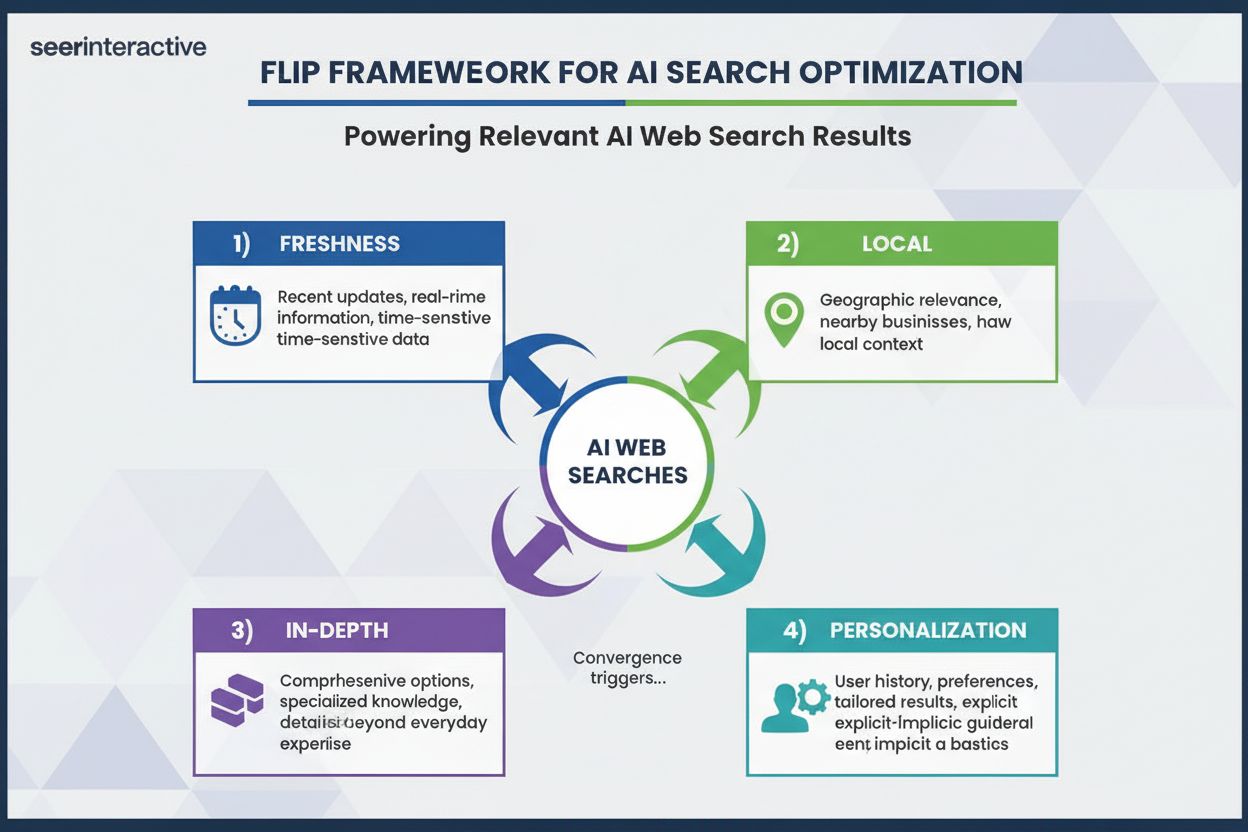
The FLIP framework represents a fundamental shift in how content must be optimized for the modern AI-driven search landscape. Unlike traditional search engine optimization that focuses on keywords and backlinks, the FLIP framework addresses how artificial intelligence systems evaluate, retrieve, and cite web content when generating answers to user queries. This framework has become essential because research shows that 82% of AI searches skip content entirely, meaning most websites remain invisible to AI systems like ChatGPT, Perplexity, Claude, and Google’s AI Overviews.
The framework consists of four critical pillars that work together to make your content discoverable and valuable to AI systems. Each component addresses a different way that users interact with AI search engines and the types of information these systems prioritize when synthesizing answers. Understanding and implementing FLIP is no longer optional for businesses seeking visibility in AI-generated responses.
The Four Components of FLIP
Freshness: Time-Sensitive and Current Content
Freshness refers to the recency and timeliness of your content, which is one of the most critical signals for AI search engines. AI systems actively hunt the web for current events, recent data, and latest trends because users asking questions expect up-to-date information. When someone queries an AI system about “latest SEO trends in 2025” or “current mortgage rates this week,” the AI prioritizes content published recently with current dates and fresh statistics.
AI search engines like ChatGPT and Perplexity are designed to provide the most relevant and accurate information available, which means they heavily weight recently published or updated content. Content that hasn’t been touched in months or years is significantly less likely to be retrieved and cited in AI responses. This is fundamentally different from traditional Google search, where older, authoritative content can still rank well. For AI systems, temporal keywords like “2025,” “latest,” “current,” “recent,” and “new” signal that your content contains fresh information worth citing.
To optimize for freshness, you should publish content with current publication dates, cover breaking industry news and trends, update statistics and examples regularly, and incorporate temporal language throughout your content. A practical approach involves establishing a content calendar that includes daily industry news and trend analysis, weekly fresh case studies and local market reports, monthly comprehensive guides with updated resources, and quarterly industry surveys and research reports.
Local Intent captures queries where users seek location-specific information, regional services, or geographically relevant data. AI systems recognize when users are asking about local businesses, regional market conditions, or location-based recommendations. Examples include “best marketing agencies in Denver,” “New York real estate prices 2025,” or “restaurants near me with outdoor seating.” These queries require content that explicitly addresses specific geographic locations and local market dynamics.
AI search engines understand that location context matters significantly for user satisfaction. When someone asks about services or information in a specific city or region, they want answers tailored to that geography, not generic national information. This means your content must include city names, region names, and local market conditions to be properly indexed and retrieved by AI systems. Content that mentions specific locations, local competitors, regional pricing, and area-specific trends is far more likely to be cited when users ask location-based questions.
Creating location-specific landing pages, including city and region names naturally throughout your content, covering local market conditions and trends, and optimizing for “near me” and location-based search phrases are essential strategies. If you operate in multiple locations or serve different regions, developing location-specific content variations ensures that AI systems can match your content to relevant local queries. This approach is particularly valuable for service-based businesses, real estate companies, and organizations with regional operations.
In-Depth Context: Comprehensive and Detailed Analysis
In-Depth Context refers to complex topics requiring detailed, comprehensive analysis that goes beyond surface-level explanations. AI systems recognize and prioritize content that thoroughly explores subjects, provides step-by-step guidance, includes technical analysis, and builds authoritative knowledge on specific topics. When users ask AI systems about “complete guide to implementing AI governance,” “step-by-step SaaS onboarding process,” or “technical analysis of blockchain scalability,” they’re seeking detailed, well-researched content that comprehensively addresses their question.
AI search engines are designed to synthesize information from multiple sources to create comprehensive answers. Content that already provides deep, detailed coverage of a topic is more valuable to these systems because it can be directly cited or quoted in AI responses. This means your content should be longer, more thorough, and more technically detailed than what might rank well in traditional search. Pillar content, comprehensive guides, detailed case studies, technical documentation, and authoritative resources are all highly valued by AI systems.
The key to succeeding with in-depth context is understanding that AI systems look for content that can serve as a primary source for their answers. Write comprehensive guides and tutorials that cover topics from multiple angles, create detailed case studies and analysis that demonstrate real-world applications, develop technical documentation and resources for your industry, and build authoritative pillar content that establishes your expertise. Each piece should have minimum 4-5 sentences per paragraph, use clear headings and subheadings, include tables and structured data, and provide actionable insights that users can immediately apply.
Personalisation: User-Specific and Customized Recommendations
Personalisation involves creating user-specific requests and customized recommendations that address the unique needs of different audience segments. AI systems increasingly recognize when users are asking for advice tailored to their specific situation, industry, role, or business type. Examples include “marketing strategy for my B2B SaaS startup,” “investment advice for tech professionals,” or “content calendar for healthcare companies.” These queries require content that acknowledges different audience segments and provides customized guidance.
AI search engines understand that one-size-fits-all answers often don’t satisfy users with specific needs. When you create content that addresses particular industries, roles, business models, or audience segments, you’re providing more valuable information that AI systems can cite when users ask for personalized guidance. This means developing industry-specific content variations, role-based solutions, audience-segmented resources, and customizable frameworks that different user types can adapt to their situations.
To optimize for personalisation, create industry-specific content variations that address unique challenges in different sectors, develop role-based content that speaks to specific job functions and responsibilities, create audience-segmented resources that acknowledge different business sizes or maturity levels, and offer customizable frameworks and templates that users can adapt. This approach recognizes that your audience isn’t homogeneous and that AI systems can better serve users when content is tailored to specific contexts and needs.
Ready to Monitor Your AI Visibility?
Track how AI chatbots mention your brand across ChatGPT, Perplexity, and other platforms.
How FLIP Impacts AI Search Visibility
| FLIP Component | Content Type | AI Search Signal | User Query Example |
|---|
| Freshness | Recent news, updated statistics, current trends | Publication date, temporal keywords, content recency | “What are the latest SEO trends in 2025?” |
| Local Intent | Location-specific pages, regional data, local services | Geographic keywords, city/region mentions, local context | “Best marketing agencies in Denver” |
| In-Depth Context | Comprehensive guides, technical analysis, detailed case studies | Content depth, topic coverage, authoritative sources | “Complete guide to implementing AI governance” |
| Personalisation | Industry-specific content, role-based guides, customized frameworks | Audience segmentation, specific use cases, tailored solutions | “Marketing strategy for my B2B SaaS startup” |
Why FLIP Matters for Your Brand
The traditional approach to search optimization focused on ranking high in Google’s search results pages. However, the emergence of AI search engines has fundamentally changed how users discover information and how businesses gain visibility. When users ask questions to ChatGPT, Perplexity, Claude, or Google’s AI Overviews, they’re not seeing a list of ranked websites—they’re seeing synthesized answers that cite specific sources. Your goal is no longer just to rank; it’s to be cited as a trusted source in AI-generated answers.
Research indicates that 90% of ChatGPT citations come from pages outside the top 20 in Google, which means you can achieve significant visibility in AI responses without dominating traditional search rankings. This creates an opportunity for businesses that understand and implement FLIP principles. By optimizing your content for these four components, you ensure that AI systems can find, understand, and cite your content when users ask relevant questions.
The competitive advantage goes to organizations that recognize this shift early. While most businesses continue optimizing for traditional search, companies implementing FLIP are already capturing visibility in AI-generated answers. This translates to real-time citation opportunities, immediate visibility in AI responses, direct influence on AI-generated answers, and competitive advantage over outdated content that hasn’t been optimized for AI discovery.
Stay Updated on AI Visibility Trends
Get the latest insights on AI mentions, brand monitoring, and optimization strategies.
Implementing FLIP in Your Content Strategy
Successful FLIP implementation requires a structured approach to content creation and maintenance. Start by auditing your existing content against each FLIP component to identify gaps. Determine which of your content pieces address freshness, local intent, in-depth context, and personalisation. Then develop a content calendar that systematically addresses all four components across your publishing schedule.
For daily content, focus on industry news, trend analysis, and market updates that demonstrate freshness. Weekly, publish local market reports and fresh case studies that address specific geographic or audience segments. Monthly, create comprehensive guides and update existing resources to maintain freshness and depth. Quarterly, conduct industry surveys and publish research reports that provide authoritative, in-depth context on important topics.
Remember that FLIP components often overlap. A single piece of content can address multiple components simultaneously. For example, a comprehensive guide to implementing AI governance in your specific industry, published recently with current examples, and tailored to your audience’s specific needs addresses all four FLIP components. The key is intentionality—ensure that your content strategy systematically addresses each component rather than leaving it to chance.