

How to Assess Your GEO Maturity: Framework and Evaluation Guide
Learn how to evaluate your GEO maturity across strategic, content, technical, and authority dimensions. Discover assessment frameworks, maturity levels, and act...
15 min read

Learn what the GEO maturity model is and how it helps organizations optimize their brand visibility in AI-generated answers and LLM search results.
The GEO maturity model is a strategic framework that helps organizations assess and improve their visibility in AI-generated answers across platforms like ChatGPT, Gemini, Perplexity, and Copilot. It progresses through four stages—from passive observation to predictive optimization—ensuring brands appear consistently in LLM-driven search results.
The GEO maturity model is a structured framework designed to help organizations understand and optimize their visibility in AI-generated answers across large language models (LLMs) and AI search engines. Unlike traditional SEO, which focuses on search engine rankings, GEO (Generative Engine Optimization) addresses how brands appear in the responses generated by AI systems like ChatGPT, Gemini, Perplexity, and Microsoft Copilot. This model provides a strategic roadmap for organizations to evolve from basic AI awareness to full-scale generative search readiness, ensuring their content is discovered and cited by AI systems that increasingly shape consumer decision-making.
The GEO maturity model consists of four distinct stages, each representing a different level of organizational readiness and capability in managing AI visibility. Understanding where your organization currently stands is essential for developing an effective strategy to improve your presence in AI-generated answers.
Organizations in the Passive Observer stage have minimal visibility into how AI models reference their brand or content. These organizations typically rely exclusively on traditional digital marketing approaches such as SEO optimization, paid digital advertising, and performance marketing campaigns, without any systematic assessment of how they appear in AI-generated answers. They have not yet begun testing their visibility across major LLM platforms or monitoring how AI systems cite their content. Product pages often lack the structured data formatting that AI models depend on for accurate information extraction and citation. The primary risk at this stage is complete invisibility in AI answers, even if the organization ranks highly in traditional Google search results. This disconnect between traditional search visibility and AI visibility represents a critical gap in modern digital strategy.
At the Prompt Tester stage, marketing teams begin conducting manual testing of how their brand appears in LLM responses. Teams enter specific prompts into ChatGPT, Gemini, Perplexity, and other platforms to observe whether their brand is mentioned and how frequently competitors appear in the results. Example prompts might include “What is the best high-yield savings account?” or “Which banks offer the best credit cards for travel?” This stage involves qualitative documentation of which AI platforms favor company-owned content versus affiliate sources, and early conversations with affiliate partners about visibility. The key benefit of this stage is that teams gain awareness of platform-specific behavior—for instance, Gemini may favor company-owned content while Perplexity relies more heavily on affiliate sources. However, this approach remains largely manual and reactive, providing limited scalability and insights.
Organizations at the Structured Content Leaders stage make significant investments in content structures that AI models depend on for parsing and understanding information. This includes implementing schema markup across product pages, replacing dense paragraphs with comparison tables that AI systems can easily extract data from, and creating FAQ sections aligned to conversational prompts that users ask AI systems. Teams at this stage also update data feeds provided to affiliate partners and establish cross-functional collaboration between SEO, affiliate marketing, content, and product teams. The structured content approach improves visibility not only on LLMs but also on Google’s AI Overviews and emerging conversational search channels. This stage represents a significant operational shift, as it requires coordination across multiple departments and a fundamental rethinking of how content is formatted and distributed.
The Predictive GEO Optimizer stage represents the ideal state of organizational maturity, where institutions move from manual, reactive testing to ongoing, scalable, and data-driven visibility management. Organizations at this stage have implemented GEO dashboards that measure AI visibility metrics, track citation frequency, and monitor share of voice across multiple AI platforms. They conduct quarterly LLM visibility audits, proactively update content based on observed changes in AI model sourcing behavior, and have integrated AI-informed content strategy into their overall digital marketing approach. Visibility-based affiliate partnerships are established, meaning affiliate relationships are evaluated and optimized based on how effectively they drive AI citations. The outcome is that brands maintain consistent visibility across all major AI engines and can rapidly adapt as model sourcing preferences change.
Understanding what drives visibility in AI-generated answers is fundamental to implementing an effective GEO strategy. The major factors that influence which brands LLMs surface in their responses are significantly different from traditional SEO ranking factors.
| Factor | Impact on AI Visibility | Description |
|---|---|---|
| Structured Data | Critical | Schema markup, comparison tables, and FAQs make content parseable and extractable by AI models |
| Affiliate Credibility | High | AI models cite trusted affiliate sources; strong affiliate presence increases visibility |
| Domain Authority | Moderate | Established domains with strong backlink profiles are more likely to be cited |
| Content Recency | High | AI models prioritize recent, updated information; outdated content decreases citation probability |
| Content Format | Critical | Tables, bullet points, and structured lists are preferred over dense paragraphs |
| Platform-Specific Behavior | High | Different AI platforms have different sourcing preferences (Gemini favors owned content, Perplexity favors affiliates) |
The critical insight is that AI-generated answers, not clicks, now shape brand visibility in the AI era. As consumers increasingly ask AI tools about products and services, the models surface brands based on these factors rather than traditional search rankings. This represents a fundamental shift in how organizations must approach digital visibility strategy.
Organizations seeking to advance through the GEO maturity stages should focus on several key operational and technical investments:
The emergence of AI search as the default discovery path for product research makes a GEO maturity model essential for competitive advantage. As AI systems become the primary way consumers research financial products, technology solutions, and other offerings, visibility in AI-generated answers directly impacts market share and customer acquisition. Organizations that build GEO capabilities early will capture disproportionate visibility, trust, and market share in the next wave of digital discovery. The GEO maturity model provides clarity on current readiness levels and gives organizational leaders a roadmap for resource allocation, operational change, and competitive positioning in the AI era. Without a structured approach to GEO, organizations risk becoming invisible in the AI-powered discovery landscape, regardless of their traditional search engine rankings.
Track how your brand appears in ChatGPT, Perplexity, Gemini, and other AI search engines with AmICited's AI monitoring platform.
Learn how to evaluate your GEO maturity across strategic, content, technical, and authority dimensions. Discover assessment frameworks, maturity levels, and act...
Discover why Generative Engine Optimization (GEO) is essential for businesses in 2025. Learn how AI-powered search is reshaping brand visibility, consumer behav...
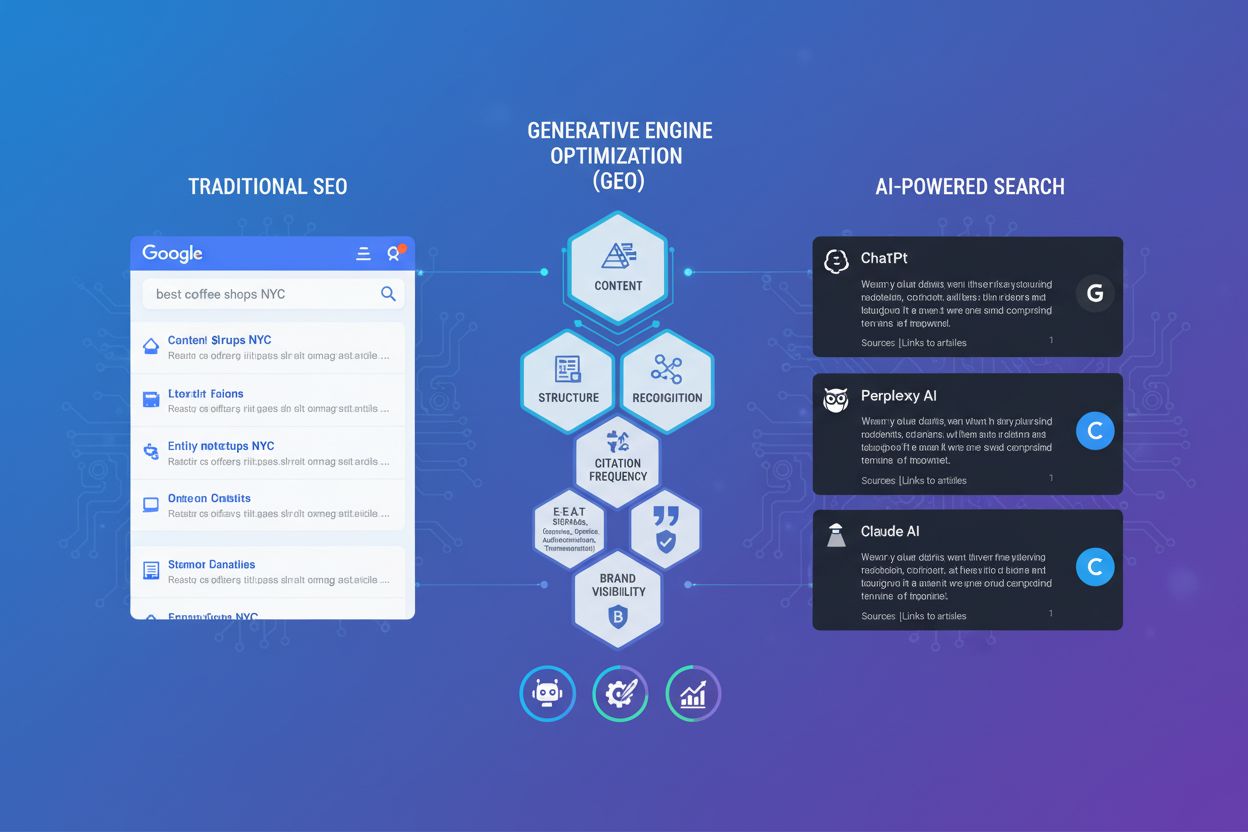
Learn what Generative Engine Optimization (GEO) is, how it differs from SEO, and why it's critical for brand visibility in AI-powered search engines like ChatGP...