
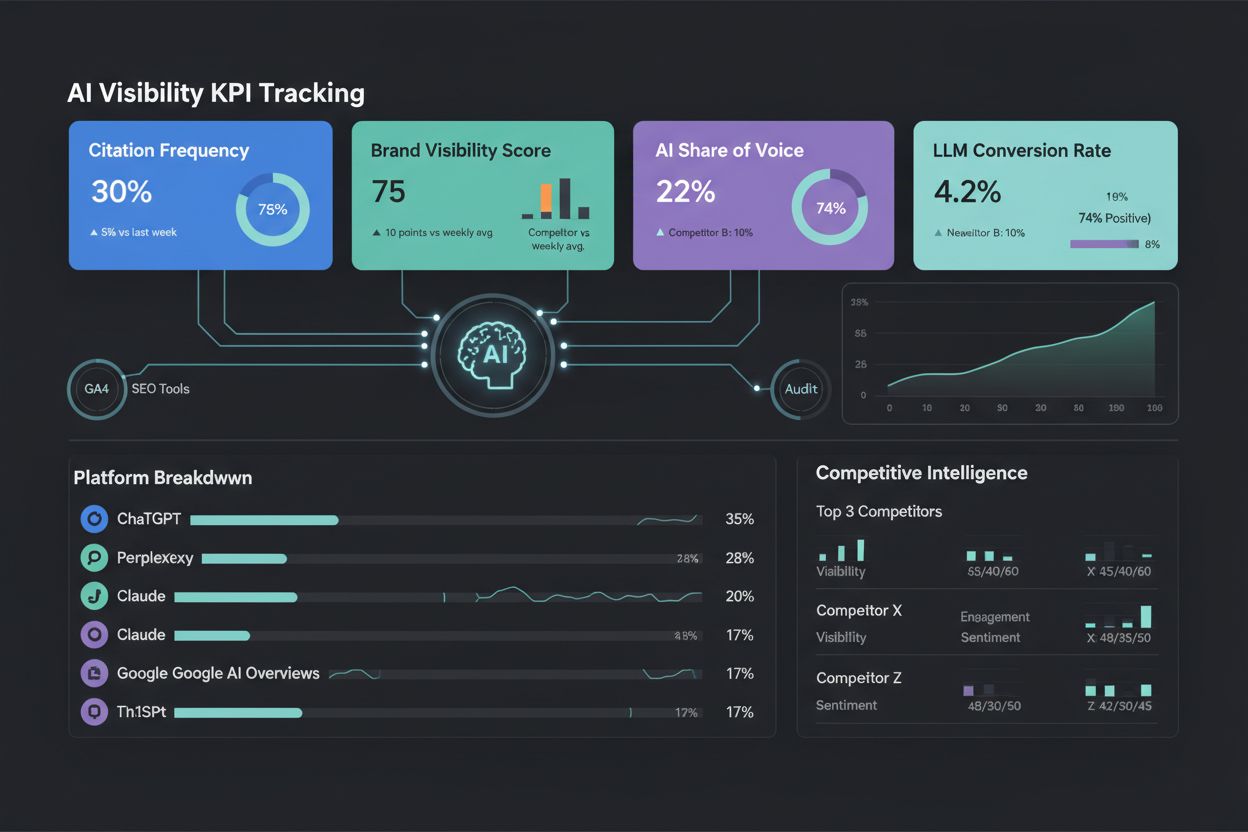
Setting AI Visibility KPIs: What Success Looks Like
Learn how to set AI visibility KPIs and measure success in AI search. Discover the 5 metrics that matter: citation frequency, brand visibility score, AI share o...
11 min read

Discover how AI search engines like ChatGPT and Perplexity are affecting organic traffic. Learn about traffic decline statistics, quality metrics, and strategies to optimize for AI search visibility.
AI search is causing a 15-64% decline in organic traffic for some websites, while simultaneously creating new traffic opportunities. AI search traffic is growing 165x faster than traditional organic search, though it currently represents less than 1% of total website traffic. However, AI-driven visitors convert 23% better than organic search visitors, making them higher quality despite lower volume.
The emergence of AI search engines and large language models (LLMs) like ChatGPT, Perplexity, Google Gemini, and Claude has fundamentally altered how users discover information online. This shift is creating a complex landscape where organic traffic from traditional search engines is declining while simultaneously opening new discovery channels. The impact varies significantly depending on industry, content type, and how well websites optimize for AI visibility. Understanding this dual dynamic is essential for any organization seeking to maintain and grow their web traffic in 2025 and beyond.
Research demonstrates that AI search is causing measurable declines in organic traffic across multiple industries. Studies show that AI Overviews can cause a 15-64% decline in organic traffic, with the severity depending on the industry and search type. When Google AI Overviews appear in search results, the top organic result can lose up to one-third of its clicks to the AI-generated summary. This compression effect occurs because AI systems provide comprehensive answers upfront, reducing the need for users to visit multiple websites to gather information.
The traffic loss isn’t uniform across all sectors. E-commerce, retail, healthcare, and hospitality industries are experiencing particularly significant impacts as users increasingly rely on AI platforms to compare products, check reviews, and gather detailed information before making purchasing decisions. However, the decline in raw traffic volume is being partially offset by the superior quality of remaining visitors. AI search visitors convert 23% better than organic search visitors, suggesting that while volume may decrease, the value per visitor increases substantially.
| Traffic Source | Current Share | Growth Rate | Conversion Quality |
|---|---|---|---|
| Organic Search | 31.09% | Declining | Baseline (100%) |
| Direct Traffic | 32.71% | Stable | High |
| AI Search (ChatGPT) | 0.16% | 165x faster | 123% higher |
| Referral Traffic | 13.22% | Declining | Moderate |
| Paid Search | 12.20% | Stable | High |
One of the most significant findings in recent AI search research is that AI-driven traffic demonstrates substantially higher engagement and conversion rates compared to traditional organic search. The average AI search visitor is worth 4.4 times more than the average traditional organic search visitor based on conversion rates. This dramatic difference stems from how AI systems fundamentally change the user journey and intent qualification process.
When users interact with AI search platforms, they engage in conversational exchanges that refine their queries and provide context before they ever click through to a website. This pre-qualification effect means that by the time a user arrives at your website from an AI platform, they have already compared options, learned about your value proposition, and made preliminary decisions. The AI system acts as an intent filter, delivering only the most relevant and engaged users to your site. Additionally, AI responses are presented like personal, word-of-mouth recommendations, which carry more emotional impact and persuasive power than traditional search results. Users arriving from AI platforms spend an average of 9 minutes 19 seconds on websites, compared to just 5 minutes 33 seconds for organic search visitors—a 67.7% increase in engagement time.
Industry projections indicate a significant shift in traffic sources over the coming years. According to comprehensive research, AI search traffic has the potential to overtake traditional organic search traffic within the next two to four years. For digital marketing and SEO-related topics specifically, AI search may start driving more visitors than traditional search by early 2028. However, this timeline could accelerate dramatically if Google makes AI Mode the default search experience, which would fundamentally reshape how users discover information.
Currently, AI platforms account for just 0.15% of global internet traffic compared to 48.5% from organic search, meaning Google still sends approximately 300 times more traffic to websites than all AI platforms combined. However, the growth trajectory is undeniable. AI traffic has increased more than seven times since 2024, growing 165 times faster than traditional organic search. This explosive growth rate suggests that the crossover point may arrive sooner than traditional projections indicate, particularly as user adoption continues to accelerate and AI platforms become more integrated into everyday search behavior.
The AI search landscape is dominated by a few key players, each with distinct market shares and user engagement patterns. ChatGPT leads overwhelmingly with 77.97% of all AI traffic, making it the undisputed leader in AI-driven referrals. This dominance reflects ChatGPT’s massive user base of over 800 million weekly active users and its position as the default AI search tool for millions of people. Perplexity comes in second with 15.10% of AI traffic, and notably performs exceptionally well in the United States where it captures 19.73% of AI traffic—higher than its global average. Google Gemini holds 6.40% of AI traffic, which is surprisingly modest given Google’s dominance in traditional search, suggesting that most users still default to classic Google search rather than Gemini’s AI-style answers.
Smaller players like DeepSeek (0.37%) and Claude (0.17%) have minimal market share but demonstrate interesting engagement patterns. Claude users spend an average of nearly 19 minutes on websites, with EU users spending over an hour on average, indicating an exceptionally engaged niche audience. ChatGPT users spend approximately 10 minutes per session, while Perplexity users spend about 9 minutes, both substantially exceeding organic search engagement times. Understanding which platforms your target audience uses is critical for developing an effective AI search optimization strategy.
AI search fundamentally compresses the marketing funnel by providing much of the information users need upfront, eliminating the need for users to visit multiple websites and pages. Traditional search encourages users to visit several websites to gather comprehensive information, compare options, and make decisions. In contrast, AI systems synthesize information from multiple sources and present it in a single, comprehensive response. This means users can get answers to complex questions without ever leaving the AI platform, or they may visit only one or two websites instead of five or ten.
Additionally, AI search deprioritizes links compared to traditional search engines. While AI systems do include citations and links to referenced content, these links tend to be less prominent than those in traditional search results. Some AI responses include links only to a subset of sources, and in many cases, users may not click through at all if the AI’s summary adequately answers their question. This fundamental shift in how information is presented and consumed means that traditional SEO strategies focused on link prominence and click-through rates may need significant adjustment to remain effective in an AI-dominant search landscape.
AI search adoption varies significantly by geography, with the United States leading adoption rates. The U.S. accounts for 0.13% of internet traffic from AI sources, slightly below the global average of 0.15%, but shows the most mature AI adoption patterns. ChatGPT’s share of total internet traffic more than doubled in the U.S. in just the first four months of 2025, from 0.0545% to 0.1218%. The European Union trails slightly at 0.12% AI traffic share, while the United Kingdom lags at 0.07%. However, growth is accelerating across all regions—ChatGPT’s traffic tripled in the UK within just four months of 2025, demonstrating that AI search adoption is rapidly becoming a global phenomenon.
These regional differences have important implications for businesses with international audiences. Organizations targeting primarily U.S. audiences may need to prioritize AI search optimization more urgently, while those focused on European or UK markets may have slightly more time to develop strategies. However, the rapid growth rates across all regions suggest that waiting to optimize for AI search is increasingly risky, regardless of geographic focus. The competitive advantage goes to early adopters who establish strong visibility in AI-generated answers before competition intensifies.
To maintain and grow traffic as AI search reshapes the digital landscape, organizations should implement a diversified, omnichannel approach that optimizes for both traditional and emerging discovery platforms. Create content specifically designed for AI systems by presenting information in easily quotable or “chunkable” formats that AI systems can readily extract and cite. Develop comprehensive FAQ pages with clear, conversational answers to high-intent questions, as these formats are particularly effective for AI citation. Implement schema markup and structured data (FAQ, HowTo, Product) to help AI systems understand your content contextually and improve citation likelihood.
Maintain consistent brand messaging across all marketing channels, as AI systems learn from patterns across multiple sources and reward consistency. Focus on creating multimodal content that combines text, images, audio, and video, giving AI systems multiple ways to interpret and display your content. Ensure your website is fully crawlable and not rendered in JavaScript, as many AI crawlers will not execute JavaScript files. Additionally, monitor your visibility in AI platforms using specialized tools to track how your brand appears in AI-generated answers, identify citation opportunities, and measure performance over time. Finally, consider getting featured on high-authority websites through digital PR and link building, as AI systems frequently cite authoritative sources like Quora, Reddit, and major news outlets.
Track how your domain, brand, and URLs appear in AI-generated answers from ChatGPT, Perplexity, Google Gemini, and other AI search platforms. Get real-time insights into your AI search visibility and competitive positioning.
Learn how to set AI visibility KPIs and measure success in AI search. Discover the 5 metrics that matter: citation frequency, brand visibility score, AI share o...

AI search visitors convert 5x better than Google organic traffic. Learn why ChatGPT, Perplexity, and Claude drive higher-quality conversions despite lower volum...
Discover how AI search monitoring is replacing traditional SEO. Learn why AI visitors are 4.4x more valuable and how to optimize for ChatGPT, Perplexity, and Go...