

How Do AI Engines Index Content? Complete Process Explained
Learn how AI engines like ChatGPT, Perplexity, and Gemini index and process web content using advanced crawlers, NLP, and machine learning to train language mod...
8 min read

Learn how AI search indexing converts data into searchable vectors, enabling AI systems like ChatGPT and Perplexity to retrieve and cite relevant information from your content.
AI search indexing is the process of converting your content into vector embeddings and storing them in a searchable database, enabling AI systems to find and cite your information when answering user queries.
AI search indexing is fundamentally different from traditional search engine indexing. While Google indexes web pages for keyword matching, AI search indexing converts your content into mathematical representations called vectors that capture semantic meaning. This process enables AI systems like ChatGPT, Perplexity, and other AI answer generators to understand context, find relevant information, and cite your content when responding to user queries. The indexing process is continuous and automatic, ensuring that your latest content becomes available for AI systems to discover and reference.
AI search indexing consists of several interconnected processes that work together to make your content discoverable by AI systems. Understanding these components helps you optimize your content for better visibility in AI-generated answers.
The indexing process begins with data ingestion, where AI search systems read content from your data sources. This includes websites, documents, databases, and other content repositories. The system then performs markdown conversion, transforming various file formats into structured, consistent markdown. For visual content like images, AI vision models perform object detection and convert images into descriptive text, ensuring that all content types become searchable. This preparation stage is critical because it standardizes your content regardless of its original format, making it uniformly processable by the indexing pipeline.
Large documents cannot be indexed as single units because they contain too much information for precise retrieval. Chunking breaks your content into smaller, semantically meaningful pieces that can be matched independently to user queries. This process is essential for improving retrieval granularity—the ability to find exactly the right information within larger documents. For example, a 50-page whitepaper might be chunked into 200-300 smaller segments, each containing a specific concept or idea. The chunking strategy directly impacts how effectively AI systems can cite your content, as smaller, focused chunks are more likely to be selected as relevant sources for AI-generated answers.
The most critical step in AI search indexing is vector embedding, where each chunk of text is transformed into a high-dimensional vector representation. This mathematical transformation captures the semantic meaning of your content—not just keywords, but concepts, relationships, and context. An embedding model analyzes the text and creates a vector (typically 384 to 1536 dimensions) that represents its meaning in a way that can be compared to other vectors. Two pieces of content with similar meanings will have vectors that are close together in this mathematical space, enabling semantic similarity search rather than simple keyword matching.
Once your content is indexed and converted to vectors, AI search engines use it in a specific workflow to generate answers and cite sources.
When a user asks a question in an AI search engine, the system converts the query into a vector using the same embedding model that indexed your content. This query vector is then compared against all indexed vectors to find the most semantically similar content. The system doesn’t look for exact keyword matches; instead, it finds content that addresses the same concepts and topics as the user’s question. This is why content that uses different terminology but covers the same topic can still be retrieved—the vector representation captures meaning beyond surface-level words.
After identifying potentially relevant content, AI systems apply semantic ranking to score and order results by relevance. The system evaluates which chunks best answer the user’s specific question, considering factors like:
| Ranking Factor | Impact on Retrieval |
|---|---|
| Semantic Similarity | How closely the content’s meaning matches the query |
| Content Authority | Whether the source is recognized as authoritative on the topic |
| Recency | How recently the content was published or updated |
| Citation Frequency | How often the content is referenced by other sources |
| Content Quality | Whether the content is well-written and comprehensive |
The top-ranked results are then passed to the language model, which uses them as grounding data to formulate its response. This is why appearing in the top retrieved results directly increases your chances of being cited in AI-generated answers.
When an AI system generates an answer using your indexed content, it includes citations and attribution to show where the information came from. This citation mechanism is what makes AI search indexing valuable for your brand—it drives traffic and establishes authority. The system tracks which specific chunks were used to formulate the answer and attributes them to your domain. However, citation depends on your content being properly indexed and ranked highly enough to be selected as a source.
Traditional search engines like Google index content for keyword-based retrieval, creating inverted indexes that map keywords to documents. AI search indexing, by contrast, focuses on semantic understanding and vector-based retrieval. This fundamental difference has important implications:
| Aspect | Traditional Search | AI Search Indexing |
|---|---|---|
| Retrieval Method | Keyword matching and relevance scoring | Vector similarity and semantic matching |
| Content Understanding | Surface-level keyword analysis | Deep semantic meaning and context |
| Citation Mechanism | Links and references in search results | Direct attribution in AI-generated text |
| Update Frequency | Periodic crawling and indexing | Continuous, real-time updates |
| Content Format | Primarily text and structured data | Multi-modal (text, images, documents) |
| Query Understanding | Exact or partial keyword matches | Conceptual and contextual understanding |
Traditional indexing works well for users searching for specific information with known keywords. AI search indexing excels at understanding intent, context, and complex questions, making it more suitable for conversational queries and nuanced information needs.
Unlike traditional search engines that crawl on schedules, AI search indexing is typically continuous and asynchronous. This means your content is monitored for changes and updates are indexed automatically without requiring manual resubmission. When you publish new content or update existing pages, the indexing system detects these changes and processes them in the background. This continuous approach ensures that your latest information is available for AI systems to discover and cite, reducing the lag between publication and appearance in AI-generated answers.
The asynchronous nature also means indexing doesn’t block or slow down your website. The system works in the background, converting your content to vectors and storing them in vector databases without impacting your site’s performance. This is fundamentally different from traditional crawling, which can consume server resources and bandwidth.
To maximize your visibility in AI-generated answers, you should understand how indexing affects discoverability. Clear, well-structured content performs better in AI search indexing because it chunks more effectively and produces higher-quality vector embeddings. Content that directly answers specific questions, uses clear headings, and provides comprehensive information is more likely to be retrieved and cited by AI systems.
Additionally, maintaining fresh, updated content improves your indexing performance. AI systems prioritize recent information, so regularly updating your content signals that it remains relevant and authoritative. Including proper metadata, structured data markup, and clear topic organization helps AI systems understand your content’s context and importance.
The indexing process also benefits from multi-format content. Including images, diagrams, and well-formatted text helps AI vision models extract more comprehensive information from your pages. This richer content representation increases the chances that your material will be selected as a source for AI-generated answers.
Track when your content appears in AI-generated answers across ChatGPT, Perplexity, and other AI search engines. Get alerts when your domain is cited.
Learn how AI engines like ChatGPT, Perplexity, and Gemini index and process web content using advanced crawlers, NLP, and machine learning to train language mod...
Learn how AI search indexes work, the differences between ChatGPT, Perplexity, and SearchGPT indexing methods, and how to optimize your content for AI search vi...
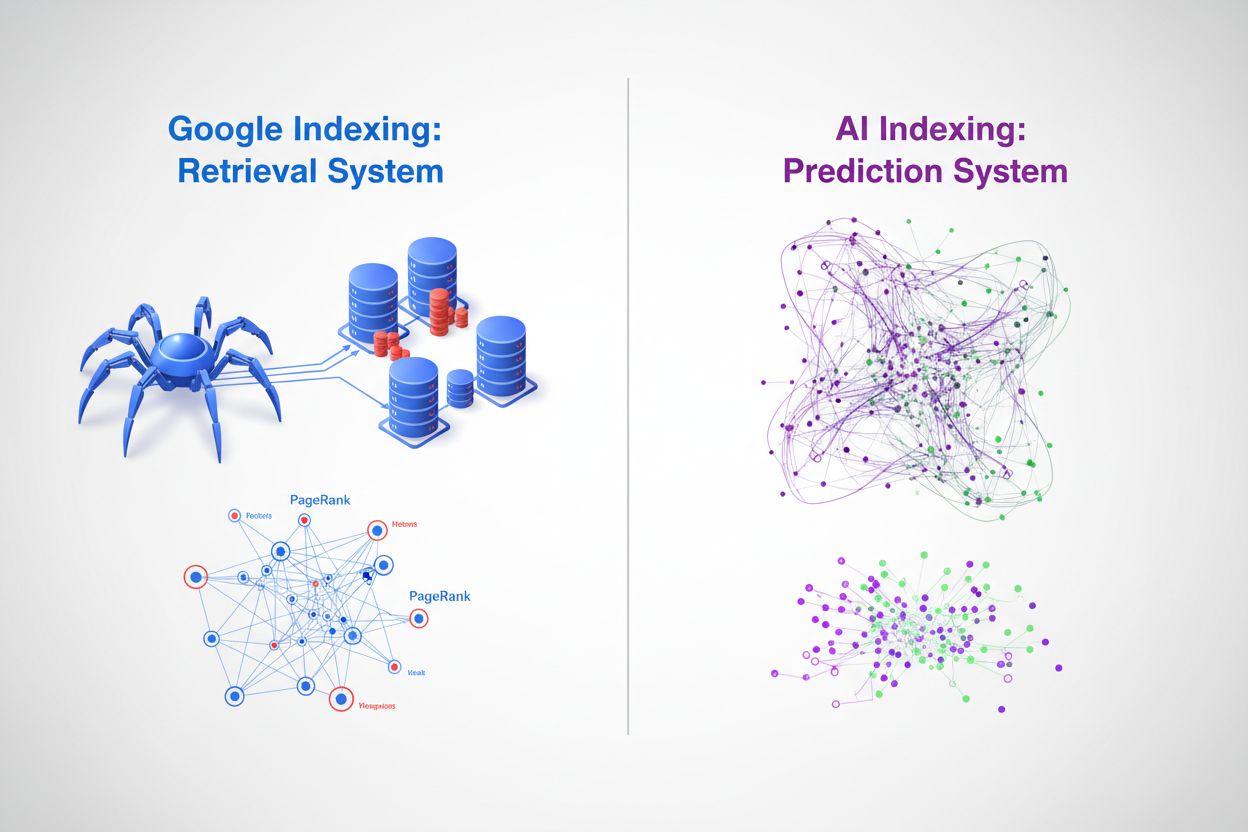
Discover the fundamental differences between AI indexing and Google indexing. Learn how LLMs, vector embeddings, and semantic search are reshaping information r...