
Informational Intent
Informational intent is when users search for knowledge or answers. Learn how to optimize content for informational queries and understand its role in AI search...
11 min read

Learn what informational search intent means for AI systems, how AI recognizes these queries, and why understanding this intent matters for content visibility in AI-powered search engines and chatbots.
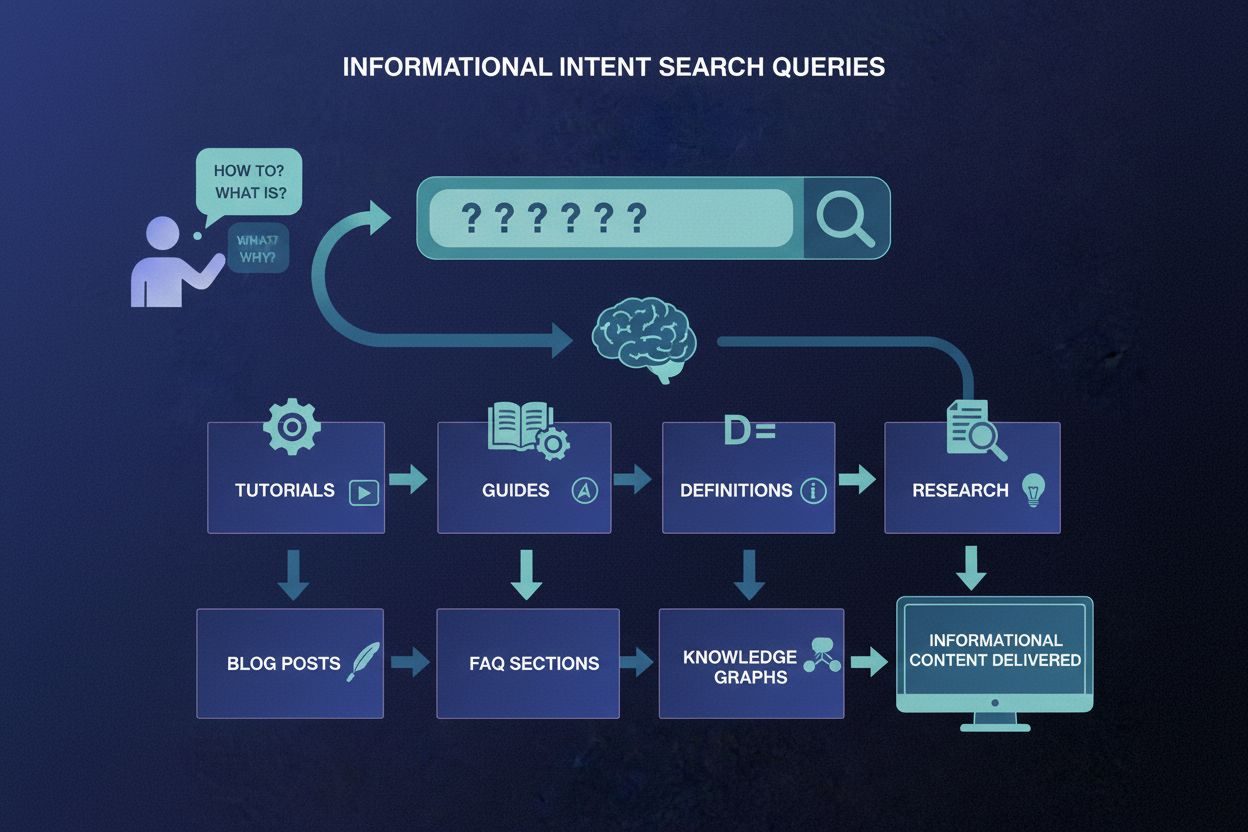
Informational search intent for AI refers to queries where users seek knowledge, answers, or educational content. AI systems recognize these queries through natural language processing and semantic understanding, delivering educational content like guides, tutorials, and explanations rather than product pages or navigation links.
Informational search intent represents one of the four primary types of user queries that AI-powered search systems must recognize and respond to effectively. When users search with informational intent, they are fundamentally seeking knowledge, answers to questions, or educational content about a specific topic. Unlike transactional queries where users want to purchase something, or navigational queries where they seek a specific website, informational queries focus on learning and understanding. AI systems have become increasingly sophisticated at identifying these queries through natural language processing (NLP) and semantic understanding, allowing them to deliver highly relevant educational content that matches what users actually want to learn.
The shift from traditional keyword-based search to AI-driven semantic search has fundamentally changed how informational queries are processed. Modern AI systems no longer simply match keywords; instead, they analyze the deeper meaning behind user questions, considering context, phrasing variations, and the user’s position in their learning journey. This semantic approach enables AI to recognize that queries like “how to fix a leaky tap,” “what is blockchain,” and “why do plants need sunlight” all represent informational intent, even though they use different keywords and phrasing. The ability to understand this intent accurately is crucial for both search engines and content creators who want their educational material to appear in AI-generated answers and responses.
AI systems identify informational search intent through multiple sophisticated mechanisms that work together to understand user queries at a semantic level. The process begins with natural language understanding (NLU), which analyzes the grammatical structure and meaning of a query. When a user types a question starting with phrases like “what is,” “how to,” “why do,” or “explain,” AI systems immediately recognize these as strong signals of informational intent. However, modern AI goes far beyond simple keyword pattern matching. It uses semantic embeddings to transform words and phrases into vector representations that capture contextual meaning, allowing the system to understand that “how do I repair a leaking faucet” and “how to fix a leaky tap” represent the same informational need despite using different terminology.
The recognition process also incorporates contextual analysis that considers the user’s location, search history, device type, and previous interactions. For example, if a user has been researching renewable energy sources and then searches for “solar panel efficiency,” AI understands this is informational intent within the context of their broader learning journey. Additionally, AI systems employ query classification algorithms that categorize queries into intent types by analyzing patterns in massive datasets of user behavior. These algorithms have learned that certain query structures, word combinations, and semantic patterns consistently correlate with informational intent. The system also uses real-time feedback mechanisms that track how users interact with results—whether they click on educational content, spend time reading, or return for follow-up searches—to continuously refine its understanding of what constitutes informational intent.
| Intent Type | User Goal | Query Examples | Content Format |
|---|---|---|---|
| Informational | Learn about a topic or find answers | “What is SEO?”, “How to bake bread”, “Why is the sky blue?” | Guides, tutorials, FAQs, blog posts, educational videos |
| Navigational | Reach a specific website or page | “Facebook login”, “Amazon homepage”, “YouTube” | Homepage, branded pages, login portals |
| Commercial | Research before making a purchase | “Best laptops 2025”, “iPhone vs Samsung”, “Top CRM software” | Reviews, comparisons, buying guides, product roundups |
| Transactional | Complete a purchase or action | “Buy running shoes”, “Download Photoshop”, “Subscribe to Netflix” | Product pages, checkout flows, pricing pages |
Informational intent occupies a critical position in the user journey, typically representing the earliest stage when potential customers or information seekers are just beginning to explore a topic. This intent type is essential for brand awareness and thought leadership because it’s where users form their first impressions about your expertise and credibility. When AI systems deliver your educational content in response to informational queries, you’re not just providing information—you’re establishing authority and building trust with audiences who may eventually become customers. The distinction between informational and other intent types matters significantly for content strategy because each requires different content formats, structures, and optimization approaches.
Understanding and optimizing for informational search intent has become increasingly important as AI-powered search engines and chatbots become primary information sources. When users ask informational questions to ChatGPT, Perplexity, Google’s AI Overviews, or similar systems, these AI tools must decide which sources to cite and which content to synthesize into their responses. If your content is well-structured, comprehensive, and clearly addresses informational queries, AI systems are more likely to include your information in their generated answers. This visibility in AI-generated responses is fundamentally different from traditional search rankings—it’s about being cited as a credible source rather than simply appearing in a list of links.
The importance of informational intent extends beyond immediate visibility. High-funnel marketing relies heavily on capturing users with informational intent because these are the people who haven’t yet decided what solution they need or even that they have a problem. By providing excellent educational content that addresses informational queries, you position your brand as a trusted resource. This builds brand recall and preference that influences purchasing decisions later in the customer journey. Additionally, informational content serves as a foundation for your entire content ecosystem—it attracts organic traffic, generates backlinks, and provides the context that makes your commercial and transactional content more effective. For AI systems specifically, well-organized informational content helps train language models to better understand your industry, products, and expertise.
Informational queries possess distinct characteristics that AI systems use to identify and classify them correctly. These queries typically begin with question words such as “what,” “how,” “why,” “when,” or “where,” though not all informational queries follow this pattern. Some informational queries are phrased as statements or searches for broad topics like “renewable energy” or “machine learning basics.” The key characteristic is that the user’s primary goal is to gain knowledge or understanding rather than to take an immediate action or reach a specific destination. Informational queries often indicate that the user is in an early stage of their decision-making journey, exploring options and building knowledge before they’re ready to make a purchase or commitment.
Another important characteristic is that informational queries often have high search volume because they represent fundamental questions that many people ask. Queries like “what is artificial intelligence,” “how does photosynthesis work,” or “why do we need sleep” attract millions of searches because they address universal human curiosity and learning needs. AI systems recognize that these high-volume informational queries deserve comprehensive, authoritative answers. The complexity level of informational queries varies widely—some are simple factual questions with straightforward answers, while others are complex conceptual questions requiring detailed explanations. Modern AI systems have become adept at recognizing this complexity and adjusting the depth and structure of their responses accordingly. Additionally, informational queries often evolve into follow-up questions, creating multi-turn conversations where users progressively deepen their understanding. AI systems that understand informational intent can anticipate these follow-up questions and structure their initial responses to facilitate this learning progression.
When AI systems identify a query with informational intent, they employ sophisticated mechanisms to retrieve and synthesize the most relevant educational content. The process begins with semantic search, where the AI converts the user’s question into a semantic representation and searches for content with similar semantic meaning. This allows the system to find relevant content even when the exact keywords don’t match perfectly. The AI then uses retrieval-augmented generation (RAG) to pull specific information from multiple sources and synthesize it into a coherent, comprehensive answer. This approach ensures that the AI’s response is grounded in actual content rather than generated from the model’s training data alone, which reduces hallucinations and improves accuracy.
The ranking and selection of sources for informational queries involves multiple factors beyond simple relevance matching. AI systems evaluate content authority and credibility, preferring sources from established experts, academic institutions, and reputable publications. They assess content structure and clarity, favoring well-organized content with clear headings, bullet points, and logical flow that makes information easy to understand. The system also considers content comprehensiveness, preferring sources that thoroughly address the topic rather than superficial treatments. For informational intent specifically, AI systems often prioritize educational content formats like guides, tutorials, FAQs, and explainer articles over product pages or promotional content. This preference reflects the user’s actual intent—they want to learn, not to be sold to. The AI also uses user feedback signals from previous interactions to refine which sources it trusts for informational queries, creating a feedback loop that continuously improves response quality.
Creating content that ranks well for informational queries in AI-powered search requires a fundamentally different approach than traditional SEO. The first principle is to answer questions directly and comprehensively. Your content should clearly address the specific question or topic that users are searching for, with the answer appearing early in the content rather than buried deep within. Use clear, descriptive headings that directly state what information follows, making it easy for both users and AI systems to understand your content structure. Break complex topics into digestible sections with short paragraphs, bullet points, and visual elements that enhance understanding. This structural clarity is crucial because AI systems analyze content structure to understand how information is organized and what topics are covered.
Semantic richness is another critical factor for AI visibility. Use synonyms and related terms throughout your content to help AI systems understand the full scope of what you’re covering. If you’re writing about “artificial intelligence,” also use terms like “machine learning,” “AI systems,” “neural networks,” and “deep learning” where contextually appropriate. This semantic richness helps AI systems recognize your content as authoritative and comprehensive. Additionally, define key terms and concepts clearly, especially technical or specialized terminology. When you explain what something is and why it matters, you’re providing the kind of foundational knowledge that AI systems look for when responding to informational queries. Include examples and use cases that illustrate abstract concepts, making your content more useful and easier for AI systems to extract relevant information from.
The content format matters significantly for informational intent. Guides and tutorials that walk users through processes step-by-step are highly valued by AI systems for informational queries. FAQ pages that address common questions directly are excellent for capturing informational intent because they’re already structured as question-and-answer pairs that AI systems can easily parse. Explainer articles that break down complex topics into understandable components perform well because they match the user’s learning objective. Comparison articles that help users understand differences between related concepts serve informational intent by providing educational context. Avoid overly promotional language or hard-selling tactics in informational content—AI systems recognize when content is primarily promotional and deprioritize it for informational queries where users seek objective information.
The evolution from keyword-based search to semantic search represents a fundamental transformation in how informational intent is recognized and served. Traditional keyword-based systems would match the exact words in a user’s query to words in indexed content, often missing relevant information because of phrasing variations or synonyms. A user searching for “how to repair a leaking faucet” might not find content about “fixing a dripping tap” because the keywords didn’t match exactly. Modern AI systems overcome this limitation through semantic understanding, which focuses on meaning rather than exact word matching. The system understands that “repair,” “fix,” and “mend” are semantically similar, and that “leaking faucet,” “dripping tap,” and “running water” refer to the same problem.
This semantic shift has profound implications for how informational content is discovered and ranked. AI systems can now recognize informational intent even when users phrase their questions in unexpected ways or use colloquial language. A user might search for “why is my plant dying” or “how to keep plants alive,” and AI systems understand both as informational queries about plant care, even though the phrasing is quite different. This semantic understanding also enables AI systems to recognize intent nuance—understanding that a query like “best practices for remote work” has informational intent focused on learning best practices, while “remote work jobs” has a different intent focused on finding employment opportunities. The ability to distinguish these subtle differences in intent allows AI to deliver more precisely targeted responses.
Generative AI search engines like ChatGPT, Perplexity, and Google’s AI Overviews have introduced new dynamics to how informational intent is processed and served. Unlike traditional search engines that return a list of links, generative engines synthesize information from multiple sources into a coherent, conversational response. This fundamentally changes how informational content is discovered and used. When a user asks an informational question to a generative AI, the system must identify the intent, retrieve relevant sources, and synthesize their information into a natural language response. The quality and structure of your content becomes even more important because AI systems need to be able to extract, understand, and integrate your information with information from other sources.
Prompt intent is an emerging concept that extends traditional search intent understanding. In generative AI systems, users often phrase their requests as multi-step prompts that combine multiple intents. A user might ask “explain machine learning, compare it to traditional programming, and tell me what jobs use machine learning.” This single prompt contains informational intent (explain and compare) combined with navigational intent (jobs that use it). AI systems must recognize this mixed intent and structure their responses to address all components. For content creators, this means that comprehensive, well-structured content that addresses multiple related aspects of a topic performs better in generative AI systems. Your informational content should anticipate follow-up questions and provide context that helps AI systems understand how your information relates to related topics.
Understanding how your content performs for informational queries requires different metrics than traditional SEO tracking. AI visibility tracking has become essential for monitoring whether your content appears in AI-generated answers across different platforms. Tools that track your brand’s appearance in ChatGPT responses, Perplexity answers, Google AI Overviews, and other generative engines provide insights into how well your informational content is being recognized and cited. These tools reveal not just whether you’re visible, but how frequently you’re cited, in what context, and alongside which competitors. This information helps you understand whether your informational content is meeting the quality and comprehensiveness standards that AI systems expect.
Content performance metrics for informational intent differ from transactional content. Rather than tracking conversions directly, you should monitor engagement metrics like time on page, scroll depth, and return visits, which indicate whether users found your informational content valuable. Backlink acquisition is another important metric because high-quality informational content naturally attracts links from other sites, which signals authority to AI systems. Search visibility across both traditional search engines and AI platforms provides a comprehensive view of your informational content’s reach. Additionally, tracking user behavior patterns like which sections users spend the most time on and which follow-up searches they perform can reveal whether your informational content is effectively addressing user needs or if there are gaps you should fill.
Track how your content appears in AI-generated answers across ChatGPT, Perplexity, Google AI Overviews, and other AI search engines. Ensure your brand gets cited when users ask informational questions.
Informational intent is when users search for knowledge or answers. Learn how to optimize content for informational queries and understand its role in AI search...

Learn how to align your content with AI query intent to increase citations across ChatGPT, Perplexity, and Google AI. Master content-prompt matching strategies ...

Learn how to identify and optimize for search intent in AI search engines. Discover methods to classify user queries, analyze AI SERPs, and structure content fo...