
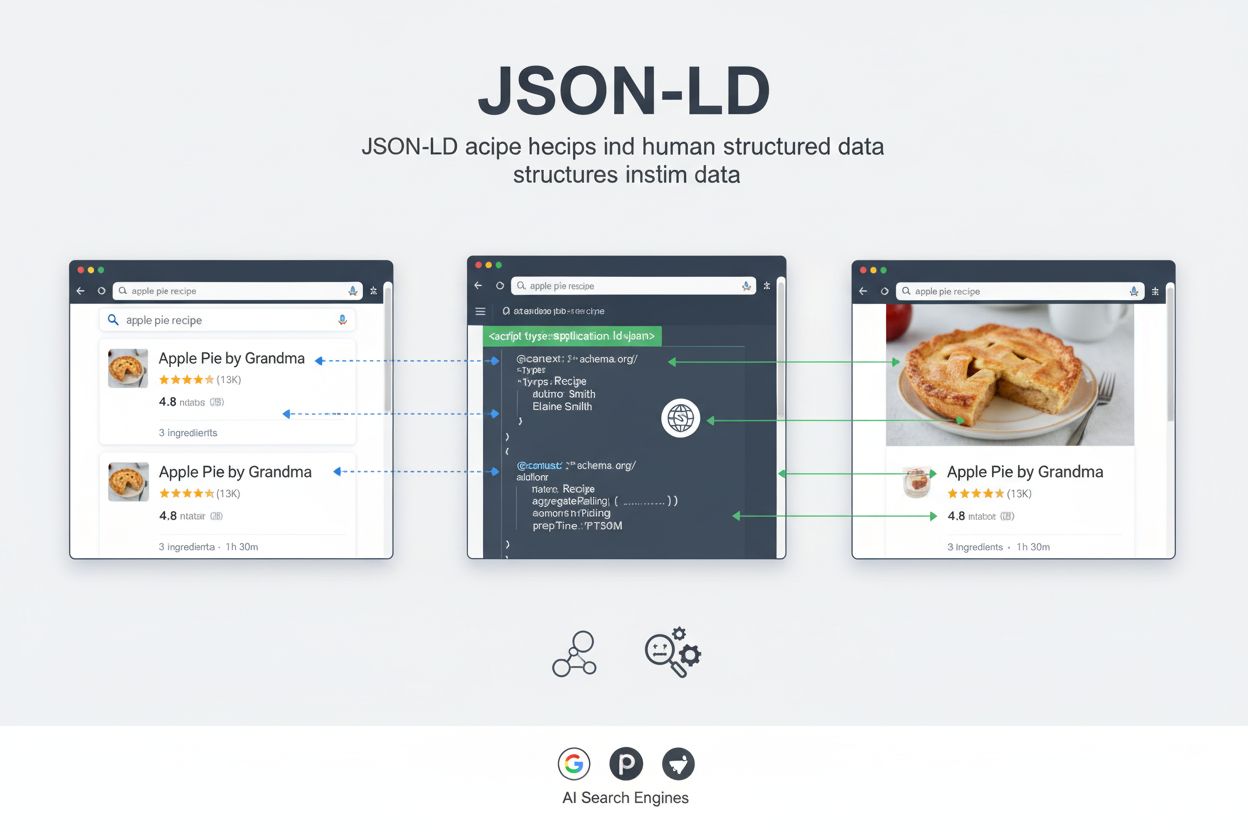
JSON-LD
JSON-LD is a W3C-standard structured data format using JSON syntax for schema.org markup. Learn how JSON-LD improves SEO, enables rich results, and helps AI sea...
12 min read

Learn what JSON-LD is and how to implement it for SEO. Discover structured data markup benefits for Google, ChatGPT, Perplexity, and AI search visibility.
JSON-LD (JavaScript Object Notation for Linked Data) is a lightweight, machine-readable data format that helps search engines understand your web content through structured markup. Implemented via <script> tags in HTML, JSON-LD enables rich search results, improves AI visibility, and is Google's recommended format for schema.org structured data implementation.
JSON-LD (JavaScript Object Notation for Linked Data) is a lightweight, machine-readable data format that enables search engines and artificial intelligence systems to understand the meaning and context of your web content. Unlike traditional HTML, which is designed for human readers, JSON-LD provides explicit semantic information that helps machines interpret what your content represents. Structured data using JSON-LD has become essential in the modern search landscape, where both traditional search engines and AI-powered systems like Google AI Overviews, ChatGPT, Perplexity, and Claude rely on clear, machine-readable signals to understand and surface your content. Google officially recommends JSON-LD as the preferred format for implementing schema.org structured data, making it the industry standard for SEO professionals and web developers. By implementing JSON-LD correctly, you signal to search engines exactly what each element on your page means—whether it’s a product price, recipe ingredients, event dates, or article authorship—which directly impacts your visibility in both traditional search results and emerging AI search experiences.
Structured data has evolved from a nice-to-have SEO tactic into a critical component of modern web visibility. The W3C (World Wide Web Consortium) standardized JSON-LD in 2014 as a W3C Recommendation, establishing it as the official format for linked data on the web. Since then, adoption has accelerated dramatically, with major search engines including Google, Bing, Yahoo, and Yandex all supporting JSON-LD markup. Research demonstrates the tangible impact of structured data implementation: Rotten Tomatoes achieved a 25% higher click-through rate on pages enhanced with structured data compared to non-marked pages, while The Food Network converted 80% of their pages to enable search features and saw a 35% increase in visits. Nestlé measured that pages showing as rich results in search had an 82% higher click-through rate than non-rich result pages. These statistics underscore why JSON-LD implementation has become non-negotiable for competitive websites. The format’s importance has only increased with the rise of AI-powered search engines, which rely heavily on structured data to understand content context and determine whether to cite your pages in their answers.
| Aspect | JSON-LD | Microdata | RDFa |
|---|---|---|---|
| Implementation Method | Embedded in <script> tags | HTML attributes and tags | HTML5 extension attributes |
| Placement | Head or body (flexible) | Typically in body | Head and body |
| Data Separation | Separate from visible content | Interleaved with HTML | Interleaved with HTML |
| Nesting Complexity | Excellent for nested data | Moderate | Moderate |
| Google Recommendation | Recommended (Primary) | Supported equally | Supported equally |
| Ease of Implementation | Easiest for developers | Requires HTML modification | Requires HTML modification |
| Dynamic Injection | Supports JavaScript injection | Limited support | Limited support |
| Learning Curve | Moderate (JSON knowledge helpful) | Steeper (HTML attributes) | Steeper (RDF concepts) |
| Maintenance at Scale | Easiest to manage | More error-prone | More error-prone |
| AI Search Compatibility | Optimal for LLMs | Good | Good |
Google explicitly states that JSON-LD is the easiest solution for website owners to implement and maintain at scale, making it less prone to user errors than alternatives. While all three formats are equally valid for Google Search, JSON-LD’s separation of structured data from visible HTML content makes it superior for complex, nested data structures—such as describing an event venue within an event, or a product’s shipping details within an offer.
JSON-LD functions by embedding a JavaScript object notation script directly into your HTML document, typically within the <head> section or anywhere in the <body>. The format uses a standardized vocabulary from schema.org, which provides definitions for hundreds of entity types and properties. When Google’s crawlers encounter JSON-LD markup, they parse the structured data and use it to better understand your page’s content, enabling them to display rich results with enhanced visual elements like star ratings, pricing information, images, and interactive features. The implementation process begins with identifying what type of content you’re marking up—whether it’s an article, product, recipe, event, FAQ, or local business—then selecting the appropriate schema.org type. Each schema type has required properties (mandatory for rich results eligibility) and recommended properties (which enhance visibility and context). The @context property, set to “https://schema.org/"
, tells the browser that you’re using schema.org vocabulary, while the @type property specifies the exact entity type you’re describing.
Here’s a basic example of JSON-LD for an article:
<script type="application/ld+json">
{
  "@context": "https://schema.org/",
  "@type": "Article",
  "headline": "Understanding JSON-LD for Modern SEO",
  "author": {
    "@type": "Person",
    "name": "Sarah Johnson"
  },
  "datePublished": "2024-01-15",
  "image": "https://example.com/article-image.jpg",
  "description": "A comprehensive guide to JSON-LD implementation"
}
</script>
For more complex structures, JSON-LD supports nesting, allowing you to embed related objects within parent objects. For instance, an Event schema can contain nested Person objects for performers and a Place object for the venue, all within a single, cohesive data structure.
While the names are similar, JSON and JSON-LD serve different purposes and should not be confused. JSON (JavaScript Object Notation) is a general-purpose, lightweight data-interchange format used for sending and receiving structured data across systems and APIs. It’s a syntax standard for organizing data into key-value pairs and arrays, but it doesn’t inherently carry semantic meaning—the data could represent anything depending on context. JSON-LD, by contrast, is specifically designed for linked data on the web and uses JSON syntax combined with semantic context from schema.org vocabularies. JSON-LD transforms raw JSON data into machine-understandable information by adding context through the @context property, which tells machines what each field means. This semantic layer is crucial for search engines and AI systems: while JSON might simply contain {"name": "John", "birthDate": "1990-05-15"}, JSON-LD explicitly declares this as a Person entity with specific properties, enabling search engines to understand the relationship between the data and real-world concepts. For SEO purposes, JSON-LD is vastly superior because it enables search engines to not just read your data, but understand its meaning and relevance to user queries.
Nesting in JSON-LD refers to organizing information into hierarchical layers, allowing you to describe relationships between multiple entities within a single markup structure. This capability is one of JSON-LD’s greatest strengths compared to other structured data formats. When you nest objects, you’re essentially saying “this entity is part of that entity” or “this property belongs to that object.” For example, in an Event schema, you might nest a Person object (the performer) and a Place object (the venue) within the Event object itself. Each nested object maintains its own @type and properties, creating a rich, interconnected data structure that search engines can parse with precision.
Consider this example of a music event with nested performer and venue information:
<script type="application/ld+json">
{
  "@context": "https://schema.org/",
  "@type": "Event",
  "name": "Summer Jazz Festival",
  "startDate": "2024-07-15T18:00:00",
  "location": {
    "@type": "Place",
    "name": "Central Park Amphitheater",
    "address": {
      "@type": "PostalAddress",
      "streetAddress": "123 Park Avenue",
      "addressLocality": "New York",
      "addressRegion": "NY",
      "postalCode": "10001"
    }
  },
  "performer": {
    "@type": "Person",
    "name": "Jazz Quartet Ensemble"
  }
}
</script>
The nesting here allows search engines to understand that the performer is associated with this specific event at this specific location. This granular context is invaluable for AI systems that need to understand relationships between entities. The immutable tags like @context and @type don’t change across different schema types, making them reusable building blocks for complex markup strategies.
Even experienced developers make mistakes when implementing JSON-LD, and these errors can prevent your structured data from being recognized by search engines. Understanding common pitfalls helps you avoid them and ensure your markup is valid and effective. Syntax errors are the most frequent problem—using straight quotes instead of curly quotes, missing commas between properties, or incorrect bracket placement will cause the entire JSON-LD block to fail validation. Many developers copy JSON-LD code from Microsoft Word or other rich-text editors, which automatically convert straight quotes to curly quotes, breaking the syntax. Always use a plain-text editor or code editor when working with JSON-LD.
Using incorrect or non-existent vocabulary is another critical mistake. Schema.org has specific property names and types, and using variations or misspellings will cause search engines to ignore your markup. For example, using “authorName” instead of the correct nested “author” object with a “name” property will not be recognized. Always reference schema.org directly to verify the exact property names and required structure for your chosen schema type.
Inaccurate or misleading data is particularly problematic because it violates Google’s structured data policies. Your JSON-LD markup must accurately reflect the visible content on your page. If your page displays a product price of $29.99, your JSON-LD must show the same price—not a different price or a price range. Marking up content that doesn’t exist on the page (like adding review ratings when no reviews are visible) is considered deceptive and can result in manual actions against your site.
Formatting mistakes often occur when developers manually construct JSON-LD without proper validation. Missing closing braces, unclosed strings, or improperly formatted arrays will cause validation failures. Always use Google’s Rich Results Test or Schema.org’s Markup Validator to check your implementation before deploying to production.
Implementing JSON-LD correctly enables your pages to appear as rich results in Google Search, which are search listings enhanced with additional visual elements and information beyond the standard title, URL, and meta description. Rich results can include star ratings, pricing information, product images, event details, FAQ expandable sections, breadcrumb navigation, and more. The visual prominence of rich results makes them significantly more likely to attract clicks: studies show that rich results can increase click-through rates by 30% or more compared to standard search results.
Google supports over 32 different types of rich results, each with specific schema requirements. Review snippets display star ratings and review counts, building credibility and trust. Product rich results show pricing, availability, and ratings directly in search results, enabling users to make purchasing decisions without visiting your site. FAQ rich results display questions and answers in expandable sections, perfect for capturing featured snippets and “People Also Ask” opportunities. Event rich results showcase event dates, locations, and ticket information, making it easy for users to discover and attend your events. Article rich results display author information, publication date, and featured images, establishing authority and freshness signals.
For local businesses, LocalBusiness schema enables your business information to appear in local search results and Google Maps, including your address, phone number, hours of operation, and customer reviews. Job posting schema makes your job listings eligible to appear in Google’s job search experience, with prominent placement at the top of search results. Each of these rich result types requires specific JSON-LD implementation, but the investment pays dividends in visibility and user engagement.
The emergence of AI-powered search engines has fundamentally changed the importance of structured data. Google AI Overviews, ChatGPT Search, Perplexity AI, and Claude Search all rely on understanding your content to determine whether to cite it in their answers. While these AI systems don’t parse JSON-LD in the same way traditional search engines do, structured data significantly improves your chances of being included in AI-generated responses. Google’s documentation explicitly states that AI Overviews pull information from “a range of sources, including information from across the web,” and pages with clear, well-structured markup are more likely to be selected as sources.
ChatGPT Search uses Bing’s index as its source, meaning your Bing-indexed pages with proper schema markup are potential sources for ChatGPT answers. Perplexity AI is a generative Q&A engine that cites web sources in its responses, and it clearly benefits from structured data that makes your content easier to identify and extract. Claude Search, introduced in early 2025, pulls real-time information from indexed sites and provides direct citations, making structured data crucial for visibility. The common thread across all these AI systems is that they prefer content that is clear, authoritative, and well-annotated with structured data.
Implementing JSON-LD transforms your website into a machine-readable knowledge graph that AI systems can tap into for grounded, contextual information. This is particularly important for FAQ and HowTo schema, which directly answer questions in a format that AI systems can easily extract and cite. By using semantic JSON-LD to develop your content knowledge graph, you’re creating AI search-ready content that’s more likely to be surfaced in generative answers across multiple platforms.
Successful JSON-LD implementation requires following established best practices that ensure your markup is valid, maintainable, and effective for both search engines and AI systems. Use JSON-LD exclusively for new implementations, as Google recommends it over Microdata and RDFa. Place your JSON-LD in a <script type="application/ld+json"> tag, typically in the <head> section, though it can appear anywhere in the document. This placement keeps your structured data separate from visible HTML, making it easier to manage and less prone to breaking when HTML changes.
Choose relevant schema types that accurately match your content. Don’t force schema types onto content where they don’t apply—use FAQPage only on actual FAQ pages, HowTo only on step-by-step guides, and Product schema only on product pages. Misusing schema types violates Google’s guidelines and can result in manual actions against your site. Validate your markup using Google’s Rich Results Test before deploying to production. This free tool checks your JSON-LD for syntax errors and tells you which rich result types your page is eligible for. After deployment, monitor your structured data using Google Search Console’s Rich Results report to ensure your markup remains valid over time.
Focus on required and recommended properties rather than trying to include every possible property. Google’s documentation emphasizes that it’s better to supply fewer but complete and accurate recommended properties than to provide every possible property with incomplete or inaccurate data. For example, on a product page, ensure you have accurate pricing, availability, and at least one high-quality image before adding optional properties like shipping details or warranty information.
Keep your data accurate and synchronized with visible page content. Your JSON-LD must reflect what users actually see on the page. If you update product prices, review counts, or event dates, update your JSON-LD accordingly. Stale or inaccurate structured data damages trust and can trigger manual actions. Implement dynamically when necessary using JavaScript, which JSON-LD supports better than other formats. If your content is generated by JavaScript frameworks or loaded dynamically, JSON-LD can still be injected into the DOM and recognized by search engines.
Validating your JSON-LD implementation is essential before and after deployment. Google’s Rich Results Test is the primary tool for checking JSON-LD validity and determining which rich result types your page qualifies for. Simply paste your URL or JSON-LD code into the tool, and it will identify any errors, warnings, or missing recommended properties. The test provides detailed feedback on what’s working and what needs improvement.
Schema.org’s Markup Validator offers schema-agnostic validation without Google-specific warnings, useful for understanding schema.org compliance independent of Google’s requirements. Google Search Console’s Rich Results report monitors your site’s structured data performance over time, showing which pages have valid markup and which rich result types are appearing in search results. This ongoing monitoring is crucial for catching issues after deployment, such as when template changes accidentally break your JSON-LD.
Structured data testing tools like BrightEdge’s SearchIQ can analyze your competitors’ schema implementations and identify which schema types are most common in your industry, helping you prioritize which markup to implement first. These competitive insights ensure you’re implementing the most impactful schema types for your specific niche.
Different content types require different schema implementations, each with specific required and recommended properties. Article schema is essential for blog posts and news content, requiring headline, author, datePublished, and image properties. Adding dateModified helps signal freshness, while articleBody can provide additional context. Product schema requires name, image, and description at minimum, with recommended properties including price, availability, and aggregateRating. For e-commerce sites, including detailed Offer and Review objects significantly improves rich result eligibility.
FAQ schema (FAQPage) is powerful for capturing featured snippets and “People Also Ask” opportunities. It requires a mainEntity array of Question objects, each with acceptedAnswer properties. HowTo schema works similarly, requiring step-by-step instructions marked up with HowToStep objects. Event schema requires name, startDate, and location, with recommended properties including description, image, and performer information. LocalBusiness schema is critical for physical businesses, requiring name, address, telephone, and hours of operation.
Recipe schema requires name, image, recipeIngredient, and recipeInstructions, with recommended properties including prepTime, cookTime, recipeYield, and nutrition information. Organization schema should be implemented site-wide to establish your brand identity, including name, logo, contact information, and social media profiles. Implementing multiple schema types on a single page is common and encouraged—for example, an article page might include Article, Organization, and Author (Person) schema simultaneously.
The trajectory of structured data is clear: as AI search engines mature and become more prevalent, structured data will become increasingly central to web visibility. Search engines and AI systems are moving toward a semantic layer approach, where structured data provides the grounding that generative models need to produce accurate, verifiable answers. This shift means that investing in JSON-LD today is not just about traditional SEO—it’s about building the semantic infrastructure that future AI tools will rely on.
We can expect schema.org vocabulary to expand with new types and properties specifically designed for AI needs. Emerging schema types like QAPage, Speakable, and sector-specific schemas will provide more granular ways to mark up content for AI consumption. The integration of structured data with knowledge graphs will deepen, allowing AI systems to understand not just individual pages but the relationships between entities across your entire website and the broader web. For digital marketers and SEO professionals, this means structured data will remain a strategic priority. Organizations that implement comprehensive, accurate JSON-LD markup today will have a significant advantage as AI search continues to evolve and capture market share from traditional search engines.
The convergence of traditional SEO and AI visibility through structured data represents a fundamental shift in how websites communicate with machines. By mastering JSON-LD implementation now, you’re future-proofing your digital presence for the AI-driven search landscape that’s already emerging.
Track how your structured data appears in AI-powered search results including Google AI Overviews, ChatGPT, Perplexity, and Claude. AmICited monitors your domain's visibility across all major AI platforms.
JSON-LD is a W3C-standard structured data format using JSON syntax for schema.org markup. Learn how JSON-LD improves SEO, enables rich results, and helps AI sea...

Learn how to implement Organization schema markup for AI visibility. Step-by-step guide to add JSON-LD structured data, improve AI citations, and enhance brand ...
Community discussion on JSON-LD implementation for AI search visibility. Developers and SEOs share how structured data affects AI citations and best practices.