
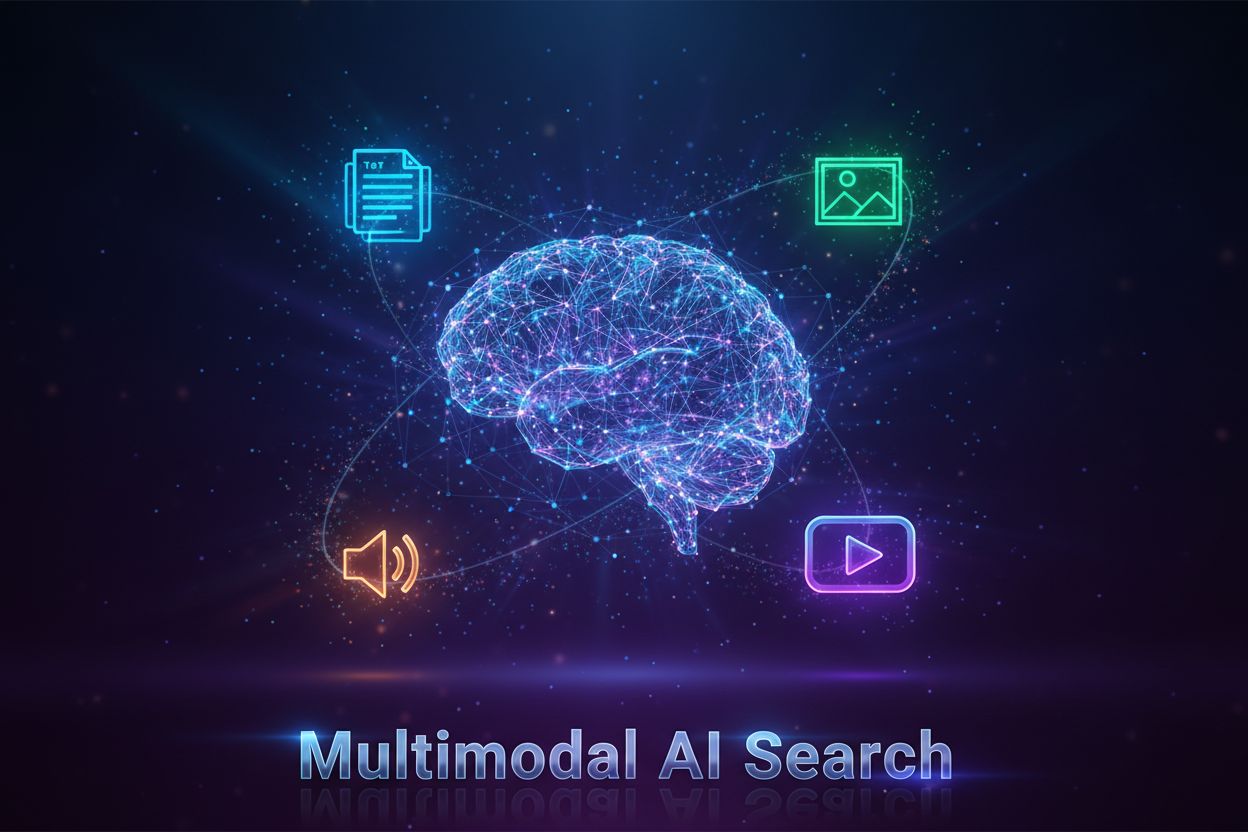
Multimodal AI Search
Learn how multimodal AI search systems process text, images, audio, and video together to deliver more accurate and contextually relevant results than single-mo...
6 min read

Learn what multi-modal content for AI is, how it works, and why it matters. Explore examples of multi-modal AI systems and their applications across industries.
Multi-modal content for AI refers to data that combines multiple types of information such as text, images, audio, and video. Multi-modal AI systems process these diverse data types simultaneously to achieve more comprehensive understanding and generate more accurate outputs than systems that handle only single data types.
Multi-modal content for AI refers to data that integrates multiple types of information—such as text, images, audio, and video—into a single system for processing and analysis. Unlike traditional AI systems that handle only one type of data (unimodal), multi-modal AI systems can simultaneously process and understand diverse data types to generate more comprehensive and accurate insights. This approach mirrors how humans naturally perceive and interact with the world, combining visual information, spoken words, written text, and sounds to form a complete understanding of their environment.
The significance of multi-modal content lies in its ability to capture context and nuance that single-modality systems cannot achieve. When an AI system processes only text, it misses visual cues and emotional tones conveyed through audio. When it processes only images, it lacks the descriptive context that text provides. By combining these modalities, multi-modal AI systems achieve higher accuracy, better contextual understanding, and more robust performance across complex real-world applications. This integration has become increasingly important as organizations seek to leverage diverse data sources for more intelligent decision-making.
Multi-modal AI systems operate through a structured architecture consisting of three primary components: encoders, fusion mechanisms, and decoders. Each component plays a critical role in transforming raw multi-modal data into actionable insights.
Encoders serve as the first layer of processing, converting raw data from different modalities into machine-readable feature vectors or embeddings. For image data, systems typically use Convolutional Neural Networks (CNNs) that analyze pixel patterns and extract visual features. For text data, transformer-based models like those in GPT frameworks convert written descriptions into numerical embeddings that capture semantic meaning. For audio data, specialized encoders like Wav2Vec2 transform raw sound files into feature vectors that capture rhythm, tone, and linguistic patterns. This encoding process is essential because it translates diverse data types into a common mathematical language that the AI system can process.
The fusion mechanism represents the heart of multi-modal processing, combining encoded data from different modalities into a unified representation. Several fusion strategies exist, each suited to different applications:
| Fusion Strategy | Description | Best Use Case |
|---|---|---|
| Early Fusion | Combines all modalities before processing | When modalities are highly correlated |
| Intermediate Fusion | Projects each modality to latent space before combining | Balancing modality independence and integration |
| Late Fusion | Processes modalities separately, then combines outputs | When modalities have distinct characteristics |
| Hybrid Fusion | Combines multiple fusion strategies at different stages | Complex tasks requiring flexible integration |
Within these strategies, developers employ specific fusion methods. Attention-based methods use transformer architecture to understand relationships between embeddings, allowing the system to focus on relevant parts of each modality. Concatenation merges embeddings into a single feature representation, while dot-product methods capture interactions between modalities by multiplying feature vectors element-wise. The choice of fusion method significantly impacts the system’s ability to extract meaningful cross-modal relationships.
Decoders process the fused feature vectors to produce the required output. These can be Recurrent Neural Networks (RNNs) for sequential tasks, Convolutional Neural Networks (CNNs) for visual outputs, or Generative Adversarial Networks (GANs) for creative generation tasks. The decoder’s architecture depends entirely on the desired output type—whether generating text descriptions, creating images, or making predictions.
Multi-modal AI systems possess three fundamental characteristics that distinguish them from simpler approaches. Heterogeneity refers to the diverse qualities, structures, and representations of different modalities—a text description of an event differs fundamentally in structure and quality from a photograph of the same event. Connections describe the complementary information shared between modalities, reflected in statistical similarities or semantic correspondence. Interactions capture how different modalities influence each other when brought together, creating emergent understanding that exceeds the sum of individual parts.
These characteristics create both opportunities and challenges. The complementary nature of multi-modal data means that if one modality is unreliable or unavailable, the system can rely on others to maintain performance. This resilience to noise and missing data is a significant advantage in real-world applications where data quality varies. However, the heterogeneous nature of multi-modal data makes alignment and synchronization complex, requiring sophisticated techniques to ensure that data from different modalities corresponds to the same context or event.
Multi-modal AI systems are transforming numerous industries by enabling more sophisticated and human-like interactions. In healthcare, multi-modal systems combine medical imaging (X-rays, MRIs) with patient records and genetic data to improve diagnostic accuracy and treatment recommendations. Autonomous vehicles integrate camera feeds, LiDAR data, radar information, and GPS coordinates to navigate safely and detect obstacles in real-time. E-commerce platforms use multi-modal systems to enable visual search, where customers can upload product images and receive text-based recommendations for similar items.
Virtual assistants and chatbots leverage multi-modal capabilities to understand voice commands, interpret gestures, and respond with both text and audio. Content moderation systems analyze videos by examining visual content, audio dialogue, and text captions simultaneously to identify inappropriate material more accurately. Medical diagnosis tools can examine patient photos, listen to symptom descriptions, and review medical history to provide comprehensive assessments. Image captioning systems generate detailed text descriptions of images, while visual question-answering systems answer user queries about image content by combining visual understanding with language comprehension.
Multi-modal AI systems deliver substantial benefits that justify their increased complexity. Enhanced accuracy results from combining complementary information sources—a system analyzing both facial expressions and voice tone achieves better emotion recognition than analyzing either alone. Improved contextual understanding emerges from the ability to cross-reference information across modalities, reducing ambiguity and capturing nuanced meanings. Better user experience comes from more natural interaction modes—users can communicate through speech, text, images, or combinations thereof, matching their preferred communication style.
Robustness and resilience represent critical advantages in production environments. If audio quality degrades in a multi-modal system, visual information can compensate. If lighting conditions make image analysis difficult, audio and text inputs can provide context. This graceful degradation ensures system reliability even when individual modalities experience problems. Broader applicability allows multi-modal systems to handle complex real-world scenarios that single-modality systems cannot address. Knowledge transfer between modalities enables the system to learn representations that generalize better to new tasks and domains.
Despite their advantages, multi-modal AI systems face significant technical and practical challenges. Data alignment requires ensuring that data from different modalities correspond to the same context, event, or time period. A video frame must be synchronized with its corresponding audio segment and any associated text descriptions. This synchronization becomes increasingly complex with large-scale datasets and diverse data sources.
Data availability and quality present substantial obstacles. While individual modalities may have abundant training data, aligned multi-modal datasets are scarce and expensive to create. Data annotation requires expertise across multiple domains—annotators must understand visual content, audio characteristics, and textual meaning simultaneously. This multi-disciplinary requirement increases annotation costs and complexity significantly.
Computational complexity escalates dramatically with multi-modal systems. Processing multiple data types simultaneously requires substantially more computational resources than single-modality processing. Model complexity increases the risk of overfitting, where the system memorizes training data rather than learning generalizable patterns. Representation challenges arise from the need to map diverse data types into a common semantic space while preserving the unique characteristics of each modality.
Interpretability and explainability become more difficult as systems grow more complex. Understanding why a multi-modal system made a particular decision requires analyzing contributions from multiple modalities and their interactions. Bias and fairness concerns multiply when combining data from multiple sources, each potentially containing different biases that can compound in the fused representation.
The field has produced several influential multi-modal models that demonstrate different architectural approaches. CLIP (Contrastive Language-Image Pre-training) by OpenAI pairs text descriptions with images using contrastive learning, enabling zero-shot image classification and retrieval. DALL-E generates images from text descriptions using a diffusion-based decoder conditioned on CLIP embeddings. GPT-4V extends GPT-4 with vision capabilities, allowing it to analyze images and answer questions about visual content.
LLaVA (Large Language and Vision Assistant) combines Vicuna language model with CLIP vision encoder to create a visual assistant capable of answering questions about images. Gemini by Google processes text, images, video, and audio with variants optimized for different computational constraints. ImageBind by Meta creates a unified embedding space for six modalities—text, image, video, audio, depth, and thermal data—enabling cross-modal generation and retrieval.
Claude 3 by Anthropic demonstrates strong multi-modal capabilities with excellent performance on visual reasoning tasks. Gen2 by Runway generates videos from text and image prompts using diffusion-based models. These models represent the current state-of-the-art in multi-modal AI, each optimized for specific use cases and computational environments.
The trajectory of multi-modal AI development points toward increasingly sophisticated systems with broader capabilities. Improved fusion techniques will enable more effective integration of diverse modalities, potentially discovering novel cross-modal relationships. Scalable architectures will make multi-modal systems more accessible and deployable across various computational environments, from cloud servers to edge devices.
Enhanced training methods including few-shot, one-shot, and zero-shot learning will reduce the data requirements for developing multi-modal systems. Explainable AI advances will improve our understanding of how multi-modal systems make decisions, building trust and enabling better debugging. Ethical frameworks will address privacy, bias, and fairness concerns inherent in multi-modal systems processing diverse data types.
The integration of real-time processing capabilities will enable multi-modal AI in time-sensitive applications like autonomous driving and augmented reality. Multimodal data augmentation techniques will generate synthetic training data combining multiple modalities, reducing dependence on scarce aligned datasets. Transfer learning advances will enable knowledge learned from one multi-modal task to benefit other tasks, accelerating development and improving performance.
As AI systems become increasingly sophisticated in understanding and generating content, multi-modal content visibility has become critical for brand presence. AI search engines and answer generators like ChatGPT, Perplexity, and others now process multi-modal content to provide comprehensive answers to user queries. Your brand’s appearance in these AI-generated responses depends on whether your content—whether text, images, videos, or combinations thereof—is discoverable and relevant to the multi-modal understanding these systems develop.
Understanding multi-modal content helps you optimize your digital presence for AI discovery. When you create content that combines text descriptions with high-quality images, videos, and structured data, you increase the likelihood that AI systems will recognize and cite your content in their responses. This multi-modal approach to content creation ensures your brand remains visible in the evolving landscape of AI-powered information discovery.
Track how your content appears in AI responses across ChatGPT, Perplexity, and other AI search engines. Ensure your brand visibility in the AI-powered future.
Learn how multimodal AI search systems process text, images, audio, and video together to deliver more accurate and contextually relevant results than single-mo...
Master multimodal AI search optimization. Learn how to optimize images and voice queries for AI-powered search results, featuring strategies for GPT-4o, Gemini,...
Learn how to optimize text, images, and video for multimodal AI systems. Discover strategies to improve AI citations and visibility across ChatGPT, Gemini, and ...