
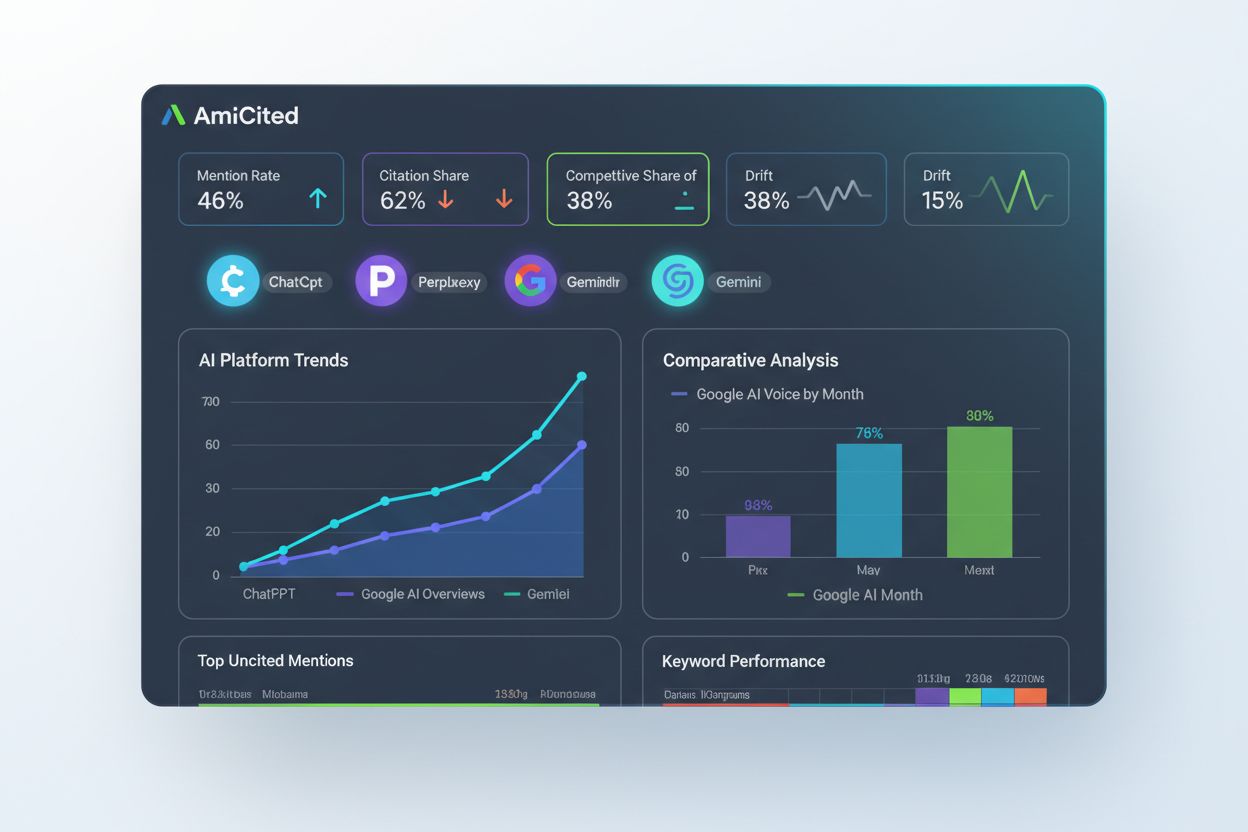
Why AI Visibility Will Define Marketing Success in the Next Decade
Discover how AI visibility is reshaping marketing success. Learn why citations matter more than clicks, how to measure AI visibility, and why your brand's prese...
10 min read

Discover the real business costs of ignoring AI search monitoring. Learn how brands lose visibility, market share, and customer discovery when they don’t track AI search performance across ChatGPT, Perplexity, and other AI platforms.
Ignoring AI search means losing visibility to millions of users who rely on AI platforms like ChatGPT, Perplexity, and Gemini for answers. This results in lost discovery opportunities, reduced brand awareness, declining market share to competitors, and misallocated marketing resources without understanding actual AI visibility performance.
The shift toward AI-powered search is no longer a future trend—it’s happening right now. According to recent research, 58% of consumers have already replaced traditional search engines with generative AI tools for product recommendations and information discovery. This fundamental change in how people find information represents one of the most significant shifts in digital discovery since the rise of Google. Traditional organic search traffic is expected to decline by 50% by 2028, according to Gartner projections, while AI platforms like ChatGPT now drive 10% of new user sign-ups through referrals. When you ignore AI search monitoring, you’re essentially ignoring where your customers are increasingly going to find answers and make decisions.
The opportunity cost begins the moment you fail to recognize that AI search operates under completely different rules than traditional search engines. Unlike Google, where you compete for positions on a results page with dozens of competitors visible, AI search engines deliver direct answers and cite only a handful of sources. If your brand isn’t mentioned in those AI-generated answers, you become invisible to users who rely on these platforms. This invisibility isn’t temporary—it compounds over time as competitors who actively monitor and optimize for AI search gain increasing visibility and market share.
When brands ignore AI search, they forfeit direct discovery opportunities that traditional SEO alone cannot capture. Research analyzing 6.8 million AI citations across ChatGPT, Gemini, and Perplexity reveals that 86% of AI citations come from brand-controlled sources, meaning your website, listings, and managed content are the primary sources AI systems use to generate answers. However, this opportunity only materializes if your brand is actually visible and cited by these platforms.
The discovery mechanism in AI search differs fundamentally from traditional search. In traditional SEO, a top-ranking page still generates visibility even if users don’t click through—they see your title and meta description on the results page. In AI search, if your content isn’t cited in the generated answer, users never see your brand at all. They receive a synthesized answer from competing sources without any awareness that your company exists or offers relevant solutions. This represents a complete loss of discovery opportunity for every query where your competitors appear but you don’t.
Consider the practical implications: if a potential customer asks ChatGPT “What are the best tools to monitor brand visibility in AI search?” and your monitoring platform isn’t mentioned, that customer never learns you exist. They discover and evaluate your competitors instead. Multiply this across thousands of relevant queries monthly, and the cumulative opportunity cost becomes staggering. Brands that actively monitor their AI visibility can identify these gaps and create content that earns citations, while those ignoring AI search remain perpetually invisible.
The opportunity cost of ignoring AI search manifests most clearly in competitive disadvantage. Brands that actively monitor their AI visibility across ChatGPT, Claude, Gemini, and Perplexity gain critical intelligence about their share of voice compared to competitors. This metric reveals what percentage of relevant AI-generated answers mention your brand versus competitors’ brands. If a competitor appears in 60% of relevant responses while you appear in only 15%, that gap represents lost market share and customer mindshare.
| Metric | Impact | Consequence |
|---|---|---|
| Brand mention frequency | How often AI references your brand | Determines customer awareness |
| Citation rates | Whether your website appears as a source | Drives traffic and credibility |
| Share of voice | Your visibility vs. competitors | Indicates market position |
| Cross-platform performance | Visibility across all major AI engines | Reveals total addressable visibility |
| Sentiment and positioning | How AI describes your brand | Shapes customer perception |
Early adopters who began monitoring AI search visibility in 2024 and 2025 are already building compounding advantages. They understand which keywords trigger maximum brand mentions, which content types earn the most citations, and how their visibility differs across platforms. Meanwhile, brands ignoring AI search are flying blind, making marketing decisions without understanding whether their content investments actually result in AI visibility. This information asymmetry creates a widening gap where competitors capture customers during the research phase before they even reach traditional search or your website.
The competitive cost accelerates as more users adopt AI search. When 58% of consumers already use AI for recommendations, brands that don’t appear in those recommendations lose access to a majority of the market during critical decision-making moments. Your competitors who monitor AI visibility are actively optimizing to capture these users, while you remain invisible through inaction.
One of the most insidious opportunity costs of ignoring AI search is resource misallocation. Without monitoring your AI visibility, you cannot determine whether your content investments actually result in brand mentions and citations across AI platforms. You might be investing heavily in blog content, whitepapers, and guides that perform well in traditional SEO but fail to earn citations in AI-generated answers. Conversely, you might be neglecting content types that AI systems heavily favor but that don’t drive traditional search traffic.
Research reveals that different AI platforms have distinct preferences for citation sources. ChatGPT mentions brands in 99.3% of eCommerce responses and heavily favors retail and marketplace domains, citing Amazon in 61.3% of citations. Google AI Overview, by contrast, mentions brands in only 6.2% of responses and prioritizes YouTube content for 62.4% of citations. Perplexity, the research-oriented platform, cites from 8,027 unique domains and rewards comprehensive, authoritative content with extensive citations. Without monitoring these platform-specific behaviors, you cannot optimize your content strategy effectively.
Brands ignoring AI search often continue investing in traditional SEO tactics that don’t translate to AI visibility. They might optimize for keyword rankings without understanding that AI systems use retrieval-augmented generation (RAG) to synthesize answers from multiple sources rather than ranking individual pages. They might focus on backlinks without recognizing that AI citation patterns depend more on content structure, fact density, and source authority than traditional ranking signals. This misalignment between investment and actual AI visibility results in wasted marketing budgets and missed opportunities to build visibility where customers are increasingly searching.
When you ignore AI search monitoring, you lose visibility into how AI systems describe and position your brand. AI platforms don’t just mention brands—they characterize them, provide context about their offerings, and sometimes make claims about their strengths or weaknesses. Without monitoring this, you remain unaware of perception gaps between how you position your brand and how AI systems present it to customers.
This creates significant brand reputation risks. If an AI system consistently describes your company inaccurately, positions it as a competitor to brands you don’t actually compete with, or omits key differentiators, customers form incorrect impressions before ever visiting your website. You have no mechanism to identify or correct these perception issues because you’re not monitoring AI-generated answers. Meanwhile, competitors who actively monitor their AI positioning can identify and address perception gaps quickly, ensuring customers receive accurate information about their offerings.
The opportunity cost extends to brand authority and entity recognition. AI systems rely on consistent, accurate information about brands across trusted sources to build entity authority. Brands that monitor their AI visibility can ensure their information is consistent across the sources AI systems rely on—their website, business listings, review platforms, and industry directories. Brands ignoring AI search often have fragmented or outdated information across these sources, weakening their entity authority and reducing the likelihood that AI systems cite them as credible sources.
An often-overlooked opportunity cost is the compounding effect of declining visibility. AI systems continually retrain on new content and update their knowledge bases. Brands that don’t actively monitor their AI visibility often experience gradual visibility decline as competitors publish more citation-worthy content and their own content becomes stale. Without monitoring, you won’t notice this decline until it’s already significantly impacted your market position.
Research shows that adding citations and quotes to content boosts AI visibility by more than 40%. Brands that monitor their AI visibility identify which content types and formats earn the most citations, then systematically create more of that content. Brands ignoring AI search continue with their existing content strategy, unaware that their visibility is declining relative to competitors. By the time they notice the problem—through declining leads or market share—competitors have already captured significant mindshare and customer relationships.
The visibility decline accelerates in competitive markets. If you’re in an industry where multiple competitors actively optimize for AI search, your relative invisibility compounds quickly. Customers increasingly rely on AI recommendations, and if your competitors consistently appear while you don’t, you become the forgotten option. The opportunity cost isn’t just the immediate lost sales—it’s the long-term brand equity and market position you forfeit to competitors who recognized the importance of AI search earlier.
The opportunity cost of ignoring AI search includes missing the first-mover advantage window. We’re still in the early stages of AI search adoption and optimization. Brands that begin monitoring and optimizing for AI visibility now will build advantages that compound significantly over time. The barrier to entry for AI search monitoring is lower than traditional SEO—you don’t need years of backlink building or domain authority accumulation. You need to understand which prompts your customers use, ensure your content is structured and citable, and maintain consistent entity information across sources.
Brands that wait to address AI search until it becomes mainstream will face a much more competitive landscape. Early adopters are already building brand authority in AI systems, establishing citation patterns, and capturing market share. By the time laggards recognize the importance of AI search, competitors will have already secured visibility in the most valuable queries. The opportunity cost of waiting includes not just the immediate lost visibility but the difficulty of displacing entrenched competitors who established their AI presence earlier.
The opportunity cost of ignoring AI search translates directly to measurable business impact. Consider a B2B software company in a competitive market where 10 relevant queries generate 1,000 monthly searches combined. If competitors appear in 80% of AI-generated answers for these queries while you appear in 20%, you’re losing visibility to 600 potential customers monthly who discover competitors instead of your solution. Over a year, that’s 7,200 lost discovery opportunities. If your average customer lifetime value is $50,000 and your conversion rate from discovery to customer is 5%, ignoring AI search costs you approximately $18 million in annual opportunity cost.
This calculation becomes even more dramatic for consumer brands. If 58% of consumers use AI for product recommendations and your brand doesn’t appear in those recommendations, you’re losing access to the majority of your addressable market during the critical research phase. The opportunity cost compounds as AI adoption increases—by 2028, when traditional search traffic has declined 50%, brands that ignored AI search will face a crisis as their primary discovery channel shrinks while they remain invisible in the channel where customers increasingly search.
Every month you delay implementing AI search monitoring is a month your competitors gain visibility advantage. The opportunity cost of ignoring AI search isn’t static—it grows exponentially as AI adoption accelerates and competitors build stronger positions. Brands that act now can establish visibility, build citation patterns, and capture market share. Brands that delay face an increasingly difficult competitive landscape where displacing entrenched competitors requires significantly more effort and investment.
The window for establishing first-mover advantage in AI search is closing rapidly. Major brands and sophisticated marketers have already recognized the importance of AI visibility and begun optimizing. The opportunity cost of ignoring AI search today includes not just the immediate lost visibility but the compounding disadvantage you’ll face as the market matures and competition intensifies. The time to begin monitoring your AI search visibility is now, before your competitors have completely captured the market and before the cost of catching up becomes prohibitively expensive.
Don't let your competitors capture visibility in AI-generated answers. Track your brand mentions, citations, and share of voice across all major AI platforms with AmICited.
Discover how AI visibility is reshaping marketing success. Learn why citations matter more than clicks, how to measure AI visibility, and why your brand's prese...
Discover how branded search volume directly correlates with AI visibility. Learn to measure brand signals in LLMs and optimize for AI-driven discovery with acti...

Explore AI Visibility Futures - forward-looking analysis of emerging trends in AI-driven brand discovery. Learn how brands will be discovered by AI systems and ...