
OtterlyAI
Learn what OtterlyAI is, how it monitors your brand across 6 AI platforms, and how it helps with generative engine optimization. Discover features, pricing, and...
10 min read

Learn what Otterly AI does: monitor brand visibility across ChatGPT, Perplexity, Google AI Overviews. Track citations, competitive benchmarking, and GEO optimization.
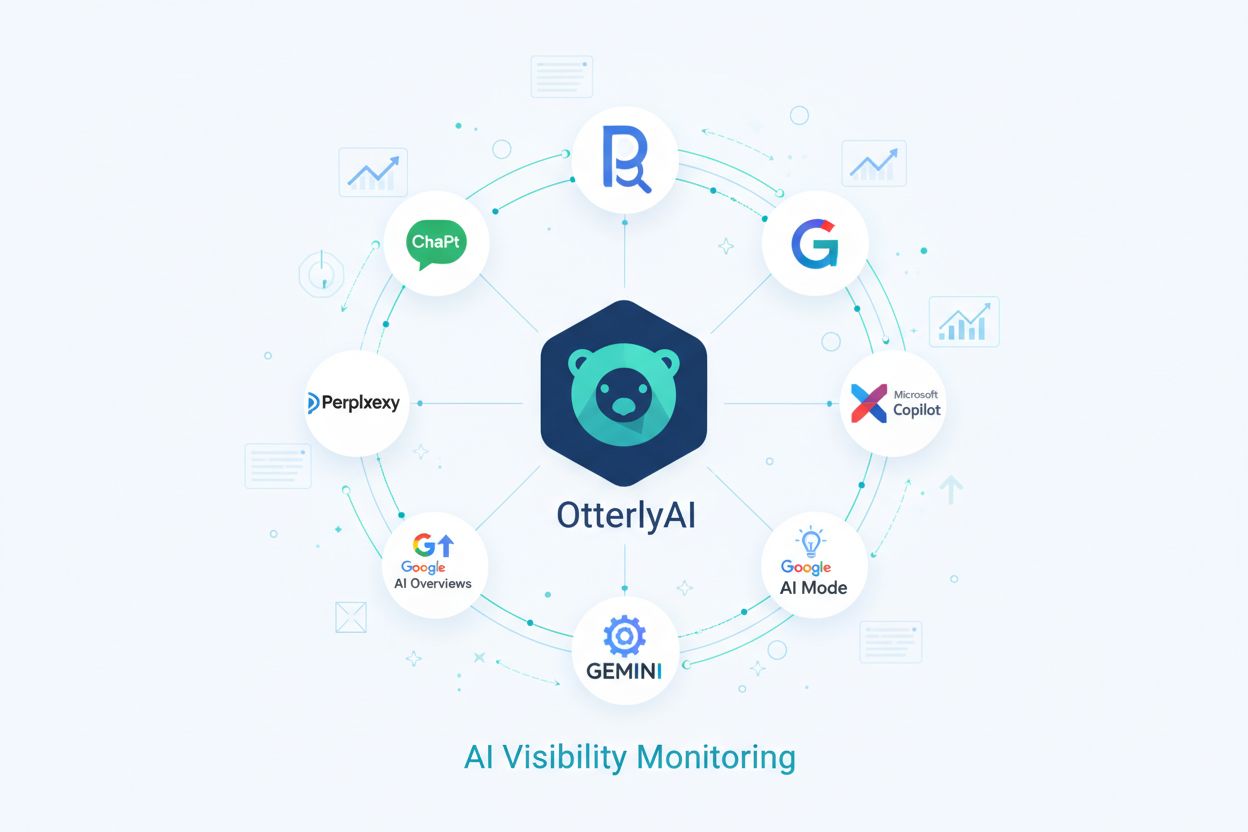
Otterly AI is an AI search visibility platform that monitors how your brand appears across ChatGPT, Perplexity, Google AI Overviews, Gemini, Microsoft Copilot, and Google AI Mode. It tracks brand mentions, website citations, and competitive positioning to help marketers optimize for generative engine optimization (GEO) and adapt to the shift from traditional search to AI-powered answers.
Otterly AI is a specialized AI search monitoring platform designed to track how your brand, products, and website content appear across the fastest-growing AI-powered search engines. Founded in 2024 by SaaS veterans Thomas Peham, Klaus-M. Schremser, and Josef Trauner, Otterly AI addresses a critical gap in modern digital marketing: the inability to monitor brand visibility in generative AI search experiences. As Gartner predicts a 50% decline in organic traffic by 2028 due to the rise of AI-powered search, understanding your presence in these new channels has become essential for competitive survival. The platform monitors six major AI search engines—ChatGPT, Perplexity AI, Google AI Overviews, Google AI Mode, Gemini, and Microsoft Copilot—providing marketers with actionable insights into brand positioning, citation frequency, and competitive benchmarking. With over 15,000 marketing and SEO professionals currently using the platform, Otterly AI has become the industry standard for Generative Engine Optimization (GEO) monitoring.
The emergence of AI-powered search experiences fundamentally changed how consumers find information online. Traditional search engine optimization (SEO) focused on ranking websites in Google’s organic results, but AI search engines like ChatGPT and Perplexity generate synthesized answers that often bypass traditional search results entirely. This phenomenon, known as “zero-click searches,” has created what many marketers describe as a “black box”—they cannot see how their brands are positioned in AI-generated responses or whether their websites are being cited as sources. According to research from Spitfire, early testing showed a decrease of between 20% and 67% of traffic as consumers embrace generative AI-powered search for informational queries. Generative Engine Optimization (GEO) emerged as the natural evolution of SEO, focusing specifically on optimizing content and website structure for AI-powered search engines rather than traditional keyword-based algorithms. Otterly AI was built from the ground up to solve this exact problem, providing the first comprehensive monitoring solution for this new search landscape.
| Use Case | Description | Business Impact | Key Metrics |
|---|---|---|---|
| Brand Mention Tracking | Monitor how often your brand appears in AI-generated answers across all platforms | Ensures visibility where customers make buying decisions | Brand coverage rate, mention frequency, average position |
| Competitive Benchmarking | Compare your brand visibility against competitors in AI search results | Identify gaps and opportunities to outrank competitors | Share of Voice, competitive positioning, citation sources |
| Product Visibility Monitoring | Track how AI engines describe and recommend your products and services | Detect misrepresentation and ensure accurate product descriptions | Product mention frequency, positioning in buying guides |
| GEO Auditing | Analyze 25+ on-page factors to identify what prevents AI citations | Optimize content structure and technical elements for AI crawlability | Citation readiness score, optimization recommendations |
| Website Citation Tracking | Monitor which URLs and domains get cited most frequently by AI platforms | Understand which content pieces drive AI visibility | Citation frequency by URL, domain authority signals |
| Brand Reputation Management | Detect inaccurate or negative mentions in AI-generated answers | Protect brand reputation in AI-driven search landscape | Sentiment analysis, mention context, correction opportunities |
| AI Search Reporting | Generate automated weekly reports on AI search visibility metrics | Communicate AI search impact to stakeholders and leadership | Trend analysis, month-over-month changes, competitive positioning |
Otterly AI uses API-based web scraping methodology to collect data directly from live AI search platforms rather than relying on cached or historical data. The platform automatically sends search prompts—conversational questions that mirror real user queries—to each monitored AI engine and analyzes the responses for brand mentions, citations, and source links. For example, if you’re a project management software company, Otterly AI might send prompts like “What’s the best project management tool for remote teams?” to ChatGPT, Perplexity, and Google AI Overviews simultaneously, then capture which brands get recommended, in what order, and which websites are cited as sources. The platform refreshes all monitoring data once per week, providing a consistent baseline for tracking changes over time. This weekly refresh cycle means your data could be up to 7 days behind real-time, though this trade-off allows Otterly AI to maintain accuracy and reduce computational overhead. The data collection process begins the moment you start tracking—if you add hundreds or thousands of search prompts, Otterly AI immediately begins monitoring and compiling historical data from that point forward.
Otterly AI captures three primary categories of metrics across all monitored AI engines. Brand Coverage measures how often your brand appears in AI responses compared to competitors, providing a percentage-based visibility score. Brand Mentions represent the total frequency count of how many times your brand is referenced across all platforms—a raw volume metric that shows overall visibility without quality assessment. Brand Position reveals where your brand ranks in AI recommendations (1st, 2nd, or 3rd mentioned), helping you understand if you’re the primary recommendation or appearing lower in the answer hierarchy. Beyond brand-level metrics, Otterly AI tracks citation-level data, capturing which URLs and domains get cited most frequently by AI engines. This reveals that third-party content often outranks your own website in AI citations, providing competitive intelligence for content strategy. The platform also provides a unique Brand Visibility Index, which shows how visible each brand is in AI answers based on mention frequency and average position within answers, using data from your tracked prompts. This metric is not found in competing AI search visibility tools and provides a holistic view of your competitive positioning.
Each AI search engine presents unique monitoring challenges and opportunities that Otterly AI addresses differently. Google AI Overviews requires tracking whether AI Overview is triggered for your specific topics and whether your website—or your competitor’s website—appears in the synthesized answer. ChatGPT monitoring focuses on identifying where links to your website are included in responses and how prominent they are within the answer structure. Perplexity AI operates as a dedicated answer engine with its own citation patterns, requiring specialized tracking to understand how your brand is positioned relative to competitors. Google AI Mode represents Google’s enhanced AI search experience, distinct from traditional AI Overviews, with its own visibility dynamics. Gemini and Microsoft Copilot each have distinct response patterns and citation behaviors that Otterly AI monitors independently. The platform discovered that Google wasn’t triggering AI Overview consistently in December, demonstrating how Otterly AI provides “first indication” signals of how fluid changes are across platforms. This platform-specific intelligence allows marketing teams to understand which AI engines represent the greatest opportunities for their industry and where to focus optimization efforts.
One of Otterly AI’s most distinctive capabilities is its GEO Audit tool, which analyzes 25+ on-page factors to reveal what’s holding your website back from earning more AI citations. This comprehensive audit examines technical elements like Open Graph tags, structured data implementation, content optimization for AI consumption, and authority signal strength. The GEO Audit provides specific recommendations across multiple optimization levers: content optimization strategies for AI consumption, technical improvements for AI crawlability, structured data implementation guidance, authority signal enhancement through strategic outreach, and content gap analysis based on competitor citations. According to independent reviews, Otterly AI’s GEO Audit is the most detailed audit available at its price point, offering significantly more depth than competing platforms. The audit identifies specific weaknesses—for example, flagging “Open Graph Tag: No”—though users must currently reference external resources to understand how to implement fixes. This represents an opportunity for Otterly AI to deepen its value proposition by providing integrated guidance or AI-powered implementation suggestions directly within the platform.
Otterly AI’s competitive benchmarking features enable direct comparison of your brand visibility against selected competitors across all monitored AI platforms. The platform shows Share of Voice (SOV)—the percentage of citations you own versus competitors—providing clear visibility into competitive positioning. For instance, if you’re tracking “best CRM software for small businesses,” Otterly AI reveals how often HubSpot, Salesforce, Zoho, and your brand appear in AI-generated answers, in what order, and with what sentiment. This competitive intelligence allows marketing teams to identify which queries you’re winning or losing and where to focus content optimization efforts. The platform also provides domain ranking analysis, discovering which domains AI platforms consider authoritative in your industry. This reveals which third-party websites are most frequently cited by AI engines, providing insights into which publications, review sites, or industry resources carry the most weight in AI recommendations. By understanding which domains dominate AI citations, you can develop targeted media outreach strategies to secure coverage on high-authority sources that AI engines trust.
Beyond tracking raw mention frequency, Otterly AI monitors brand sentiment and positioning context within AI-generated answers. The platform analyzes whether your brand is mentioned in positive, neutral, or negative contexts, providing insight into how AI engines perceive and represent your company. For example, if an AI engine mentions your product as “expensive but feature-rich” versus “outdated and overpriced,” these sentiment differences significantly impact brand perception. This sentiment tracking allows PR and marketing teams to detect inaccurate or negative mentions in AI-generated answers and take corrective action by updating web content to fix AI training gaps. The platform also tracks brand positioning relative to competitors—whether your brand is positioned as a premium option, budget alternative, or feature leader—helping you understand how AI engines categorize your offering in the competitive landscape. This positioning intelligence is particularly valuable for companies undergoing rebranding efforts or launching new product categories, as it reveals how AI engines currently perceive and categorize your business.
Getting started with Otterly AI follows a streamlined four-step setup process powered by AI assistance. First, you define your niche or industry, and the platform suggests relevant search prompts based on your business category. Second, you create a prompt library of conversational questions that prospects actually ask—for example, “What’s the best project management tool for remote teams?” or “How do I choose between Salesforce and HubSpot?” Third, you select competitors to benchmark against, and Otterly AI automatically compares your visibility against these selected brands. Fourth, you configure your monitoring preferences, including which AI platforms to track and how frequently to receive reports. Once configured, Otterly AI automatically runs your prompts across all selected AI engines on a weekly basis, compiling results into comprehensive dashboards and automated reports. The platform provides 95% of customers with measurable insights after just one month of monitoring, according to official statistics. Marketing teams then use these insights to inform content strategy—identifying which pages to optimize, which third-party sites to pursue for coverage, and where gaps exist in their AI search presence.
Otterly AI offers flexible pricing tiers designed to accommodate different business sizes and monitoring needs. The Lite Plan starts at $29 per month and includes 10-15 search prompts with all core monitoring features, suitable for small businesses or individual users testing the platform. The Standard Plan costs $189 per month and provides 100 search prompts with full feature access across all AI platforms, representing the most popular choice for marketing teams. The Professional Plan is priced at $489 per month and includes 400 search prompts for large organizations with extensive monitoring needs. The Enterprise Plan reaches $989 per month with 1,000 search prompts for maximum monitoring capacity. All plans include unlimited users, allowing entire marketing teams to access the platform without per-seat charges. Otterly AI offers a free 14-day trial with full access to all features, requiring no credit card to explore the platform. The platform also integrates with Semrush, available through the Semrush App Center, providing exclusive pricing and single sign-on access for Semrush subscribers.
Otterly AI functions as an API-first platform, leveraging composable architecture to integrate with existing marketing technology stacks. The platform works with multiple APIs, crawlers, and data sources to compile and normalize data into visual dashboards and reports. The Semrush integration represents a significant partnership, allowing Otterly AI users to access organic search insights from Semrush while providing Semrush users with AI search visibility data. This complementary relationship addresses a critical gap: Semrush provides traditional SEO metrics and organic traffic data, while Otterly AI provides AI search visibility metrics. Together, they enable marketers to understand the complete search landscape—both traditional and AI-powered. The platform’s API-first approach positions it for future integrations with content management systems (CMS), allowing marketing teams to measure content performance not just from web and omnichannel perspectives, but also from AI search perspectives. This would enable content teams to see how their published content performs across ChatGPT, Perplexity, and Google AI Overviews directly within their CMS workflow.
The AI search monitoring space is rapidly evolving as more AI-powered search engines emerge and mature. Otterly AI is already exploring research partnerships with universities to analyze patterns across AI platforms and publish insights about emerging search trends. The platform’s data reveals fascinating patterns—for example, how link citations differ between ChatGPT and Google AI Overviews, or how brand positioning changes over time as AI models are retrained. As AI search becomes increasingly central to how consumers find information, the ability to monitor and optimize for these channels will become as essential as traditional SEO. Generative Engine Optimization (GEO) is expected to become a core competency for marketing teams, similar to how SEO became standard practice over the past two decades. Otterly AI’s position as the first comprehensive GEO monitoring platform positions it to shape industry standards and best practices as this space matures. The platform’s recognition as a Gartner Cool Vendor for AI in Marketing in 2025 and its top ratings on G2 and OMR Reviews validate its importance in the emerging GEO landscape.
Just as Otterly AI tracks your visibility in ChatGPT and Perplexity, AmICited monitors your brand mentions across all major AI platforms. Get real-time insights into where your domain appears in AI-generated answers and optimize your content strategy accordingly.
Learn what OtterlyAI is, how it monitors your brand across 6 AI platforms, and how it helps with generative engine optimization. Discover features, pricing, and...

Community discussion on Otterly AI for AI search monitoring. Users share experiences with the platform's GEO tracking features, pricing, and effectiveness.
Learn how to select the right AI visibility agency for your brand. Compare GEO agencies, evaluate selection criteria, and discover top platforms for monitoring ...