
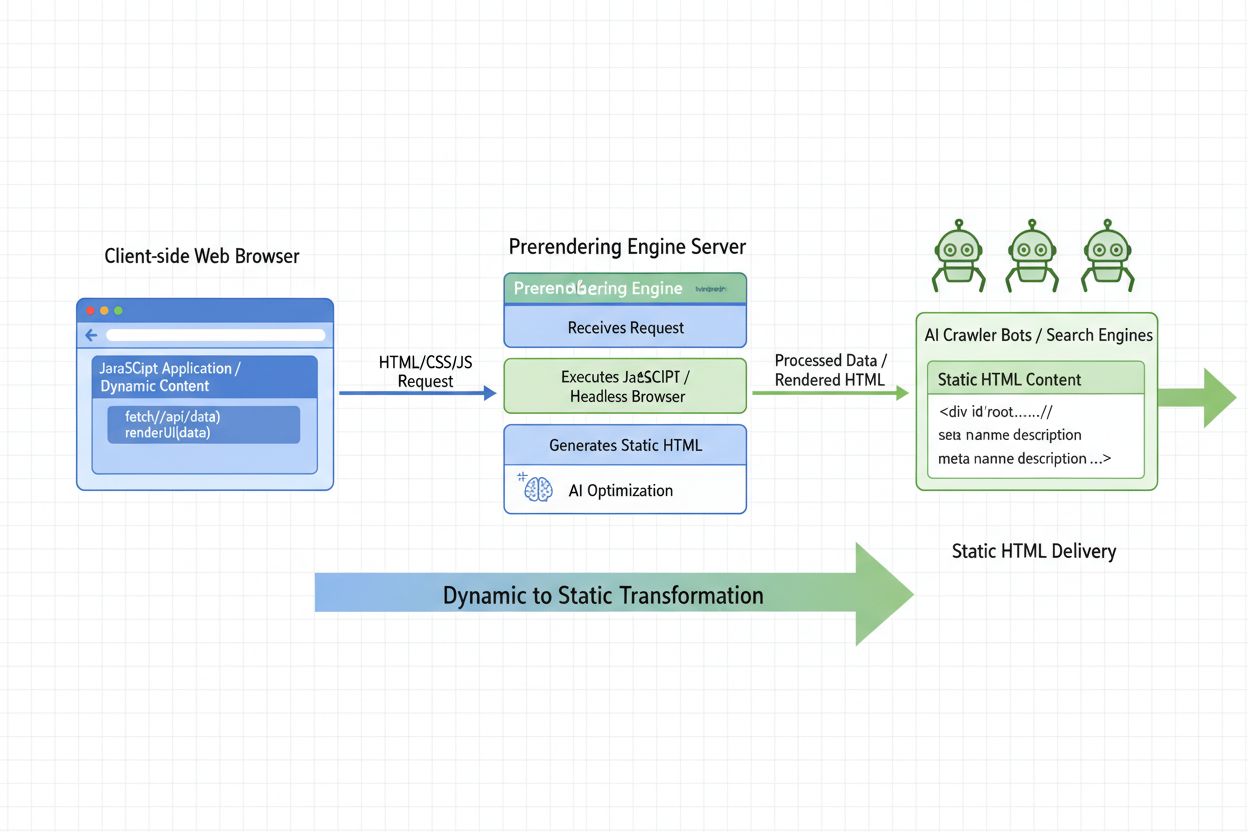
AI Prerendering
Learn what AI Prerendering is and how server-side rendering strategies optimize your website for AI crawler visibility. Discover implementation strategies for C...
6 min read

Learn how pre-rendering helps your website appear in AI search results from ChatGPT, Perplexity, and Claude. Understand the technical implementation and benefits for AI visibility.
Pre-rendering for AI search is the process of generating fully rendered HTML pages at build-time or through specialized services, making your content immediately accessible to AI crawlers like those used by ChatGPT, Perplexity, and Claude without requiring JavaScript execution.
Pre-rendering for AI search is a technical optimization strategy that generates fully rendered HTML pages before users or AI crawlers request them. Unlike traditional client-side rendering where JavaScript executes after a user visits a page, pre-rendering compiles your website’s content at build-time, creating static HTML files that are immediately accessible to AI search engines. This approach ensures that AI crawlers from platforms like ChatGPT, Perplexity, Claude, and Google’s Gemini can instantly access and read your content without waiting for JavaScript to execute. The fundamental difference between pre-rendering and other rendering methods lies in timing: pre-rendering shifts the computational work from runtime (when users visit) to build-time (before deployment), resulting in faster content delivery and better visibility across AI platforms.
AI crawlers operate fundamentally differently from traditional search engine bots like Googlebot. While Google has been able to render JavaScript for years, most AI crawlers cannot execute JavaScript at all, making them unable to access content that depends on client-side rendering. Research shows that approximately 25% of AI crawlers can fetch JavaScript but cannot execute it, meaning your dynamically rendered content remains completely invisible to these systems. Additionally, AI crawlers have significantly shorter timeout windows—typically 1-5 seconds—compared to traditional search bots, and they won’t wait for slow pages to load. This creates a critical problem: if your website relies on JavaScript to display content, AI platforms won’t be able to find your information when users ask questions that your content could answer. Pre-rendering solves this by ensuring all your important content is available as plain HTML, eliminating the need for JavaScript execution and guaranteeing that AI systems can access your pages instantly.
Pre-rendering operates through a straightforward but powerful process that transforms your website’s architecture. When you implement pre-rendering, your build system generates complete HTML files for each page of your website during the deployment phase, rather than generating them on-demand when visitors arrive. This means that when an AI crawler requests your page, the server immediately responds with fully rendered HTML containing all text, headings, links, and structured data—no JavaScript execution required. The process typically involves three key steps: first, your build tool (like Next.js, Gatsby, or Hugo) processes your source code and content; second, it generates static HTML files for each route or page; and third, these pre-rendered files are deployed to your hosting infrastructure. When an AI crawler visits your site, it receives the complete, ready-to-read HTML immediately, allowing it to extract information, understand your content structure, and potentially cite your website in AI-generated answers. This approach is particularly effective because AI crawlers are 47 times less efficient than Googlebot, meaning they need content to be as accessible as possible to successfully index and reference your pages.
There are several approaches to implementing pre-rendering for your website, each with different levels of complexity and control. Static Site Generation (SSG) is the most straightforward method, where frameworks like Next.js, Gatsby, Hugo, and others automatically generate static HTML pages at build-time. These frameworks handle the entire process automatically—you simply configure which pages should be pre-rendered, and the framework generates the necessary HTML files during deployment. This method is ideal if you’re starting a new project or already using one of these frameworks, as it requires minimal additional configuration and provides complete control over which pages are pre-rendered. For websites already built with client-side rendering frameworks like Create React App, pre-rendering services such as Prerender.io or Netlify Prerendering offer an alternative solution. These services intercept requests from AI crawlers and serve them pre-rendered versions of your pages while regular users still receive the interactive JavaScript version. While this approach requires more configuration and relies on external services, it allows you to add AI search optimization to existing applications without major architectural changes.
| Rendering Method | Execution Timing | AI Crawler Access | Performance | Best For |
|---|---|---|---|---|
| Client-Side Rendering (CSR) | Runtime (after user request) | ❌ Limited - requires JavaScript | Slower initial load | Interactive single-page apps |
| Static Site Generation (SSG) | Build-time (before deployment) | ✅ Full - pure HTML | Fastest | Blogs, documentation, content sites |
| Pre-rendering Services | Build-time via external service | ✅ Full - pure HTML | Fast | Existing CSR applications |
| Server-Side Rendering (SSR) | Runtime on server | ✅ Full - pure HTML | Medium | Dynamic content with SEO needs |
One of the most critical aspects of pre-rendering for AI search is ensuring that all important content is readable without JavaScript execution. Many modern websites heavily rely on JavaScript to display content, using techniques like lazy loading, dynamic tabs, accordions, and other interactive elements that hide content behind JavaScript interactions. AI crawlers cannot access this hidden content because they don’t execute JavaScript. To verify whether your content is accessible to AI crawlers, you can use browser extensions like the Rendering Difference Engine, which shows exactly which elements of your page may be invisible to non-JavaScript-capable crawlers. The extension highlights headings hidden behind JavaScript elements, invisible or unclickable links, and text that requires JavaScript rendering to be visible. Another useful tool is AI Eyes, which generates reports showing how much content is lost when JavaScript is enabled on your page. By ensuring that all critical information—including headings, product descriptions, pricing, contact information, and key value propositions—is available in plain HTML without JavaScript dependencies, you guarantee that AI crawlers can access and potentially cite your content in their responses.
Pre-rendering delivers substantial benefits beyond just AI search visibility, significantly improving your overall search engine optimization performance. Search engines can index pre-rendered pages much more effectively because they receive complete HTML content immediately, without needing to execute JavaScript or wait for dynamic content to load. This results in faster indexing, better crawl budget efficiency, and improved rankings in traditional search results. Pre-rendered websites typically experience faster page load times because users receive fully rendered HTML instead of a bare HTML file plus JavaScript that needs to execute in their browser. This performance improvement directly impacts user experience and search rankings, as page speed is a confirmed ranking factor for both Google and other search engines. Additionally, pre-rendering eliminates the common SEO problems associated with client-side rendering, such as poor meta tag handling, missing structured data, and incomplete content indexing. By shifting rendering to build-time, you ensure that every page is fully optimized for search engines before it’s deployed, resulting in better visibility across all search platforms—both traditional search engines and AI-powered search systems.
Understanding how different AI platforms access and crawl your website is essential for effective pre-rendering strategy. Different AI models and even different modes from the same AI platform can access pages differently. For example, Google’s Gemini App accesses page content in real-time and can be tracked in server logs, while Gemini via API reports that it cannot access certain pages. ChatGPT previously preferred reading Google search snippets instead of accessing pages directly, though this behavior may have changed with newer versions. AI platforms don’t maintain an index of visited pages or cache web content like traditional search engines do—instead, they must visit your page every time they encounter it during an external search to read and extract information. This means your pages need to be consistently accessible and readable every single time an AI crawler visits. Additionally, AI crawlers access pages through different mechanisms: some use search tools that provide access to indexed content with structured data already parsed, while others use direct page access tools that may not have full access to JSON-LD structured data. To ensure maximum compatibility, you should make sure your pages are indexed in Google and Bing, monitor your server logs for direct visits from AI crawlers, and keep all important content accessible without JavaScript dependencies.
While the debate about structured data’s impact on AI search continues, implementing schema markup alongside pre-rendering provides additional benefits for AI visibility. Structured data visibility varies dramatically between different AI agent types and access methods. When AI agents use search tools (like GPT-5’s web.search or Gemini’s google_search), they gain full access to your structured data because search engines pre-index JSON-LD, microdata, and RDFa markup, providing rich, semantically-enhanced snippets with complete entity information. However, when agents use direct page access tools, a critical gap emerges: JSON-LD structured data becomes largely invisible, and only microdata embedded directly in HTML attributes remains accessible during direct page parsing. Despite this inconsistency, implementing schema markup is still recommended because there’s a reasonable chance it can help, it won’t cause any harm, and it takes minimal time to implement. You can use free schema generators for common types like Organization schema, Person/Author schema, FAQ schema, and Dataset schema to quickly add structured data to your pre-rendered pages.
After implementing pre-rendering, it’s crucial to monitor how your content appears in AI search results across different platforms. Tracking your brand, domain, and specific URLs in AI-generated answers from ChatGPT, Perplexity, Claude, and other AI search engines helps you understand whether your pre-rendering efforts are effective. You should regularly check whether your website is being cited in AI responses to relevant queries, verify that the information being cited is accurate and up-to-date, and identify opportunities to improve your content for better AI visibility. Server logs provide valuable insights into AI crawler activity—you can see which pages are being accessed, how frequently crawlers visit, and whether they’re successfully retrieving your content. By combining pre-rendering implementation with active monitoring of your AI search presence, you can ensure that your website remains visible and relevant as AI-powered search continues to grow in importance.
Track where your domain, brand, and URLs appear in AI-generated answers across all major AI platforms. Get real-time insights into your AI visibility and ensure your content is being cited correctly.
Learn what AI Prerendering is and how server-side rendering strategies optimize your website for AI crawler visibility. Discover implementation strategies for C...

Learn how JavaScript rendering impacts your website's visibility in AI search engines like ChatGPT, Perplexity, and Claude. Discover why AI crawlers struggle wi...
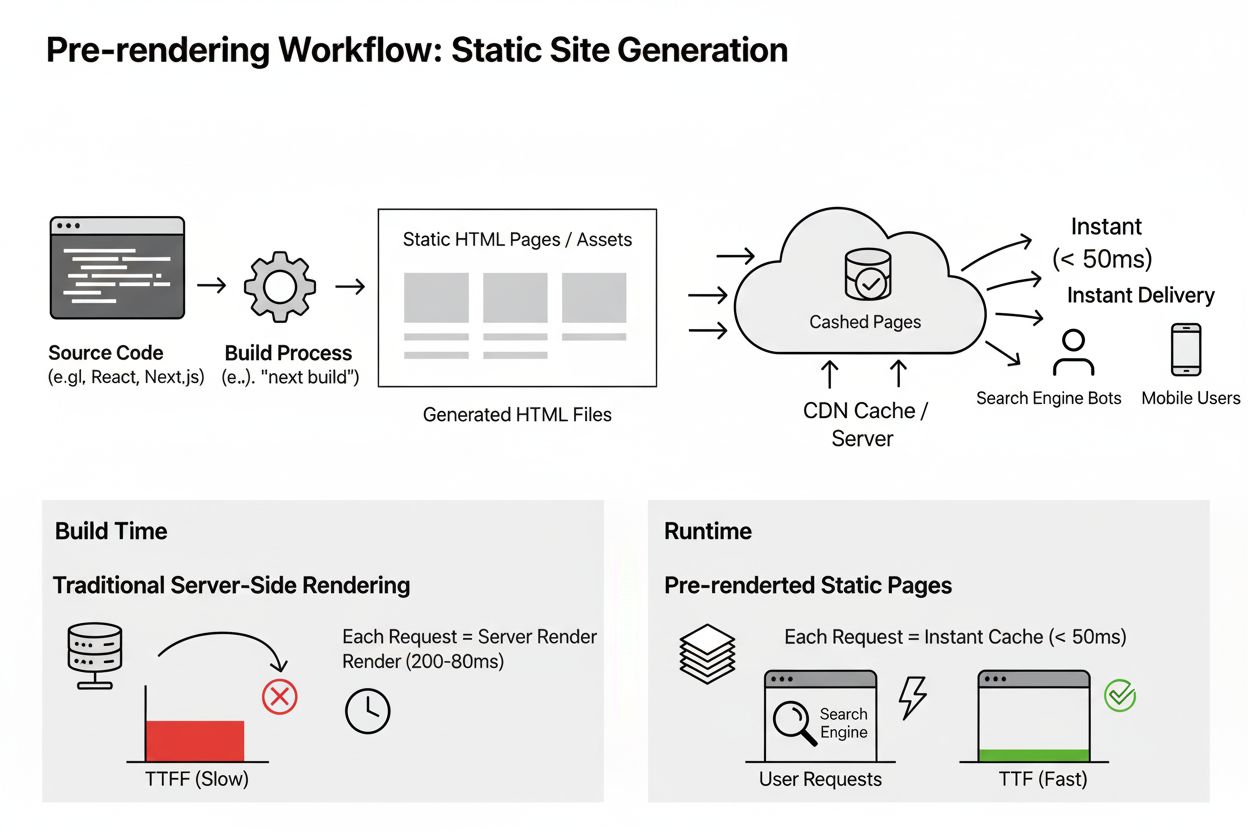
Pre-rendering generates static HTML pages at build time for instant delivery and improved SEO. Learn how this technique benefits AI indexing, performance, and s...