
Prompt Engineering
Prompt engineering is the art of structuring instructions to guide generative AI models. Learn techniques, best practices, and how it impacts AI visibility and ...
12 min read

Learn what prompt engineering is, how it works with AI search engines like ChatGPT and Perplexity, and discover essential techniques to optimize your AI search results and get better answers.
Prompt engineering is the art and science of designing and optimizing prompts to guide AI models and search engines toward generating accurate, relevant, and contextually appropriate responses. It involves crafting effective input queries and instructions that help AI systems like ChatGPT, Perplexity, and other AI search engines understand your intent and deliver desired outputs.
Prompt engineering is the art and science of designing and optimizing prompts to guide AI models, particularly large language models (LLMs), toward generating accurate, relevant, and contextually appropriate responses. When you interact with AI search engines like ChatGPT, Perplexity, or similar AI answer generators, the quality of your results depends heavily on how well you structure your input query. Think of a prompt as providing a roadmap for the AI, steering it toward the specific output you have in mind. The effectiveness of your prompt directly influences the quality and relevance of the AI’s response, making it a critical skill for anyone seeking to maximize the value of AI-powered search and content generation.
In the context of AI search, prompt engineering becomes increasingly important because these systems rely on natural language understanding to interpret your intent. Unlike traditional search engines that match keywords to indexed content, AI search engines analyze the meaning behind your query and generate responses based on their training data. By crafting well-structured prompts, you provide the model with context, instructions, and examples that help it understand your intent and respond in a meaningful way. This is particularly valuable for businesses monitoring their brand presence in AI answers, as understanding how prompts influence AI responses helps you anticipate how your content might be cited or referenced.
Several fundamental elements contribute to effective prompt engineering when working with AI search systems. Mastering these elements allows you to communicate effectively with AI models and unlock their full potential for generating high-quality responses.
Prompt format plays a significant role in guiding the AI’s response. Different AI models may respond better to specific formats, such as natural language questions, direct commands, or structured inputs with specific fields. Understanding the model’s capabilities and preferred format is essential for crafting effective prompts. For example, asking “What are the benefits of renewable energy?” will produce different results than “List five benefits of renewable energy in bullet points.” The second format provides explicit structure that helps the AI organize its response more effectively.
Context and examples are powerful tools in prompt engineering. Providing relevant background information and examples within your prompt helps the AI understand the desired task and generate more accurate and relevant outputs. If you’re asking an AI search engine to explain a technical concept, including context about your audience’s knowledge level significantly improves the results. For instance, specifying “Explain quantum computing for a non-technical audience” produces fundamentally different output than “Explain quantum computing for computer science students.”
Specificity and clarity are paramount when crafting prompts for AI search. Vague or ambiguous prompts often result in generic or irrelevant responses. Using precise language, avoiding ambiguity, and quantifying your requests whenever possible dramatically improves output quality. Instead of asking “Write something about climate change,” a more effective prompt would be “Write a persuasive essay arguing for the implementation of stricter carbon emission regulations in developed nations.” The second prompt provides clear direction about the topic, format, perspective, and scope.
| Technique | Description | Best Use Case |
|---|---|---|
| Zero-Shot Prompting | Asking the model to perform a task without examples or prior context | Straightforward questions where the model’s general knowledge suffices |
| Few-Shot Prompting | Providing one or more examples before the actual prompt | Tasks where demonstrating the desired format or style improves accuracy |
| Chain of Thought (CoT) | Breaking down complex reasoning into step-by-step instructions | Complex problems requiring logical reasoning or multi-step solutions |
| Direct Instructions | Clear, specific commands telling the AI exactly what to do | Straightforward tasks with clear expectations |
| Open-Ended Instructions | Less restrictive prompts encouraging broader exploration | Brainstorming, creative writing, or exploratory discussions |
| Task-Specific Instructions | Precise, goal-oriented prompts for specialized tasks | Translations, summarization, calculations, or domain-specific queries |
Zero-shot prompting involves providing the model with a direct instruction or question without any additional context or examples. This technique relies entirely on the AI’s pretrained knowledge to interpret and respond to the prompt. For example, asking “Explain the concept of blockchain technology” without providing examples or context is zero-shot prompting. This approach works well for straightforward questions where the model’s general knowledge is sufficient. Zero-shot prompting is particularly useful when you need quick answers without spending time crafting detailed examples or context.
Few-shot prompting includes a small number of examples within the prompt to demonstrate the task to the model. This approach helps the model better understand the context and expected output format. For instance, if you want an AI search engine to explain complex topics in a specific style, you might provide two or three examples of how other topics were explained, then ask it to apply the same approach to your topic of interest. This technique significantly improves output consistency and relevance. Few-shot prompting is especially valuable when you have specific formatting requirements or stylistic preferences for how information should be presented.
Chain of Thought (CoT) prompting encourages the model to reason through a problem step by step, breaking it into smaller components to arrive at a logical conclusion. Instead of asking “What are the implications of artificial intelligence on employment?” you might ask “Step 1: Identify current AI applications in the workplace. Step 2: Analyze how these applications affect different job categories. Step 3: Discuss both positive and negative employment implications.” This structured approach helps the AI generate more comprehensive and logically coherent responses. Chain of Thought prompting is particularly effective for complex analytical questions where you need detailed reasoning rather than quick answers.
Set clear goals and objectives before crafting your prompt. Use action verbs to specify the desired action, define the desired length and format of the output, and specify the target audience. For example, instead of “Tell me about digital marketing,” try “Write a 500-word guide on digital marketing strategies for small e-commerce businesses.” This clarity helps the AI understand exactly what you need. Clear objectives also help you evaluate whether the AI’s response actually meets your requirements, making it easier to refine your prompt if needed.
Provide context and background information to enhance the AI’s understanding. Include relevant facts and data, reference specific sources or documents if applicable, and define key terms and concepts. When searching for information about your industry, providing context about your business type, target market, and specific challenges helps the AI generate more relevant and tailored responses. Context is particularly important when dealing with specialized or technical topics where the AI needs to understand your specific perspective or use case.
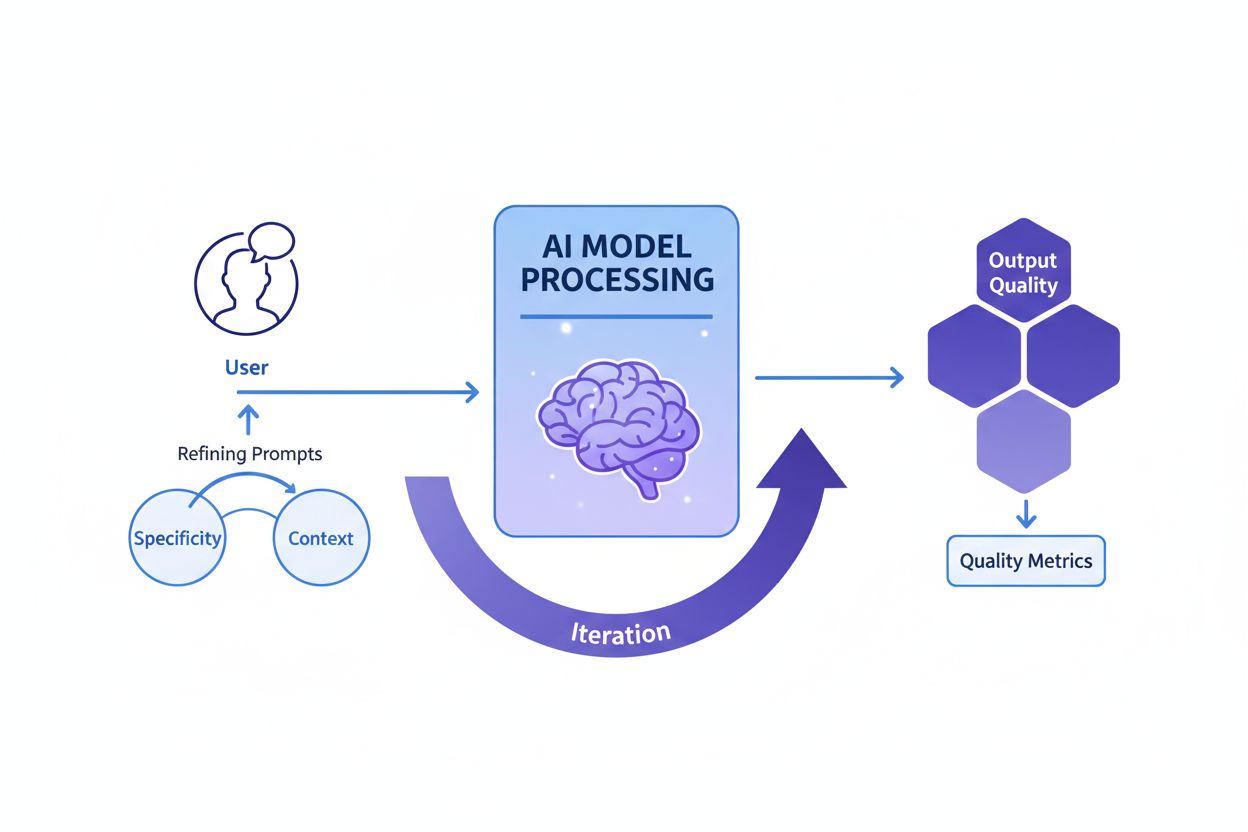
Use iterative refinement to improve your prompts over time. Try different phrasings and keywords, adjust the level of detail and specificity, and test different prompt lengths. AI search engines often benefit from experimentation—what works perfectly for one query might need adjustment for another. Keep track of which prompt structures produce the best results for your specific needs. This iterative approach transforms prompt engineering from a one-time task into an ongoing optimization process that continuously improves your results.
Break down complex tasks into smaller, manageable steps. Instead of asking for a comprehensive analysis in a single prompt, consider breaking it into multiple related prompts where each builds on the previous response. This approach, known as prompt chaining, helps the AI maintain focus and produce more accurate results for complex information needs. Prompt chaining is particularly useful when you need to gather information progressively or when you want to ensure each step is thoroughly addressed before moving to the next.
The quality of your prompts directly affects how AI search engines retrieve and present information. When you craft a well-structured prompt, you’re essentially training the AI to understand your specific information needs. This becomes particularly important when considering how your brand, domain, or URLs might appear in AI-generated answers. AI search engines like Perplexity and ChatGPT analyze prompts to determine what information to retrieve and how to present it. If users are searching for information related to your industry with poorly structured prompts, they may miss your content entirely. Conversely, well-crafted prompts that include specific keywords or context related to your business increase the likelihood that your content will be cited in AI-generated responses.
Understanding prompt engineering also helps you anticipate how your content might be discovered and cited. When monitoring your brand’s appearance in AI search results, you should consider not just what information users are searching for, but how they’re asking for it. Different prompt structures lead to different retrieval patterns, which means your content might appear in responses to some prompt variations but not others. This insight is valuable for content strategy and ensuring your brand maintains visibility across various AI search platforms. By understanding common prompt patterns in your industry, you can optimize your content to address the questions users are actually asking through AI search engines.
Improved accuracy and relevance is the primary benefit of effective prompt engineering. Well-crafted prompts lead to more accurate, relevant, and informative outputs from AI models, as they provide clear instructions and context. This means you get better answers to your questions and more useful information from AI search engines. When you master prompt engineering, you spend less time sifting through irrelevant results and more time working with high-quality information that directly addresses your needs.
Reduced bias and harmful responses can be achieved through careful prompt design. By controlling the input and guiding the AI’s focus, prompt engineering helps mitigate bias and minimize the risk of generating inappropriate or misleading content. This is particularly important when using AI search for research or decision-making purposes. Well-designed prompts can help ensure that AI responses are balanced, factual, and free from unintended biases that might skew your understanding of a topic.
Increased control and predictability empowers you to influence the AI’s behavior and ensure consistent and predictable responses aligned with your desired outcomes. When you understand how to structure prompts effectively, you can reliably get the type of information you need in the format you prefer. This predictability is especially valuable in business contexts where you need consistent, reliable information for decision-making.
Enhanced user experience results from clear and concise prompts that make it easier for users to interact effectively with AI models. Whether you’re using AI search for personal research or business intelligence, well-structured prompts lead to more intuitive and satisfying experiences. Users who understand prompt engineering can accomplish their goals faster and with greater confidence in the results they receive.
For businesses monitoring their brand presence in AI search results, prompt engineering knowledge is invaluable. Understanding how different prompt structures influence AI responses helps you optimize your content strategy. When your target audience searches for information using various prompt styles—from simple questions to complex, multi-part queries—your content needs to be discoverable and relevant across all these variations. By studying prompt engineering techniques, you can better understand user intent and ensure your content addresses the questions and concerns that drive AI search queries in your industry.
Additionally, prompt engineering insights help you identify gaps in your content strategy. If you notice that certain prompt variations consistently fail to surface your brand in AI-generated answers, you can adjust your content to better address those specific information needs. This proactive approach to content optimization ensures your brand maintains strong visibility across AI search platforms like ChatGPT, Perplexity, and emerging AI answer generators. By aligning your content with how users actually ask questions through AI search, you increase the likelihood that your brand will be cited and referenced in AI-generated responses, ultimately improving your visibility in this rapidly growing search channel.
Track how your brand, domain, and URLs appear in AI-generated answers across ChatGPT, Perplexity, and other AI search engines. Get real-time insights into your AI visibility.
Prompt engineering is the art of structuring instructions to guide generative AI models. Learn techniques, best practices, and how it impacts AI visibility and ...

Learn how prompt engineering enhances GEO strategy to get your brand cited by AI search engines like ChatGPT, Perplexity, and Google AI Overviews.
Community discussion on whether marketers need prompt engineering skills to optimize for AI search. Understanding how users query AI systems.