
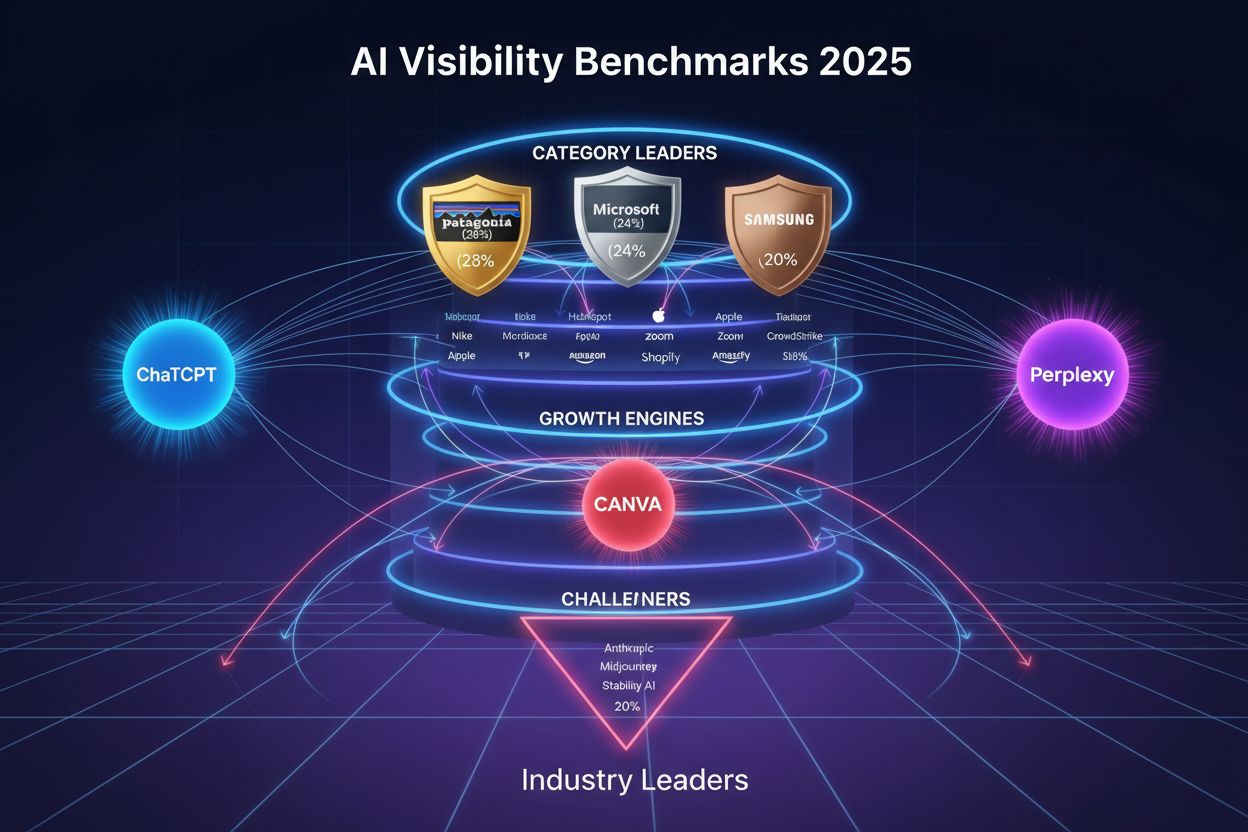
Who's Winning AI Visibility? Industry Benchmarks
Discover which brands are winning AI visibility benchmarks. Analyze industry leaders across ChatGPT, Perplexity, and Google AI with data-driven insights and com...
12 min read

Understand the critical relationship between brand visibility and AI search visibility. Learn how AI systems discover, cite, and recommend brands in ChatGPT, Perplexity, and other AI answer engines.
Brand visibility and AI visibility are interconnected: strong brand authority, consistent messaging, and credible presence across digital channels directly influence how AI systems discover, understand, and recommend your brand in AI-generated answers. Unlike traditional search rankings, AI visibility depends on your overall digital reputation and how well AI can parse and trust your content.
The relationship between brand visibility and AI visibility represents a fundamental shift in how companies need to think about digital presence. While traditional brand visibility focused on search engine rankings and website traffic, AI visibility encompasses how well artificial intelligence systems like ChatGPT, Perplexity, Google AI Overviews, and Claude can discover, understand, and recommend your brand in their generated answers. These two concepts are deeply interconnected, with strong brand authority directly influencing how prominently your company appears in AI-generated responses.
Brand visibility has historically been measured through search rankings, website traffic, and media mentions. However, as AI systems increasingly become the primary discovery mechanism for consumers researching products and services, the definition of visibility has expanded. Today, a brand can rank well on Google yet remain completely invisible to ChatGPT users asking similar questions. This visibility gap represents a critical challenge for modern marketers who must now optimize for multiple discovery channels simultaneously.
AI systems don’t rank brands the way traditional search engines do. Instead, they use retrieval-augmented generation (RAG) technology to pull information from multiple sources across the web and synthesize that information into conversational answers. This fundamental difference means that brand visibility in AI depends on how well your brand information is distributed, consistent, and credible across the entire digital landscape, not just on your website.
When an AI system receives a user query, it searches for relevant information from its training data and live web sources. The system then evaluates which sources are most trustworthy and relevant before deciding whether to cite your brand, mention it by name, or recommend it as a solution. This evaluation process relies heavily on authority signals that AI systems extract from across the web, including backlinks, media mentions, customer reviews, social media presence, and structured data markup.
| Discovery Factor | Traditional SEO | AI Visibility |
|---|---|---|
| Primary ranking signal | Keywords and backlinks | Authority, consistency, and trustworthiness |
| Content evaluation | Keyword relevance and page structure | Expertise, originality, and factual accuracy |
| Citation source | Primarily your website | Multiple sources across the web |
| User behavior | Click-through to website | Direct answer consumption without clicks |
| Authority measurement | Domain authority score | Distributed credibility across channels |
| Update frequency | Weeks to months | Real-time based on new information |
Brand authority serves as the foundation for AI visibility. When AI systems encounter your brand name in multiple credible sources—industry publications, analyst reports, customer reviews, LinkedIn discussions, and media coverage—they develop confidence in your brand’s legitimacy and expertise. This distributed authority is fundamentally different from traditional SEO, where authority concentrates on your domain through backlinks.
AI systems prioritize brands that demonstrate consistent expertise and trustworthiness across multiple channels. If your brand appears in analyst reports, earns positive reviews on G2 or Capterra, receives mentions in industry publications, and maintains an active presence on LinkedIn, AI systems recognize these signals as indicators of genuine authority. Conversely, brands that lack this distributed presence struggle to gain visibility in AI-generated answers, regardless of their website’s technical SEO quality.
The relationship between brand authority and AI visibility creates a virtuous cycle: strong brand authority leads to more AI citations and mentions, which increases brand awareness, which generates more user-generated content and media coverage, which further strengthens authority. Breaking into this cycle requires deliberate investment in building credibility across multiple channels simultaneously.
One of the most critical factors determining AI visibility is message consistency across all digital touchpoints. AI systems learn about your brand from every mention across the web, and inconsistencies create confusion that reduces visibility. If your product name differs between your website, social media, and press releases, or if your positioning varies across channels, AI systems struggle to form a coherent understanding of who you are and what you offer.
Consistent brand messaging enables AI systems to confidently recognize and recommend your brand. When your company description, product features, pricing information, and leadership details align across your website, social profiles, media coverage, and review sites, AI systems can easily verify and cite this information. This consistency also reduces the risk of AI misrepresenting your brand or omitting it entirely due to conflicting information.
Building this consistency requires coordination across multiple teams and channels. Your PR team, marketing department, sales organization, and customer success team must all work from the same brand guidelines and messaging framework. When inconsistencies do occur—such as outdated product names or former executives still listed in old press releases—they should be corrected promptly to prevent AI systems from perpetuating inaccurate information.
Understanding the difference between AI citations and AI brand mentions is essential for developing an effective AI visibility strategy. These represent two distinct aspects of how AI systems represent your brand, and they require different optimization approaches.
AI citations occur when an AI system lists your website or content as a source in its response. When a user asks ChatGPT about emerging technology trends and the AI cites your research report, that’s a citation. Citations drive credibility and authority, positioning your brand as a trusted source of information. However, citations don’t always generate website traffic, as many users consume AI-generated answers without clicking through to source material.
AI brand mentions occur when an AI system mentions your brand by name within its response, regardless of whether it links to your site. When ChatGPT recommends your product as a solution to a user’s problem, that’s a mention. Mentions directly influence purchasing decisions and brand awareness, as they occur at the exact moment users are evaluating their options. Importantly, research shows that fewer than 30% of brands most mentioned by AI are also among the most cited, indicating these require distinct strategies.
Building visibility in both citations and mentions requires different content approaches. Citations depend on creating original, authoritative content that demonstrates expertise and provides unique insights. Mentions depend more on building brand recognition, positive sentiment, and community discussion across platforms where AI systems source information, such as Reddit, LinkedIn, and review sites.
The relationship between content quality and AI visibility has become more pronounced as AI systems become more sophisticated at evaluating information. Generic, keyword-stuffed content that might have ranked in traditional search engines now struggles to gain traction with AI systems. Instead, AI systems prioritize content that demonstrates genuine expertise, answers specific questions, and provides unique insights.
High-quality content for AI visibility should possess several characteristics. First, it must directly answer user questions in a clear, conversational manner that mirrors how people actually ask AI systems. Second, it should include original data, research, or insights that AI systems cannot find elsewhere. Third, it must be well-structured with clear headings, short paragraphs, and scannable sections that make it easy for AI systems to extract relevant information. Fourth, it should include specific facts, statistics, and quotable statements that AI systems can incorporate directly into their responses.
The technical structure of your content also matters significantly. Content wrapped in excessive JavaScript or hidden behind interactive elements becomes difficult for AI systems to parse. Conversely, content presented as clean HTML with minimal JavaScript, clear semantic markup, and descriptive alt text for images makes it easier for AI systems to understand and cite your material. This technical optimization doesn’t require separate “AI content”—it simply means following web standards that benefit both human readers and AI systems.
Brand visibility in the AI era depends heavily on how your brand information is distributed across the digital landscape. Unlike traditional SEO, where authority concentrates on your domain through backlinks, AI visibility requires a distributed presence across multiple authoritative platforms and channels. This distribution serves as proof of your brand’s legitimacy and relevance.
The platforms that matter most vary by industry. For SaaS companies, mentions in analyst reports, software review sites like G2 and Capterra, and industry publications carry significant weight. For consumer brands, reviews on Amazon and specialized retail sites matter more. For professional services, mentions in industry publications, LinkedIn activity, and professional directories prove more influential. AI systems recognize these industry-specific authority sources and weight them accordingly when evaluating brand credibility.
This distributed presence also protects against visibility gaps. A brand might rank well on Google but remain invisible in ChatGPT if it lacks presence on platforms that ChatGPT’s training data emphasizes. Similarly, a brand might be well-represented in Perplexity but absent from Google AI Overviews if it hasn’t built authority in sources that Google’s AI system prioritizes. Monitoring your visibility across multiple AI platforms reveals these gaps and helps you identify which channels to prioritize for your specific audience.
The path to strong AI visibility begins with building genuine brand visibility across multiple channels. This requires a coordinated approach that extends beyond traditional SEO and encompasses PR, social media, community engagement, and content marketing. The most effective strategy treats AI visibility not as a separate initiative but as a natural outcome of strong overall brand building.
Original research and thought leadership serve as particularly effective tools for building both brand visibility and AI visibility simultaneously. When you publish original research, industry reports, or unique insights, you create content that AI systems want to cite. This content also attracts media coverage, generates discussion on social platforms, and builds your reputation as an authority. The combination of these effects strengthens your overall brand visibility while simultaneously improving your AI visibility.
Community engagement on platforms like Reddit and LinkedIn also significantly impacts AI visibility. AI systems, particularly ChatGPT, rely heavily on Reddit as a source of information. When your brand is discussed positively in relevant subreddits, AI systems encounter these discussions and incorporate them into their understanding of your brand. Similarly, active LinkedIn presence with thoughtful commentary and original insights helps AI systems recognize your brand as a credible voice in your industry.
Customer reviews and testimonials represent another critical component of the brand visibility-to-AI visibility pipeline. Positive reviews on industry-specific platforms like G2, Capterra, and TrustPilot signal to AI systems that real customers value your brand. These reviews also provide AI systems with specific language and use cases they can reference when recommending your brand to users. Encouraging satisfied customers to leave reviews therefore directly impacts your AI visibility.
Measuring the relationship between brand visibility and AI visibility requires tracking metrics across multiple channels and platforms. Traditional metrics like organic traffic and search rankings no longer tell the complete story. Instead, you need to monitor how your brand appears in AI-generated answers across different platforms.
Key metrics for AI visibility include citation frequency (how often AI systems cite your content), brand mention frequency (how often AI systems mention your brand by name), share of voice (your brand mentions compared to competitors), and sentiment analysis (whether mentions are positive, neutral, or negative). These metrics should be tracked across multiple AI platforms including ChatGPT, Google AI Overviews, Perplexity, Claude, and Gemini, as visibility varies significantly between platforms.
The relationship between these AI visibility metrics and traditional brand metrics reveals important insights. If your brand receives many citations but few mentions, it suggests strong authority but weak brand recognition. If your brand receives mentions but few citations, it suggests brand awareness but potentially weaker authority. Tracking both metrics together provides a complete picture of your AI visibility and helps identify which aspects of your brand visibility strategy need strengthening.
As AI systems continue to evolve and become more central to how people discover information, the relationship between brand visibility and AI visibility will only deepen. Brands that recognize this connection early and invest in building strong, distributed visibility across multiple channels will maintain competitive advantages as search behavior continues to shift toward AI-powered discovery.
The integration of brand visibility and AI visibility also means that traditional marketing disciplines—PR, content marketing, social media, and community engagement—have become more important, not less. These disciplines build the distributed authority and consistent messaging that AI systems rely on to understand and recommend brands. The most successful brands in the AI era will be those that treat AI visibility not as a technical SEO problem but as a natural outcome of strong, coordinated brand building across all channels.
Track how your brand appears across ChatGPT, Perplexity, Google AI Overviews, and other AI answer engines. Get real-time insights into your AI citations, brand mentions, and competitive positioning.
Discover which brands are winning AI visibility benchmarks. Analyze industry leaders across ChatGPT, Perplexity, and Google AI with data-driven insights and com...

Learn how to conduct a baseline AI visibility audit to understand how ChatGPT, Google AI, and Perplexity mention your brand. Step-by-step assessment guide for b...

Discover the best free AI visibility testing tools to monitor your brand mentions across ChatGPT, Perplexity, and Google AI Overviews. Compare features and get ...