
Featured Snippet
Learn what featured snippets are, how they work in Google search results, their impact on CTR, and strategies to optimize your content for position zero visibil...
9 min read

Discover how featured snippets relate to AI systems, their impact on AI training, and how to optimize content for both traditional snippets and AI Overviews in search results.
Featured snippets and AI are deeply interconnected. Featured snippets serve as training data for AI models, while AI Overviews now consolidate information from multiple sources to provide conversational answers. Understanding this relationship is crucial for maintaining visibility in both traditional search results and emerging AI-powered answer engines.
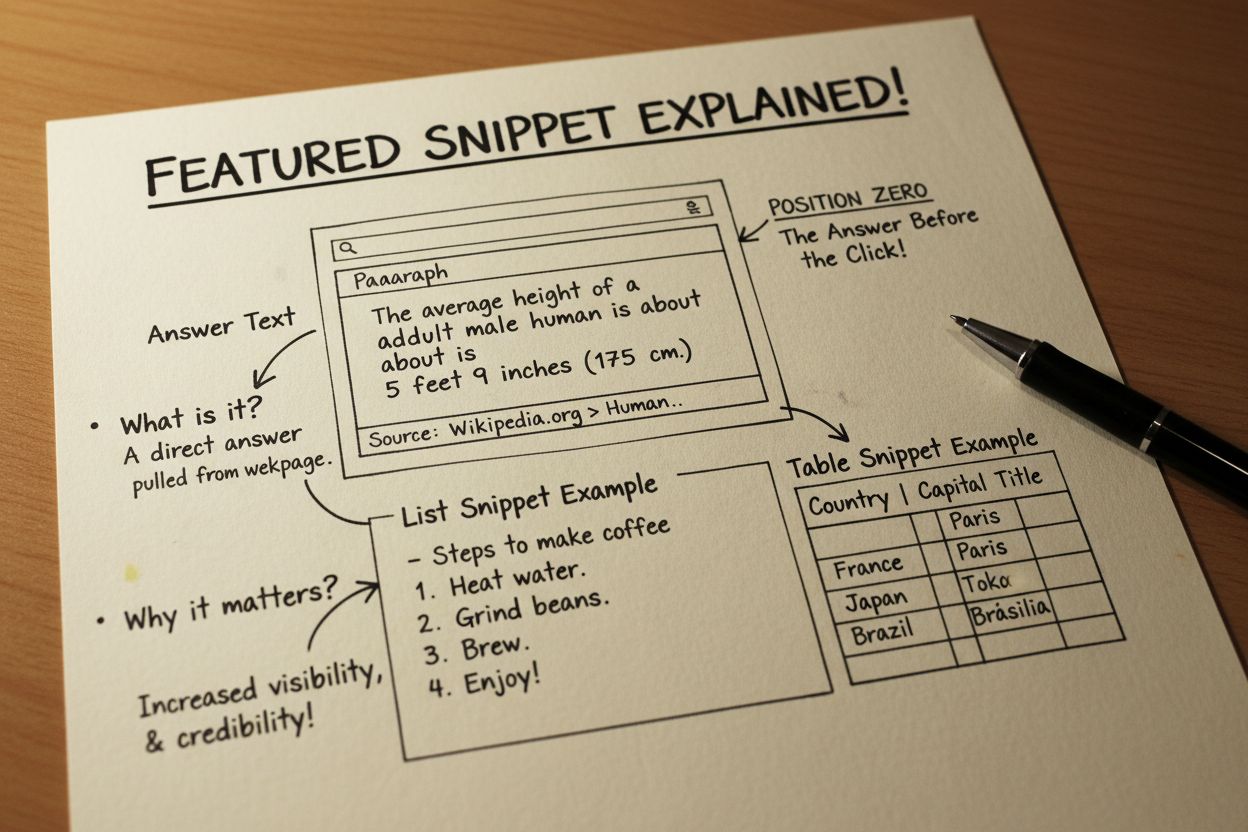
Featured snippets are concise, structured answers extracted from a single webpage and displayed at the top of Google search results in “Position Zero.” These snippets come in multiple formats including paragraphs, lists, tables, and video moments. The relationship between featured snippets and AI is fundamental to understanding modern search dynamics. Featured snippets have evolved from simple answer boxes into critical components of how AI systems train and learn from web content. Every question-formatted heading, every concise answer block, and every FAQ schema you create is now feeding the algorithms that power ChatGPT, Perplexity, and other AI answer generators.
The significance of this relationship cannot be overstated. When you optimize content for featured snippets, you’re simultaneously making it more discoverable and usable by AI systems. This dual optimization approach has become essential for maintaining visibility in both traditional search results and emerging AI-powered platforms. The structured nature of featured snippets—with clear questions, direct answers, and organized information—makes them ideal training material for large language models that power modern AI search engines.
AI models require vast amounts of high-quality, structured data to function effectively. Featured snippets provide exactly this type of data: well-organized, question-answer pairs that are already vetted by Google’s algorithms for relevance and quality. When AI systems like ChatGPT, Perplexity, and Google’s Gemini process web content, they prioritize information that is clearly structured and easy to extract. Featured snippets represent some of the most valuable training material available because they’ve already been identified as authoritative answers to specific questions.
The training process works in multiple ways. First, AI models learn from the content that appears in featured snippets, understanding how to structure answers to similar questions. Second, they learn from the metadata and schema markup associated with snippets, which helps them understand content relationships and context. Third, they learn from the ranking signals that caused a particular piece of content to earn a featured snippet position, including factors like topical authority, E-E-A-T signals (Experience, Expertise, Authoritativeness, Trustworthiness), and content freshness. This means that content optimized for featured snippets is inherently more likely to be cited and referenced by AI systems.
| Aspect | Featured Snippets | AI Training Data |
|---|---|---|
| Structure | Clear Q&A format | Highly organized information |
| Quality | Google-verified answers | Pre-filtered authoritative content |
| Freshness | Updated regularly | Reflects current information |
| Authority | Ranked by SEO signals | Prioritizes trusted sources |
| Accessibility | Easy to read | Machine-parseable format |
Google’s introduction of AI Overviews represents a significant shift in how search results are generated and presented. Unlike traditional featured snippets that pull information from a single source, AI Overviews synthesize information from multiple sources to create comprehensive, conversational answers. This evolution demonstrates how the relationship between featured snippets and AI has matured. AI Overviews use large language models to understand user intent and generate responses that feel natural and conversational, similar to how a human expert might answer a question.
The transition from featured snippets to AI Overviews has been dramatic. Research shows that by August 2025, approximately 83% of featured snippets were replaced by AI Overviews, a massive change within just a few months. This shift reflects Google’s strategic move toward AI-powered search experiences. However, this doesn’t mean featured snippets are obsolete. Rather, they’ve become foundational elements in the broader AI search ecosystem. Featured snippets still appear in traditional search results, and the optimization strategies that help content earn snippets also help it get cited in AI Overviews.
The relationship between these two features is complementary rather than competitive. Featured snippets remain important for traditional SEO because they indicate that your content ranks on the first page and is considered authoritative enough to answer user questions directly. AI Overviews, meanwhile, represent the next evolution where your content might be cited alongside other sources to provide a more comprehensive answer. Both features rely on similar content characteristics: clear structure, authoritative information, and direct answers to user questions.
The relationship between featured snippets and AI has created both challenges and opportunities for website owners. Studies indicate that AI Overviews can lead to a 64% decrease in organic traffic for websites not featured within them, highlighting the importance of visibility in AI-generated results. However, this doesn’t tell the complete story. When your website is cited in an AI Overview, even without a direct click, your brand gains significant visibility and credibility. Users see your domain name and recognize your brand as an authoritative source, which can lead to future direct visits and increased brand awareness.
Featured snippets have historically been a double-edged sword regarding traffic. While earning a featured snippet position increases brand visibility and establishes authority, it can sometimes reduce click-through rates because users find their answer directly in the snippet without needing to visit your website. However, when combined with AI Overviews, this dynamic changes. If your content appears in both a featured snippet and an AI Overview, you’re maximizing visibility across multiple search formats. Additionally, if your featured snippet content is well-written with a compelling call-to-action or additional value proposition, users are more likely to click through to learn more.
The key to managing this relationship effectively is understanding that visibility and traffic are not the same thing. In the AI era, brand visibility in AI-generated answers is increasingly valuable. When Perplexity, ChatGPT, or Google AI Overviews cite your content, they’re essentially endorsing your expertise to millions of users. This endorsement builds trust and authority that translates into long-term business value, even if it doesn’t immediately drive clicks to your website.
To succeed in the current search landscape, you need to optimize content for both traditional featured snippets and AI systems. The good news is that these optimization strategies largely overlap. Start by answering questions directly and concisely at the beginning of your content. Place your main answer in the introduction or immediately after your opening heading, ideally in 40-60 words. This approach helps both Google’s snippet algorithm and AI systems quickly identify and extract your answer.
Structure your content using clear, question-based headings that mirror natural search language. Instead of vague headings like “Overview” or “Details,” use specific questions such as “What is featured snippet optimization?” or “How do AI systems use featured snippets?” This formatting helps AI systems understand content boundaries and extract relevant information more effectively. Use multiple formatting options including paragraphs for definitions, bullet points for lists, numbered lists for processes, and tables for comparisons. This variety makes your content more useful for both human readers and AI systems.
Implement schema markup to provide structured data that helps search engines and AI systems understand your content. FAQ schema, HowTo schema, and other relevant structured data types increase the likelihood of your information being featured in snippets and cited in AI Overviews. Maintain topical authority by covering your subject comprehensively and linking to high-quality research and references. When AI systems evaluate content for citation, they prioritize sources that demonstrate deep expertise and cite credible references. Finally, keep your content fresh and updated regularly. Both Google and AI systems favor current information, so revisit your content at least annually to add new insights, remove outdated material, and refresh statistics.
E-E-A-T (Experience, Expertise, Authoritativeness, Trustworthiness) has become increasingly important in both featured snippet optimization and AI content selection. Google explicitly considers E-E-A-T signals when determining which content deserves a featured snippet position. Similarly, AI systems prioritize content from sources that demonstrate clear expertise and trustworthiness. To strengthen your E-E-A-T signals, include author bios that highlight relevant credentials and experience. Cite credible sources and back up claims with data from reputable institutions. Build your online reputation through customer reviews, industry recognition, and media mentions.
The relationship between E-E-A-T and AI visibility is particularly important for sensitive topics. In fields like health, finance, and law, AI systems are especially cautious about which sources they cite. Content from recognized experts with strong credentials and established authority is far more likely to appear in AI-generated answers. This means that investing in your professional reputation and expertise signals pays dividends across both traditional search and AI platforms. Additionally, maintaining an impeccable online reputation by responding to reviews, correcting misinformation, and demonstrating a commitment to accuracy strengthens your position in both featured snippets and AI citations.
Understanding the relationship between featured snippets and AI requires ongoing monitoring of your visibility in both formats. Use Google Search Console to track which queries are driving impressions and clicks, and monitor whether your content appears in featured snippets. Look for patterns in the types of queries that earn snippets and the content formats that perform best. For AI Overviews and other AI search engines, monitoring is more challenging but increasingly important. Tools like OmniSEO and similar platforms allow you to track your visibility across multiple AI search engines including Perplexity, ChatGPT, Gemini, and others.
When monitoring your presence, pay attention to which sources are cited alongside yours in AI Overviews. This competitive intelligence helps you understand what types of content and sources AI systems prioritize. If you notice that competitors are being cited more frequently, analyze their content structure, freshness, and authority signals to identify improvement opportunities. Track changes in your traffic and visibility metrics as AI Overviews expand. Some industries and query types see more AI Overviews than others, so understanding your specific landscape is crucial for developing an effective optimization strategy.
The relationship between featured snippets and AI is dynamic and constantly evolving. As AI systems become more sophisticated and AI Overviews become more prevalent, the importance of understanding this relationship only increases. By optimizing your content for both featured snippets and AI systems, you’re future-proofing your visibility in search results and positioning your brand as an authoritative source across multiple platforms.
Track where your content appears in AI-generated answers across ChatGPT, Perplexity, Google AI Overviews, and other AI search engines. Get real-time insights into your AI visibility.
Learn what featured snippets are, how they work in Google search results, their impact on CTR, and strategies to optimize your content for position zero visibil...

Learn proven strategies to optimize for position zero (featured snippets) on Google. Discover content structure, schema markup, keyword research, and technical ...
Community discussion on the relationship between featured snippets and AI visibility. Real insights on whether position zero still matters in the AI era.