

How to Manage Brand Reputation for AI Search Engines
Learn how to monitor and manage your brand reputation across AI search engines like ChatGPT, Perplexity, and Gemini. Discover strategies for improving visibilit...
10 min read

Learn what reputation management for AI search means, why it matters for your brand, and how to monitor your presence across ChatGPT, Perplexity, Claude, and other AI search engines.
Reputation management for AI search is the practice of monitoring and optimizing how your brand appears in AI-generated answers from platforms like ChatGPT, Perplexity, Claude, and Google AI Overviews. Unlike traditional search engines that display links, AI search engines synthesize information from multiple sources to provide direct answers, making it essential to ensure your brand is accurately represented and cited in these AI responses.
Reputation management for AI search represents a fundamental shift in how brands protect and promote their online presence. Unlike traditional reputation management focused on Google search results and review platforms, AI search reputation management addresses how your brand appears in AI-generated answers from platforms like ChatGPT, Perplexity, Claude, and Google AI Overviews. This emerging discipline is critical because AI search engines don’t simply rank web pages—they synthesize information from multiple sources to create direct answers, meaning your brand’s visibility depends on whether AI systems recognize, cite, and recommend your content to users asking relevant questions.
The distinction between traditional search and AI search is profound. When a user searches on Google, they receive a list of ranked results and can click through to find information. In contrast, when someone asks ChatGPT or Perplexity a question about your industry, the AI generates a comprehensive answer by pulling information from various sources across the web. If your brand isn’t included in those sources, or if the AI misinterprets your content, potential customers may never discover you—even if your website ranks well on Google. This makes AI search reputation management not just an optional marketing tactic, but a strategic necessity for modern businesses.
The urgency of AI search reputation management stems from rapidly changing user behavior and market dynamics. Research shows that 58% of consumers have replaced traditional search engines with generative AI tools for product recommendations, and traditional organic search traffic is expected to decline by 50% by 2028. These statistics underscore a critical reality: the discovery mechanisms that drove traffic and visibility for decades are being fundamentally disrupted. AI search engines are experiencing triple-digit growth, with platforms like ChatGPT attracting over 800 million weekly users, making them impossible to ignore.
The challenge intensifies because AI search operates differently from traditional search engines. While Google’s algorithm considers hundreds of ranking factors like backlinks and keyword relevance, AI search engines use retrieval-augmented generation (RAG) to pull information from multiple sources and synthesize a single answer. This means your brand might rank on page one of Google but still be invisible in AI-generated answers. Additionally, AI responses are variable—the same query might produce different answers depending on the AI platform, the user’s location, and the specific data sources the AI accesses. This variability makes traditional SEO metrics insufficient for understanding your true visibility in the AI search landscape.
| Aspect | Traditional Search | AI Search |
|---|---|---|
| Discovery Mechanism | Ranked list of links | Direct synthesized answers |
| User Interaction | Click-through to websites | Read AI-generated response |
| Citation Model | Page ranking | Source citation in answer |
| Visibility Metric | Search position | Brand mention frequency |
| Content Requirement | Keyword optimization | Semantic depth and authority |
| Platform Fragmentation | Primarily Google | Multiple platforms (ChatGPT, Perplexity, Claude, Gemini) |
Understanding how AI search engines work is essential for effective reputation management. When a user asks an AI search engine a question about your industry or brand, the AI doesn’t simply retrieve a pre-ranked list of results. Instead, it performs a semantic search across its training data and live web sources, identifying content that’s relevant to the query. The AI then analyzes this content, extracts key information, and synthesizes it into a coherent answer. During this process, the AI decides which sources to cite, which information to prioritize, and how to characterize your brand.
This synthesis process creates both opportunities and risks for your reputation. If your content is well-structured, authoritative, and directly addresses the user’s question, the AI is more likely to cite you and present your brand positively. Conversely, if your content is outdated, poorly structured, or contradicted by other sources, the AI might exclude you entirely or present a negative characterization. For example, if a user asks “What is the best project management software?” and your company’s website hasn’t been updated in two years while competitors publish fresh case studies and feature comparisons, the AI will likely cite competitors instead of you. This isn’t a ranking problem—it’s a content synthesis problem that requires a different approach to solve.
The AI’s reliance on multiple sources also means that negative reviews, outdated information, or misinformation from third-party sites can be synthesized into AI answers about your brand. If a competitor publishes a critical article about your company, or if an old news story contains inaccurate information, the AI might include these perspectives in its answer. This makes proactive reputation management essential—you can’t simply optimize your own content and hope for the best. You must also monitor what AI systems are saying about you and take action to correct inaccuracies or counterbalance negative information with authoritative, positive content.
Traditional online reputation management focuses on controlling your presence across Google search results, review platforms like Yelp and Trustpilot, and social media. The goal is typically to achieve high rankings for branded keywords, accumulate positive reviews, and suppress negative content. This approach works because users actively search for your brand or read reviews before making decisions. However, AI search reputation management operates on a different principle: users aren’t necessarily searching for your brand directly. Instead, they’re asking AI systems general questions about problems they’re trying to solve, and they expect the AI to recommend relevant solutions.
This shift changes the nature of reputation management fundamentally. In traditional reputation management, you compete for visibility by optimizing for specific keywords and managing your review profile. In AI search reputation management, you compete for inclusion and citation by demonstrating expertise, authority, and relevance across a broad range of topics related to your industry. An AI system might cite your brand in response to dozens of different questions—not because you optimized for those specific keywords, but because your content demonstrates deep knowledge of your category. This requires a more sophisticated content strategy that emphasizes semantic depth, topic mastery, and entity authority rather than keyword density and backlink quantity.
Additionally, traditional reputation management is largely reactive—you respond to negative reviews, suppress negative search results, and manage crises as they arise. AI search reputation management requires a more proactive approach. You must continuously monitor how AI systems are representing your brand, ensure your content is current and accurate, and actively feed high-quality information into AI systems through structured data, authoritative publications, and strategic content distribution. The stakes are higher because AI systems reach millions of users simultaneously, and their answers carry significant weight in user decision-making.
Effective AI search reputation management begins with comprehensive monitoring across all major AI search platforms. Unlike traditional search where Google dominates with over 90% market share, AI search is fragmented across multiple platforms, each with different user bases, data sources, and retrieval methods. ChatGPT leads with over 800 million weekly users, but Google AI Overviews appear on billions of searches, Claude is growing rapidly with integration into Safari, Perplexity attracts research-oriented users, and Gemini is expanding quickly. Your brand might have strong visibility in one platform while being completely absent in another, making cross-platform monitoring essential.
Monitoring your AI search reputation involves tracking several key metrics. Brand mention frequency measures how often AI engines reference your brand when answering relevant queries—this is the AI search equivalent of search visibility. Citation rates track whether your website appears as a source in AI-generated responses, which is critical because being mentioned without being cited means users can’t easily access your content. Share of voice compares your visibility to competitors within AI answers, revealing whether you’re gaining or losing ground in the AI search landscape. Sentiment and positioning analyze how AI describes your brand—whether it’s characterized as innovative, reliable, expensive, or any other attribute that shapes user perception.
To implement effective monitoring, start by identifying your core prompts—the natural language questions your potential customers ask at each stage of their buying journey. Unlike traditional keyword research, prompt research focuses on conversational questions people type into AI chatbots. For example, instead of tracking the keyword “project management software,” you’d track prompts like “What project management tool should I use for remote teams?” or “How do I choose between Asana and Monday.com?” Once you’ve identified your core prompts, use dedicated GEO (Generative Engine Optimization) tracking tools to monitor how often your brand appears in AI responses to these prompts across ChatGPT, Claude, Gemini, Perplexity, and Google AI Overviews. Track this data over time to identify trends, spot opportunities, and measure the impact of your optimization efforts.
Optimizing your brand presence in AI search requires a multi-faceted approach that differs significantly from traditional SEO. The first critical strategy is leveraging structured data through schema markup. Structured data helps AI systems better understand the context and meaning behind your content by providing explicit signals about what your content covers. When you implement structured data for product reviews, services, client testimonials, and other key information, AI models can more accurately understand your content and include it in their responses when users inquire about your brand. This structured data acts as a bridge between your content and AI systems, making it easier for them to recognize your expertise and cite your sources.
The second essential strategy is updating your content regularly. AI search engines don’t rely on static, archived content—they pull from real-time data sources across the web. This means outdated information can negatively impact how your brand is perceived. By keeping your website, blog posts, product pages, and news articles fresh and relevant, you help AI tools present an accurate reflection of your brand to users. This doesn’t mean constantly rewriting everything, but rather systematically updating key pages to reflect current offerings, recent case studies, latest statistics, and evolving industry insights. A website that was last updated two years ago signals to AI systems that your company might be stagnant, while regular updates demonstrate that you’re actively engaged in your industry.
The third strategy involves building trust and authority through high-quality content creation. Just as traditional search engines like Google prioritize authoritative content, AI tools also value content from trustworthy and authoritative sources. Publish in-depth, well-researched content that establishes your brand as a thought leader in your industry. Engage with your audience on social media, answer questions in relevant forums, provide valuable insights through blog posts, and contribute to industry publications. The more authoritative and positive content AI tools can pull from, the better your brand’s reputation will be. This also means ensuring your brand information is consistent across trusted sources—your company description, leadership team, mission statement, and key facts should be identical across your website, Wikipedia (if applicable), industry directories, and other authoritative sources that AI systems rely on.
Your content strategy is the foundation of effective AI search reputation management. Unlike traditional SEO content that targets specific keywords, AI search content must demonstrate semantic depth—it must be explicit about your brand DNA, the benefits of your products, and your unique value proposition. Content should cover themes related to your category in both breadth and depth, signaling topic mastery to AI systems. This means creating comprehensive guides that explore your industry from multiple angles, addressing not just your products but the broader problems your customers face and how your solutions fit into the larger ecosystem.
The fragmentation of the digital landscape adds another layer of complexity to content strategy. Your customers are getting inspired on TikTok, researching alternatives on ChatGPT, asking for opinions on Reddit, checking reviews on Google, and watching educational content on YouTube. This means your content strategy must extend beyond your website to include strategic presence on multiple platforms where AI systems source their knowledge. You need to ensure that authoritative content about your brand appears not just on your website, but also on industry publications, news sites, social media platforms, and other trusted sources that AI systems prioritize. This requires a more sophisticated approach to content distribution and partnership development.
Additionally, your content must be meaningfully different from competitors. In a landscape where AI systems are synthesizing information from thousands of sources, generic content gets lost in the noise. Your content must offer unique angles, original research, distinctive perspectives, or proprietary insights that set you apart. This might mean publishing original research, sharing unique case studies, offering frameworks or methodologies that competitors don’t have, or providing perspectives that challenge industry conventional wisdom. The goal is to give AI systems reasons to cite you specifically, rather than just aggregating generic information from multiple sources.
Measuring the success of your AI search reputation management efforts requires different metrics than traditional SEO. Citation frequency is perhaps the most important metric—it measures how often your site or content gets cited in AI-generated answers. This is the AI search equivalent of earning a backlink, except it directly shapes what millions of users see. Track not just whether you’re cited, but how frequently, in response to which queries, and across which platforms. A brand that appears in 40% of relevant AI responses is in a much stronger position than one that appears in only 10%.
Brand visibility score is a composite metric that shows how prominently your brand appears across AI platforms for your target keywords and topics. High visibility means the AI reliably recognizes and references your brand as relevant to user queries. This should be tracked over time to identify trends—are you gaining visibility or losing ground? AI share of voice compares your brand’s mention rate to competitors in AI-generated answers. If a competitor shows up in 60% of relevant responses and you appear in only 15%, that gap represents a significant lost opportunity. Understanding your competitive position in AI search is just as important as understanding your position in traditional search.
Beyond visibility metrics, track sentiment and positioning—how AI describes your business. Is your brand characterized as innovative, reliable, affordable, or premium? Does the AI associate you with the right use cases and customer segments? Understanding how AI positions your brand helps identify perception gaps and optimization opportunities. Finally, measure the business impact of your AI search visibility by tracking how AI search referrals correlate with leads, conversions, and revenue. While AI search currently drives less than 1% of referral traffic to websites, this is growing rapidly, and early movers who build strong AI search visibility will capture disproportionate value as the channel scales.
Track how your brand appears in AI-generated answers across all major AI search engines. Get real-time insights into your AI search visibility and stay ahead of your competitors.
Learn how to monitor and manage your brand reputation across AI search engines like ChatGPT, Perplexity, and Gemini. Discover strategies for improving visibilit...
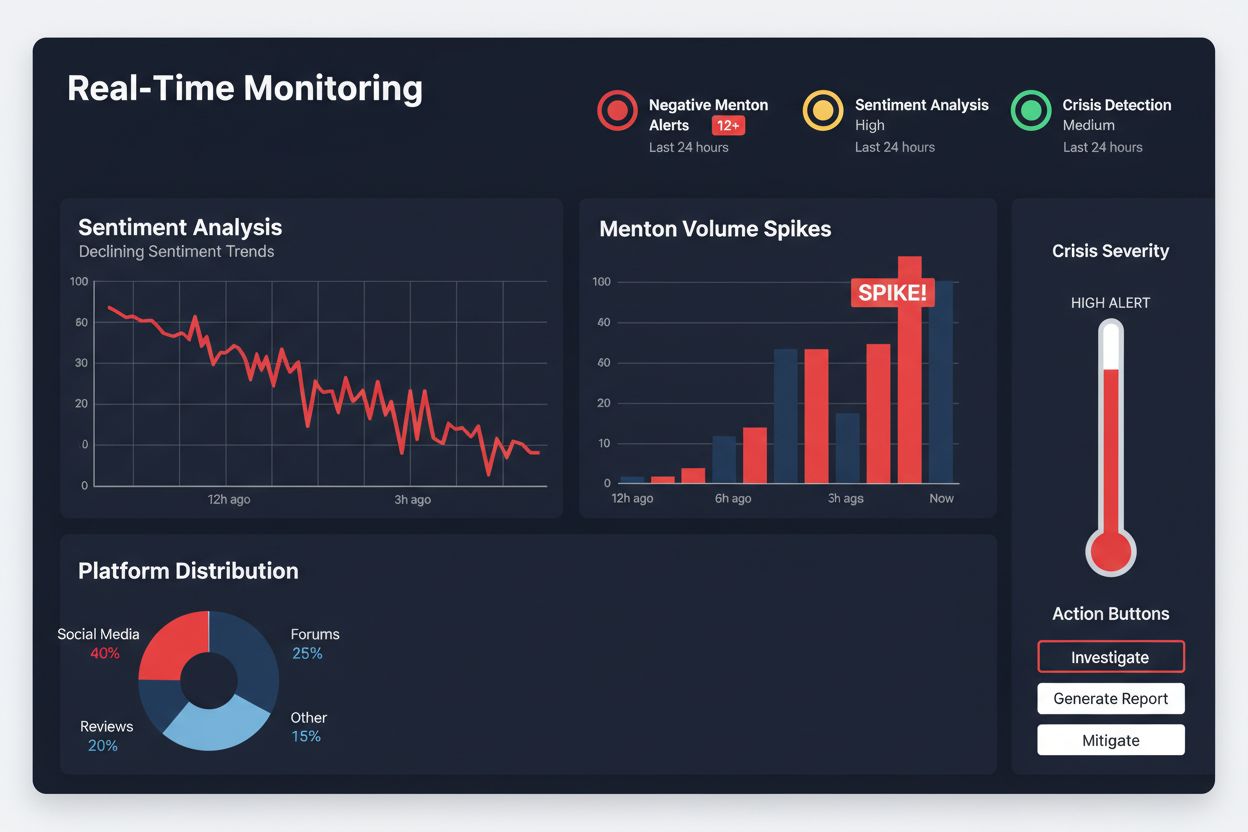
Learn how to detect and respond to negative brand mentions in AI search platforms with real-time alert systems. Protect your reputation before negative content ...
Learn how to protect and control your brand reputation in AI-generated answers from ChatGPT, Perplexity, and Gemini. Discover strategies for brand visibility an...