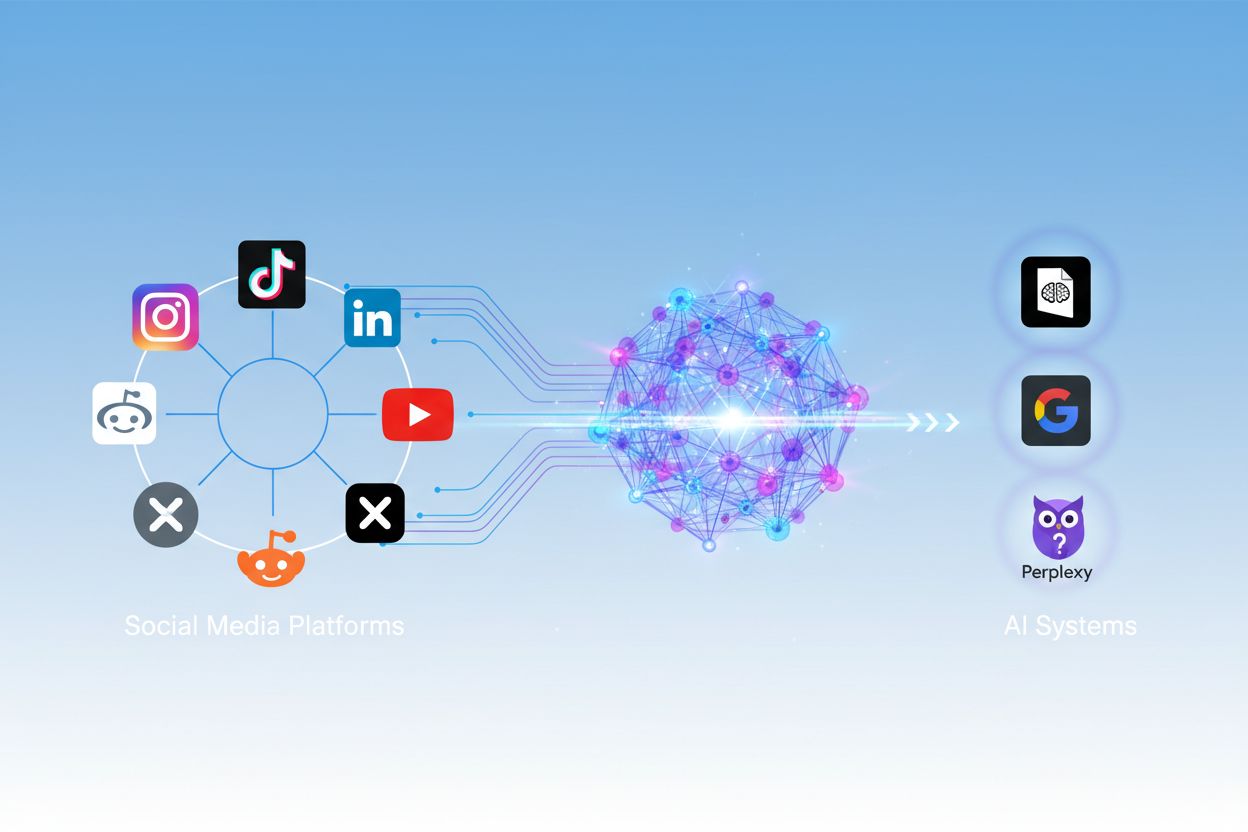
Social media has become a critical data source for AI search engines, fundamentally changing how brands appear in AI-generated answers. Unlike traditional search engines that primarily crawl websites, AI tools like ChatGPT, Perplexity, and Google Gemini actively incorporate social media content into their training data and response generation. This shift means that your brand’s social presence directly impacts whether and how you appear when users ask AI systems questions about your industry, products, or services.
The relationship between social media and AI search is multifaceted and increasingly important for brand visibility. When users query AI tools with questions like “What are the best pizza places in North Vancouver?” or “How do I pick a social agency for a technical product?”, the AI system draws from multiple data sources, including social media platforms. Active, verified, and widely followed social accounts send powerful authority and popularity signals that AI algorithms recognize and value when determining which brands to recommend.
Authority and Popularity Signals
Active social media presence builds digital trust that AI tools recognize and reward. When your brand maintains regular, verified social accounts with strong engagement metrics, AI systems interpret this as a signal of legitimacy and relevance. If your brand is frequently mentioned in top-ten lists, goes viral on social platforms, or receives consistent engagement, AI tools may reference these signals when identifying trending and authoritative sources in specific areas.
For example, if a local blog features your restaurant in a “Top 5 Most Instagrammable Pizza Joints in North Vancouver” article and that post gains significant social traction, AI tools index this content and boost your visibility in related future queries. The more your brand is discussed and shared across social platforms, the more likely AI systems will recognize you as an authority in your category. This creates a compounding effect where social engagement directly translates to improved AI search visibility.
User-Generated Content and Brand Recognition
User-generated content (UGC) creates a continuous stream of authentic data that AI systems pull into their models. When customers tag your brand in their posts, especially with location information or relevant hashtags, they’re essentially creating indexed content that AI tools can access. This organic mention pattern helps AI systems understand your brand’s real-world relevance and customer satisfaction levels.
Encouraging customers to tag your brand in their content—such as “Tag us in your pizza night pics”—amplifies your brand’s footprint far beyond your direct followers. AI tools analyze these customer mentions to gauge brand sentiment, popularity, and real-world usage patterns. The more authentic customer mentions your brand receives across social platforms, the stronger the signal you send to AI systems about your relevance and trustworthiness. This is particularly powerful because it represents genuine customer advocacy rather than branded messaging.
Content That Mirrors Customer Search Intent
AI tools prioritize content that reflects how people naturally ask questions and seek information. Your social media posts can be optimized to match this natural language pattern, making them more likely to be referenced in AI-generated answers. Instead of posting generic promotional content, crafting posts that address specific customer pain points or questions increases the likelihood that AI systems will surface your content when users ask related queries.
For instance, instead of posting “Try our new Margherita Pizza,” a more effective approach would be “Hiking Quarry Rock in North Van? Refuel with our wood-fired Margherita pizza #NorthVancouver #PostHikeEats.” This subtle shift mirrors actual search intent and local discovery patterns, making your content more discoverable to both AI systems and human searchers. When your social content answers questions your audience is actually asking, AI tools are more likely to cite it as a relevant source.
Ready to Monitor Your AI Visibility?
Track how AI chatbots mention your brand across ChatGPT, Perplexity, and other platforms.
| Information Source | How AI Uses It | Impact on Visibility |
|---|
| Individual Business Listings | Foundational data like brand name, hours, category | Essential baseline information |
| Customer Reviews | Sentiment analysis, popularity indicators, freshness signals | Demonstrates brand reputation and recency |
| Local Web Content | Blog posts, “best of” lists, city guides mentioning your brand | Establishes authority and relevance |
| Structured Website Data | Schema markup, local landing pages, FAQ pages | Improves content understanding and context |
| Social Discussions | Reddit threads, Twitter/X posts, TikTok mentions, LinkedIn content | Provides real user sentiment and experiences |
AI systems don’t rely on a single source of information. Instead, they synthesize data from multiple channels to build a comprehensive understanding of your brand. Social media platforms like Reddit, LinkedIn, and TikTok have become increasingly important in this equation because they contain authentic, conversational content that reflects real user experiences and opinions. When AI tools encounter consistent mentions of your brand across multiple social platforms, they gain confidence in your relevance and authority.
Reddit has emerged as the top social media platform referenced by AI tools in their generated answers. Threads with rich discussion and high engagement are frequently cited as sources, suggesting that AI systems value the conversational depth and authentic user perspectives found on Reddit. The platform’s structure—where users share detailed experiences and recommendations—aligns perfectly with how AI systems extract and synthesize information.
LinkedIn content also appears frequently in AI search results, with a notable difference: company profiles and “About Us” sections receive extra relevance weight. This suggests that AI systems view LinkedIn as a professional authority source where brands can establish credibility and expertise. For B2B companies, maintaining a comprehensive LinkedIn presence with detailed company information and thought leadership content is crucial for AI visibility.
Other platforms like TikTok, Instagram, and YouTube appear less frequently in AI-generated answers, but this is changing rapidly. As AI systems become more sophisticated at processing video content and short-form media, these platforms will likely gain importance. The key is that any social platform where your target audience actively discusses your category becomes a potential source for AI systems.
Stay Updated on AI Visibility Trends
Get the latest insights on AI mentions, brand monitoring, and optimization strategies.
Practical Strategies to Optimize for AI Search Visibility
Geo-tag and hashtag all location-specific content to surface in local search queries. When you include location information and relevant hashtags in your social posts, you’re helping AI systems understand the geographic relevance of your content. This is particularly important for local businesses trying to appear in AI answers about specific regions or neighborhoods.
Encourage user tagging and repost user-generated content to build organic buzz and broaden your reach. When customers tag your brand, they’re creating indexed content that AI systems recognize as authentic endorsements. By reposting this content, you amplify its visibility and signal to AI systems that your brand is actively engaged with its community.
Get featured in roundup content and “best of” lists to increase your odds of being cited by AI tools. These curated lists are exactly the type of content that AI systems reference when generating answers to discovery questions. Actively seek opportunities to be included in industry roundups, local guides, and expert-curated lists.
Share local-specific tips and moments that align with how users ask discovery questions. Instead of generic content, focus on posts that address specific local needs, seasonal trends, or community interests. This makes your content more likely to match the natural language queries that users pose to AI systems.
Embed social content on your website in a structured way to gain visibility across multiple channels. When you integrate your social media content into your website with proper markup, you create additional opportunities for AI systems to discover and reference your content. This cross-channel approach strengthens your overall digital presence.
The Broader Impact on Brand Visibility
Social media is no longer just a branding tool—it’s a critical component of your AI search visibility strategy. The brands that understand this shift and actively optimize their social presence for AI discovery will have a significant competitive advantage. Whether it’s a viral post, a customer tag, or a well-placed hashtag, your social content plays a direct role in how and if you appear in answers to high-intent queries like “Best chiropractor near me,” “Top-rated dentist in Chicago,” or “Pizza spots locals love in North Vancouver.”
The convergence of social media and AI search represents a fundamental shift in how customers discover brands. Your social media presence now influences visibility across three distinct discovery channels: traditional social search, AI-generated answers, and traditional search engines. This interconnected ecosystem means that investing in social media optimization pays dividends across all discovery channels, not just social platforms themselves.
As AI tools continue to evolve and incorporate more social data into their models, the importance of maintaining an active, authentic, and optimized social presence will only increase. Brands that recognize social media as a critical AI search visibility tool—rather than just a marketing channel—will be better positioned to capture high-intent customers at the moment they’re seeking solutions.