
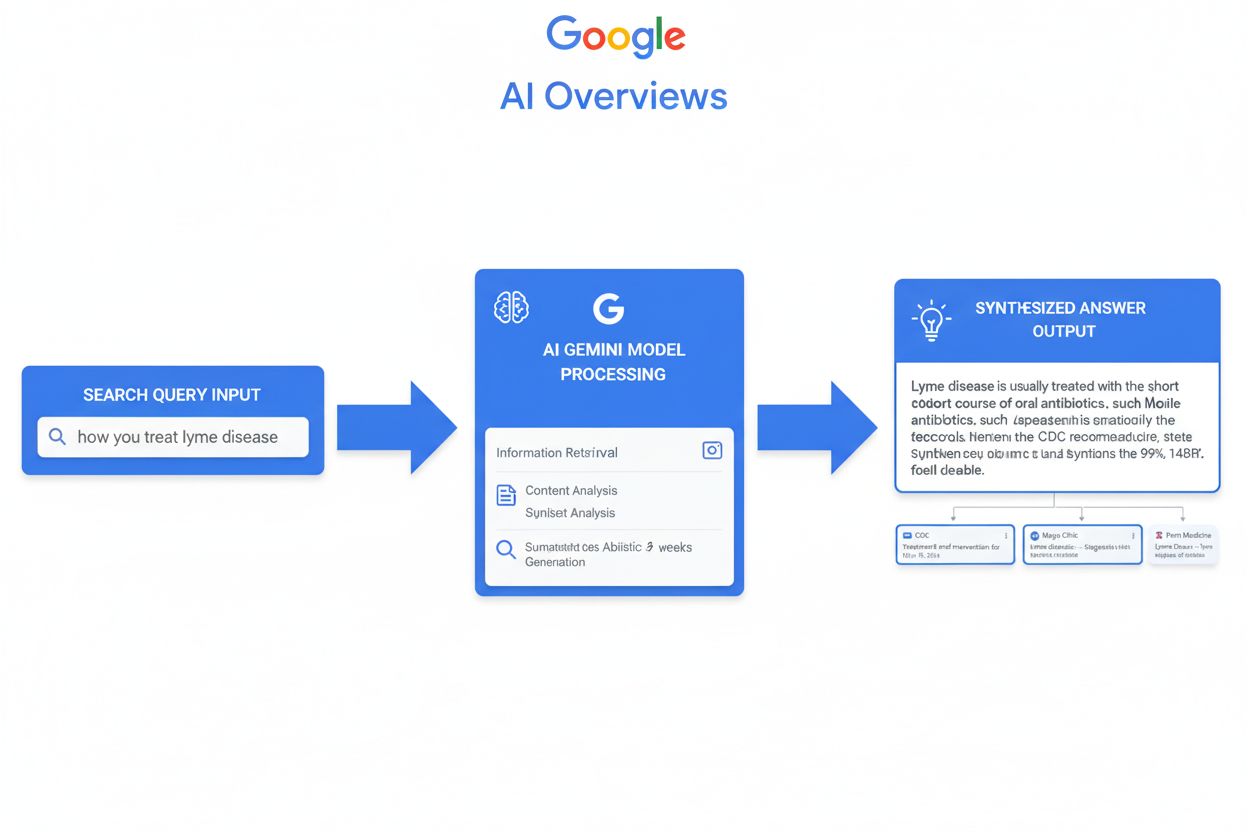
Search Generative Experience (SGE)
Learn what Search Generative Experience (SGE) is, how Google's AI Overviews work, and why this AI-powered search feature is transforming SEO and digital visibil...
9 min read

Learn what Search Generative Experience (SGE) is, how it works, and why monitoring your brand visibility in SGE results is critical for your digital presence.
Search Generative Experience (SGE) is Google's experimental AI-powered search feature that uses generative artificial intelligence to provide users with AI-generated summaries and answers directly in search results, compiled from multiple web sources, without requiring users to click through to individual websites.
Search Generative Experience (SGE) represents a fundamental transformation in how Google presents search results to users. Rather than simply organizing and ranking traditional web pages, SGE uses generative artificial intelligence to create new, synthesized content directly within search results. This experimental feature, launched through Google Search Labs in May 2023, combines Google’s advanced Pathways Language Model 2 (PaLM 2) with sophisticated natural language processing and machine learning technologies to understand user queries and generate contextually relevant responses. The technology fundamentally changes the search experience by providing users with quick overviews of complex topics without requiring them to navigate multiple websites.
The core innovation behind SGE lies in its ability to process vast amounts of information from multiple sources and present it in a unified, easy-to-understand format. When a user searches for information, SGE doesn’t just retrieve existing content—it synthesizes information from various sources to create a comprehensive answer tailored to the specific search intent. This represents a significant departure from traditional search engine optimization, where ranking high in organic results was the primary goal. With SGE, your content may be used as a source for AI-generated answers, but users might never click through to your website.
SGE operates through a sophisticated combination of artificial intelligence technologies that work together seamlessly. The system uses natural language processing (NLP) to understand the nuances and context of user queries, going beyond simple keyword matching to comprehend what users actually want to know. Machine learning algorithms continuously improve the system’s ability to identify relevant sources and synthesize information, while deep learning models enable the system to understand complex relationships between concepts and generate coherent, contextually appropriate responses.
When you enter a search query into SGE, the system performs several simultaneous operations. First, it analyzes your query to determine your search intent—whether you’re looking for factual information, trying to make a purchase decision, seeking how-to instructions, or exploring a topic. Next, it retrieves relevant content from Google’s index, prioritizing sources based on relevance, authority, and quality signals. The system then uses generative AI to synthesize this information into a coherent answer, often including multiple perspectives and supporting details. Finally, it presents this AI-generated response alongside traditional search results and source citations, allowing users to verify information and explore deeper if desired.
The Multitask Unified Model (MUM) technology underlying SGE enables it to understand complex, multi-faceted queries that traditional search engines struggle with. For example, if you ask “What’s better for a family with kids under 3 and a dog, Bryce Canyon or Arches?” SGE can break down this complex question into multiple components—family-friendliness, suitability for young children, pet-friendliness, and comparative analysis—then synthesize information from various sources to provide a comprehensive answer addressing all these factors.
| Feature | Traditional Search | SGE |
|---|---|---|
| Result Format | Links to websites | AI-generated summaries with sources |
| User Interaction | Click through to websites | Read answers directly in results |
| Information Synthesis | User must compile from multiple sites | AI synthesizes from multiple sources |
| Follow-up Questions | New search required | Conversational follow-ups in same session |
| Source Visibility | Organic rankings determine visibility | Sources cited but not ranked |
| Time to Answer | Multiple clicks needed | Immediate answer provided |
SGE includes several distinctive features that enhance the search experience. The Answer Box appears at the top of SGE results, providing an AI-generated summary of the most relevant information for your query. This box includes a disclaimer noting that “Generative AI is experimental. Info quality may vary,” acknowledging the technology’s current limitations. To the right of the answer box, the Source Panel displays up to three primary sources initially, with ten available upon scrolling, showing which websites the AI used to generate its response.
The conversational follow-up feature allows users to ask related questions without starting a new search. When you select a suggested follow-up question or type your own, SGE maintains context from your previous query and generates new answers based on the conversation thread. This creates a more natural, dialogue-like search experience compared to traditional search engines. For instance, if you search for “best chocolate chip cookie recipe,” SGE might suggest follow-up questions like “What is the secret to a perfect cookie?” or “How can you make chocolate chip cookies healthier?” Each follow-up generates fresh sources and detailed answers, creating multiple engagement opportunities for content creators.
SGE also displays Additional Questions at the bottom of results, presenting related queries that users might want to explore. These suggestions are intelligently generated based on the original query and help users discover new angles and perspectives on their topic of interest. The system also includes suggested next steps that guide users through their research journey, whether that’s comparing products, finding local options, or diving deeper into specific aspects of a topic.
Not all search queries trigger SGE results, and when they do, they appear in different states affecting visibility. The Opt-in State represents the most common SGE presentation, where users actively request AI-generated results. In the Collapsed State, SGE results appear truncated initially, requiring users to click “Show more” to view the full content. This state typically appears for lower-volume keywords and provides less visibility than fully expanded results. The No SGE State occurs when a query doesn’t trigger any AI-generated response—research indicates approximately 15% of queries fall into this category, particularly in certain industries like B2B technology and entertainment.
Understanding these states is crucial for brand monitoring. When your content appears in SGE results, it may be cited as a source, but users might not click through to your website if the AI-generated answer fully satisfies their query. This is particularly significant for informational queries where users seek quick answers rather than in-depth exploration. However, SGE also creates opportunities—when users want to learn more or verify information, they can click on source citations to visit your website, potentially bringing more qualified traffic.
SGE displays information through various content modules, each tailored to specific search intents. Unordered Lists present information in bullet-point format, often with descriptions and citations. These lists have evolved to include “breakout” versions with expandable descriptions, images, reviews, and direct shopping options. Ordered Lists rank items by relevance or importance, commonly appearing for “best of” queries and comparisons.
Recipe Cards appear for cooking-related searches, displaying ingredients, cooking steps, preparation times, and images in an organized format. Local Packs (called “Places” in SGE code) show location-based results with maps, reviews from Google Business Profiles, and local business information—these have become increasingly prominent in SGE results. Product Viewers showcase products in various formats, from simple listings to carousel displays with pricing, reviews, and availability information. For apparel, SGE uses specialized viewers with larger images and trend commentary. Code Blocks generate code snippets for technology-related queries, allowing users to copy and deploy code directly.
Emerging modules include Pro/Con comparisons that highlight advantages and disadvantages, Review modules displaying user feedback, and Plan My Itinerary features for travel planning. Each module represents a different opportunity for your content to be sourced and displayed, making it essential to understand which formats are most relevant to your industry and content type.
The emergence of SGE has significant implications for brand visibility in AI search results. When your content is used as a source for SGE answers, your brand may receive attribution, but users might not click through to your website if the AI-generated summary fully answers their question. This is particularly impactful for “what is” queries, definitions, and straightforward informational searches where users seek quick answers. Research indicates that SGE could reduce click-through rates for these query types, as users get the information they need directly from search results.
However, SGE also creates new opportunities. Users who want more detailed information, additional perspectives, or to verify claims can click on source citations to visit your website. These visitors are often more qualified and engaged, having already received context about your content from the SGE summary. Additionally, SGE’s conversational nature means users may conduct multiple follow-up searches within a single session, creating multiple touchpoints where your content could be sourced and cited.
The Your Money or Your Life (YMYL) category—topics affecting health, finance, and safety—receives special treatment in SGE. Google displays additional disclaimers for medical, financial, and legal queries, emphasizing that information “does not constitute medical advice” or professional guidance. This means YMYL content must meet exceptionally high standards of accuracy and authority to be sourced by SGE, with preference given to established medical institutions, financial experts, and legal authorities.
For businesses and content creators, monitoring brand visibility in SGE is now as important as tracking traditional search rankings. Unlike organic search where you can see your position in results, SGE visibility requires active monitoring of how your content is being sourced and cited. This involves tracking which queries trigger SGE results that cite your content, understanding which content modules your information appears in, and monitoring how frequently your brand is mentioned in AI-generated answers.
Several key metrics matter for SGE monitoring. Source citation frequency indicates how often your content is used as a source for SGE answers. Module appearance shows which types of content modules your information appears in—whether it’s unordered lists, product viewers, or local packs. Query coverage reveals which search queries trigger SGE results that cite your content, helping you understand which topics and keywords are most valuable. Competitive positioning shows whether your content is cited more or less frequently than competitors’ content for the same queries.
The challenge with SGE monitoring is that it requires specialized tools and approaches. Traditional rank tracking tools don’t capture SGE visibility because SGE results are dynamic and require user interaction to display. This is where AI search monitoring platforms become essential, providing real-time tracking of how your brand, domain, and URLs appear in AI-generated answers across Google SGE, ChatGPT, Perplexity, Claude, and other AI search engines.
To optimize your content for SGE visibility, focus on several key strategies:
As SGE continues to evolve and expand, the importance of monitoring your brand’s appearance in AI search results will only increase. Google has indicated that SGE will eventually become a standard feature rather than an experimental one, meaning AI-generated answers will become the default way many users interact with search. This fundamental shift requires businesses to adapt their digital strategies beyond traditional SEO.
The rise of SGE and similar AI search technologies means that brand visibility monitoring must now encompass multiple AI platforms, not just Google. ChatGPT, Perplexity, Claude, and other AI answer generators are becoming significant sources of information discovery. Users increasingly turn to these platforms for answers, and your brand’s presence—or absence—in these AI-generated responses directly impacts your visibility and credibility.
For organizations serious about maintaining and growing their online presence, implementing a comprehensive AI search monitoring strategy is no longer optional. This includes tracking how your content is sourced and cited across multiple AI platforms, understanding which topics and keywords drive the most visibility, identifying gaps where competitors are outranking you in AI results, and continuously optimizing your content to improve AI search visibility. The companies that adapt quickly to this new search landscape will maintain competitive advantage, while those that ignore SGE and AI search monitoring risk losing significant visibility and traffic.
Don't let your brand disappear in AI-generated search answers. Track how your content appears across Google SGE, ChatGPT, Perplexity, and other AI search engines with real-time monitoring.
Learn what Search Generative Experience (SGE) is, how Google's AI Overviews work, and why this AI-powered search feature is transforming SEO and digital visibil...

Learn what Google AI Overviews are, how they work, their impact on search traffic, and how to optimize your content to appear in AI-generated summaries.
Learn what generative engines are, how they differ from traditional search, and their impact on ChatGPT, Perplexity, Google AI Overviews, and Claude. Complete g...