
Sonar Algorithm
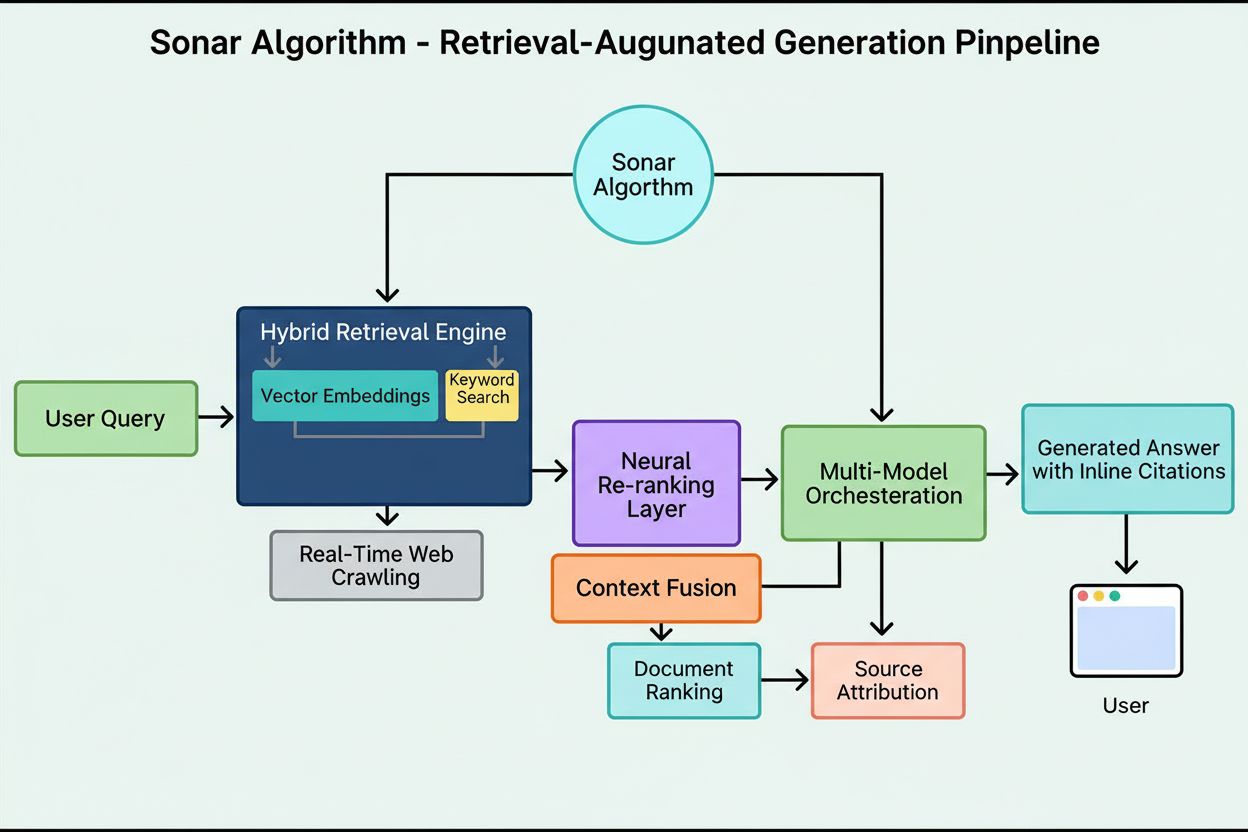
Sonar Algorithm is Perplexity's proprietary RAG ranking system combining hybrid retrieval, neural re-ranking, and real-time citation generation. Learn how it ra...
15 min read

Learn how Perplexity’s Sonar algorithm powers real-time AI search with cost-effective models. Explore Sonar, Sonar Pro, and Sonar Reasoning variants.
Sonar is Perplexity's lightweight, cost-effective search model family optimized for real-time web search integration with large language models. It combines fast retrieval with grounded answers, offering variants including base Sonar for quick Q&A, Sonar Pro for complex queries, and Sonar Reasoning for chain-of-thought problem-solving with live web access.
Sonar is Perplexity’s proprietary search model family designed to integrate real-time web search capabilities directly into large language models for generating grounded, accurate answers. Unlike traditional search engines that return blue links, Sonar algorithms power an AI-first search experience where the model synthesizes information from multiple sources to provide comprehensive, cited responses. The Sonar family represents a fundamental shift in how AI systems access and process current information, enabling models to answer questions about recent events, breaking news, and up-to-date data without relying on static training data. This technology is critical in the evolving landscape of AI search engines like Perplexity, ChatGPT with web search, Google AI Overviews, and Claude, where real-time information retrieval has become essential for maintaining accuracy and relevance.
Perplexity’s search infrastructure processes over 200 million daily queries and maintains an index tracking over 200 billion unique URLs, making it one of the largest and most frequently updated web indices optimized specifically for AI consumption. The Sonar algorithm was developed to address critical limitations in legacy search APIs that were designed for human users rather than AI models. Traditional search APIs charged exorbitant fees (some providers charged $200 per thousand queries), operated with stale indices, and returned document-level results that were too coarse-grained for AI models with limited context windows. Sonar solves these problems through a hybrid retrieval and ranking pipeline that combines both lexical search (keyword-based) and semantic search (meaning-based) signals to identify the most relevant information at the sub-document level.
The architecture of Sonar relies on three foundational principles: completeness, freshness, and speed. The search index must comprehensively map the web, be constantly updated to reflect the latest information, and respond to queries within milliseconds to support real-time AI applications. Perplexity’s crawling infrastructure comprises tens of thousands of CPUs and hundreds of terabytes of RAM, enabling the system to process tens of thousands of indexing operations per second. Machine learning models predict which URLs need indexing and when to schedule those operations, ensuring that high-traffic and frequently updated documents remain current while maintaining a manageable crawl rate for website operators.
| Model Variant | Primary Use Case | Key Features | Context Length | Optimization Focus |
|---|---|---|---|---|
| Sonar (Base) | Quick Q&A and straightforward searches | Lightweight, cost-effective, real-time web search | 128K tokens | Speed and affordability |
| Sonar Pro | Complex queries and advanced research | Enhanced retrieval, source customization, citations | 128K tokens | Accuracy and complexity handling |
| Sonar Reasoning | Logical problem-solving and analysis | Chain-of-Thought reasoning, step-by-step inference | 128K tokens | Deep reasoning with live search |
| Sonar Reasoning Pro | High-performance complex analysis | Advanced multi-step CoT, enhanced retrieval | 128K tokens | Maximum reasoning capability |
Perplexity’s Sonar family includes four distinct model variants, each optimized for different use cases and complexity levels. The base Sonar model is the most lightweight and cost-effective option, designed for everyday use cases like summarizing content, looking up definitions, and browsing news. It processes queries at $1 per 1 million input tokens and $1 per 1 million output tokens, making it significantly more affordable than competing solutions. Sonar Pro builds on this foundation with enhanced capabilities for handling complex, multi-step queries that require deeper analysis and source customization. Users can specify which sources to prioritize or exclude, giving them granular control over the information retrieval process.
Sonar Reasoning introduces Chain-of-Thought (CoT) reasoning, a technique where the model explicitly works through problems step-by-step before arriving at conclusions. This variant is powered by DeepSeek-R1 technology and excels at logical reasoning, mathematical problem-solving, and structured analysis. Sonar Reasoning Pro represents the highest-performance tier, combining advanced multi-step reasoning with enhanced information retrieval capabilities for the most demanding analytical tasks. All Sonar variants maintain a 128K token context length, providing substantial space for processing long documents, multiple sources, and complex prompts.
The Sonar algorithm implements a multi-stage retrieval and ranking pipeline that progressively refines search results with increasing sophistication. The process begins with hybrid retrieval, where the system queries the search index using both lexical and semantic methods simultaneously, then merges the results into a comprehensive candidate set. This dual-approach ensures that both keyword-specific matches and conceptually similar content are captured. Subsequent stages apply prefiltering heuristics to remove clearly irrelevant or outdated content, followed by multiple rounds of ranking using increasingly advanced models.
Early ranking stages employ lexical and embedding-based scorers optimized for speed, while later stages leverage cross-encoder reranker models that perform sophisticated semantic analysis. The entire pipeline operates at both document and sub-document levels, meaning the system can identify and extract specific paragraphs, sections, or even sentences that directly answer a query, rather than forcing users to parse entire web pages. This fine-grained content understanding is crucial for AI models, where every token of context matters and irrelevant information can degrade performance. Perplexity’s content understanding module uses dynamic rulesets and AI-driven self-improvement to parse the messy, diverse structure of the web, continuously adapting to new website layouts and content patterns.
Perplexity’s Sonar models have demonstrated exceptional performance in rigorous evaluations against competing AI search solutions. In comprehensive benchmarking using frameworks like SimpleQA, FRAMES, BrowseComp, and HLE, Sonar variants consistently outperformed models from Google Gemini 2.0 Flash, OpenAI GPT-4o Search, and other leading AI systems. On the SimpleQA benchmark, Sonar achieved a score of 0.930, significantly exceeding competitors like Brave Search (0.822) and SERP-based APIs (0.890). For deep research tasks measured by the HLE benchmark, Sonar reached 0.288, substantially ahead of alternative providers.
Beyond quality metrics, Sonar excels in latency performance, a critical factor for user-facing applications. Perplexity’s median search latency is 358 milliseconds, over 150 milliseconds faster than the second-fastest provider. The 95th-percentile latency remains under 800 milliseconds, ensuring consistent performance even under peak load conditions. This speed advantage stems from Perplexity’s infrastructure investments, including distributed indexing across hundreds of terabytes of storage, intelligent caching strategies, and optimized inference pipelines. The combination of state-of-the-art quality and industry-leading speed means developers no longer face a tradeoff between building fast applications and ensuring accurate results.
Sonar algorithms represent a paradigm shift in how AI systems access real-time information, fundamentally different from traditional search engines and earlier AI chatbots. ChatGPT with web search and Google AI Overviews provide real-time capabilities, but Sonar’s design specifically optimizes for AI consumption rather than retrofitting human-oriented search onto AI models. The Sonar API provides developers with programmatic access to Perplexity’s search infrastructure, enabling them to build AI applications that require current information without managing their own crawling, indexing, and ranking systems.
Perplexity’s search infrastructure processes queries with real-time web search-based answers that include detailed search results and citations, allowing users to verify information sources. The system provides 5.01 links per answer on average, positioning it between ChatGPT (10.42 links) and other AI search tools. This balanced approach provides sufficient source diversity for verification without overwhelming users with excessive citations. The Sonar algorithm’s ability to cite sources is particularly important for brand monitoring and content visibility, as organizations can track when their domains appear in AI-generated answers across platforms like Perplexity, ChatGPT, Claude, and Google AI Overviews using tools like AmICited, which specializes in monitoring brand and domain appearances in AI search results.
Sonar algorithms power diverse applications across research, business intelligence, content creation, and real-time information retrieval. Researchers use Sonar to conduct comprehensive literature reviews and synthesize information from multiple sources with proper citations. Business analysts leverage Sonar Pro for competitive intelligence, market research, and trend analysis that requires current data. Content creators use Sonar to verify facts, find recent examples, and ensure their work reflects the latest developments in their field. News organizations and fact-checkers rely on Sonar’s real-time search capabilities to verify claims and provide context for breaking stories.
The Sonar Reasoning variants are particularly valuable for technical problem-solving, where step-by-step analysis combined with current information yields superior results. Software developers use Sonar Reasoning to troubleshoot issues by accessing the latest documentation, Stack Overflow discussions, and GitHub repositories. Data scientists leverage Sonar to stay current with rapidly evolving methodologies and access recent research papers. Financial professionals use Sonar Pro to monitor market conditions, track regulatory changes, and analyze emerging trends. The ability to combine real-time web search with advanced reasoning makes Sonar particularly valuable in domains where information changes rapidly and accuracy is paramount.
The Sonar algorithm represents just the beginning of AI-native search infrastructure. Perplexity’s research indicates that legacy search engines have plateaued at approximately 10 billion queries per day, while the next generation of AI-powered search will serve orders of magnitude more requests as autonomous AI agents become ubiquitous. Future iterations of Sonar will need to address emerging challenges including efficient scaling in the face of exponential query growth, novel context engineering approaches optimized for increasingly sophisticated AI models, and the perpetual tension between comprehensiveness, recency, and latency.
Perplexity’s infrastructure is uniquely positioned to tackle these challenges, combining a massive production search system serving millions of users daily with technical talent and research capabilities. The company’s self-improving content understanding module demonstrates how AI can continuously enhance search quality without manual intervention. As AI agents become more autonomous and capable, the quality of their underlying search infrastructure becomes increasingly critical. Sonar’s evolution will likely include deeper integration with agentic workflows, more sophisticated context curation for specific AI model architectures, and enhanced source verification capabilities to combat misinformation. Organizations seeking to maintain visibility in this evolving landscape should monitor their brand appearances across AI search platforms using specialized tools, ensuring their content remains authoritative and properly cited as AI systems become the primary interface for information discovery.
Track when your domain appears in Perplexity Sonar answers and other AI search results. Ensure your content is cited as an authoritative source across all major AI platforms.
Sonar Algorithm is Perplexity's proprietary RAG ranking system combining hybrid retrieval, neural re-ranking, and real-time citation generation. Learn how it ra...

Perplexity AI is an AI-powered answer engine combining real-time web search with LLMs to deliver cited, accurate responses. Learn how it works and its impact on...
Understand the differences between voice search and AI search. Learn how voice queries, ChatGPT, Perplexity, Google AI Overviews, and Claude differ in technolog...