
Thin Content
Thin content definition: web pages with insufficient valuable information. Learn types, SEO impact, identification methods, and strategies to improve or remove ...
12 min read

Learn what thin content is, how AI systems detect it, and whether ChatGPT, Perplexity, and Google AI penalize low-quality pages. Expert guide with detection methods.
Thin content refers to web pages with little or no valuable information for users, lacking depth, originality, or meaningful insights. While AI systems don't explicitly penalize thin content like Google does, they heavily favor comprehensive, authoritative content and are less likely to cite or reference shallow pages in AI-generated answers.
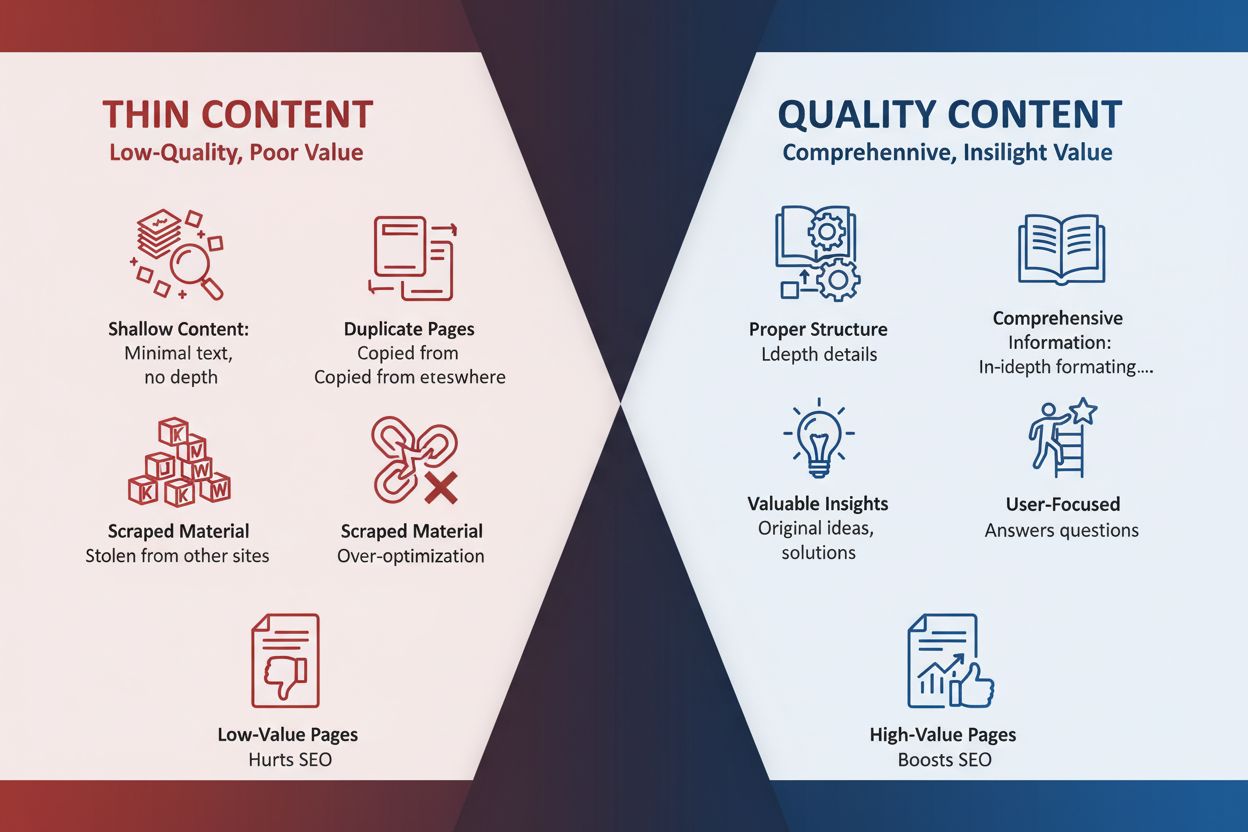
Thin content refers to web pages that offer visitors little or no added value, lacking depth, quality, originality, or meaningful insights. These pages fail to answer search intent, provide insufficient information, or simply rehash content readily available elsewhere without adding unique perspective. In today’s landscape where AI search engines like ChatGPT, Perplexity, Google AI Overviews, and Claude are reshaping how people find information, understanding thin content has become even more critical. The distinction between thin and authoritative content now determines not just traditional search rankings, but whether your content gets cited, referenced, or even discovered by AI systems. Thin content violates fundamental principles that both traditional search engines and AI systems use to evaluate quality, making it a significant liability for any website seeking visibility across the entire search landscape.
AI search engines employ sophisticated detection mechanisms that go far beyond simple keyword matching. Unlike traditional search algorithms that primarily focus on keyword relevance and backlink authority, AI systems analyze content at multiple semantic levels to understand meaning, context, and authority. When AI systems like ChatGPT, Perplexity, and Google AI Overviews process your content, they evaluate whether it provides comprehensive answers to user questions, demonstrates genuine expertise, and offers information not easily found elsewhere. Research shows that 88.1% of queries triggering AI Overviews are informational, meaning AI systems prioritize content that thoroughly answers questions from multiple angles. AI systems are particularly adept at identifying shallow content, keyword stuffing, scraped material, and low-effort AI-generated pages because they can compare your content against thousands of other sources simultaneously and assess relative depth and originality. The algorithms powering these systems understand that thin content provides poor user experience, which directly contradicts their core mission of delivering helpful, reliable information.
| Aspect | Traditional Google Search | AI Search Engines (ChatGPT, Perplexity, Claude) | Google AI Overviews |
|---|---|---|---|
| Primary Detection Method | Algorithmic ranking + manual penalties | Semantic analysis + source synthesis | Hybrid: ranking signals + AI comprehension |
| Minimum Content Depth | 300+ words recommended | 2,000-3,000+ words preferred | 1,500+ words for consideration |
| Penalty Type | Manual action or algorithmic demotion | Non-citation; exclusion from answers | Lower visibility in AI-generated summaries |
| Authority Signals | Backlinks, domain age, E-E-A-T | Author credentials, source diversity, expertise | E-E-A-T + citation frequency |
| Duplicate Content Handling | Canonical tags can mitigate | Prefers original sources; may ignore duplicates | Prioritizes first-published authoritative version |
| AI-Generated Content | No direct penalty; quality matters | Acceptable if high-quality and original | Acceptable if adds value and demonstrates expertise |
| Featured Snippet Optimization | Structured answers in 40-60 words | Comprehensive context preferred | Direct answer + supporting detail |
| Thin Content Examples Penalized | Keyword-stuffed pages, doorways, scraped content | Shallow affiliate pages, low-effort AI content | Minimal-value pages, thin category pages |
Keyword-stuffed pages represent one of the most obvious forms of thin content that AI systems immediately recognize and deprioritize. These pages force keywords repeatedly into content without providing genuine value or natural language flow, creating an experience that feels artificial to both human readers and AI language models. Doorway pages designed solely to rank for specific keywords before redirecting users elsewhere are another category AI systems actively avoid, as they violate the principle of providing direct, helpful answers. Scraped or duplicated content copied from other sources without permission, attribution, or transformation offers zero unique value and is easily detected by AI systems that can compare your content against the original source. Low-quality affiliate pages that promote products with minimal original research, personal testing, or unique insights fail to meet the E-E-A-T standards (Experience, Expertise, Authoritativeness, Trustworthiness) that AI systems use to evaluate source credibility. Thin category pages that simply list products or articles with no descriptive content, context, or added information provide insufficient material for AI systems to extract meaningful answers. Automatically generated content created by scripts or basic AI tools without human review often lacks coherence, contains factual errors, or provides generic information that doesn’t address specific user needs. Pages with excessive advertising that prioritize monetization over user experience create poor content environments that AI systems recognize as low-value, especially when ads dominate the visible content area.
While Google issues explicit manual penalties for thin content and algorithmically demotes low-quality pages through core updates, AI search engines employ a different but equally effective approach. Google’s Panda algorithm update (launched in 2011) established the foundation for penalizing thin content, and these principles remain embedded in Google’s ranking systems today. However, AI systems don’t issue manual penalties in the traditional sense; instead, they simply don’t cite, reference, or include thin content in their generated answers. This distinction is crucial: your thin content won’t necessarily disappear from search results, but it becomes invisible to AI systems that synthesize information for users. Research indicates that 46% of documents linked in AI Overviews come from top organic search results, meaning AI systems prefer content that already ranks well traditionally, but they apply additional quality filters. AI systems evaluate content comprehensiveness more strictly than Google does—while Google might rank a 500-word article if it’s the best available result, AI systems prefer 2,000-3,000+ word content that thoroughly covers topics from multiple angles. The AI Content Score metric introduced by leading platforms now measures content quality specifically for AI systems, focusing on comprehensive topical coverage and precise intent alignment rather than traditional SEO metrics like keyword density or word count alone.
The data clearly demonstrates that AI systems have higher quality thresholds than traditional search. Content over 3,000 words wins 3x more traffic than average-length content of 1,400 words, indicating that AI systems reward comprehensive coverage. Featured snippets have a 42.9% click-through rate, and 40.7% of voice search answers are pulled from featured snippets, showing that AI systems prioritize structured, direct answers to questions. 88.1% of queries triggering AI Overviews are informational, meaning AI systems focus on content that educates and explains rather than transactional or navigational content. 36.6% of search keywords trigger at least one featured snippet derived from schema markup, demonstrating that structured data significantly improves AI visibility. 75% of marketers leverage AI to reduce time on manual tasks, yet only 19% of marketers plan to add AI in search to their SEO strategy, indicating a significant opportunity gap for early adopters. 13.14% of all queries triggered AI Overviews in March 2025, up from 6.49% in January 2025, showing rapid growth in AI search adoption. 8% of U.S. respondents now use ChatGPT as their primary search engine, up from just 1% in June 2024, demonstrating accelerating shift toward AI-powered search.
ChatGPT prioritizes content from authoritative sources and tends to cite pages that demonstrate clear expertise and comprehensive coverage. When ChatGPT encounters thin content, it simply doesn’t reference it, instead pulling information from deeper, more authoritative sources. Perplexity explicitly shows source citations in its answers, making it immediately obvious when content is thin or low-quality—if your page doesn’t appear in Perplexity’s citations, it’s likely because the AI determined other sources provided better information. Google AI Overviews blend traditional ranking signals with AI comprehension, meaning thin content that ranks well traditionally might still be excluded from AI-generated summaries if Google’s AI systems determine it lacks sufficient depth. Claude emphasizes accuracy and source reliability, actively avoiding thin content that might contain errors or unsubstantiated claims. All these platforms share a common principle: thin content is invisible to AI systems, not because of explicit penalties, but because AI systems have access to better alternatives and actively choose authoritative sources. This creates a new form of penalty—not a ranking drop, but complete exclusion from the fastest-growing search channel.
The most direct method to identify thin content is conducting a content audit using both automated tools and manual review. Start by examining pages with low word counts (under 500 words), high bounce rates (above 70%), and minimal time on page (under 30 seconds), as these metrics often correlate with thin content. Use Google Search Console to identify pages receiving impressions but few clicks, indicating content that appears in search results but fails to satisfy user intent. Check for duplicate content using tools like Copyscape or built-in SEO platform features, as duplicated pages are automatically classified as thin. Review your affiliate pages to ensure they contain original research, personal testing, and unique insights beyond basic product descriptions. Examine category pages to confirm they include descriptive content, context, and added value rather than just product listings. Look for keyword stuffing by reading your content naturally—if it feels forced or repetitive, AI systems will recognize it as thin. Analyze your page structure to ensure proper heading hierarchy, descriptive subheadings, and clear organization that helps both users and AI systems understand content quickly. Monitor technical issues like broken internal links, missing alt text, and poor mobile optimization, as these signal low-quality pages to AI systems.
Expanding content with valuable information is the most direct solution for thin content problems. Add specific statistics, research findings, expert quotes, case studies, and real-world examples that provide context and depth. Aim for 2,000-3,000+ words for comprehensive topic coverage, ensuring you address related subtopics and answer common user questions from multiple angles. Implementing schema markup helps AI systems understand your content structure and extract key information more effectively—use FAQ schema for question-based content, How-To schema for step-by-step guides, and Article schema for long-form content with author credentials and publication dates. Combining thin pages on similar topics into comprehensive resources creates stronger content that AI systems prefer—for example, merging “Can dogs eat apples?” and “Can dogs eat bananas?” into “Can dogs eat fruit?” provides better coverage. Redirecting or deleting completely useless pages with no traffic and no backlinks helps clean up your site and ensures AI systems only encounter your best content. Refocusing thin content using keyword research to identify related topics and user questions helps you expand pages into authoritative resources. Repurposing content into new formats like infographics, videos, or webinars adds value and creates multiple entry points for AI systems to discover and cite your expertise. Updating outdated information with latest data, trends, and developments keeps content fresh and relevant to AI systems that value current, accurate information.
As AI search adoption accelerates—with 13.14% of queries triggering AI Overviews in March 2025 and 8% of U.S. users now using ChatGPT as their primary search engine—the distinction between thin and authoritative content will become even more pronounced. The AI Content Score metric now measures content quality specifically for AI systems, focusing on comprehensive topical coverage and precise intent alignment rather than traditional SEO metrics. This represents a fundamental shift: content quality is no longer just about ranking in blue links, but about being cited, referenced, and trusted by AI systems that synthesize information for millions of users. Organizations that continue producing thin content will find themselves increasingly invisible to AI search engines, even if they maintain traditional search rankings. The competitive advantage will belong to companies that invest in deep, authoritative, original content that demonstrates genuine expertise and provides comprehensive answers to user questions. FlowHunt.io and similar AI automation platforms can help streamline content creation workflows, but they cannot replace the fundamental requirement for quality, original research and insights. Using AmICited to monitor how your content appears across AI search engines—whether it’s being cited in ChatGPT, Perplexity, Google AI Overviews, or Claude—provides crucial visibility into whether your content meets AI quality standards or remains thin and invisible.
Track how your content appears across AI search engines and get alerts when thin content issues impact your AI citations and visibility.
Thin content definition: web pages with insufficient valuable information. Learn types, SEO impact, identification methods, and strategies to improve or remove ...

Learn how to enhance thin content for AI systems like ChatGPT and Perplexity. Discover strategies for adding depth, improving content structure, and optimizing ...
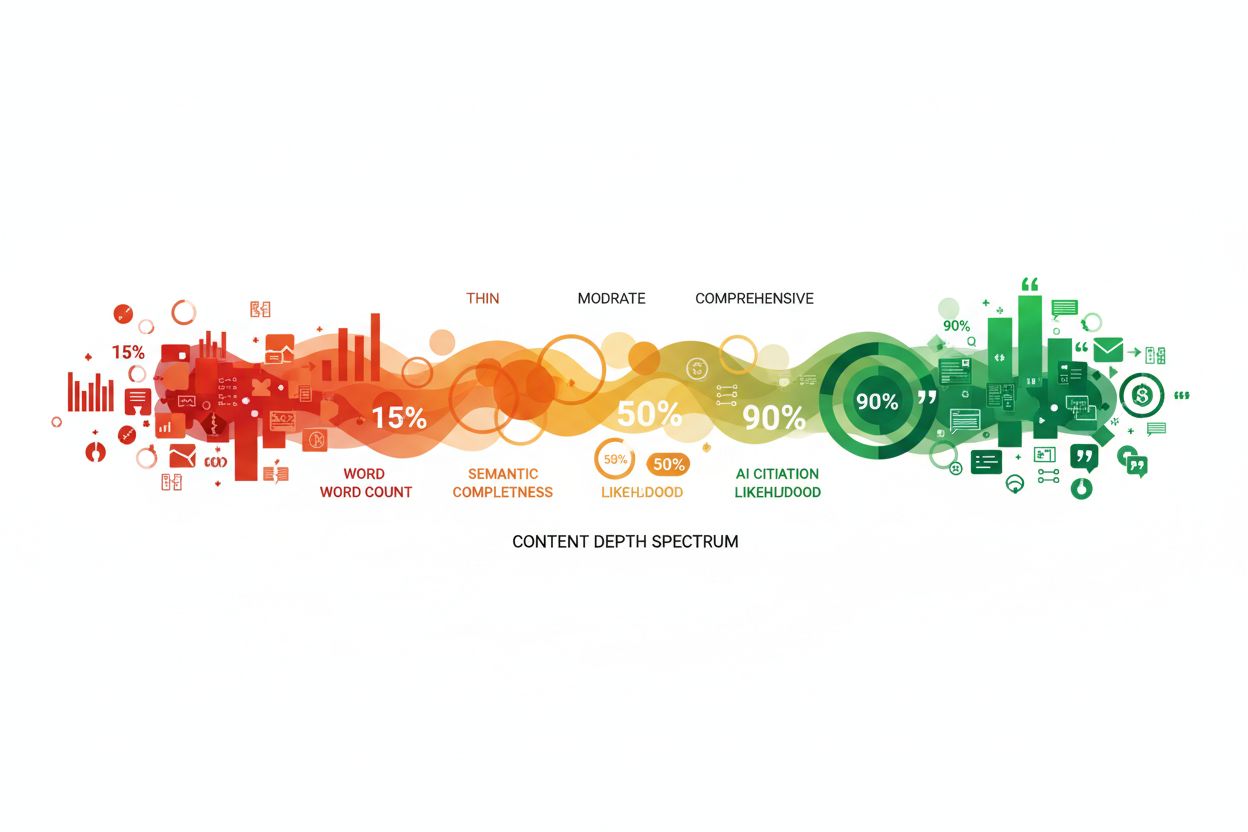
Learn how to create content deep enough for AI systems to cite. Discover why semantic completeness matters more than word count for ChatGPT, Perplexity, and Goo...