
Topic Cluster Model
Learn what the Topic Cluster Model is, how it works for SEO, and why it matters for ranking in Google, ChatGPT, Perplexity, and other AI search platforms. Compl...
12 min read

Learn how topic clusters help your brand appear in AI-generated answers. Discover how interconnected content improves visibility in ChatGPT, Perplexity, and other AI search engines.
A topic cluster is a group of interconnected, thematically related pages organized around a central pillar page. This structure helps AI systems understand your content's authority on a topic, making your brand more likely to appear in AI-generated answers and citations.
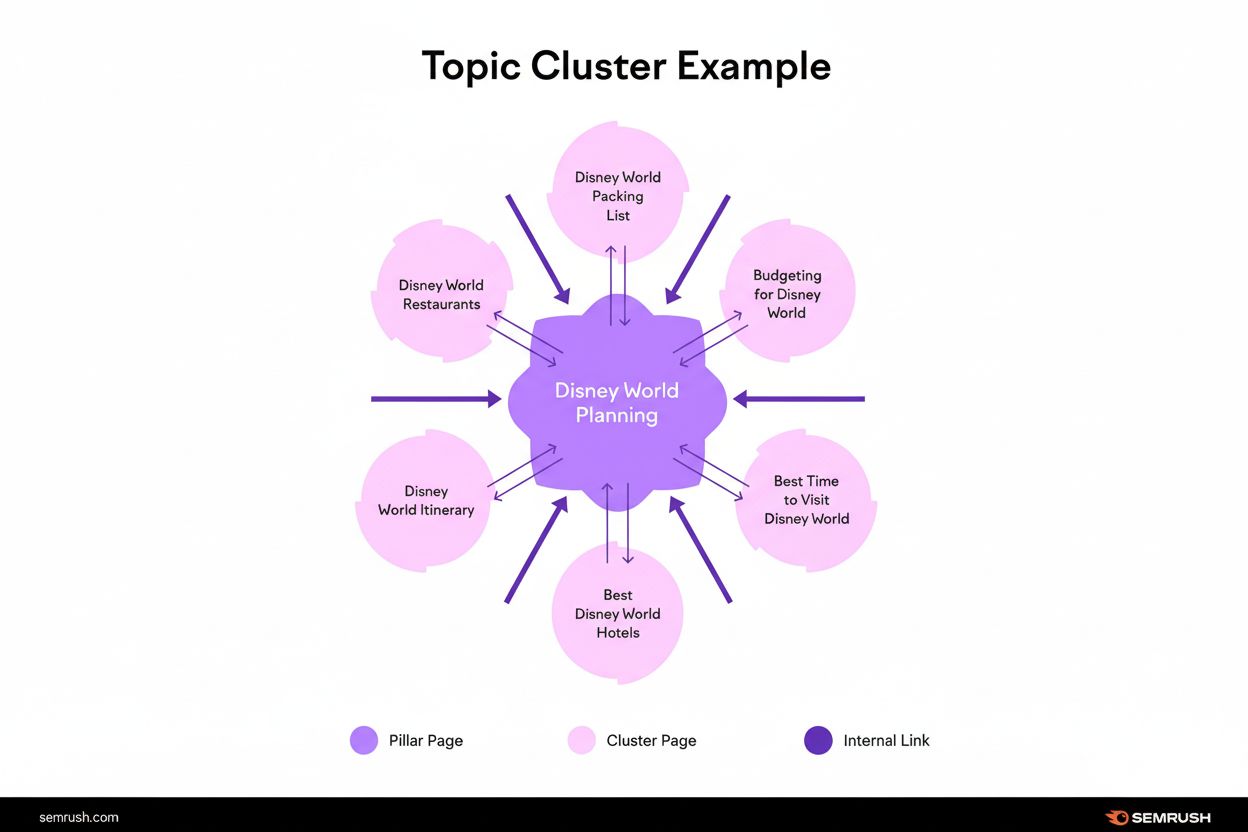
A topic cluster is a strategically organized group of interconnected web pages built around a central pillar page that covers a broad topic comprehensively. Each cluster includes multiple supporting pages that explore specific subtopics in depth, all linked together through internal linking. This structure creates a semantic web that helps both search engines and large language models (LLMs) understand your content’s authority and relevance on a particular subject. For brands monitoring their appearance in AI answers, topic clusters are essential because they signal topical expertise to AI systems that generate responses for platforms like ChatGPT, Perplexity, and other AI search engines.
The importance of topic clusters has grown significantly with the rise of AI-driven search and generative engine optimization (GEO). As AI systems become more sophisticated in understanding content relationships and topical authority, websites that organize their content into well-structured clusters gain a competitive advantage in appearing within AI-generated answers and citations. This is particularly critical for brands using AI visibility monitoring platforms to track their presence across multiple AI answer generators.
Topic clusters operate on a spoke-and-wheel model where the pillar page serves as the central hub and cluster pages act as spokes radiating outward. The pillar page is a comprehensive, broad-coverage page that addresses the main topic from multiple angles without going too deep into any single aspect. It answers the fundamental question users and AI systems ask about a topic. Supporting cluster pages then dive deeper into specific subtopics mentioned on the pillar page, providing detailed information that complements the broader overview.
The internal linking structure is crucial to how topic clusters function. Each cluster page links back to the pillar page using consistent anchor text, signaling to search engines and AI systems that these pages are thematically related and that the pillar page is the authoritative source on the topic. This interconnected structure creates what’s known as topical authority—a signal that your website comprehensively covers a subject area. When AI systems crawl and analyze your content, they recognize this authority through the semantic relationships established by your internal linking strategy.
| Component | Purpose | Characteristics |
|---|---|---|
| Pillar Page | Central hub covering broad topic | Comprehensive, 2,000-5,000+ words, covers multiple subtopics |
| Cluster Pages | Deep dives into specific subtopics | Focused, 1,500-3,000 words, targets specific keywords |
| Internal Links | Connect pages semantically | Consistent anchor text, bidirectional linking |
| Anchor Text | Signals topical relevance | Keyword-rich, descriptive, consistent across cluster |
AI systems and large language models rely on understanding topical relationships to generate accurate, authoritative answers. When you organize your content into topic clusters, you’re essentially creating a roadmap that helps these systems understand your expertise. AI platforms like ChatGPT, Perplexity, and others use sophisticated algorithms to identify which sources are most authoritative on specific topics. A well-structured topic cluster demonstrates this authority more effectively than scattered, unrelated content pages.
The rise of AI Overviews and AI-generated answers has fundamentally changed how brands need to think about content organization. Rather than competing solely for individual keyword rankings, brands now compete for inclusion in AI-generated responses. Topic clusters improve your chances of being cited in these AI answers because they provide the semantic clarity that AI systems need to confidently attribute information to your brand. When an AI system encounters your pillar page and its interconnected cluster pages, it recognizes a comprehensive, authoritative treatment of a topic and is more likely to reference your content when generating answers.
For companies using AI visibility monitoring platforms to track their brand mentions across AI search engines, topic clusters become a strategic asset. These platforms help you see exactly where and how your content appears in AI-generated answers. By implementing topic clusters, you create the conditions that make your content more discoverable and citable by AI systems, directly improving the metrics you track through monitoring tools.
Creating an effective topic cluster begins with identifying your core topic—a subject broad enough to support multiple supporting pages but focused enough to maintain coherence. This topic should align with your business goals and address problems your target audience actually searches for. The best approach involves researching what questions your audience asks, what competitors cover, and what content you already have that could be reorganized into a cluster structure.
Once you’ve identified your core topic, the next step is conducting keyword research to identify the pillar page topic and potential cluster page subtopics. This research should focus on understanding search intent—whether users are looking for informational content, commercial information, or transactional resources. AI systems also consider intent when determining which sources to cite, so aligning your cluster structure with user intent improves both traditional SEO and AI visibility.
The actual content creation process should prioritize quality and comprehensiveness. Your pillar page should provide a broad overview that touches on all major aspects of your topic without exhaustively covering any single element. This page should be substantial—typically 2,000 to 5,000+ words—and include a clear structure with headings that preview the subtopics you’ll explore in cluster pages. Each cluster page should then take one of these subtopics and explore it in depth, typically running 1,500 to 3,000 words depending on the topic’s complexity.
Internal linking is where the magic happens in a topic cluster. Every cluster page should link back to the pillar page using consistent, keyword-rich anchor text. The pillar page should link to each cluster page, ideally within relevant sections of the content. This bidirectional linking creates the semantic relationships that help AI systems understand your topical authority. The consistency of anchor text matters because it reinforces the topical connection between pages.
Generative Engine Optimization (GEO) is the practice of optimizing content to appear in AI-generated answers, and topic clusters are fundamental to an effective GEO strategy. Unlike traditional SEO, which focuses on ranking for specific keywords in search results, GEO focuses on being cited as a source within AI-generated responses. Topic clusters support GEO by providing the comprehensive, interconnected content that AI systems prefer when generating authoritative answers.
AI systems evaluate content quality using frameworks similar to Google’s E-E-A-T (Experience, Expertise, Authoritativeness, Trustworthiness). A well-structured topic cluster demonstrates all four of these qualities. The breadth of your cluster shows expertise and authoritativeness on a topic. The depth of individual cluster pages demonstrates experience with specific aspects of the topic. The interconnected structure and consistent internal linking build trustworthiness by showing that you’ve thoroughly covered a subject area.
When monitoring your AI visibility through platforms that track your mentions in ChatGPT, Perplexity, and similar systems, you’ll notice that topic clusters directly impact your citation frequency. Brands with well-organized topic clusters tend to appear more frequently in AI-generated answers because the AI systems can more easily identify and trust their content as authoritative sources. This is why companies serious about their presence in AI search engines invest in restructuring their content around topic clusters.
Tracking the performance of your topic clusters requires monitoring both traditional SEO metrics and AI visibility metrics. For search engine rankings, you should track how your pillar page and cluster pages rank for their target keywords over time. Most SEO tools allow you to group related keywords and track them as a cluster, giving you visibility into how the entire cluster performs rather than individual pages.
AI citation tracking is equally important for understanding your topic cluster’s effectiveness in the AI visibility space. Specialized monitoring platforms can track how often your content appears in AI-generated answers across different platforms. You should see improvements in citation frequency as your topic cluster matures and gains authority. Additionally, monitor which specific pages from your cluster are being cited most frequently—this information helps you understand which subtopics resonate most with AI systems and your audience.
Engagement metrics like time on page, bounce rate, and internal click-through rates provide insights into whether your topic cluster structure is actually helping users navigate your content. A well-designed cluster should encourage users to explore multiple pages within the cluster, increasing overall engagement and time spent on your site. This user behavior also signals to AI systems that your content is valuable and worth citing.
One of the most common mistakes in topic cluster implementation is choosing a pillar page topic that’s too narrow or too broad. A topic that’s too narrow won’t support enough cluster pages to create meaningful topical authority. A topic that’s too broad becomes unfocused and dilutes your authority signal. The sweet spot is a topic broad enough to encompass 15-30 related subtopics but focused enough that all pages clearly relate to a central theme.
Another frequent error is inconsistent internal linking. If you link to cluster pages from your pillar page but fail to link back from cluster pages to the pillar page, you’re breaking the semantic connection that makes topic clusters effective. Similarly, using different anchor text for the same topical connection confuses both search engines and AI systems about the relationship between pages. Consistency in anchor text is critical for signaling topical relationships.
Many organizations also struggle with content quality and depth. Creating thin, low-quality cluster pages to quickly expand your cluster actually harms your topical authority. AI systems are sophisticated enough to recognize when content is shallow or duplicative. Each cluster page should provide genuine value and unique insights that complement rather than repeat information from other pages in the cluster. Quality always trumps quantity when it comes to building topical authority for AI visibility.
Track how your content appears across AI search engines and AI answer generators. Get real-time insights into your brand mentions in ChatGPT, Perplexity, and other AI platforms.
Learn what the Topic Cluster Model is, how it works for SEO, and why it matters for ranking in Google, ChatGPT, Perplexity, and other AI search platforms. Compl...

Learn what content clusters are, how they work, and why they're essential for SEO and AI search visibility. Discover pillar pages, internal linking strategies, ...
Learn how semantic content clustering for GEO helps your brand appear in AI-generated answers. Discover entity relationships, topical authority, and how to stru...