

How to Build Topical Authority for Your Website
Learn how to build topical authority through strategic content creation, keyword research, and link building. Establish expertise and improve your search rankin...
11 min read

Learn how topical authority impacts AI search visibility, citations in ChatGPT and Perplexity, and how to build expertise that AI systems recognize and cite.
Topical authority is the level of trust AI search engines assign to your website within a specific subject area. It determines whether your content gets cited in AI-generated answers, appears in ChatGPT summaries, or shows up in Perplexity results. Sites with strong topical authority demonstrate comprehensive coverage, expertise, and reliability across a topic, making them preferred sources for AI systems to reference.
Topical authority is the recognized expertise and comprehensive coverage your website demonstrates within a specific subject area. Unlike traditional domain authority, which measures overall site strength through backlinks and age, topical authority focuses on how completely and accurately you cover a particular topic. For AI search engines like ChatGPT, Perplexity, and Google’s AI Overviews, topical authority has become a critical factor in determining which sources get cited and which content appears in AI-generated answers.
When AI systems generate responses to user queries, they rely on retrieval-augmented generation (RAG) technology, which pulls information from web sources that already demonstrate proven expertise. Research shows that 76.1% of citations in AI Overviews come from pages ranking in the top 10 organic search results, confirming that the same signals that build traditional SEO authority also determine AI visibility. This means topical authority is no longer optional—it’s essential for appearing in the AI search results your audience uses daily.
The shift toward AI-powered search has fundamentally changed how visibility works. A site no longer needs massive domain authority to dominate a niche. Instead, it needs to prove deep, organized expertise within a focused topic area. Small, specialized websites can outrank larger competitors if they demonstrate superior topical authority through comprehensive content coverage, clear internal structure, and consistent expertise signals.
AI systems evaluate topical authority through multiple interconnected signals that go far beyond simple keyword matching. These systems analyze how your content demonstrates understanding of entities, relationships, and semantic meaning within your subject area. Understanding these evaluation methods helps you build content that AI systems recognize as authoritative.
| Evaluation Factor | How AI Systems Assess It | Impact on AI Citations |
|---|---|---|
| Content Depth & Breadth | Checks if you cover all major subtopics and answer related questions comprehensively | Pages with complete topic coverage are 3x more likely to be cited |
| Entity Recognition | Analyzes mentions of related concepts, tools, people, and products within your topic | Proper entity alignment increases AI selection by 32% |
| Internal Linking Structure | Evaluates how pages connect to show topic relationships and hierarchy | Well-linked clusters rank 24% faster in AI results |
| E-E-A-T Signals | Assesses Experience, Expertise, Authoritativeness, and Trustworthiness through author credentials and sourcing | Content with clear authorship gets cited 2x more often |
| Content Freshness | Monitors update frequency and recency of information | Recently updated pages appear in 38% more AI summaries |
| Semantic Consistency | Checks if terminology and topic relationships align with how the topic is discussed across trusted sources | Semantically aligned content has 19% higher AI visibility |
AI systems prioritize semantic relevance over keyword density. When your content naturally discusses related entities—such as tools, methodologies, people, and concepts—that appear together across trusted sources, AI systems recognize this as a sign of genuine expertise. This semantic alignment tells AI models that your information is reliable and reduces their risk of generating inaccurate summaries.
The Knowledge Graph, Google’s massive database of entities and their relationships, plays a crucial role in how AI systems evaluate your topical authority. When your content accurately reflects the relationships between entities that Google’s Knowledge Graph recognizes, AI systems gain confidence in your expertise. For example, if you’re writing about email marketing, mentioning related entities like “list segmentation,” “deliverability,” “A/B testing,” and “welcome sequences” in proper context signals to AI that you understand the full scope of the topic.
Traditional search engines like Google have always valued topical authority, but AI search engines depend on it even more heavily. The reason is fundamental: AI systems need to trust your information to avoid generating false or misleading answers. When an AI model cites your content, it’s essentially endorsing your information to users. This creates a higher bar for inclusion than traditional search rankings.
AI systems use your content as training material for generating responses. If your site demonstrates inconsistent information, gaps in coverage, or lacks clear expertise signals, AI models learn to deprioritize your content. Conversely, sites with strong topical authority become preferred sources because they reduce the model’s error rate. This creates a powerful feedback loop: strong topical authority leads to more AI citations, which increases brand visibility and user trust, which further strengthens your topical authority signals.
Research from Ahrefs found that brands cited multiple times in Google’s AI Overviews saw an 18% increase in branded search volume within three months. This increase comes directly from repeated AI system selection. When users see your brand mentioned as a trusted source in AI answers, they’re more likely to search for your brand directly, creating additional visibility signals that further improve your topical authority.
The stakes are higher in AI search because zero-click answers are becoming the norm. Users increasingly get their answers directly from AI systems without clicking through to websites. This means your brand visibility depends entirely on being cited as a source, not on driving clicks. Topical authority is what gets you cited.
Building topical authority requires a strategic, systematic approach that goes beyond publishing individual blog posts. You need to create an interconnected content ecosystem that demonstrates comprehensive expertise. The process involves five key phases: topic selection, content mapping, strategic publishing, structural optimization, and continuous refinement.
Start with focused topic selection. Choose one clear subject area where your organization can provide sustained, original insight. This focus allows you to cover every connected question and subtopic, making it easier for AI systems to recognize your comprehensive expertise. Avoid trying to be an authority on everything—AI systems recognize and reward specialization. A small site that completely dominates one niche will outrank a large generalist site in AI results for that topic.
Map all related entities and semantic relationships. Before publishing, identify every entity, concept, tool, and relationship associated with your topic. This entity mapping ensures you don’t miss important coverage areas that AI systems expect. Use tools like Google’s Knowledge Graph, AlsoAsked, and semantic SEO platforms to identify what entities and relationships are associated with your topic across the web. This research becomes your content roadmap.
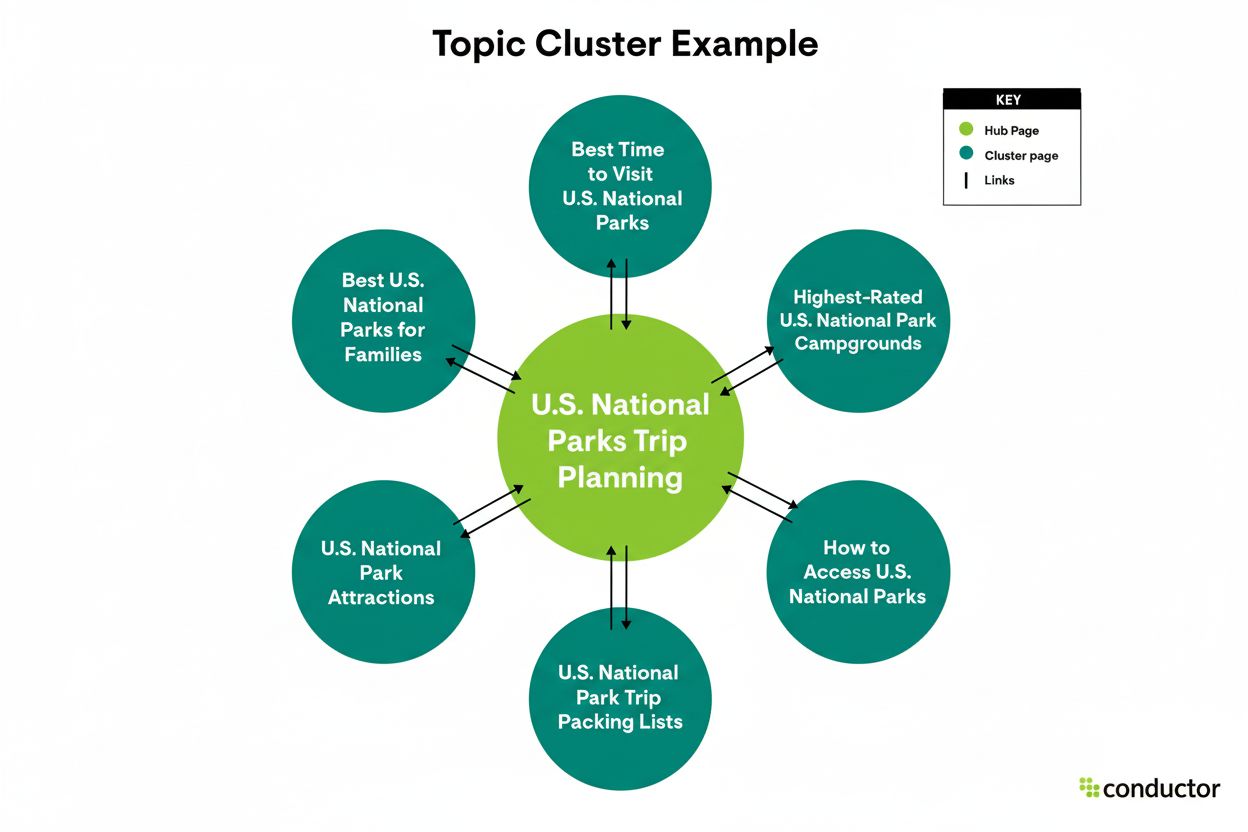
Create a pillar-and-cluster content structure. Develop one comprehensive pillar page that provides a complete overview of your core topic, then create supporting cluster pages that dive deep into specific subtopics. Each cluster page should link back to the pillar, and related cluster pages should link to each other. This structure helps AI systems understand how your content connects and reinforces your topical authority across the entire cluster.
Implement strategic internal linking with semantic anchor text. Internal links are how you tell AI systems (and search engines) that your content is interconnected and comprehensive. Use descriptive anchor text that accurately reflects the subtopic being linked to. For example, instead of “click here,” use “learn about email list segmentation strategies.” This semantic clarity helps AI systems understand the relationships between your pages and confirms your topical expertise.
Publish content that demonstrates original expertise. AI systems prioritize content that shows first-hand knowledge, original research, or unique insights. Include author credentials, cite reputable sources, feature original data or case studies, and provide tested recommendations. Content that simply rehashes information from other sources gets deprioritized by AI systems. Your content needs to add genuine value and demonstrate that you’ve actually worked with the topic.
Measuring topical authority’s impact on AI search requires tracking different metrics than traditional SEO. While Google Search Console shows keyword rankings, AI visibility requires monitoring whether your content actually appears in AI-generated answers and how frequently you’re cited.
Track AI citations and mentions. Monitor where your content appears in AI Overviews, ChatGPT responses, and Perplexity answers. Tools like Semrush One and Profound provide AI visibility tracking that shows which of your pages are being cited and in what context. This direct measurement of AI citations is the most reliable indicator of topical authority impact.
Monitor topic-level keyword growth. Instead of tracking individual keywords, track how your visibility expands across all semantically related queries within your topic. If you’re building topical authority in email marketing, you should see growing impressions across queries related to segmentation, automation, deliverability, and personalization. This broad keyword expansion indicates that AI systems recognize your comprehensive expertise.
Measure indexing speed for new content. As your topical authority grows, new content in your topic cluster should index and rank faster. Semrush data shows that sites with high topical consistency reduced index-to-rank time by 23% on average. If your new articles are appearing in search results and AI summaries faster than they used to, your topical authority is increasing.
Track branded search volume growth. When AI systems cite your brand as a trusted source, users are more likely to search for your brand directly. An increase in branded search volume correlates with increased AI citations and improved topical authority recognition. This metric shows that your expertise is becoming recognized both by AI systems and by your audience.
Analyze backlink quality and relevance. Focus on earning backlinks from sites within your topic area rather than generic high-authority sites. Topically relevant backlinks are 32% more valuable for topical authority than generic links. Monitor whether you’re earning links from publications, creators, and organizations that operate in your niche.
Many organizations inadvertently damage their topical authority through common content mistakes. Understanding these pitfalls helps you avoid them and maintain strong AI visibility.
Publishing volume over substance is the most common mistake. Creating ten shallow articles about different angles of a topic is far less effective than creating one comprehensive guide that thoroughly covers the entire topic. AI systems can detect surface-level content and deprioritize it. Quality and depth matter far more than quantity. One detailed, well-researched article that answers every aspect of a question will outperform multiple thin posts every time.
Failing to update and refresh content signals to AI systems that your expertise is stale. Information that hasn’t been reviewed in a year shows neglect, even if it once ranked well. AI systems monitor recency and reliability. Set a quarterly review schedule for your pillar pages and update them with new data, examples, and current best practices. Clearly display update dates so both users and AI systems know your information is current.
Creating orphaned or poorly linked content prevents AI systems from understanding your full topical coverage. If you publish articles that don’t link to your pillar page or connect to related cluster content, AI systems can’t see how they fit into your overall expertise. Every piece of content should have a clear place in your topical structure with appropriate internal links.
Lacking clear author credentials and sourcing undermines trust signals that AI systems rely on. If users and AI systems can’t verify who wrote your content or where your data came from, they question your expertise. Always include author bios with relevant credentials, cite credible sources, and link to primary research or first-hand data. This transparency is essential for topical authority.
Inconsistent terminology and entity usage confuses AI systems about what you’re actually discussing. If you refer to the same concept by different names throughout your content, AI systems struggle to recognize your semantic consistency. Use consistent terminology, define key terms clearly, and maintain semantic alignment with how your topic is discussed across trusted sources.
As AI search continues to evolve, topical authority will become even more critical for visibility. The trend is clear: AI systems are moving toward preferring specialized, authoritative sources over generalist content. This shift creates opportunities for organizations willing to build deep expertise in focused areas.
The integration of retrieval-augmented generation (RAG) into more AI systems means that topical authority will increasingly determine which sources get included in the retrieval set that powers AI responses. Sites that demonstrate comprehensive, well-organized expertise will be prioritized in these retrieval sets, while thin or scattered content will be excluded entirely.
Semantic SEO and entity optimization will become standard practice for building topical authority. As AI systems become more sophisticated at understanding semantic relationships, the ability to demonstrate how entities and concepts connect within your topic will become a core competitive advantage. Organizations that map their topics semantically and structure their content accordingly will dominate AI search results.
The zero-click answer economy means that brand visibility increasingly depends on being cited as a source rather than on driving clicks. This makes topical authority the foundation of modern digital visibility. Your goal isn’t just to rank—it’s to be recognized as the authoritative source that AI systems cite when answering questions about your topic.
Track where your domain appears in AI-generated answers across ChatGPT, Perplexity, and other AI search engines. Get real-time alerts when your content is cited and understand how topical authority impacts your AI visibility.
Learn how to build topical authority through strategic content creation, keyword research, and link building. Establish expertise and improve your search rankin...
Topical authority is a website's proven expertise in a specific subject area through comprehensive content coverage. Learn how it impacts AI search visibility a...
Learn how page authority works in AI search engines like ChatGPT and Perplexity. Discover what signals AI systems use to evaluate page credibility and how to op...