
Transactional Intent
Transactional intent defines searches with purchase or action intent. Learn how to identify, target, and optimize for high-converting transactional keywords to ...
11 min read

Understand transactional search intent in AI systems. Learn how users interact with ChatGPT, Perplexity, and other AI search engines when ready to take action or make purchases.
Transactional search intent for AI refers to user queries where people are ready to take immediate action, such as making a purchase, signing up for a service, or completing a transaction. In AI systems like ChatGPT and Perplexity, transactional intent has grown 9x compared to traditional search, representing 6.1% of all AI prompts as users increasingly ask AI assistants to help them buy products and complete actions directly within the chat interface.
Transactional search intent represents a fundamental shift in how users interact with artificial intelligence systems. Unlike traditional search engines where users click through to websites, transactional intent in AI refers to queries where users expect the AI system to help them complete an action directly within the chat interface. This includes purchasing products, signing up for services, downloading resources, booking appointments, or any other conversion-focused action. The critical distinction is that users with transactional intent are no longer in the research phase—they are ready to act and want immediate assistance from the AI to facilitate that action.
In the context of AI search engines like ChatGPT, Perplexity, Claude, and Gemini, transactional intent has experienced explosive growth. Research analyzing over 50 million real ChatGPT prompts revealed that transactional intent jumped from just 0.6% in traditional Google search to 6.1% in AI interactions—a remarkable 9x increase. This dramatic shift indicates that users are fundamentally changing how they approach decision-making and purchasing, increasingly delegating these tasks to AI assistants rather than conducting independent research across multiple websites.
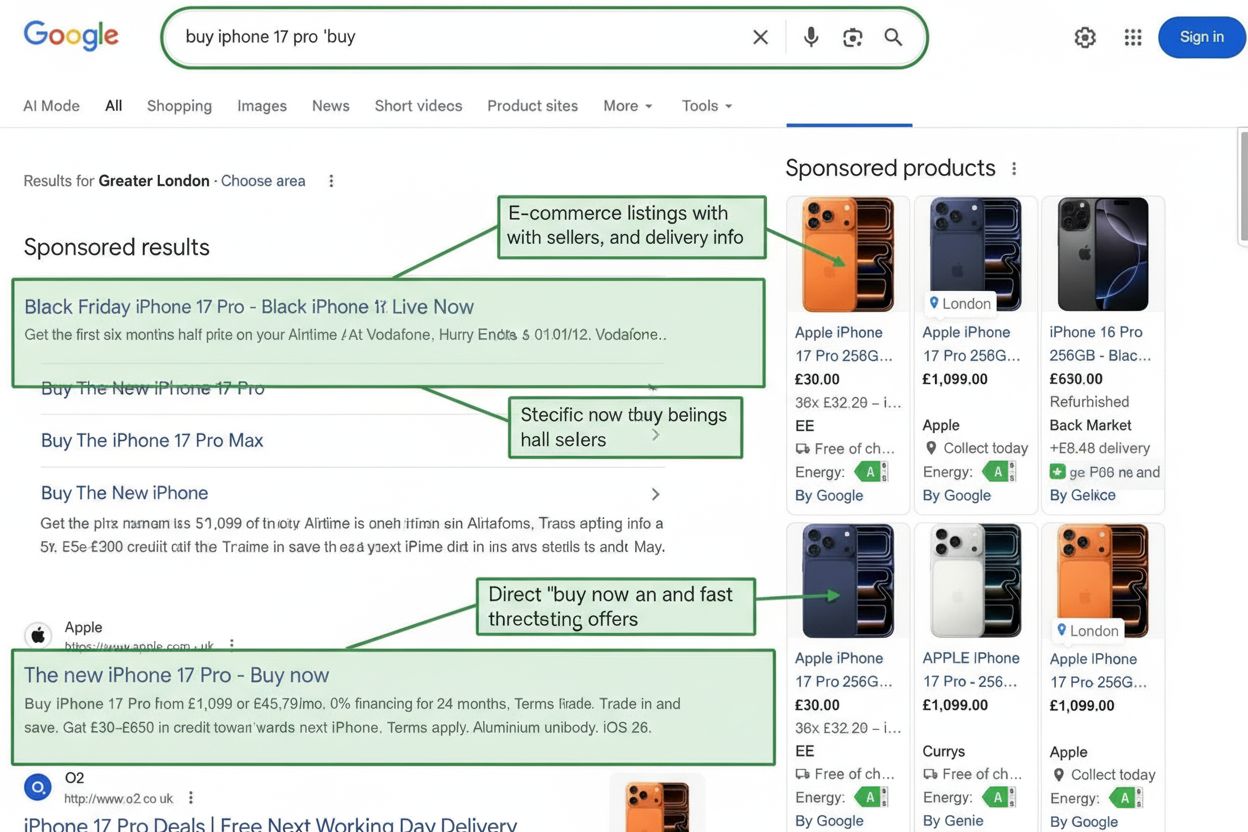
The way transactional intent manifests differs significantly between traditional search engines and AI systems. In Google Search, transactional queries typically include action-oriented keywords like “buy,” “order,” “subscribe,” “download,” or specific product names with purchase modifiers. These queries trigger product pages, shopping carousels, and direct purchase links. However, Google’s AI Overviews rarely appear for purely transactional queries—only about 4% or less of transactional searches trigger an AI summary, because Google recognizes that users need direct access to purchase options rather than explanatory content.
In contrast, AI chat systems handle transactional intent fundamentally differently. When users ask ChatGPT to “help me find the best running shoes under $100” or “find me a deal on project management software,” the AI doesn’t just provide links—it actively participates in the decision-making process. The AI can compare options, explain features, discuss pricing, and even help users understand which product best fits their specific needs, all within the conversation. This represents a complete reimagining of the transactional journey, where the AI becomes an active participant in the purchase decision rather than a passive directory of links.
The growth of transactional intent in AI systems reflects broader changes in user behavior and expectations. Traditional search intent distribution showed informational queries dominating at 52.7%, navigational at 32.2%, commercial at 14.5%, and transactional at only 0.6%. This distribution remained relatively stable for years because the search experience was fundamentally limited—users had to navigate between websites, compare information manually, and make decisions independently.
AI systems have fundamentally altered this dynamic. In ChatGPT, the distribution shifted dramatically: informational dropped to 32.7%, navigational collapsed to 2.1%, commercial remained at 9.5%, but transactional exploded to 6.1%. Additionally, a new category emerged—generative intent at 37.5%—where users ask AI to create, draft, or synthesize content directly. This reshuffling demonstrates that users are no longer using AI primarily for information gathering; instead, they’re using it to accomplish tasks and make decisions with AI assistance.
The reasons for this shift are compelling. Users recognize that AI can simultaneously research, compare, evaluate, and recommend solutions in real-time, eliminating the need to visit multiple websites or spend hours reading reviews. When someone asks ChatGPT “I need to buy a CRM for my small business, what should I choose?” the AI can provide a comprehensive analysis of options like HubSpot, Zoho, and Pipedrive, discuss pricing, explain features relevant to small businesses, and even help the user understand which option aligns with their specific workflow—all without the user leaving the chat interface.
Transactional queries in AI systems share several distinctive characteristics that differentiate them from other intent types. First, they contain action-oriented language and keywords such as “buy,” “order,” “subscribe,” “sign up,” “download,” “book,” “reserve,” “get a deal,” or “find me.” These keywords signal that the user has moved beyond the research phase and is ready to take concrete action. Second, transactional AI queries often include specific constraints or preferences, such as budget limitations (“under $100”), specific features needed (“with AI capabilities”), or particular use cases (“for small teams”). This specificity helps the AI provide more targeted recommendations.
Third, transactional queries in AI frequently combine multiple intents within a single prompt. A user might ask: “Compare three affordable project management tools and recommend the best one for remote teams with a budget under $50/month.” This single query encompasses commercial intent (comparison), informational intent (learning about features), and transactional intent (readiness to purchase). AI systems excel at handling these mixed-intent queries because they can synthesize information, provide analysis, and guide users toward decisions all within one conversation.
Fourth, transactional AI queries often include follow-up requests for implementation help. After receiving a recommendation, users frequently ask “How do I set this up?” “What’s the onboarding process?” or “Can you help me understand the pricing tiers?” This represents a fundamental difference from traditional search, where users would need to navigate to the product website and find this information independently. In AI systems, the transactional journey extends beyond the purchase decision to include implementation support.
The rise of transactional intent in AI systems has profound implications for how brands achieve visibility and influence purchasing decisions. In traditional search, appearing in the top organic results for transactional keywords was critical because users would click through to product pages. However, in AI systems, visibility is determined by whether your brand gets cited as a recommended solution within the AI’s response. This represents a fundamental shift from ranking-based visibility to citation-based visibility.
Research on AI Overviews and ChatGPT responses reveals that AI systems cite multiple sources when providing transactional recommendations, typically pulling from 6-8 sources for focused transactional queries. When an AI recommends your product or service, it will cite the source where it found that information—often your website, a review site that mentions your product, or industry publications that feature your solution. This means brands need to optimize their content not just for search rankings, but for AI citation and recommendation.
The implications are significant. A brand that ranks #1 for a transactional keyword in Google but isn’t cited by ChatGPT when users ask for recommendations in that category will lose visibility and influence. Conversely, a brand that appears in AI recommendations might drive substantial traffic and conversions even if it doesn’t rank in the top positions for traditional search. This has created what experts call an “existential pivot moment” for SEO and digital marketing, where companies must shift from optimizing for discoverability (traditional rankings) to optimizing for recommendability (AI citations).
Different AI platforms handle transactional intent with varying approaches, reflecting their different architectures and business models. ChatGPT, as a conversational AI, engages deeply with transactional queries, often providing detailed comparisons and recommendations. When users ask transactional questions, ChatGPT can discuss pricing, features, pros and cons, and even help users think through their specific needs before making a recommendation. However, ChatGPT doesn’t directly facilitate purchases within the chat—it provides information and guidance that helps users make informed decisions.
Perplexity, positioned as an AI search engine, handles transactional intent by providing synthesized answers with citations, similar to how Google’s AI Overviews work. When users search for transactional queries on Perplexity, they receive a concise answer with links to relevant sources. This approach bridges traditional search and conversational AI, providing the research benefits of search with the synthesis capabilities of AI. Perplexity’s approach to transactional queries emphasizes providing users with the information they need to make decisions while directing them to relevant sources.
Google’s AI Overviews, as discussed earlier, rarely appear for purely transactional queries. Instead, Google relies on its traditional SERP features—shopping carousels, product listings, local business results, and direct product links—to serve transactional intent. This reflects Google’s recognition that for transactional queries, users benefit more from direct access to purchase options than from AI-generated summaries. However, Google is increasingly integrating AI into its shopping experience, showing product images, prices, and AI-generated comparisons alongside traditional shopping results.
Brands seeking to capture transactional intent in AI systems must optimize their content differently than they would for traditional search. The first principle is ensuring your content is discoverable and citable by AI systems. This means creating comprehensive, well-structured content that clearly presents your products, services, pricing, and unique value propositions. AI systems extract information from pages that are easy to parse—pages with clear headings, organized information, and specific details about what you offer.
Second, brands should create content that directly addresses transactional queries and decision-making needs. This includes detailed product pages with specifications, pricing information, comparison guides that position your solution against competitors, customer testimonials and reviews, and implementation guides. When AI systems encounter this content, they can confidently cite it as a source for recommendations. For example, if your product page clearly states “Our CRM is designed for small businesses with teams of 5-50 people and costs $49/month,” an AI system can cite this information when recommending your solution to users with those specific needs.
Third, brands should optimize for mixed-intent queries that combine transactional elements with informational or commercial elements. Create content that helps users understand not just what you offer, but why they should choose your solution and how to implement it. A comprehensive guide titled “How to Choose a Project Management Tool for Remote Teams: Features, Pricing, and Implementation” serves multiple intents simultaneously—it helps users learn about the category, compare options, and understand how to get started.
Fourth, brands should ensure their content is accessible to AI systems through proper technical implementation. This includes using structured data markup (Schema.org) to clearly identify products, pricing, and features; ensuring your website is crawlable by AI systems; and potentially implementing an llms.txt file that guides AI systems to your most important content. Some AI systems, like those used by Profound and other AI monitoring platforms, specifically look for content that clearly communicates your value proposition and differentiators.
The trajectory of transactional intent in AI systems suggests continued growth and evolution. As AI systems become more sophisticated and integrated into users’ daily workflows, we can expect transactional intent to continue increasing as a percentage of all AI interactions. Users will increasingly delegate purchasing decisions, service selections, and other transactional tasks to AI assistants, expecting them to provide comprehensive analysis and recommendations.
Future developments will likely include deeper integration between AI systems and e-commerce platforms. We may see AI systems that can not only recommend products but also facilitate purchases directly within the chat interface, similar to how some AI systems already help users book flights or reserve hotel rooms. This would represent the ultimate evolution of transactional intent in AI—where the entire purchase journey, from discovery to checkout, occurs within the AI interface.
Additionally, brands will need to adapt their marketing and content strategies to emphasize AI visibility and citation. This means moving beyond traditional SEO metrics like rankings and traffic to focus on metrics like citation frequency, citation context, and influence on AI-generated recommendations. Companies that successfully position themselves as trusted sources for transactional recommendations in their categories will gain significant competitive advantages as AI-mediated commerce continues to grow.
While transactional and commercial intent are often confused, they represent distinct stages in the user journey. Commercial intent refers to queries where users are researching and comparing options before making a purchase decision. Someone searching “best CRM for small businesses” or “Salesforce vs HubSpot comparison” has commercial intent—they’re gathering information to make an informed decision but haven’t committed to purchasing yet. Commercial queries typically include words like “best,” “top,” “review,” “compare,” or “vs.”
Transactional intent, by contrast, indicates the user has already decided what they want and is ready to take action. Queries like “buy HubSpot CRM,” “sign up for Salesforce free trial,” or “order CRM software online” demonstrate transactional intent. The user has moved past the research phase and is now focused on execution. In AI systems, this distinction becomes even more important because AI can help users move from commercial intent (research and comparison) to transactional intent (decision and action) within a single conversation.
| Aspect | Commercial Intent | Transactional Intent |
|---|---|---|
| User Stage | Research and comparison phase | Ready to take action |
| Keywords | “best,” “review,” “compare,” “vs” | “buy,” “order,” “sign up,” “subscribe” |
| AI Behavior | Provides comparisons and analysis | Facilitates decision and action |
| Content Type | Comparison guides, reviews, roundups | Product pages, pricing pages, checkout flows |
| Conversion Stage | Early-to-mid funnel | Late funnel, ready to convert |
| AI Citation Likelihood | High (15-20% of AI Overviews) | Low in traditional search, high in chat AI |
For brands operating in competitive markets, monitoring how your company appears in AI responses to transactional queries is critical. This involves tracking not just whether you appear in AI recommendations, but the context in which you’re recommended, what competitors are cited alongside you, and how frequently your brand is mentioned in transactional scenarios. Specialized AI monitoring platforms can track your brand’s appearance across ChatGPT, Perplexity, Google AI Overviews, and other AI systems, providing insights into your citation frequency and competitive positioning.
Effective monitoring should answer questions like: When users ask AI systems for product recommendations in your category, is your brand mentioned? How often is your brand cited compared to competitors? What specific features or benefits does the AI highlight when recommending your solution? Are there gaps between how you position your product and how AI systems describe it? By answering these questions, brands can identify opportunities to improve their AI visibility and ensure they’re being recommended to users with transactional intent.
Track how your brand appears in AI-generated answers across ChatGPT, Perplexity, and other AI search engines. Ensure your content is cited when users have transactional intent.
Transactional intent defines searches with purchase or action intent. Learn how to identify, target, and optimize for high-converting transactional keywords to ...
Learn how large language models interpret user intent beyond keywords. Discover query expansion, semantic understanding, and how AI systems determine which cont...

Learn how conversational intent shapes AI dialogue. Discover strategies to match your content to how users interact with AI systems and monitor brand visibility...