

Defining AI Visibility KPIs: Complete Metrics Framework
Learn how to define and measure AI visibility KPIs. Complete framework for tracking mention rate, representation accuracy, citation share, and competitive voice...
16 min read

Learn the essential KPIs for monitoring your brand’s visibility in AI search engines like ChatGPT, Perplexity, and Google AI Overviews. Track AI Signal Rate, Answer Accuracy, and more.
Track three core KPIs for AI visibility: AI Signal Rate (how often your brand appears in AI answers), Answer Accuracy Rate (how correctly AI represents your brand), and AI Influenced Conversion Rate (how AI traffic converts). Additionally monitor Share of AI Voice, Average Rank Position, and engagement metrics across platforms like ChatGPT, Perplexity, and Google AI Overviews.
AI visibility KPIs are the essential metrics that help you understand how your brand appears, performs, and is represented across AI-powered search platforms and answer generators. As artificial intelligence continues to reshape how users discover information online, traditional SEO metrics like rankings and clicks no longer tell the complete story. AI search experiences introduce new layers of visibility that require fundamentally different measurement approaches. The shift from keyword-driven discovery to conversation-driven discovery demands a complete reset of how marketers measure success in the digital landscape.
Unlike traditional search where users click through ranked results, AI platforms like ChatGPT, Perplexity, Google AI Overviews, and Claude generate direct answers to user questions. Your brand may be mentioned, cited, or recommended within these AI-generated responses without generating a traditional click. This creates a critical measurement gap that standard analytics tools cannot address. Without proper AI visibility KPIs, you’re essentially flying blind in one of the fastest-growing channels for brand discovery. The companies that learn to interpret and act on these new visibility signals will have a significant competitive advantage in reaching their audiences first.
AI Signal Rate measures how often your brand is mentioned or appears in AI-generated answers for queries in your category. This is the foundational metric that answers the critical question: “Is your brand visible when AI tools answer questions about your industry?” The metric represents the percentage of AI answers that mention your brand compared to the total number of AI questions asked across your target keywords and topics.
The formula is straightforward: AI Signal Rate = (Number of AI answers that mention your brand) / (Total AI questions asked). For example, if you ask Perplexity 100 questions about your industry and your brand appears in 35 of those answers, your AI Signal Rate would be 35 percent. This metric becomes even more powerful when compared against your competitors’ signal rates and tracked over time to identify improvement trends. Leaders in competitive categories might achieve 60 to 80 percent citation rates, while challenger brands typically start at 5 to 10 percent. The key is tracking direction and improvement rather than obsessing over absolute perfection.
Why AI Signal Rate matters: Visibility is the starting point of any discovery journey. If AI tools are not mentioning your brand when answering questions in your space, you are completely invisible where discovery is now happening. This metric directly correlates with brand awareness and reach in the AI-driven search ecosystem. Without visibility, you cannot influence decisions or drive traffic from these emerging channels.
Answer Accuracy Rate measures how accurately and credibly AI systems represent your brand when they do mention you. This metric is critical because visibility without accuracy creates significant risk to your brand reputation. If AI platforms are spreading incorrect information about your products, services, or company values, you’re actually damaging your credibility rather than building it. This represents the new frontier of reputation management in the AI era.
To measure accuracy effectively, establish a Brand Canon that documents your mission statement, core values, key product features, and essential brand information. Then evaluate how AI platforms represent this information. Each AI answer mentioning your brand should be scored on specific traits: Factual Correctness (is the information true?), Alignment with Canon (does it match your official brand positioning?), and Hallucination Presence (is the AI making up false claims?). Each trait can be worth 0 to 2 points, creating a maximum score of 6 points per answer.
Why Answer Accuracy Rate matters: Visibility without accuracy is a reputational liability. If people receive incorrect information about your brand from AI platforms, credibility erodes quickly and trust is damaged. Brands with strong content foundations can achieve accuracy rates above 85 percent, while scores below 70 percent indicate real risk requiring immediate content intervention. This metric helps you identify when content needs refreshing or when AI platforms are perpetuating outdated information about your business.
AI Influenced Conversion Rate measures the percentage of users who arrive at your website from AI platforms and complete a desired action—whether that’s a purchase, signup, download, or other conversion goal. This is the metric your CFO cares about because it directly connects AI visibility to actual business impact and revenue. It answers the ultimate question: “Are people who find us through AI actually choosing our brand and taking action?”
To measure this effectively, you need to track AI referral traffic in your analytics platform and identify which sessions resulted in conversions. The formula is: AI-Influenced Conversion Rate = (Conversions from AI-influenced sessions) / (Total AI-influenced sessions). You can measure this through three approaches: Direct tracking using UTM parameters or custom channel groupings from AI platforms, Behavioral inference by identifying patterns like branded search occurrences or deep page entry, or Post-conversion surveys asking users “What led you here today?” Research shows that AI-influenced sessions often convert between 3-16 percent, which is frequently higher than average traffic from other channels.
Why AI Influenced Conversion Rate matters: This metric bridges the gap between visibility and business outcomes. It reveals whether your AI visibility is actually translating into customer acquisition and revenue. High conversion rates from AI traffic indicate that your content is meeting user expectations set by AI summaries and that your brand is effectively converting AI-referred visitors into customers.
Share of AI Voice represents the percentage of AI search results where your brand is mentioned compared to the total possible results in a scanned area or keyword set. This metric is particularly important for local businesses and multi-location enterprises. If you run a scan for your Google AI Overview visibility and achieve a SAIV score of 35.8, this means your brand is mentioned in AI Overview summaries for 35.80 percent of the results found in that scan. For a 9x9 geo-grid with 81 total data points, this translates to appearing in 29 locations.
The goal is always to increase your Share of AI Voice so your brand is mentioned more frequently when users see AI-generated results. However, context matters significantly—an SAIV of 35.8 might sound low, but if all your top competitors have lower SAIV scores, it’s a strong indicator that you’re dominating AI search results in your market. This metric becomes most valuable when tracked over time and compared against your competitive set.
ARP measures the average sequence position where your brand is mentioned in AI-generated results, but only counting data points where you were mentioned at all. ATRP measures your average position across all AI-generated results, including those where you weren’t mentioned. If your brand was mentioned first at 16 out of 81 data points, your ARP would be 1, but your ATRP would be 3.15 (accounting for the 65 results where you didn’t appear).
Just like traditional search rankings, lower ARP and ATRP scores are always better because they indicate that users are seeing your business name before competitors. When taken alongside your SAIV score, these metrics give you a comprehensive view of how strong your brand’s AI search visibility truly is.
| Platform | Key Metrics | Measurement Focus | Tracking Method |
|---|---|---|---|
| Google AI Overviews | SAIV, ARP, ATRP, Citation Rate | Local and organic visibility | Specialized AI monitoring tools |
| ChatGPT Search | AI Signal Rate, Answer Accuracy | Brand mentions in conversational responses | Query testing and monitoring |
| Perplexity | Citation Rate, Answer Accuracy, Sentiment | Source attribution and credibility | Prompt testing and analysis |
| Google Search Console | Impressions, CTR, Queries | Traditional search impact from AI features | Native GSC reporting (limited) |
| Google Analytics 4 | Engaged Sessions, Conversion Rate, Bounce Rate | Traffic quality and conversion behavior | Custom channel groupings |
| Ahrefs/SEMRush | AI Citations, Competitor Visibility, Query Growth | Competitive positioning and reach | Built-in AI tracking features |
Active Users from AI Referrals tracks unique users who had engaged sessions after arriving from AI platforms, filtering out low-quality traffic. Engaged Sessions from AI Referrals measures visits lasting over 10 seconds, containing conversions, or with 2+ pageviews—separating meaningful interactions from brief bounces. AI Engagement Rate shows the percentage of total AI sessions that were engaged, helping you benchmark AI channel performance against other traffic sources.
Bounce Rate from AI Referrals reveals the percentage of non-engaged sessions from AI users, which may signal a disconnect between how AI platforms summarize your content and what users actually find on your site. AI Landing Page Performance identifies which content pieces are most AI-friendly and where optimization opportunities exist. Average Engagement Time from AI Referrals signals how useful the AI-generated visit actually was—if users from AI spend significantly less time on-site, it may indicate the AI summary provided sufficient information or that your content didn’t meet expectations.
Beyond traffic metrics, measuring how AI platforms represent your brand is essential for reputation management. Brand Mentions in AI Platforms tracks how often AI tools reference your brand, even without direct links. AI sometimes summarizes content without attribution, so tracking unlinked mentions reveals your true AI visibility. Sentiment of AI-Generated Mentions analyzes whether AI platforms portray your brand neutrally, positively, or negatively—critical for identifying when AI perpetuates outdated or incorrect information.
Semantic Coverage Score measures how comprehensively your content covers all key entities, subtopics, questions, and attributes that AI models expect for your topic. AI platforms favor comprehensive, authoritative content, so measuring semantic coverage helps identify gaps preventing citations. Answer Accuracy and Freshness Score tracks whether AI platforms return outdated information from your brand or no information at all, signaling when content needs refreshing to maintain visibility.
Manually evaluating AI answers works for spot checks but doesn’t scale for ongoing measurement. The most effective approach combines automation with human oversight. Start by building a query set of approximately 100 prompts—using 80 unbranded and 20 branded queries across category, comparison, education, and problem-solving intents. Run your query set across AI tools and document brand appearance, accuracy, misattributions, and competitor presence to establish your baseline.
Audit your content foundation for completeness, clarity, entity accuracy, and trust signals. Implement AI-influenced tracking in your analytics to connect visibility to outcomes. We recommend measuring consistently—bi-weekly for most brands—to identify trends and patterns. The measurement cycle should follow this pattern: Draft content → Measure performance → Learn from data → Improve content → Repeat. This iterative approach ensures continuous optimization based on real performance data.
One critical consideration when tracking AI metrics is that personalization in large language models presents significant measurement challenges. Many LLMs actively personalize outputs based on user location, interaction history, and inferred preferences. When testing LLM tracking tools against actual platform responses, results often diverge substantially. ChatGPT, for example, may rewrite or reinterpret prompts based on what it knows about individual users, making consistent measurements difficult.
This means AI metrics should be viewed as directional indicators rather than absolute measurements. Spot-check your tracking tools against real-world testing, understand that reported citations may not reflect every user’s experience, and focus on trends over time rather than obsessing over exact numbers. As the industry matures, AI tracking methodologies will evolve and improve, but some measurement ambiguity is currently unavoidable. The brands that establish strong measurement practices now will be best positioned to optimize their AI visibility as the channel matures.
The AI search revolution is already reshaping how customers discover, evaluate, and choose brands every day. Without the right data and KPIs, it’s impossible to know whether your brand is being seen or silently passed over in those critical moments. AI Signal Rate shows how prominently you’re being represented in AI-driven search, Answer Accuracy Rate ensures your reputation is protected, and AI Influenced Conversion Rate proves business impact. Combined, these three core KPIs give you a clear roadmap for understanding your position in the emerging world of intelligent brand discovery. As Google, ChatGPT, Perplexity, and other AI platforms continue to redefine what “search” means, the businesses paying attention to these signals now are the ones that will own visibility tomorrow.
Get real-time insights into how your brand appears across ChatGPT, Perplexity, Google AI Overviews, and other AI platforms. Track the KPIs that matter and optimize your presence in the AI-driven search landscape.
Learn how to define and measure AI visibility KPIs. Complete framework for tracking mention rate, representation accuracy, citation share, and competitive voice...
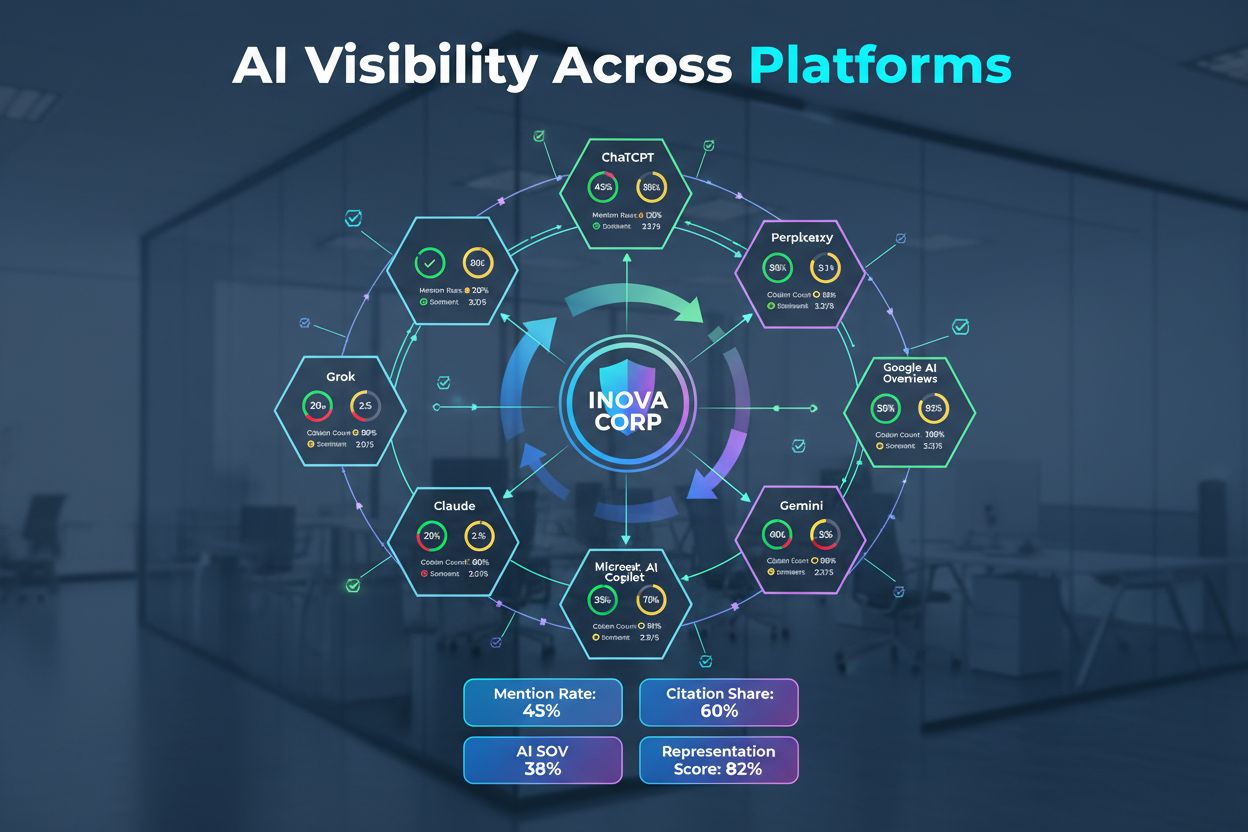
Discover the essential AI visibility metrics and KPIs to monitor your brand's presence across ChatGPT, Perplexity, Google AI Overviews, and other AI platforms. ...

Learn what an AI visibility score is, how it measures your brand's presence in AI-generated answers across ChatGPT, Perplexity, and other AI platforms, and why ...