

How Long Does GEO Take to Show Results?
Discover realistic timelines for Generative Engine Optimization results. Learn when you can expect initial citations, ROI milestones, and factors affecting GEO ...
11 min read

Discover actionable GEO quick wins to improve visibility in ChatGPT, Perplexity, and Google AI Overviews. Get cited faster with proven tactics.
Quick GEO wins include fixing robots.txt to allow AI crawlers, creating comparison tables and FAQ content, updating existing pages with fresh data, and securing mentions on high-authority sites where competitors already appear. These tactical improvements can boost AI citations within 30-90 days without requiring complete content rewrites.
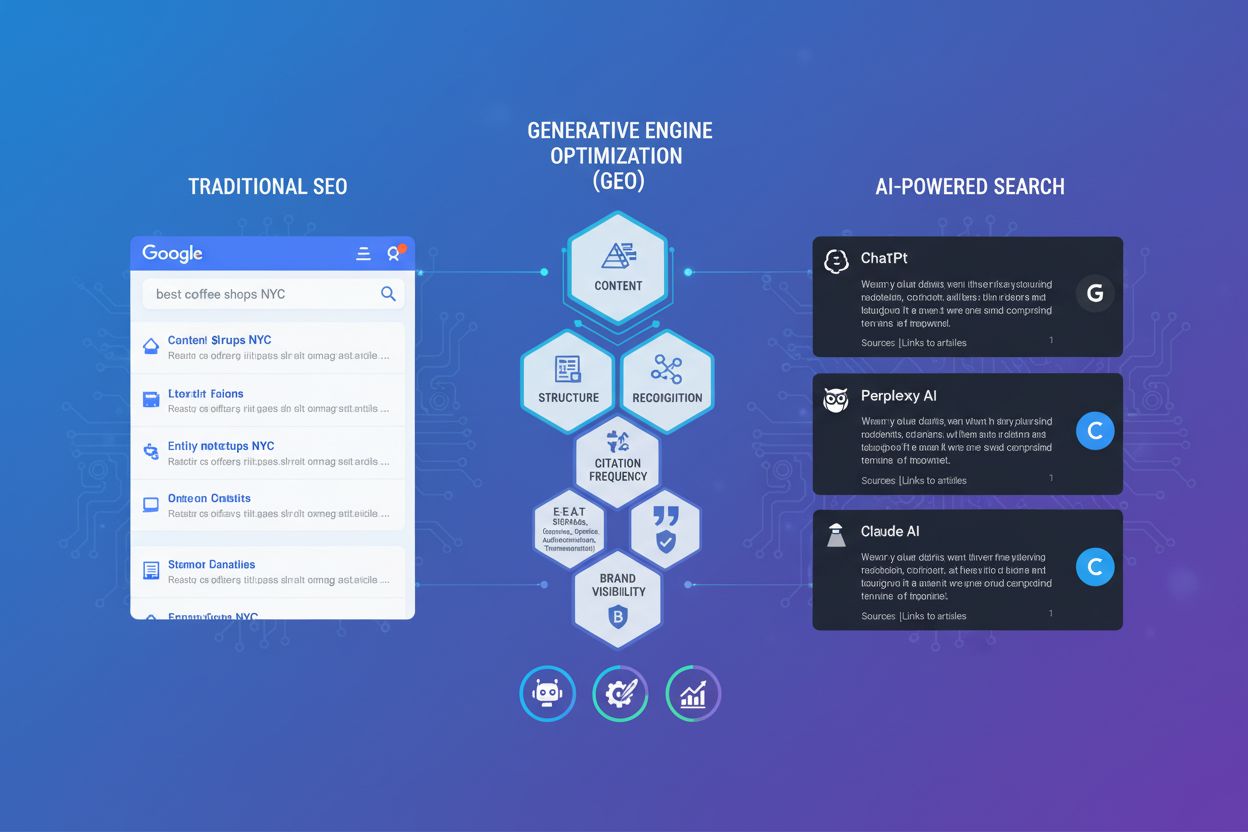
Generative Engine Optimization (GEO) represents a fundamental shift in how brands achieve visibility in AI-powered search. Unlike traditional SEO, which focuses on ranking positions in Google’s blue links, GEO prioritizes getting your content cited and referenced in AI-generated answers from platforms like ChatGPT, Perplexity, Claude, and Google AI Overviews. The good news is that you don’t need to overhaul your entire content strategy to see results. Quick wins in GEO are tactical improvements that can generate measurable AI citations within 30 to 90 days. These aren’t long-term plays—they’re immediate actions that leverage existing content, fix technical barriers, and capitalize on high-authority opportunities already available to your brand. Understanding which quick wins deliver the fastest ROI is essential for staying competitive as AI search reshapes how prospects discover solutions.
The shift toward AI-powered search is accelerating faster than most marketers realize. ChatGPT reached 400 million weekly users as of February 2025, making it one of the fastest-growing platforms in history. Google’s AI Overviews now appear on billions of searches monthly, showing up on at least 13% of all SERPs, with some research indicating they appear for more than half of tracked keywords. Research from Semrush predicts that LLM traffic will overtake traditional Google search by the end of 2027, representing an 800% year-over-year increase in referrals from LLMs in recent months. This isn’t a distant future scenario—it’s happening now. Brands that wait for perfect GEO strategies will miss the window to establish authority in these emerging channels. Quick wins allow you to start capturing AI visibility immediately while building longer-term optimization efforts.
The fastest, most overlooked quick win is ensuring AI crawlers can actually access your website. Many sites accidentally block the exact bots they need to attract. ChatGPT uses three primary crawlers: ChatGPT-User (serving live queries), OAI-SearchBot (for search toggle activation), and GPTBot (for training data collection). If your robots.txt file blocks these bots, your content will never appear in ChatGPT responses, regardless of quality. The same applies to Claude-Web, PerplexityBot, and GoogleOther (for Gemini). This is a 15-minute fix that can unlock immediate visibility. Simply add the following to your robots.txt file:
User-agent: ChatGPT-User
Allow: /

User-agent: Claude-Web
Allow: /

User-agent: PerplexityBot
Allow: /

User-agent: OAI-SearchBot
Allow: /
After implementing this change, verify that AI crawlers are actually accessing your site by checking your server logs for these user agents. If you use a CDN like Cloudflare or Fastly, confirm that default security settings aren’t blocking these bots. Many sites have aggressive DDoS protection that inadvertently prevents legitimate AI crawlers from indexing content. This single fix has generated measurable citation increases within weeks for brands that previously had no AI visibility.
AI systems heavily favor structured, scannable content formats. Research shows that pages with comparison tables, pros/cons lists, and structured data have 30-40% higher visibility in AI answers. This is because AI models can easily extract and cite information from well-organized content. If you sell software, offer services, or provide recommendations, comparison content is a quick win that requires minimal effort. Create a simple comparison table contrasting your solution with 2-3 competitors. Include pricing, key features, best-use cases, and honest limitations. AI systems prefer fair comparisons over biased reviews, so acknowledge where competitors excel. For example, a project management tool comparison might look like:
| Feature | Your Tool | Competitor A | Competitor B |
|---|---|---|---|
| Pricing | $15/user/month | $12/user/month | $20/user/month |
| Learning Curve | Moderate | Steep | Easy |
| Best For | Creative teams | Enterprise | Small teams |
| Mobile App | Yes | Limited | Yes |
| Integrations | 200+ | 150+ | 300+ |
This single table can be cited across dozens of AI responses to comparison queries. The effort is minimal, but the citation potential is substantial. You can create 3-5 comparison tables targeting your most competitive keywords within a week.
Content freshness is a critical ranking factor for AI systems. Research indicates that content from the past 2-3 months dominates AI citations, with freshness being a key signal that AI models use to decide which sources to reference. If your best-performing pages haven’t been updated in 6+ months, they’re losing citations to newer alternatives. This quick win requires no new content creation—just strategic updates to existing pages. Identify your top 10-20 pages by traffic and revenue impact. For each page, add 2-3 new statistics, include a recent case study, update the “Last Modified” date prominently, and add one new FAQ. Change the title to include “(Updated [Month Year])” to signal freshness to both users and AI systems. This 30-minute update per page can restore citations that were lost to newer content. Brands implementing this tactic report citation recovery within 2-3 weeks.
Citation gaps represent the highest-leverage quick win most brands miss. A citation gap occurs when AI platforms cite web pages that mention your competitors but not you. These pages are already trusted by AI systems and already appear in AI responses. Getting mentioned on even 10 of these pages can multiply your AI visibility exponentially. The process is straightforward: identify 50 high-authority articles where competitors are mentioned but you’re not. These might be industry roundups, comparison articles, or “best tools” listicles. Contact the author with genuine value—exclusive data, unique use cases, or updated information they missed. Because these pages are already cited by AI systems, adding your mention creates visibility across multiple search variations simultaneously. One placement on a TechRadar “best tools” article that gets cited for dozens of queries can generate citations across all those variations. This quick win requires outreach effort but minimal content creation.
Schema markup helps AI systems understand your content structure and extract information more easily. FAQ schema, HowTo schema, and Organization schema all improve extractability, making it more likely that AI systems will cite your content. This is a technical quick win that doesn’t require content changes—just markup implementation. If you use WordPress, plugins like Yoast SEO or Rank Math handle schema implementation automatically. For custom sites, use JSON-LD format to add FAQ schema to your most important pages. Here’s a simple example:
{
  "@context": "https://schema.org",
  "@type": "FAQPage",
  "mainEntity": [
    {
      "@type": "Question",
      "@id": "https://example.com/faq#q1",
      "name": "What is GEO?",
      "acceptedAnswer": {
        "@type": "Answer",
        "text": "Generative Engine Optimization is the practice of optimizing content to appear in AI-generated answers from platforms like ChatGPT and Perplexity."
      }
    }
  ]
}
Validate your schema using Google’s Rich Results Test or Schema.org’s validator. Proper schema markup signals to AI crawlers that your content is well-organized and trustworthy, increasing citation likelihood. This implementation takes 1-2 hours but can improve extractability across your entire site.
AI systems prioritize original research and first-hand data as authoritative sources. If you can publish original data—even a simple survey of 100 customers—you create a unique asset that AI systems want to cite. This doesn’t require expensive research. A quick customer survey asking “What’s your biggest challenge with [your industry]?” generates quotable data that AI systems will reference. Publish findings with clear charts, key takeaways, and methodology. This positions your brand as a primary source rather than a secondary commentator. Brands publishing quarterly original research report significantly higher citation rates because AI systems treat original data as more authoritative than aggregated information. A simple survey takes 1-2 weeks to execute and can generate citations for months.
AI systems generate multiple queries to ground their answers, a process called query fanout. When someone asks ChatGPT “What’s the best CRM for startups?”, the system might search for “best CRM for startups 2025”, “CRM for small business”, and “startup CRM comparison” simultaneously. If you rank for the original query but not the fanout variations, you’ll miss citations. Identify the typical fanout patterns for your priority queries. Common patterns include appending the current year, adding “forum” or “discussion”, including “interview” for people-related queries, and adding “comparison” for product queries. Create or optimize content to target these variations. This quick win requires keyword research but minimal content creation—often just title and heading adjustments. Brands targeting fanout patterns report 20-30% increases in citation frequency because they capture citations across multiple query variations.
Reddit citations in AI Overviews surged 450% in just three months, growing from 1.3% to 7.15% of all citations. User-generated content now comprises 21.74% of all AI citations, making community platforms critical for visibility. This quick win requires no content creation—just authentic participation. Find Reddit threads, Quora answers, and LinkedIn discussions that AI systems already cite for your industry. Join these conversations with genuine insights, not promotional content. Share real experience, hidden costs, scaling challenges, or migration tips. Because AI systems already trust these platforms, your contribution gets included in future AI answers. This quick win is scalable: spending 30 minutes daily on 3-5 relevant communities can generate citations within weeks. The key is authenticity—AI systems and users quickly identify and ignore promotional content.
The emerging llms.txt standard helps AI systems understand your content policies and preferred crawling behavior. Creating this file is a 15-minute quick win that signals to AI crawlers that you’re optimized for their access. Add a file at your domain root (example.com/llms.txt) with basic information:
User-Agent: *
Allow: /

# Link to your sitemap
Sitemap: https://example.com/sitemap.xml

# Preferred crawl rate
Crawl-delay: 1
This emerging standard isn’t mandatory, but early adoption signals to AI systems that you’re serious about AI visibility. Some advanced AI crawlers already check for this file, making it a quick way to improve crawl efficiency.
Most AI crawlers cannot execute JavaScript, meaning content hidden behind JavaScript is invisible to AI systems. This is a technical quick win that requires developer involvement but delivers immediate results. Audit your top pages to ensure main content loads without JavaScript. If your product descriptions, key information, or primary content requires JavaScript to display, AI crawlers see a blank page. Solutions include server-side rendering (Next.js, Nuxt.js), static site generators (Gatsby, Hugo), or progressive enhancement (core content works without JS). This fix is essential for SPA (Single Page Application) sites. Brands implementing server-side rendering for main content report immediate citation increases because AI crawlers can finally access their content.
Tracking your GEO progress is essential to understanding which quick wins deliver results. Start with manual testing: ask the same questions across ChatGPT, Claude, Perplexity, and Google AI Overviews. Take screenshots and note which sources get cited. Do this monthly to spot trends. For more comprehensive tracking, use dedicated GEO tools that automate this process. These platforms show you exactly where your brand appears, how often you’re cited, and which content formats generate the most citations. Track key metrics including Citation Share (your citations divided by total citations for priority queries), Response Inclusion Rate (prompts including your brand divided by total tested prompts), and AI Visibility Trend (month-over-month citation changes). This data reveals which quick wins are working and where to focus next. AmICited specifically helps you monitor how often your brand appears across all major AI platforms, making it easy to measure the impact of your quick wins.
| Quick Win | Implementation Time | Citation Impact | Difficulty |
|---|---|---|---|
| Fix robots.txt | 15 minutes | High (unlocks all crawling) | Very Easy |
| Create comparison tables | 1-2 hours | High (30-40% visibility boost) | Easy |
| Update existing pages | 30 min per page | Medium-High (restores lost citations) | Easy |
| Secure competitor mentions | 2-4 weeks (outreach) | Very High (multiplies visibility) | Medium |
| Implement schema markup | 1-2 hours | Medium (improves extractability) | Medium |
| Publish original data | 1-2 weeks | High (positions as primary source) | Medium |
| Target query fanout | 3-5 hours | Medium (captures variation queries) | Easy |
| Engage in communities | 30 min daily | Medium (builds authentic presence) | Easy |
| Create llms.txt | 15 minutes | Low-Medium (signals optimization) | Very Easy |
| Fix JavaScript issues | 4-8 hours (dev work) | High (enables crawling) | Hard |
The order in which you implement quick wins matters. Start with the 15-minute fixes (robots.txt, llms.txt) because they unlock everything else. If AI crawlers can’t access your site, no other optimization matters. Next, implement schema markup and fix JavaScript issues because these are technical foundations. Then create comparison tables and update existing pages—these generate immediate citations with minimal effort. Finally, pursue the longer-term quick wins like securing competitor mentions and publishing original data. This sequencing ensures you’re not wasting effort on content optimization if crawlers can’t access your site. Most brands can implement the first 5 quick wins within 1-2 weeks, generating measurable citation increases by week 3-4.
Quick wins are tactical improvements, but they should connect to your broader GEO strategy. Each quick win should align with your priority keywords, target audience, and business objectives. For example, if your priority is “best CRM for startups,” your quick wins should focus on that query cluster: create a comparison table for startup CRMs, update your startup CRM guide with fresh data, secure mentions on startup-focused publications, and engage in startup communities. This alignment ensures quick wins compound into sustained visibility rather than generating isolated citations. Quick wins also reveal what works for your specific audience and AI systems. If comparison tables generate high citations, invest more in comparison content. If community engagement drives visibility, allocate more resources there. Quick wins are learning opportunities that inform your longer-term GEO roadmap.
AI systems evolve rapidly, and quick wins that work today may shift in importance tomorrow. The fundamentals—quality content, technical accessibility, authority signals—remain constant, but specific tactics change. Stay ahead by monitoring how AI systems cite your competitors. If you notice a shift toward video content, prioritize YouTube optimization. If AI systems start favoring recent publications, increase content refresh frequency. Use tools like AmICited to track not just your citations but also patterns in how AI systems select sources. This ongoing monitoring ensures your quick wins remain effective as AI search evolves. The brands winning in GEO aren’t those with perfect strategies—they’re those who implement quick wins, measure results, and adapt based on data.
+++
Track how often your brand appears in AI answers across ChatGPT, Perplexity, Claude, and Google AI Overviews. Measure your quick wins and identify new opportunities.
Discover realistic timelines for Generative Engine Optimization results. Learn when you can expect initial citations, ROI milestones, and factors affecting GEO ...
Learn what Generative Engine Optimization (GEO) is, how it differs from SEO, and why it's critical for brand visibility in AI-powered search engines like ChatGP...
Learn how to get started with Generative Engine Optimization (GEO) today. Discover essential strategies to optimize your content for AI search engines like Chat...