
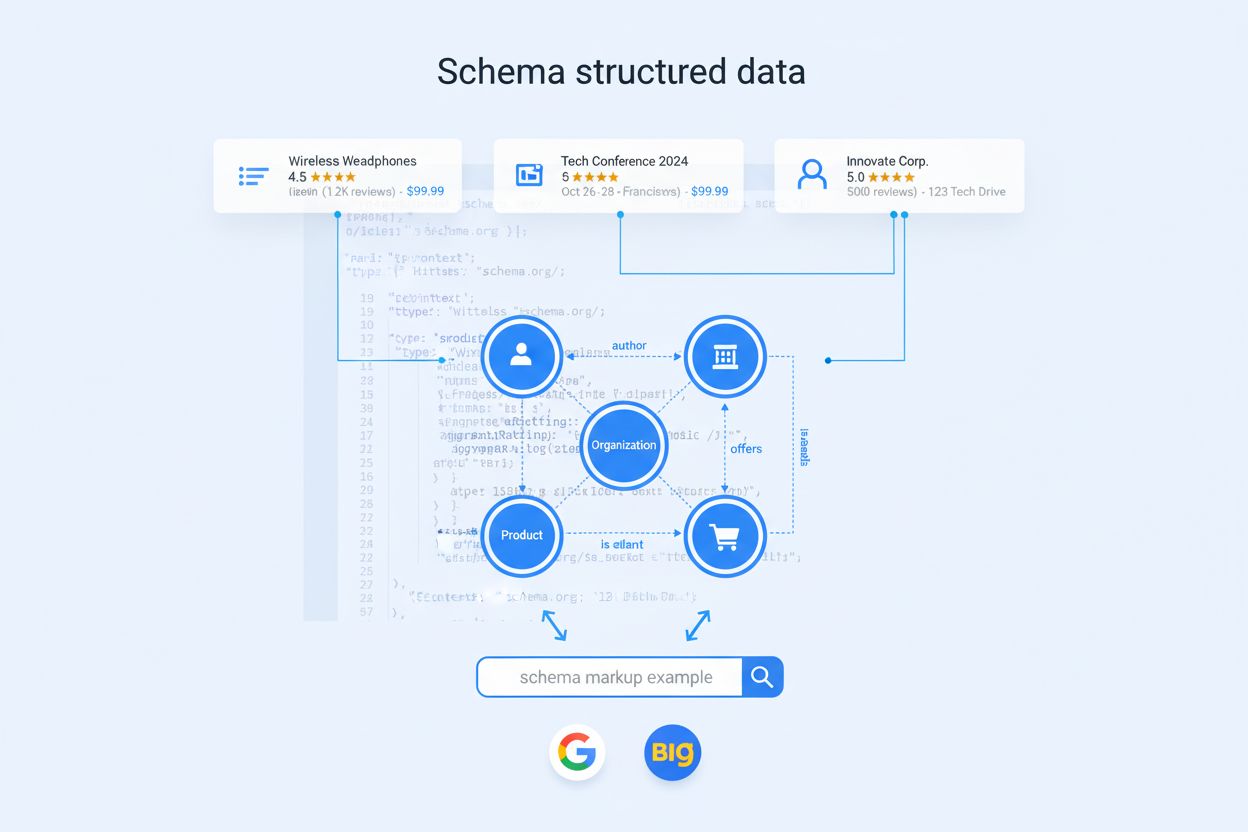
Schema Markup
Schema markup is standardized code that helps search engines understand content. Learn how structured data improves SEO, enables rich results, and supports AI s...
9 min read

Discover which schema markup types boost your visibility in AI search engines like ChatGPT, Perplexity, and Gemini. Learn JSON-LD implementation strategies for AI answer generators.
Schema markup, particularly JSON-LD format, helps AI search engines understand your content structure and context. Key types include Organization, Article, FAQ, Product, and LocalBusiness schema. Implementing structured data signals authority and relevance to LLMs, improving your chances of being cited in AI-generated answers across ChatGPT, Perplexity, Gemini, and other AI platforms.
Schema markup is a standardized vocabulary of structured data that transforms your website content into machine-readable information. Unlike traditional SEO that focuses on keywords and links, schema markup provides explicit context about what your content means, enabling AI systems to interpret and present your information with precision. As AI search engines like ChatGPT, Perplexity, and Google’s Gemini become primary discovery channels, schema markup has evolved from a nice-to-have feature into a critical component of your digital visibility strategy.
The fundamental difference between traditional search and AI search lies in how information is processed and presented. Traditional search engines rank pages and display blue links; AI search engines analyze content to generate direct answers and summaries. This shift means your content must be machine-readable and semantically rich to be selected by LLMs as a trusted source. Google and Microsoft have both confirmed in 2025 that their AI systems actively use schema markup to ground AI-generated answers in factual, structured data. Without proper schema implementation, your content becomes invisible to these emerging search platforms, regardless of how well it ranks on traditional Google search.
Different schema types serve distinct purposes in helping AI systems understand your content. The most impactful schema types for AI search visibility include Organization schema, which establishes your business identity and credibility; Article schema, which helps AI systems identify and summarize your content; FAQ schema, which directly addresses common questions and increases citation likelihood; Product schema, which provides detailed product information for e-commerce visibility; and LocalBusiness schema, which optimizes your presence in location-based AI queries. Each schema type communicates specific information to AI systems, helping them determine whether your content is authoritative, relevant, and trustworthy enough to include in their responses.
| Schema Type | Primary Purpose | AI Search Benefit | Best For |
|---|---|---|---|
| Organization | Establishes business identity, contact info, social profiles | Builds brand authority and recognition | All businesses |
| Article | Marks content as news or blog posts with metadata | Improves content discovery and summarization | Publishers, blogs, news sites |
| FAQ | Structures question-answer pairs | Directly matches AI query patterns | Service providers, SaaS, support pages |
| Product | Details pricing, availability, reviews, ratings | Enables product recommendations in AI responses | E-commerce, marketplaces |
| LocalBusiness | Location, hours, services, reviews | Optimizes “near me” and location-based AI queries | Local services, restaurants, clinics |
| Event | Event details, dates, locations, registration | Improves event discovery in AI platforms | Event organizers, venues |
| BreadcrumbList | Site navigation hierarchy | Helps AI understand content structure | All websites |
JSON-LD (JavaScript Object Notation for Linked Data) is the format officially recommended by Google and endorsed by major AI platforms for implementing schema markup. Unlike older formats like Microdata or RDFa, JSON-LD is placed in the <head> section of your HTML as a separate script block, making it easier to implement, maintain, and update without modifying your page’s visual structure. This format is particularly valuable for AI systems because it provides clean, unambiguous data that LLMs can parse with high accuracy. JSON-LD’s structured approach means AI systems can reliably extract information about your organization, products, articles, and services without confusion or misinterpretation.
The technical advantage of JSON-LD for AI search lies in its semantic clarity. When you implement JSON-LD schema, you’re essentially creating a machine-readable version of your content that explicitly states relationships, properties, and values. For example, an Article schema in JSON-LD clearly identifies the author, publication date, headline, and content body, allowing AI systems to understand not just what the article says, but who wrote it, when it was published, and how authoritative the source is. This structured approach directly influences whether ChatGPT, Perplexity, or Gemini will cite your content in their responses. AI systems prioritize sources with clear, verifiable metadata over ambiguous content, making JSON-LD implementation a competitive advantage in AI search visibility.
AI search engines operate fundamentally differently from traditional search engines in how they evaluate and cite sources. While Google’s algorithm considers hundreds of ranking factors, AI systems focus on semantic understanding and factual grounding. When an LLM generates an answer, it searches for content that clearly demonstrates expertise, authority, and accuracy. Schema markup signals all three of these qualities by providing explicit, structured information that the AI can verify and trust. Content with comprehensive schema markup is significantly more likely to be selected for inclusion in AI-generated answers because the AI can confidently extract and present the information without ambiguity.
The citation mechanism in AI search works through a process called entity recognition and linking. When you implement schema markup with properties like sameAs (which links your entities to external authorities like Wikipedia or official social profiles), you’re helping AI systems connect your content to established knowledge bases. This connection is crucial because AI systems use it to verify credibility and avoid hallucinations. For instance, if your Organization schema includes a sameAs link to your official Wikipedia page or LinkedIn profile, the AI can cross-reference this information and confidently cite your brand in responses. Without these semantic connections, your content remains isolated and less likely to be selected, even if it contains valuable information.
Entity linking extends schema markup’s power by creating semantic relationships between entities on your website and across the broader web. Internal entity linking connects related content on your site, while external entity linking anchors your entities to authoritative sources like Wikipedia, Wikidata, and Google’s Knowledge Graph. This dual approach creates what’s known as a Content Knowledge Graph, which AI systems use to understand not just individual pieces of content, but how they relate to each other and to established knowledge. When your schema markup includes clear entity relationships, AI systems can navigate your content more intelligently and present it with greater confidence.
The practical implementation of entity linking involves using schema properties like sameAs, mentions, and relatedLink to establish these connections. For example, if you’re writing about a specific technology or methodology, you can link that entity to its Wikipedia page or official documentation using the sameAs property. This tells AI systems that you’re referring to the same entity they already know about, which increases your credibility and improves the likelihood of citation. Additionally, internal entity linking—where you connect related articles and topics on your own site—helps AI systems understand your topical authority. If you have multiple articles about a specific subject, and they’re properly linked through schema markup, AI systems recognize you as a comprehensive resource on that topic and are more likely to cite your content when answering related questions.
Implementing schema markup effectively requires more than just adding code to your website; it demands a strategic approach that aligns with your content and business goals. Start by identifying the most critical content on your site—the pages that drive conversions, establish authority, or answer key customer questions. These pages should receive priority for schema implementation because they represent your highest-value opportunities for AI visibility. For most businesses, this includes homepage Organization schema, key service or product pages with appropriate schema types, FAQ pages with FAQ schema, and blog articles with Article schema. Once you’ve prioritized your content, use tools like Google’s Structured Data Markup Helper or Schema.org’s official documentation to generate accurate schema code.
The validation process is equally important as implementation. After adding schema markup to your pages, always test it using Google’s Rich Results Test and Schema.org’s validator to ensure the code is syntactically correct and semantically meaningful. Common errors include missing required properties, incorrect data types, or incomplete information that confuses AI systems. For instance, if your Organization schema is missing contact information or social profiles, AI systems may question your legitimacy. Similarly, if your Article schema lacks author information or publication dates, AI systems may deprioritize your content. Beyond initial validation, you should review and update your schema quarterly to ensure it remains accurate and current. Outdated business hours, incorrect product availability, or stale author information signals low trust to both AI systems and users, potentially harming your visibility.
Tracking the impact of schema markup on AI search visibility requires different metrics than traditional SEO. Since AI platforms like ChatGPT don’t provide direct referral data or ranking positions, you need to employ indirect measurement strategies to understand your performance. Start with manual testing by prompting AI systems with branded and non-branded queries relevant to your business, then asking follow-up questions like “Where did you get that information?” or “Can you provide a source?” This reveals whether your content is being cited and how accurately it’s being represented. Document these findings monthly to track trends and identify opportunities for improvement.
Google Analytics 4 provides additional insights into AI-driven traffic, though it requires careful analysis. Look for spikes in direct traffic to specific pages shortly after you’ve tested prompts in AI systems, as this often indicates AI referral traffic that doesn’t include clear referrer data. You can also monitor traffic patterns from known AI platforms like Perplexity.ai or Bing, which sometimes pass referral information. More importantly, analyze the quality of traffic from these sources by examining metrics like average session duration, pages per session, and conversion rates. AI-driven traffic often shows different characteristics than traditional search traffic—it may have longer session durations but lower click volumes, reflecting the nature of AI-generated answers. By understanding these patterns, you can better assess whether your schema markup is attracting high-quality AI citations that drive meaningful business results.
Beyond basic schema implementation, advanced strategies can significantly enhance your AI search visibility. Building a Content Knowledge Graph involves creating a comprehensive, interconnected network of schema markup across your entire website that reflects how your content relates conceptually and semantically. This goes beyond individual page optimization to create a holistic representation of your expertise and authority. When AI systems encounter your Content Knowledge Graph, they can navigate your content more intelligently, understanding not just individual articles but how they fit into a larger body of knowledge. This comprehensive approach signals deep expertise and increases the likelihood of being cited across multiple related queries.
Another advanced strategy involves semantic enrichment through external linking. While traditional SEO emphasizes backlinks pointing to your site, semantic SEO emphasizes your links pointing outward to authoritative sources. By linking your schema entities to Wikipedia, official documentation, and other trusted sources, you’re providing AI systems with verification pathways that increase your credibility. This approach is particularly effective for technical or specialized content where external authority is crucial. Additionally, consider implementing dynamic schema markup that updates in real-time based on your content management system. Static schema markup can become outdated quickly, especially for businesses with frequently changing information like pricing, inventory, or event schedules. Dynamic schema ensures your structured data always reflects current information, maintaining trust with AI systems and users alike.
Track how your brand appears in AI search engines and ensure your schema markup is optimized for maximum visibility across ChatGPT, Perplexity, and other AI answer generators.
Schema markup is standardized code that helps search engines understand content. Learn how structured data improves SEO, enables rich results, and supports AI s...

Learn how to implement HowTo schema markup for better visibility in AI search engines. Step-by-step guide to adding structured data for ChatGPT, Perplexity, and...
Learn how to implement FAQ schema for AI search engines. Step-by-step guide covering JSON-LD format, best practices, validation, and optimization for AI platfor...