

What is the Best AI Visibility Tool for Monitoring Your Brand?
Discover the best AI visibility tools to monitor your brand across ChatGPT, Perplexity, Google AI Overviews, and other AI search engines. Compare features, pric...
9 min read

Discover the top AI search visibility monitoring tools to track your brand across ChatGPT, Perplexity, and Google AI Overviews. Compare features, pricing, and capabilities for monitoring AI answer engines.
AI search visibility monitoring tools like Otterly AI, Cognizo, Peec AI, and Profound track brand mentions across ChatGPT, Perplexity, Google AI Overviews, and other AI platforms. These tools measure where your brand appears in AI-generated answers, track citations, analyze sentiment, and provide competitive benchmarking to help optimize your presence in generative search engines.
AI search visibility monitoring tools are specialized platforms designed to track how your brand, products, and content appear in responses generated by artificial intelligence search engines and large language models. These tools automatically monitor platforms like ChatGPT, Perplexity, Google AI Overviews, Gemini, Claude, and Microsoft Copilot to measure your brand’s presence, analyze how you’re positioned, and identify opportunities to improve your visibility in generative search results. Unlike traditional SEO tools that focus on Google rankings, AI visibility monitors track mentions, citations, and sentiment across the rapidly growing ecosystem of AI-powered answer engines that are reshaping how users discover information.
The importance of monitoring AI search visibility cannot be overstated. As Gartner predicts a 50% decline in organic traffic until 2028, brands are increasingly losing visibility to AI-generated answers that cite competitors while omitting them entirely. These tools provide the critical visibility data needed to understand where your brand appears in AI conversations, what context surrounds those mentions, and how to optimize your content to earn more citations from AI platforms. Without monitoring, you’re operating blind—unable to see if your brand is being recommended, how often it appears, or whether your content optimization efforts are actually working.
AI visibility trackers function by automatically sending queries and prompts to AI search engines, then analyzing the responses to identify brand mentions, citations, and source links. The process begins with defining a library of search prompts that mirror real user questions—conversational queries that potential customers might ask ChatGPT or Perplexity about solutions in your industry. These prompts are carefully selected to represent high-intent searches where your brand should ideally appear.
Once prompts are defined, the monitoring platform continuously runs these queries across multiple AI engines, capturing the complete responses including which brands are mentioned, in what order, and with what context. The tool then extracts critical data points: whether your brand appears, how many times it’s mentioned, what sentiment surrounds the mention, which websites are cited as sources, and how your visibility compares to competitors. This data is compiled into dashboards and reports that show visibility trends over time, allowing you to measure whether your optimization efforts are moving the needle.
| Monitoring Capability | What It Measures | Why It Matters |
|---|---|---|
| Brand Mentions | How often your brand appears in AI-generated answers | Indicates overall visibility and awareness in AI conversations |
| Citation Tracking | Which of your web pages are cited as sources | Shows which content AI engines find most authoritative |
| Share of Voice | Your brand mentions vs. competitors in same queries | Reveals competitive positioning and market share in AI |
| Sentiment Analysis | Positive, neutral, or negative context around mentions | Determines if you’re positioned as leader, alternative, or laggard |
| Position Metrics | Whether you’re first mention, middle, or end of response | Shows prominence and likelihood of user engagement |
| Source Analysis | Which websites and content types get cited most | Guides content strategy to improve citation likelihood |
The technical methodology varies between platforms. Some tools use UI-based monitoring where they simulate user interactions with AI platforms, while others leverage API access where available for more reliable data collection. The most sophisticated platforms employ repeat-prompt sampling, running the same query multiple times to account for the inherent variability in AI responses. This statistical approach provides confidence that visibility changes represent genuine shifts rather than random fluctuations in model outputs.
Comprehensive platform coverage is essential for effective AI visibility monitoring. The best tools track across all major AI search engines including ChatGPT, Perplexity, Google AI Overviews, Google AI Mode, Gemini, Claude, Microsoft Copilot, and emerging platforms like Grok and DeepSeek. This breadth ensures you’re not missing visibility opportunities on platforms where your audience is actively seeking information. Different AI engines have different citation patterns and user bases, so monitoring across all of them provides a complete picture of your AI search presence.
Competitive benchmarking capabilities allow you to see not just where you appear, but how your visibility compares to direct competitors and category leaders. These tools show which competitors dominate specific queries, what content they’re getting cited for, and where you have opportunities to gain ground. This competitive intelligence is invaluable for identifying content gaps—queries where competitors appear but you don’t, representing immediate opportunities for improvement. Understanding your competitive position in AI search is just as important as understanding your absolute visibility numbers.
Sentiment analysis and context tracking go beyond simple mention counting to reveal how AI platforms are actually positioning your brand. A mention can be positive (recommending you as a top solution), neutral (listing you among options), or negative (positioning you as outdated or inferior). Advanced sentiment analysis examines the specific language and context surrounding your brand mentions, helping you understand the narrative AI platforms are building around your company. This contextual understanding is critical because appearing in AI answers is only valuable if you’re being positioned favorably.
Citation source tracking identifies which of your web pages are being cited by AI engines, revealing which content is most valuable to AI models. This data directly informs content strategy—if certain pages consistently get cited while others never appear, you understand what types of content AI engines find most authoritative and useful. This insight allows you to replicate successful content patterns across your site, improving overall citation likelihood. Some tools go further by analyzing the specific characteristics of cited content—length, structure, comprehensiveness, freshness—to provide actionable guidance on content optimization.
Otterly AI stands out as a specialized platform trusted by over 15,000 marketing and SEO professionals. The tool automatically tracks brand mentions and website citations across ChatGPT, Perplexity, Google AI Overviews, Google AI Mode, Gemini, and Microsoft Copilot. Users report that Otterly AI delivers measurable insights within the first month of monitoring, with 95% of customers seeing actionable data immediately. The platform includes GEO Audit tools that analyze 25+ on-page factors to identify what’s preventing your site from earning more AI citations, providing specific optimization recommendations beyond just visibility metrics.
Cognizo positions itself as a comprehensive Answer Engine Optimization platform with deep visibility analytics and automated content optimization. The platform monitors how AI platforms talk about your brand, tracks real-time citations and sentiment, and provides competitive benchmarking across all major answer engines. What differentiates Cognizo is its content optimization workflow that turns visibility insights into specific content creation actions. The platform identifies content gaps, generates optimization briefs, and helps teams create AI-optimized content without leaving the platform. Users report seeing substantial visibility increases within 6 weeks of using the platform.
Peec AI specializes in AI search analytics with a focus on visibility, position, and sentiment metrics. The platform tracks across ChatGPT, Perplexity, Gemini, Claude, and Google AI Overviews, providing detailed competitive analysis and share-of-voice calculations. Peec AI is particularly strong for teams that need structured reporting and data export capabilities for client presentations or internal stakeholder communication. The platform’s strength lies in its ability to segment visibility data by model, region, and audience, allowing teams to understand nuanced differences in how different AI platforms represent their brand.
Profound serves enterprise organizations with advanced analytics and custom reporting capabilities. Backed by $35 million in Series B funding from Sequoia, Profound ingests millions of citations and crawler visits to provide Fortune 500-grade analytics. The platform includes Conversation Explorer that reveals AI conversation demand, showing what questions users are asking AI platforms about your category. Enterprise features include API access for custom integrations, dedicated account management, and SOC 2 compliance for organizations with strict security requirements.
Rankability’s AI Analyzer integrates AI visibility tracking directly into a content optimization platform, allowing teams to identify visibility gaps and fix them without switching tools. The platform tests branded and commercial prompts across major answer engines, maps where pages are cited, and provides competitive citation comparisons. What makes Rankability unique is the tight integration with content creation workflows—you can identify a visibility gap and immediately create optimized content to address it within the same platform.
Assess your primary objective before selecting a monitoring platform. Are you primarily interested in basic visibility tracking to understand if you appear in AI answers? Do you need competitive intelligence to understand your market position? Are you looking for attribution data connecting AI visibility to actual website traffic and conversions? Or do you need strategic guidance on how to improve your AI presence? Different tools excel at different objectives, and matching your primary goal to the platform’s core strength ensures you get maximum value.
Consider your team’s expertise and resources. Some platforms like Otterly AI and Peec AI are designed for marketing teams without deep GEO expertise, providing clear dashboards and actionable insights without requiring technical knowledge. Other platforms like Profound or seoClarity ArcAI are built for enterprise teams with dedicated specialists who can leverage advanced features and custom reporting. If you lack GEO expertise internally, choose a platform that provides strategic recommendations and guidance rather than just raw data.
Evaluate platform coverage and refresh frequency. Ensure the tool monitors all AI engines where your audience is active. If your customers primarily use ChatGPT and Perplexity, a tool that only monitors Google AI Overviews will miss critical visibility opportunities. Similarly, understand how frequently the platform refreshes data—daily updates provide more current insights than weekly or monthly monitoring, which is important for fast-moving categories where visibility can shift rapidly.
Factor in scalability and team collaboration features. If you’re an agency managing multiple client brands, you need tools that support multi-brand tracking with role-based permissions and client-ready reporting. If you’re an enterprise with distributed teams, you need collaboration features that allow different departments to access relevant data without exposing sensitive competitive information. Solo marketers and small teams can often use simpler, more affordable tools, while larger organizations need platforms that scale with their complexity.
The landscape of AI search visibility monitoring continues to evolve rapidly as new tools launch and existing platforms add capabilities. The fundamental principle remains constant: you cannot optimize what you don’t measure. By implementing AI visibility monitoring, you gain the visibility data needed to understand your brand’s presence in generative search, identify optimization opportunities, and measure the impact of your efforts to improve AI citations. This data-driven approach to AI search optimization is becoming essential as AI-powered answer engines increasingly influence how users discover solutions in your category.
Start tracking where your brand appears in AI-generated answers across ChatGPT, Perplexity, Google AI Overviews, and other AI search engines. Get real-time insights into your AI visibility and competitive positioning.
Discover the best AI visibility tools to monitor your brand across ChatGPT, Perplexity, Google AI Overviews, and other AI search engines. Compare features, pric...
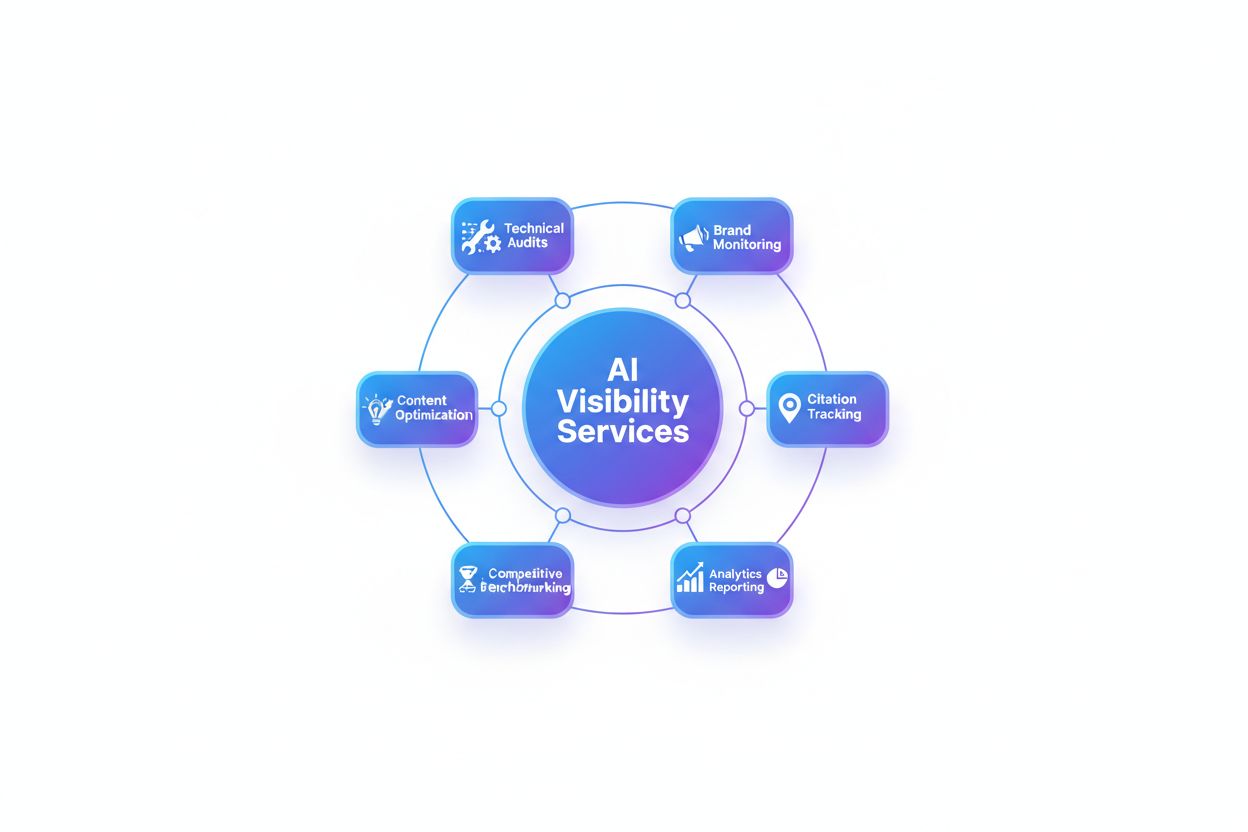
Discover what AI visibility services deliver: brand monitoring, citation tracking, analytics, competitive benchmarking, content optimization, and technical audi...
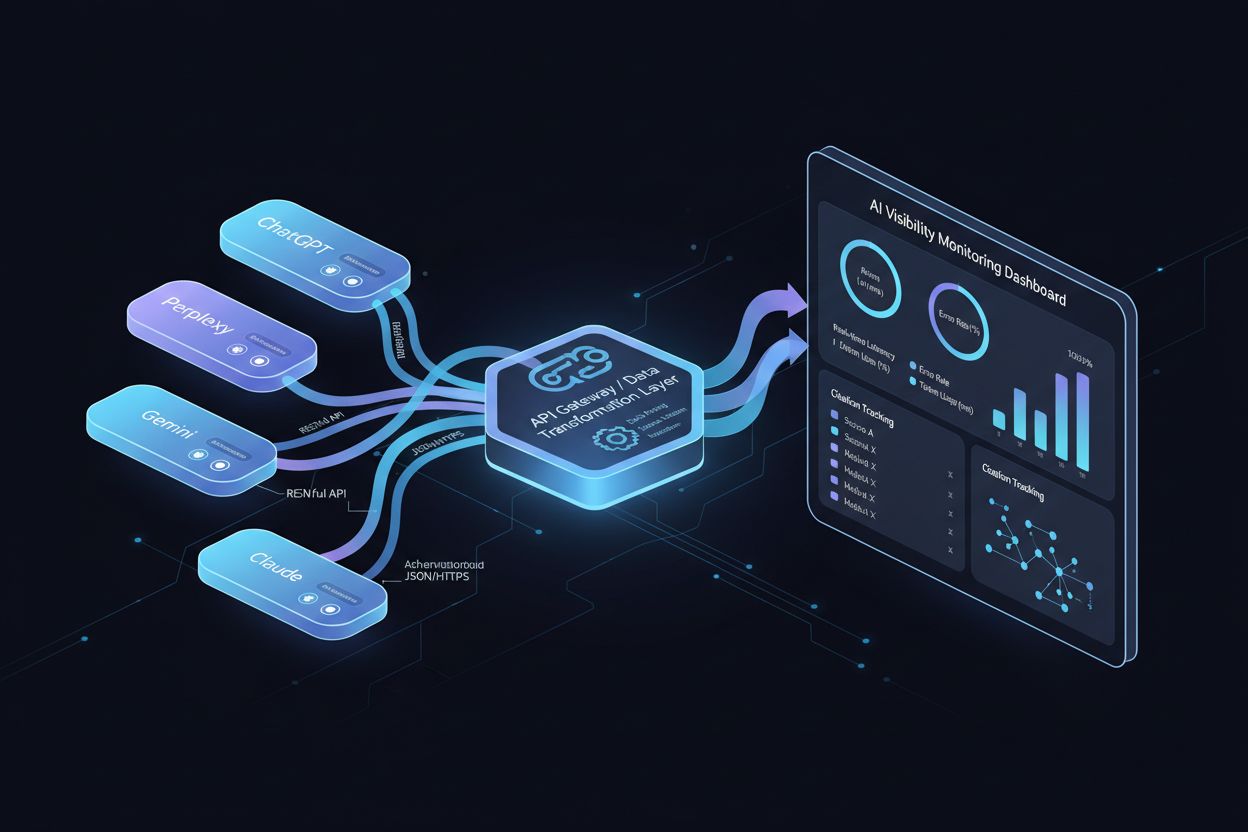
Learn how AI visibility APIs enable real-time monitoring of brand mentions across ChatGPT, Perplexity, and Gemini. Discover API integration strategies, workflow...