
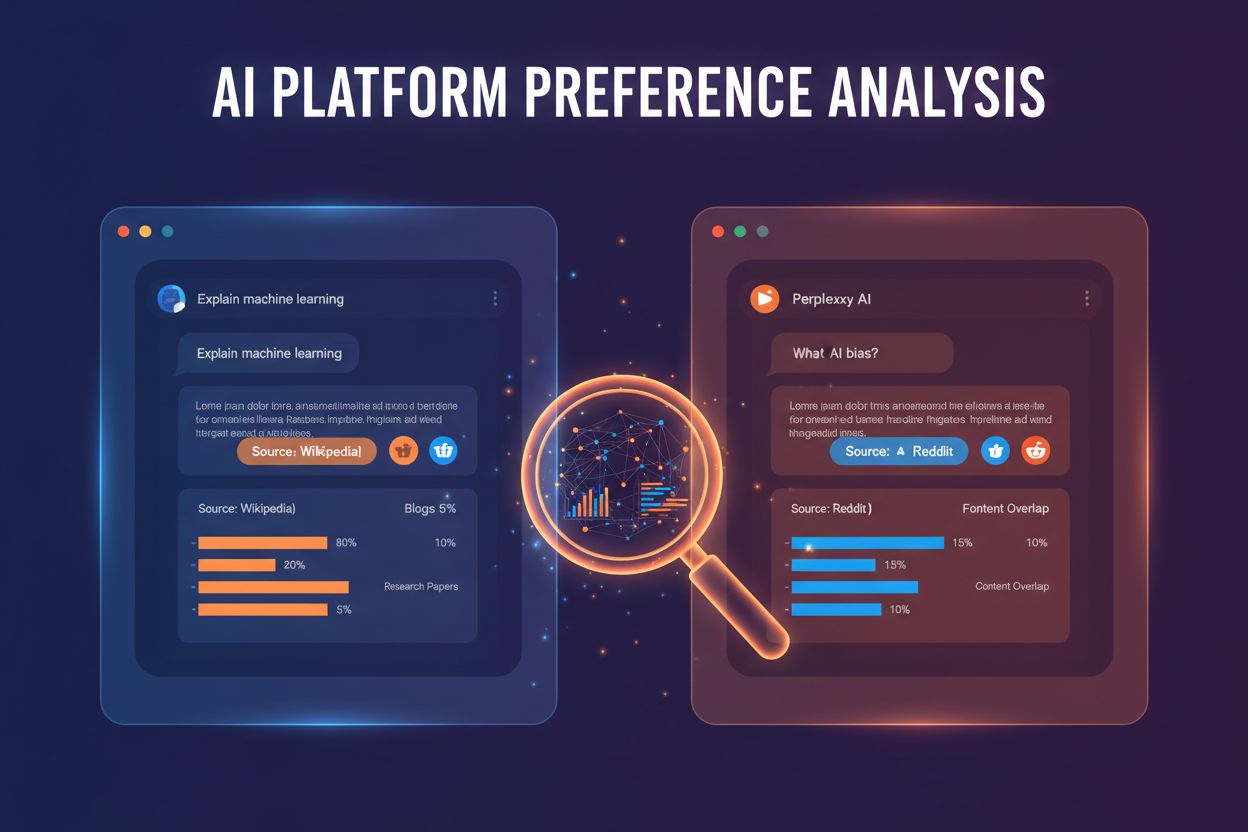
AI Platform Preference Analysis
Learn how different AI platforms have distinct preferences for citing sources and brands. Discover ChatGPT's Wikipedia bias, Perplexity's Reddit focus, and Goog...
6 min read

Discover which AI platform to prioritize for your business. Compare ChatGPT, Claude, Perplexity, and other leading AI tools based on features, pricing, and use cases. Make informed decisions for your AI strategy.
The best AI platform depends on your specific needs: prioritize ChatGPT for general-purpose tasks and creativity, Claude for handling large documents and complex analysis, or Perplexity for real-time research with verified sources. Most professionals benefit from using multiple platforms strategically.
Choosing the right AI platform to prioritize requires understanding your specific business needs, use cases, and operational requirements. The AI landscape has evolved significantly, with multiple powerful platforms offering distinct advantages depending on your goals. Rather than seeking a single “best” platform, successful organizations adopt a strategic approach by understanding each platform’s strengths and deploying them where they excel most. This comprehensive guide helps you navigate the decision-making process and build an effective AI strategy aligned with your business objectives.
When evaluating which AI platform should I prioritize, consider these fundamental dimensions that differentiate leading solutions. Real-time information access represents a critical distinction—Perplexity excels here with automatic web search integration, while ChatGPT and Claude rely primarily on training data with optional browsing features. Context window capacity determines how much information a platform can process simultaneously; Claude leads with 200,000 tokens, enabling analysis of entire documents in single interactions, whereas ChatGPT typically handles 8,000-128,000 tokens depending on the model version. Reasoning and problem-solving capabilities vary significantly, with GPT-4 and Claude Opus 4 demonstrating superior performance on complex analytical tasks. Integration ecosystem matters for workflow efficiency—ChatGPT offers the most extensive plugin and API ecosystem, while Claude and Perplexity provide growing integration options. Cost structure ranges from free tiers with limitations to premium subscriptions, with pricing models varying between usage-based and flat-rate options.
| Platform | Best For | Context Window | Real-Time Data | Pricing |
|---|---|---|---|---|
| ChatGPT | Creative work, coding, general tasks | 8k-128k tokens | Optional (browsing) | Free / $20/month |
| Claude | Large documents, analysis, coding | 200k tokens | Limited | Free / $20/month |
| Perplexity | Research, current information, citations | Limited | Standard | Free / $20/month |
| Gemini | Google Workspace integration | 1M tokens | Yes | Free / Premium |
ChatGPT remains the most widely adopted AI platform, offering exceptional versatility across multiple use cases. The platform excels in creative content generation, producing engaging marketing copy, blog posts, social media content, and creative narratives with natural fluency. For software development, ChatGPT’s Code Interpreter feature enables actual code execution, allowing developers to test solutions immediately and iterate based on results. The conversational interface feels natural and intuitive, making it accessible to users without technical backgrounds. ChatGPT’s strength lies in its ability to maintain context across extended conversations, making it ideal for iterative brainstorming sessions where ideas build upon previous exchanges. The platform’s multimodal capabilities allow processing of images and text simultaneously, enabling analysis of visual content alongside textual queries. However, ChatGPT’s knowledge cutoff in March 2025 means it lacks awareness of very recent events without explicit web browsing activation. The platform sometimes exhibits overconfidence in responses, providing plausible-sounding but potentially inaccurate information, particularly on obscure topics. For organizations handling sensitive data, the default data usage policy (where conversations may inform model improvements) requires careful consideration, though enterprise plans address this concern.
Claude from Anthropic distinguishes itself through exceptional long-context processing capabilities, handling documents up to 200,000 tokens—equivalent to entire books or hundreds of pages of documentation. This makes Claude invaluable for legal document analysis, research synthesis, and comprehensive code review tasks requiring examination of extensive codebases. The platform demonstrates superior reasoning clarity, often explaining its thinking process in ways that help users understand complex concepts. Claude’s safety-first approach means it refuses fewer legitimate requests than competitors while maintaining strong ethical guardrails, making it suitable for sensitive business applications. The Claude Opus 4 model achieves state-of-the-art performance on coding benchmarks, with 72.5% accuracy on the SWE-bench, enabling autonomous execution of complex programming tasks. For enterprise deployments, Claude offers the strictest data privacy guarantees, with explicit commitments that conversation data won’t train future models. The platform’s verbose response style sometimes requires explicit brevity instructions, and its limited multimodal capabilities (text-only processing) restrict use cases involving image analysis. Claude’s availability limitations in certain regions and occasional rate limiting during peak usage can impact continuous workflow integration.
Perplexity AI positions itself as an answer engine rather than a general chatbot, fundamentally changing how it approaches queries. The platform’s automatic source citation provides transparency often missing in other AI tools—every statement includes clickable references to original sources, enabling verification and deeper research. This makes Perplexity essential for academic research, journalism, and fact-checking where source attribution is mandatory. The real-time web search integration means Perplexity always accesses current information, making it superior for queries about recent events, market trends, stock prices, and breaking news. The Deep Research feature automates multi-step investigation, gathering information from multiple sources and synthesizing comprehensive reports in minutes rather than hours. Perplexity’s access to multiple underlying models (GPT-4, Claude, Gemini) within a single interface enables comparison across different AI approaches. However, Perplexity’s limited suitability for creative tasks reflects its research-focused design—the platform prioritizes factual accuracy over imaginative generation. The dependence on search engine indexing means information not yet published online remains inaccessible, and legal concerns regarding content scraping create uncertainty about long-term viability in certain jurisdictions.
Determining which AI platform should I prioritize requires mapping your specific use cases to platform strengths. For marketing and content creation, prioritize ChatGPT for initial ideation and draft generation, then use Claude for detailed analysis of competitor content and market positioning. For software development, start with Claude for architectural decisions and large-scale refactoring, use ChatGPT for rapid prototyping and debugging, and leverage Perplexity for researching new frameworks and technologies. For business analysis and research, begin with Perplexity for gathering current market data and competitive intelligence, move to Claude for synthesizing large documents and identifying patterns, and use ChatGPT for generating strategic recommendations. For customer-facing applications, prioritize Claude for its superior safety and clarity, ensuring consistent, professional communication. For data-driven decision-making, combine Perplexity’s real-time market insights with Claude’s analytical depth and ChatGPT’s ability to generate actionable recommendations.
When implementing your AI platform prioritization strategy, consider organizational readiness and team capabilities. Teams with strong technical backgrounds can leverage advanced features across all platforms, while less technical teams benefit from ChatGPT’s intuitive interface and Perplexity’s straightforward research functionality. Budget constraints significantly influence prioritization—free tiers provide substantial functionality for evaluation, but professional use typically requires paid subscriptions ($20-200/month per platform). Integration requirements with existing tools matter considerably; ChatGPT offers the most extensive ecosystem, while Claude and Perplexity provide growing integration options through APIs and browser extensions. Data sensitivity demands careful evaluation—Claude offers the strongest privacy guarantees, while ChatGPT Enterprise provides compliance features for regulated industries. Workflow optimization suggests starting with one primary platform, adding secondary platforms for specific use cases, and avoiding unnecessary proliferation that creates management overhead.
The AI platform landscape continues evolving rapidly, with several important developments influencing prioritization decisions. Multimodal capabilities are expanding across platforms—Claude is expected to add image processing, while Perplexity enhances video and multimedia analysis. Reasoning models like OpenAI’s o3 and Claude’s thinking mode represent a new category optimized for complex problem-solving, suggesting future prioritization may emphasize reasoning capabilities for analytical tasks. Browser integration is becoming standard, with dedicated AI browsers from OpenAI, Perplexity, and others promising seamless integration into daily workflows. Enterprise features are maturing, with all major platforms offering team collaboration, audit trails, and compliance certifications. Cost optimization through model efficiency improvements suggests pricing may become more competitive, potentially shifting prioritization based on value rather than feature differences. Specialized AI agents for specific domains (coding, research, writing) may eventually replace general-purpose platforms for certain use cases, requiring periodic reassessment of prioritization strategies.
Organizations frequently make critical errors when prioritizing AI platforms that undermine their AI strategy. Selecting based solely on popularity ignores the reality that ChatGPT’s widespread adoption doesn’t make it optimal for every use case—specialized platforms often outperform in their domains. Failing to test before committing leads to expensive subscriptions for unused features; free trials reveal actual fit better than marketing claims. Ignoring integration requirements creates workflow friction when platforms don’t connect with existing tools; compatibility assessment should precede adoption. Underestimating training needs results in underutilization of platform capabilities; teams require guidance on effective prompting and feature usage. Neglecting data privacy implications exposes sensitive information; careful review of data handling policies is essential before processing confidential content. Treating platforms as replacements rather than supplements misses the synergistic benefits of strategic multi-platform deployment; the most effective organizations use complementary platforms for different purposes.
The question “Which AI platform should I prioritize?” has no universal answer—the optimal choice depends entirely on your specific needs, constraints, and strategic objectives. For most organizations, a tiered approach works best: prioritize ChatGPT as the primary general-purpose tool for its versatility and ease of use, add Claude for tasks requiring deep analysis or large document processing, and incorporate Perplexity for research and current information needs. For specialized teams, prioritization should reflect domain requirements—developers should prioritize Claude for coding tasks, researchers should prioritize Perplexity for information gathering, and marketing teams should prioritize ChatGPT for creative work. Start with free tiers to evaluate actual fit before committing to paid subscriptions, and reassess quarterly as platforms evolve and your needs change. The most successful AI strategies treat platform selection as an ongoing optimization process rather than a one-time decision, continuously evaluating whether current prioritization aligns with business objectives and emerging capabilities.
Ensure your domain and brand appear in AI-generated answers across ChatGPT, Perplexity, Claude, and other AI platforms. Track your visibility and optimize your presence in the AI-powered search landscape.
Learn how different AI platforms have distinct preferences for citing sources and brands. Discover ChatGPT's Wikipedia bias, Perplexity's Reddit focus, and Goog...
Master multi-platform AI visibility strategy. Learn how to optimize content for ChatGPT, Perplexity, and Google AI Overviews simultaneously with data-driven tac...

Community discussion on which AI platform to prioritize for optimization. Comparing ChatGPT, Perplexity, Claude, and Google AI Overviews.