
Generative Engine Optimization (GEO)
Learn what Generative Engine Optimization (GEO) is, how it differs from SEO, and why it's critical for brand visibility in AI-powered search engines like ChatGP...
11 min read

Discover why Generative Engine Optimization (GEO) is essential for businesses in 2025. Learn how AI-powered search is reshaping brand visibility, consumer behavior, and why monitoring your appearance in AI answers is critical for competitive advantage.
GEO (Generative Engine Optimization) is critical for businesses in 2025 because search behavior is fracturing across AI-powered platforms like ChatGPT, Perplexity, and Google's AI Overviews. With 82% of consumers finding AI-powered search more helpful than traditional search engines and half of consumers already using AI tools, businesses must optimize their content and authority signals for AI-generated answers to maintain visibility and attract customers through this emerging search channel.
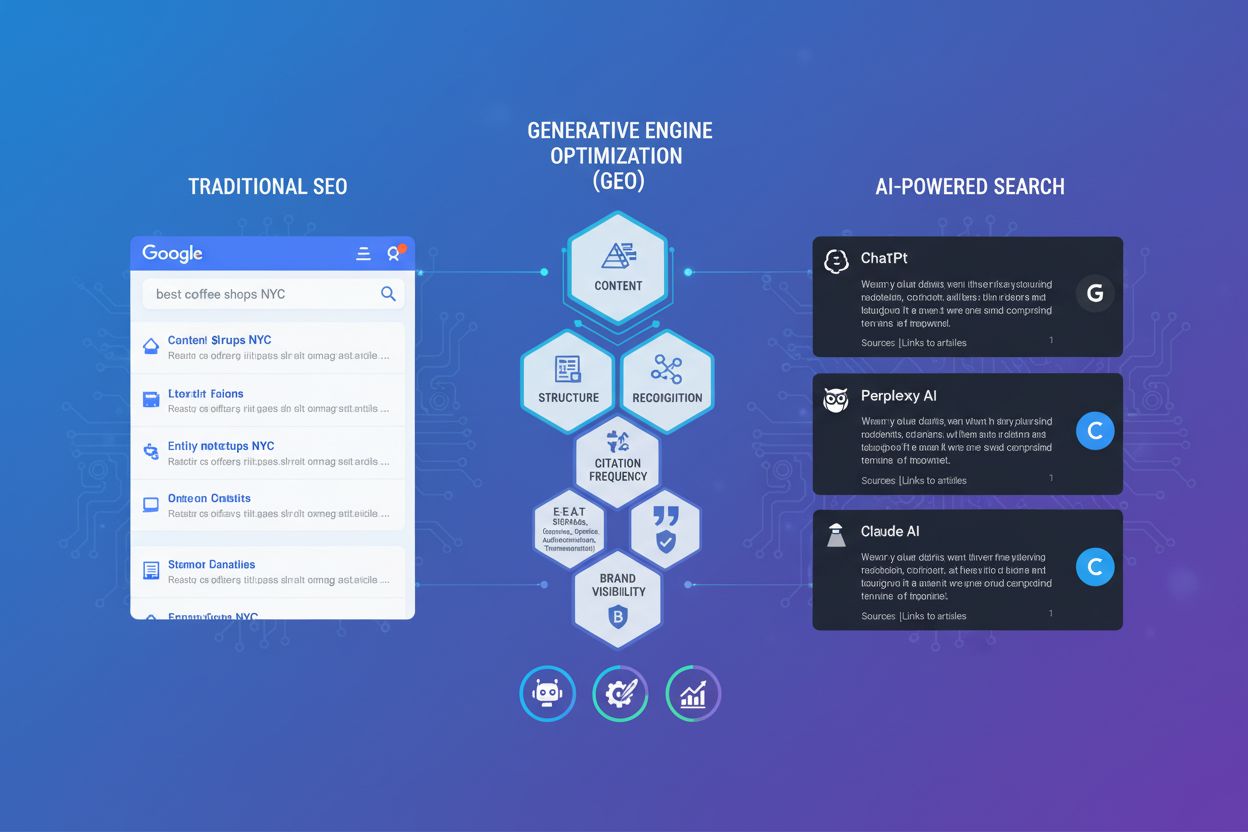
Generative Engine Optimization (GEO) represents a fundamental shift in how businesses must approach digital visibility in 2025. Unlike traditional Search Engine Optimization (SEO), which focuses on ranking in Google’s search results, GEO is the practice of optimizing your content, brand authority, and online presence to appear prominently in AI-generated answers across platforms like ChatGPT, Perplexity, Google’s AI Overviews, and similar AI search engines. This distinction is crucial because consumer search behavior is rapidly fracturing across multiple platforms, and businesses that fail to optimize for AI visibility risk losing significant market share.
The urgency of GEO cannot be overstated. Research shows that 82% of consumers find AI-powered search more helpful than traditional search engines, yet only 22% of marketers have set up monitoring systems to track their brand visibility in AI-generated answers. This gap represents both a risk and an opportunity for forward-thinking businesses. As AI continues to reshape how people discover information, products, and services, the businesses that master GEO will capture disproportionate market share from competitors still focused solely on traditional SEO.
Consumer search behavior is undergoing a seismic shift that demands immediate business attention. While Google still processes approximately 5.9 million searches per minute and 8.5 billion searches per day, the emergence of AI-powered search tools has created a parallel ecosystem where consumers are increasingly turning for answers. ChatGPT alone has achieved household-name status, with over 200 million registered users by Q1 2025 and nearly 5 billion monthly visits, making it the 5th most visited website globally.
The data reveals a nuanced picture: consumers aren’t abandoning Google entirely, but they are experimenting with AI alternatives at unprecedented rates. Approximately 49% of consumers click through to original sources when using AI search tools, meaning your brand still has opportunities to capture traffic even when AI generates answers. However, the critical difference is that your brand must first appear in the AI-generated answer itself to be considered for that click-through. This is where GEO becomes essential—it ensures your content, expertise, and brand authority are recognized by AI systems as worthy of citation and inclusion in their responses.
| Search Platform | Consumer Usage | Key Characteristic |
|---|---|---|
| Google Search | 77% | Traditional SERP results with ads |
| Large Language Models (LLMs) | 49% | AI-generated conversational answers |
| Google AI Overviews | 38% | AI summaries within Google results |
| Perplexity | Growing | Citation-focused AI search |
| ChatGPT | Growing | Conversational AI with web access |
Traditional SEO strategies focused on keyword optimization, backlink building, and technical site performance remain important, but they are increasingly insufficient for capturing visibility in AI-powered search results. AI systems operate on fundamentally different principles than Google’s ranking algorithms. While Google rewards keyword relevance and domain authority, AI systems prioritize source credibility, factual accuracy, and the ability to cite authoritative sources when generating answers.
This distinction creates a critical challenge: a website that ranks on page one of Google for a particular keyword may not appear in AI-generated answers about the same topic. AI systems are trained to recognize and cite trusted, authoritative sources that demonstrate expertise, experience, and trustworthiness. This means that businesses must now focus on building entity authority—establishing their brand, domain, and key personnel as recognized authorities within their industry.
The implications are profound. Businesses that have invested heavily in traditional SEO tactics but neglected to build genuine authority and expertise may find themselves invisible in AI search results. Conversely, businesses that prioritize original research, expert credentials, media mentions, and structured data will naturally appear more frequently in AI-generated answers. This represents a fundamental shift from gaming algorithms to building genuine credibility.
To succeed in GEO, businesses must understand and implement the entity authority framework, which consists of four key components that AI systems use to evaluate and cite sources:
Media Mentions and Trusted Publications: AI systems are trained on vast amounts of text from reputable sources, including news outlets, industry publications, and authoritative websites. When your brand, domain, or key personnel are mentioned in these trusted publications, AI systems recognize these mentions as signals of authority. This is why digital PR and earned media have become critical components of GEO strategy. A mention in Forbes, TechCrunch, or industry-specific publications carries significantly more weight than a mention on your own website.
Schema-Enriched Pages with Structured Data: Structured data markup (Schema.org) helps AI systems understand the context and meaning of your content. By implementing proper schema markup for your organization, products, articles, and expertise, you make it easier for AI systems to extract and cite your information accurately. This is particularly important for author bios, credentials, and expertise signals that help AI systems understand who created the content and why they are qualified to speak on the topic.
First-Party Research and Original Insights: AI systems are increasingly trained to recognize and value original research, proprietary data, and unique insights. Businesses that conduct and publish original research—whether through surveys, studies, or data analysis—create content that AI systems are more likely to cite. This is because original research is inherently more valuable and trustworthy than aggregated or derivative content. When you publish original research, you’re not just creating content for humans; you’re creating authoritative source material that AI systems will recognize and cite.
Expert Quotes and Branded Citations: AI systems recognize when industry experts, company executives, or subject matter experts are quoted in authoritative publications. These citations serve as signals that your organization and its leaders are recognized authorities. Additionally, branded citations—mentions of your company name, domain, or key personnel in authoritative contexts—help establish entity authority. This is why building relationships with journalists, industry analysts, and thought leaders is crucial for GEO success.
The business implications of GEO are substantial and multifaceted. First, brand visibility in AI-generated answers directly influences consumer trust and purchasing decisions. When a consumer asks ChatGPT or Perplexity for a recommendation, and your brand appears in the AI’s response, you gain credibility and visibility that would otherwise require expensive paid advertising. Research shows that 80% of consumers have a neutral or positive attitude toward trusting brands that use AI-generated content, meaning consumers are receptive to discovering brands through AI search results.
Second, GEO affects organic traffic patterns and lead generation. While AI-generated answers may reduce click-through rates to individual websites in some cases, they also create new opportunities for brands that appear in those answers. Consumers who see your brand cited in an AI response are more likely to search for you directly, visit your website, or engage with your content. This creates a halo effect where AI visibility drives both direct traffic and brand awareness.
Third, GEO impacts competitive positioning and market share. As AI search adoption accelerates, businesses that fail to optimize for GEO will lose visibility to competitors who do. This is particularly critical in competitive industries where multiple brands compete for the same customer attention. A business that appears in AI-generated answers while competitors do not gains a significant competitive advantage.
Implementing an effective GEO strategy requires a coordinated approach across multiple business functions. Content creation must prioritize originality, accuracy, and expertise. Rather than creating generic content optimized for keywords, businesses should focus on creating content that demonstrates genuine expertise and provides unique value. This includes original research, case studies, expert interviews, and data-driven insights that AI systems will recognize as authoritative.
Digital PR and media relations become critical components of GEO strategy. Building relationships with journalists, industry publications, and thought leaders ensures that your brand receives mentions in authoritative sources. These mentions serve as signals to AI systems that your organization is recognized as an authority in your field. Additionally, structured data implementation ensures that AI systems can accurately extract and understand your content, making it more likely to be cited in AI-generated answers.
Author credentials and expertise signals must be prominently featured on your website and in your content. AI systems are trained to recognize and value content created by recognized experts. By clearly displaying author credentials, certifications, and expertise, you help AI systems understand why your content is trustworthy and authoritative. This is particularly important for E-E-A-T signals (Experience, Expertise, Authoritativeness, Trustworthiness), which are increasingly important for both traditional SEO and GEO.
Finally, businesses must monitor their GEO performance to understand how their brand appears in AI-generated answers. This requires specialized tools and platforms that track brand mentions, citations, and visibility across multiple AI search engines. By monitoring GEO performance, businesses can identify opportunities to improve their visibility and track the impact of their GEO initiatives on brand awareness and customer acquisition.
The convergence of traditional search, social media, and AI-powered search represents a fundamental shift in how businesses must approach digital visibility. Rather than treating these channels as separate silos, successful businesses will develop unified content and authority-building strategies that drive visibility across all platforms. This means creating content that is optimized not just for Google, but for AI systems, social platforms, and direct consumer engagement.
The businesses that thrive in 2025 and beyond will be those that recognize GEO not as a replacement for SEO, but as a complementary strategy that addresses the evolving landscape of consumer search behavior. By building genuine authority, creating original content, earning media mentions, and implementing proper technical signals, businesses can ensure they remain visible and competitive as search continues to fracture across multiple platforms and AI systems.
Track how your brand, domain, and URLs appear in AI-generated answers across ChatGPT, Perplexity, Google AI Overviews, and other AI search engines. Stay ahead of the competition with real-time visibility monitoring.
Learn what Generative Engine Optimization (GEO) is, how it differs from SEO, and why it's critical for brand visibility in AI-powered search engines like ChatGP...

Learn what Generative Engine Optimization (GEO) is and how to optimize your brand for visibility in AI search engines like ChatGPT, Perplexity, and Gemini. Disc...
Learn how to get started with Generative Engine Optimization (GEO) today. Discover essential strategies to optimize your content for AI search engines like Chat...