


Citation Ranking Gap Analysis
AmICited compares your organic rank against your AI citation rate for the same query, in two directions: invisible winners you rank for but are never cited on, and the inverse gap — pages AI already trusts that rank poorly everywhere else.
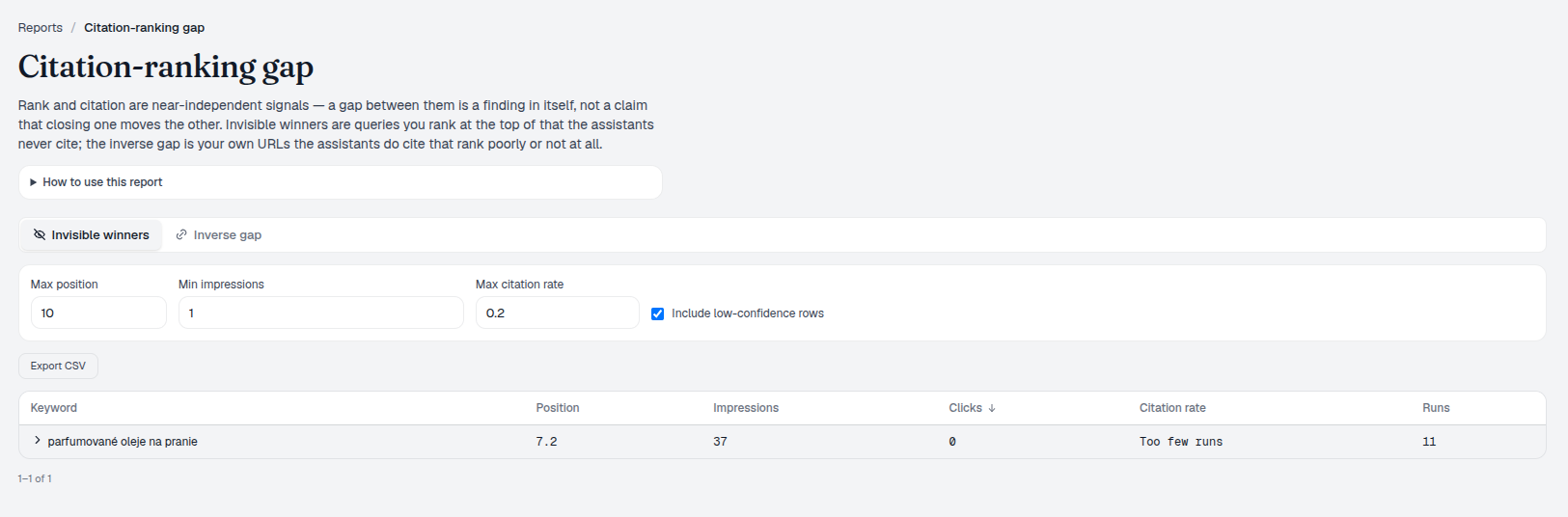
Citation Ranking Gap Evidence
Closing the gap does not mean rewriting for rank, and it does not mean the page is broken. It means the difference between a #1 Google result and a first-pick AI citation is usually structure: a direct answer up top, named entities, a date and a quotable fact — not more content.
- Invisible winners tab — queries you rank at or near the top for that no AI assistant has ever cited, filtered by Max position, Min impressions and Max citation rate.
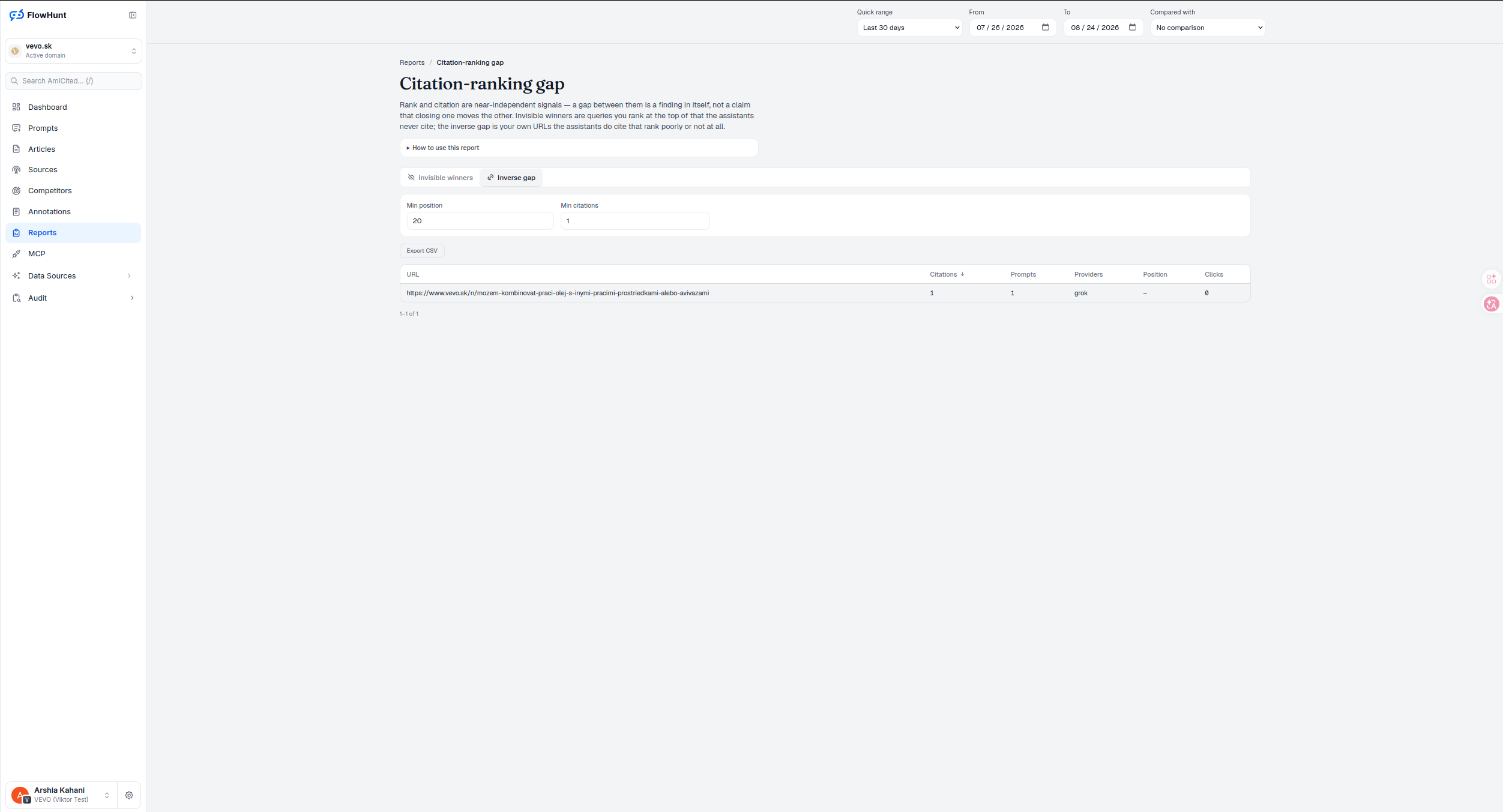
- Inverse gap tab — your own URLs that AI cites regularly despite ranking poorly, filtered by Min position and Min citations.
- Include low-confidence rows — a checkbox that decides whether rows built on too few prompt runs are shown or held back, never silently dropped either way.
- Per-row citation detail — Citations, Prompts, Providers, Position and Clicks for every URL in the inverse gap, so you see exactly which engine is doing the trusting.
- Export CSV — take either tab’s filtered table straight into a brief or a ticket.
Citation Visibility Thresholds
Max position caps how good the ranking has to be to qualify — set it tight for only your strongest pages, or loose to see the whole picture. Min impressions keeps the list to queries with real demand behind them, not statistical noise. Max citation rate is the actual test: how rarely, across every tracked prompt, an AI engine has cited this query’s top-ranking page — low means genuinely invisible, not just occasionally missed. Rows sort by clicks descending by default, so your most valuable organic wins surface first; expand any row to see the matched prompts, the match type and similarity behind them, a per-provider breakdown of runs and cited runs, and which competing hosts are getting cited instead.
- Max position — how well you have to rank organically for a query to even be considered.
- Min impressions — a demand floor so low-volume queries don’t crowd out real opportunities.
- Max citation rate — how rarely AI engines cite you here; a genuinely invisible winner sits near zero.
- A confidence floor, not a fake zero — a rate built on too few prompt runs shows as low confidence, never as a misleading 0%; a checkbox decides whether those rows are shown or held back.
- Expand any row — matched prompts, match type and similarity, per-provider run counts, and the competing hosts winning the citation instead.
Cited Pages with Low Rankings
Switch to Inverse gap and the question flips: which of your own URLs does AI cite despite a weak or non-existent organic rank? Two filters set the bar — Min position (how poorly it has to rank to qualify) and Min citations (how many times AI has to have cited it to count as a real pattern, not a one-off). Each row shows the URL, its citation count, how many distinct prompts it’s cited on, which provider is doing the citing, its organic position and its clicks. The list starts from up to 500 of your most-cited URLs, so it’s a capped, prioritized slice, not a full citation census — the report says so when it’s sampling.
- Min position — how poorly a URL has to rank organically to qualify for this list.
- Min citations — a floor that turns a single lucky citation into a genuine, repeatable pattern before it counts.
- A blank position isn’t rank zero — it means the keyword warehouse has no organic row for that URL at all; absent from search, not literally bottom-ranked.
- Citations and Prompts — how often, and across how many distinct questions, AI is choosing this page.
- Providers and Position — which engine trusts the page, and exactly how poorly it ranks despite that trust; every state — tab, dates, thresholds, sorting — lives in the URL, so a filtered view is shareable and export to CSV takes exactly what’s on screen.
Track Citation Competitors
As the best tool to track brand mentions on ChatGPT, AmICited shows the domain and page AI picked instead for every query you rank well on but are never cited for — so you can compare structure, not guess at it.
- Cited by provider — which engine is citing your competitor on your own top-ranking query.
- Domain or URL view — from the whole competitive landscape down to the single page winning the citation.
- Structure, side by side — a direct answer up top, named entities, a date and a quotable fact are usually the difference.
Track Citation Rank Changes
Once you restructure an invisible winner or shore up an inverse-gap page, AmICited keeps tracking citation rank per prompt and per engine, so you can confirm the fix actually changed anything.
- Per prompt, per engine — see exactly where a restructured page started winning citations.
- Daily history — not a monthly snapshot, a curve you can point to.
- Re-run the same band — a page that leaves the gap is fixed; one that stays needs a different fix than more words.
independent signals, read together for the first time
Rank tells you where Google puts a page. AI citation tells you whether an AI engine trusted it enough to quote. AmICited is the first place you can see both for the same query.
See the AI Rank TrackerFind Citation Ranking Gaps
Invisible winners you rank for but are never cited on, and an inverse gap of pages AI already trusts despite poor rank — read both directions in one report.
Ready to find what ranks well but never gets cited?
Free check · 7-day trial · card required