


Content Freshness and Publishing Cadence
AmICited tracks every URL added, updated or removed from your sitemap — and your competitors’ — every day, then correlates page age against AI citation position so you know whether a faster publishing cadence actually moves the needle. History starts the day a host is first tracked; a 90-day view doesn’t manufacture data that isn’t there yet.
Content Freshness Score
Raw URL counts favor whoever has the biggest site, so content freshness needs a fairer yardstick. AmICited scores every host 0–100, weighting size-adjusted publish rate 35%, refresh rate 25%, median recency 25% and inverse year-old share 15% — so a small site that ships steadily is not automatically beaten by a large one that does not.
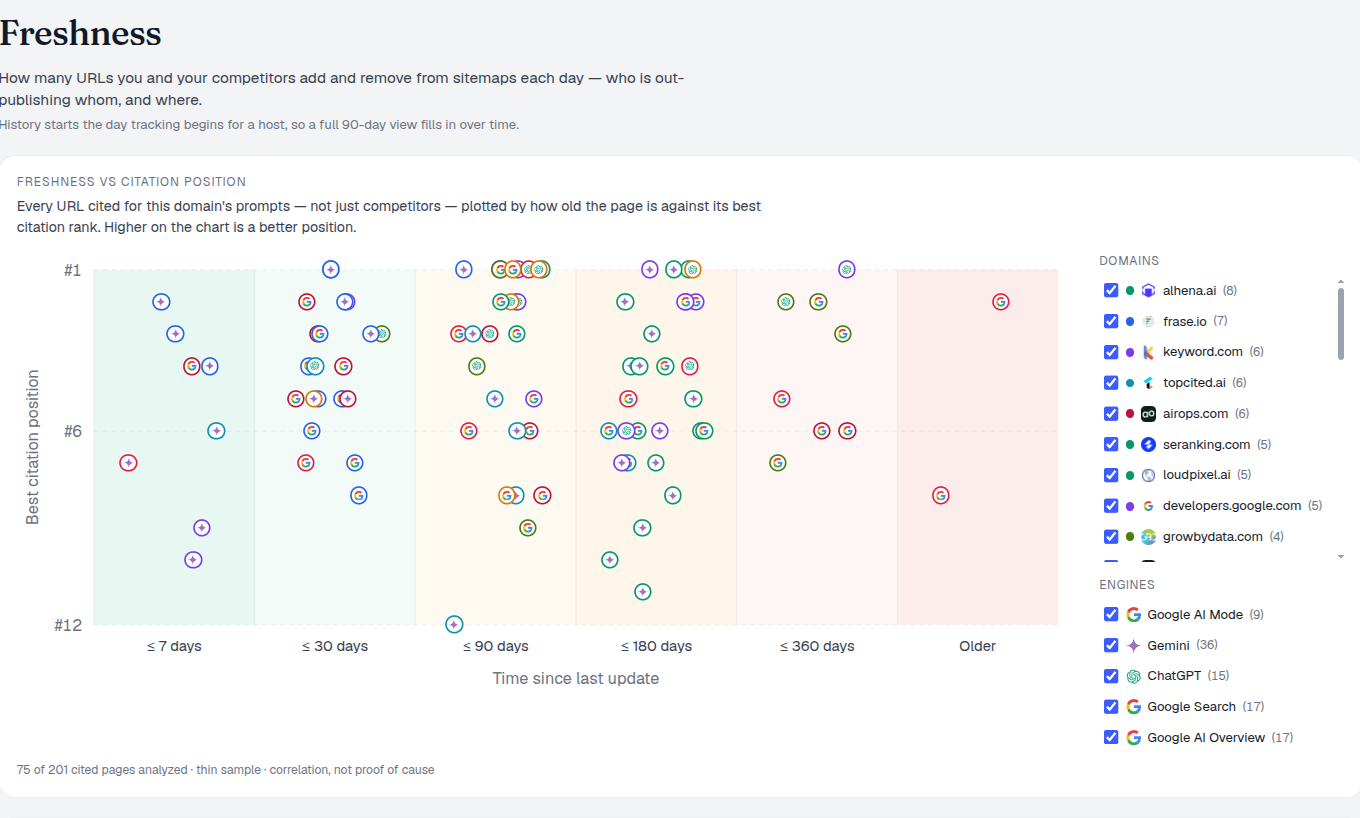
- Freshness vs citation position — every age-known cited page plotted by age band against its best citation rank; the UI labels this correlation, not proof of cause, and suppresses the plot under three points.
- Sitemap churn, daily — one bar per day, added above the axis and removed below, segmented by host and clickable down to the exact URLs; missing or partial crawl days render as gaps, never a false zero.
- Freshness leaderboard — a 0-100 score per host with 7-day and 30-day URL deltas, mean added/removed per day and a normalized trend sparkline, your own domain pinned first.
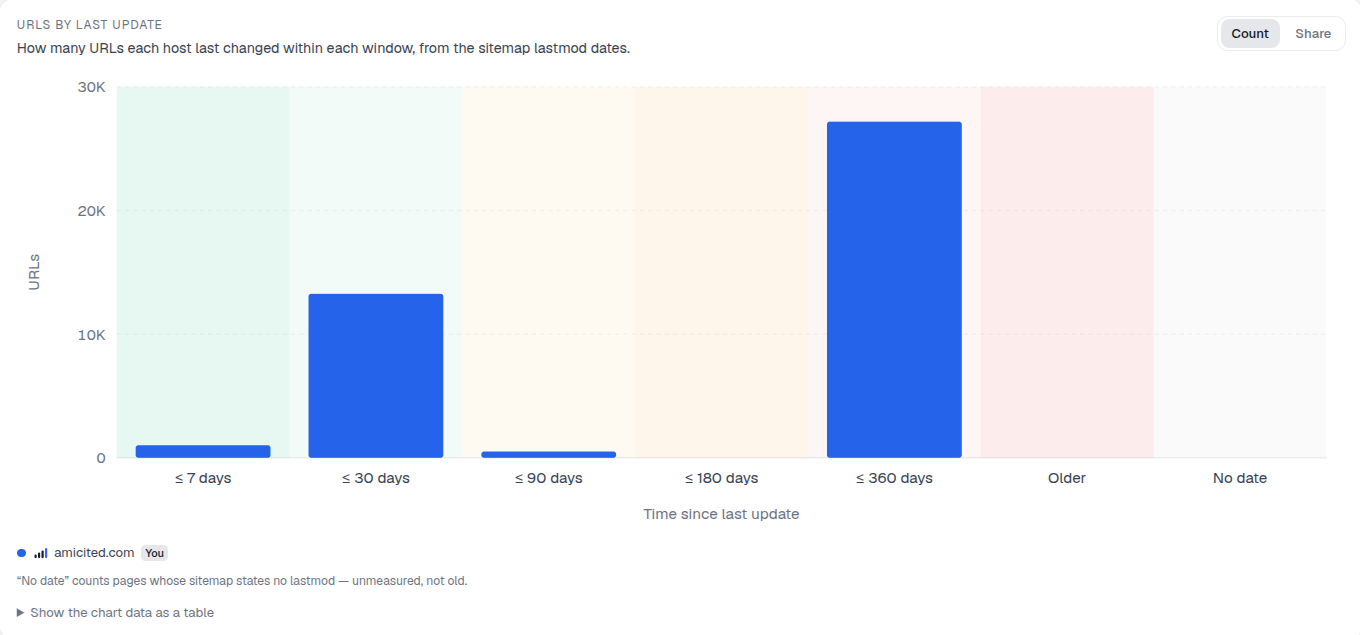
- Directory treemap — rectangle area is URL count; switch to Freshness color mode to spot large sections with a low share of recently updated pages.
Freshness Score Signals
The 0–100 Freshness Index isn’t one raw count. It weights size-adjusted publish rate at 35%, refresh rate at 25%, median recency at 25% and inverse year-old share at 15%. If fewer than 20% of a host’s URLs have a parseable lastmod date, the last three signals drop out and weight shifts to publishing alone — and confidence falls with them, since a high index built on thin dating data is directional, not precise. Failed, partial, baseline and suspect-drop crawl days are excluded from scoring entirely rather than counted as zero activity.
- Publish rate — 35% — size-adjusted, so a small site shipping steadily competes with a large one that isn’t.
- Refresh rate — 25% — how often existing URLs get a new lastmod, not just new URLs appearing.
- Median recency — 25% — the midpoint age of dated URLs; dropped from scoring below the 20% lastmod-coverage floor.
- Inverse year-old share — 15% — rewards hosts with fewer pages a year or older sitting untouched.
Content Freshness and Speed
Publishing often is not enough if the new page fails Core Web Vitals. AmICited tracks freshness and technical health side by side, because AI crawlers favor pages that are both recently updated and quick to fetch.
- Core Web Vitals, per cited page — LCP, INP and CLS scored against a 90+ target.
- One health score — folds speed, stability and freshness signals into a single number you can rank and act on.
- Fix the pages worth fixing — prioritized by citation upside, not a generic warning list.
Content Accessibility for Agents
Shipping fast only pays off if the page is actually readable by the crawlers feeding AI answers. Pair freshness tracking with a full agent-readiness audit so nothing you publish gets steered away from by llms.txt or a broken accessibility tree.
- Agent Readiness Summary — six pass/fail checks: llms.txt, accessibility, crawler access, sitemap, WebMCP, agentic commerce.
- Accessibility tree checker — the same structure AI agents and screen readers use to parse a page.
- Catch it before it ships — audit a new page the same day it hits the sitemap.
of publishing history, from the day tracking starts
History fills in from the day a host is first tracked. A full 90-day view of who is shipping and who is stalling builds automatically, no backfill required.
See performance impactCompare Content Publishing Cadence
Daily sitemap churn, a size-adjusted freshness score per host, and the correlation between page age and AI citation position — for you and every tracked competitor.
Ready to see who is out-publishing you?
Free check · 7-day trial · card required