


Customer Retention and RFM Segmentation
Customers and Retention is a cohort retention analysis tool that shows whether the shop is buying customers or keeping them — cohort retention month over month, every customer placed into a segment by recency, frequency and spend, and how much revenue rests on the top spenders.
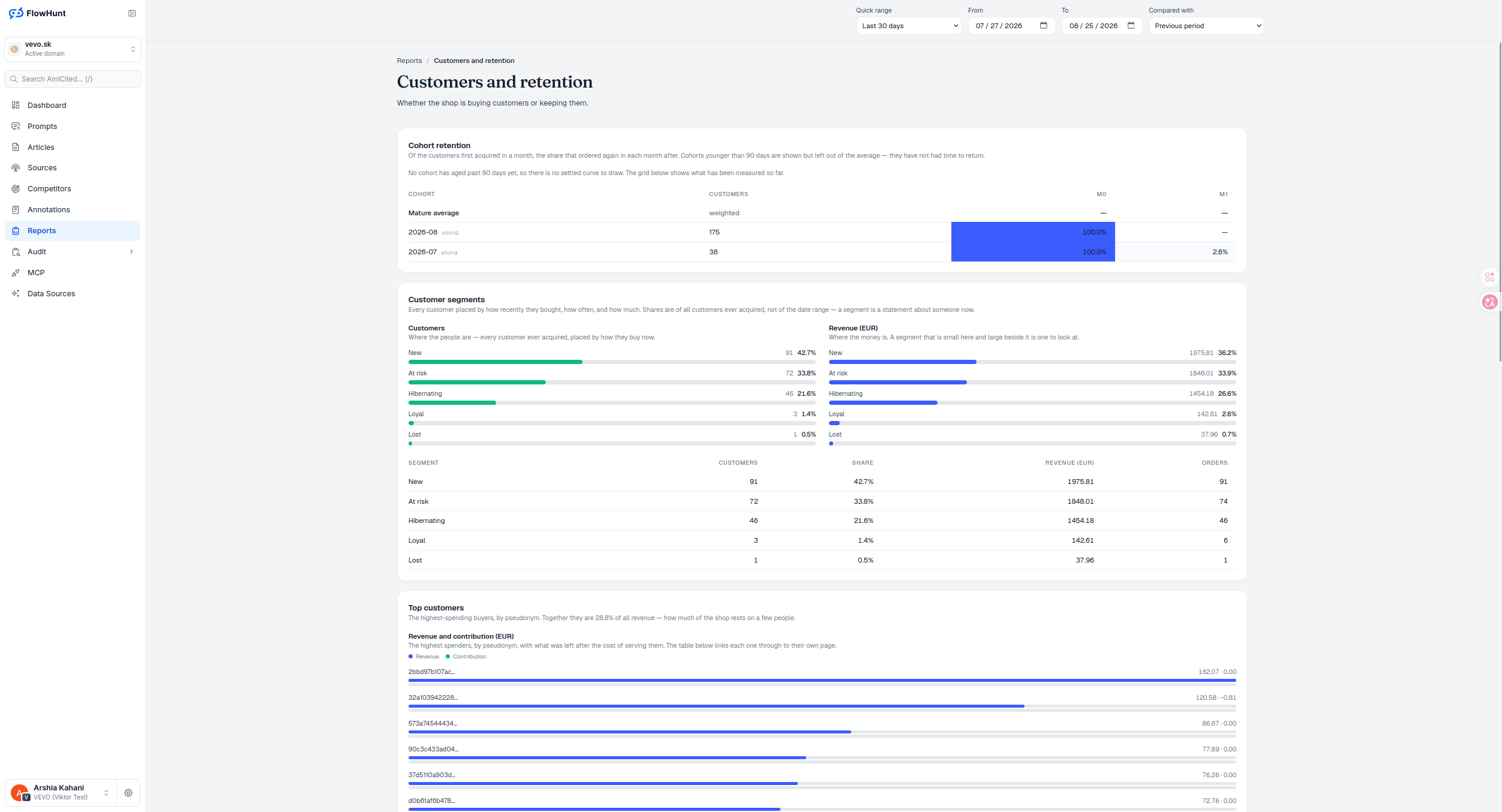
Monthly Customer Cohort Retention
Customers first acquired in a month, tracked for the share that orders again in each month after. The mature view includes a cohort period only after its next month begins, so unfinished periods never depress the average as if nobody returned.
- Cohort retention analysis — of customers first acquired in a month, the share that ordered again in each month after, one column per month-after-acquisition.
- Completed periods only in the mature view — a cohort-month cell enters the mature average only after its next month has begun; unfinished periods are excluded, not counted as zero.
- RFM customer segmentation — every customer placed by recency, frequency and spend into New, At risk, Hibernating, Loyal or Lost.
- Segment shares are lifetime, not windowed — shares are of all customers ever acquired, not of the date range, because a segment is a statement about someone now.
- Segment revenue, not just headcount — the same five segments charted by revenue in EUR, so a small but valuable segment doesn’t disappear next to a large cheap one.
- Small share, big revenue: protect it — a segment with few customers but outsized revenue is worth defending; the reverse usually needs reactivation or cheaper treatment, not the same attention.
- Read the shape, not the level — a sharp early drop in the retention curve points to onboarding or second-purchase work; where the mature curve flattens is the shop’s natural loyalty threshold.
- Compare like with like — judge cohorts at the same month-since-acquisition position, never a young cohort’s early months against an older cohort’s full history.
- Top customers — the highest-spending buyers by pseudonym, revenue and contribution side by side, ranked.
Retention by Acquisition Month
Cohort retention is read across, not down: pick a row (the month customers were first acquired) and read right to see the share still ordering one month later, two months later, and on. Cells are shaded by how much of the cohort returned, capped at full opacity at 100% — a cell that has not completed yet, or has no data, stays blank with an em dash rather than a false zero. A separate Mature Cohort Retention card states the exact observation dates and maturity rule, size-weights completed periods by cohort customers, and switches to a not-enough-data note when support is too thin to trust.
Top Customer Revenue Concentration
The highest-spending buyers, by pseudonym, charted with revenue and contribution side by side in EUR. Together the top customers here are 28.8% of all revenue — a number worth knowing before assuming growth just needs more traffic. Identity is a pseudonymous key by default, or a real name/email where the shop’s privacy and import settings allow it; the report handles named, anonymized and unavailable identity plainly rather than guessing. Clicking a customer opens their own lifetime detail page.
of all revenue held by the top customers
The Top Customers chart ranks buyers by pseudonym — revenue and contribution side by side — so it’s clear how much of the shop rests on a few people.
See Lifetime ValueAnalyze Customer Retention and Segments
Cohort retention by month, customers segmented by recency, frequency and spend, and how much revenue rests on your top buyers.
Ready to see who’s actually coming back?
Free check · 7-day trial · card required