


Organic Click Decay and Growth
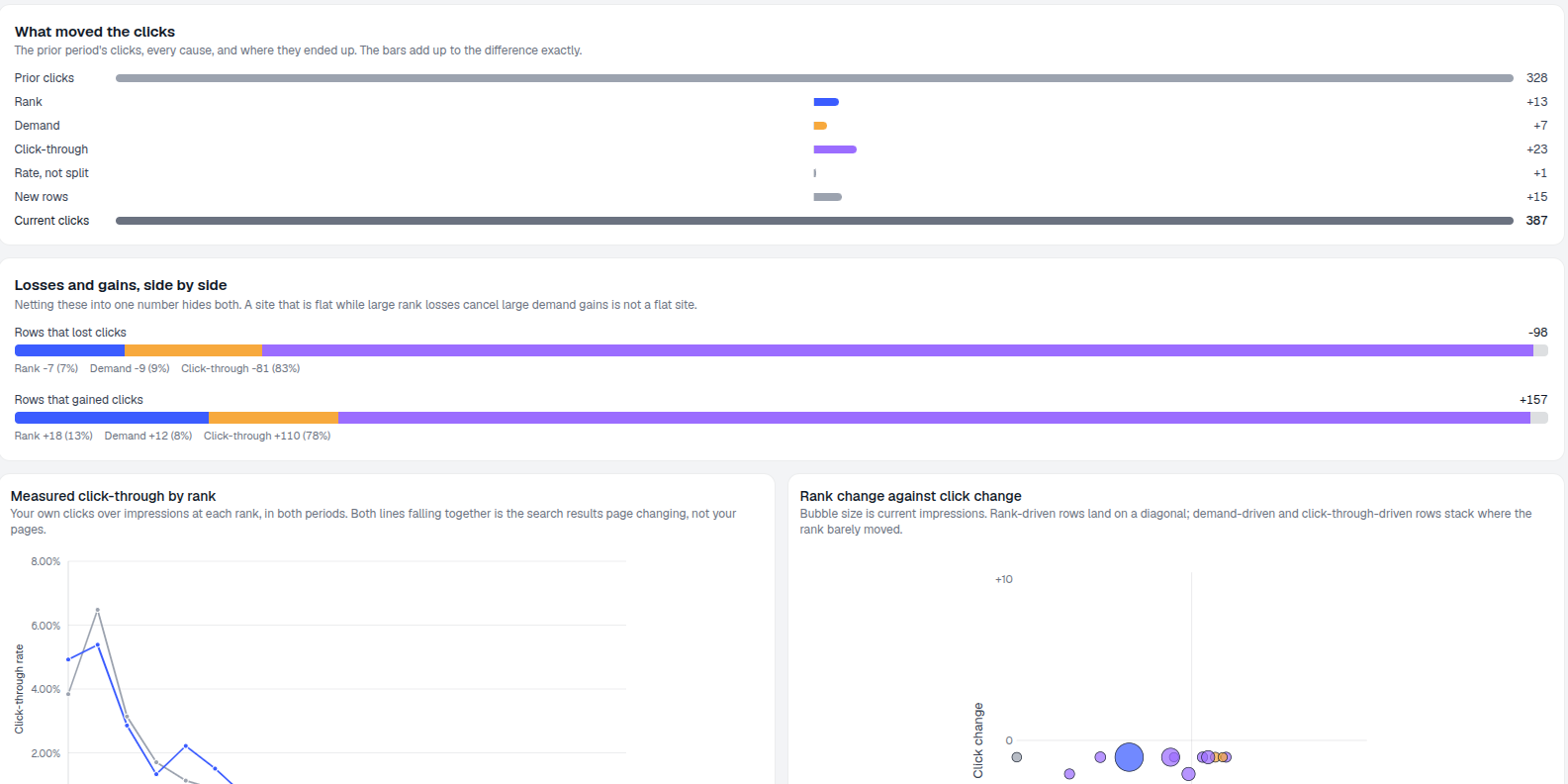
Decay & Growth compares a current and prior period, then decomposes observed click change for pages, queries, or directories. It separates demand from the rate effect where possible, and splits rate into position and CTR only when the site’s own click-through curve covers both ranks. The result is a prioritised investigation, not a claim that one factor caused the outcome.
Organic Click Change Components
The report always measures the click delta first. For comparable rows, demand captures the part associated with impression change; rate captures the remaining click-through change. When the stored curve can cover both positions, rate is split into a position effect and a CTR effect. New and lost rows do not receive a rank split because one side has no impressions.
- Page, query, or directory altitude matches the decision you need to make.
- Losses, gains, or both prevents large positive and negative changes from cancelling into an unhelpful net.
- The waterfall and ranked movers use components that sum back to the observed total.
- Component sorting and minimum filters bring material changes forward without hiding the chosen scope.
An SEO expert can investigate a position-driven page loss differently from a CTR-driven one. A domain owner can see that flat net traffic may still contain meaningful opposing movements.
Decay Attribution Evidence
Every row carries current and prior clicks, impressions, position, CTR, and its verdict: position-driven, demand-driven, CTR-driven, mixed, new, or lost. Where calculated, it also carries demand, rate, position, and CTR components plus the curve fallback level and sample evidence. The CTR-by-rank chart shows measured CTR in both periods rather than disguising it as a fitted result.
Use the top-movers table to choose a next check: a position loss may call for SERP and relevance review; a CTR loss may call for a snippet and result-page review; demand movement may be market or seasonality rather than a page problem. These are investigation paths, not automatic fixes.
At ranks beyond the curve’s final bucket, the fitted curve is flat by design. A row can therefore report no position effect even when its displayed average position moved.
Decay Attribution Limits
The report warns when a period spans a data gap, prior data has not been imported, a period is incomplete, or Search Console impressions are suspect. If a curve has not been fitted, the report still gives an exact demand-versus-rate answer but does not fabricate a three-way split. Anonymised query traffic remains unattributed at query altitude because an average rank over withheld queries would not be meaningful.
- Curve snapshots are dated and scoped so changes are not compared against a hidden benchmark.
- SERP features are unknown, so a CTR component cannot distinguish an AI overview, a carousel, a title change, or another result-page change.
- New and lost clicks stay separate from ranked rows rather than receiving invented positions.
- Warnings travel with the response, including the actual coverage dates where available.
Use it to focus a diagnosis, then verify the working hypothesis in the live SERP and source reports.
measured components: demand, position, and CTR
An exact decomposition makes a traffic change readable, while its confidence and limitations remain visible beside the conclusion.
Explore CTR GapInvestigate Organic Click Changes
Compare periods, rank the biggest movers, and keep the evidence limits in the same view.
Ready to understand what sits behind your organic gains and losses?
Free check · 7-day trial · card required