


Entry Product Analysis for Repeat Customers
Entry Products tracks every customer from their first order through the second, third and fourth, then breaks that repeat rate down by the product that acquired them — so you can see which first purchase actually builds a relationship, and which one is a dead end.
First Purchase Customer Baseline
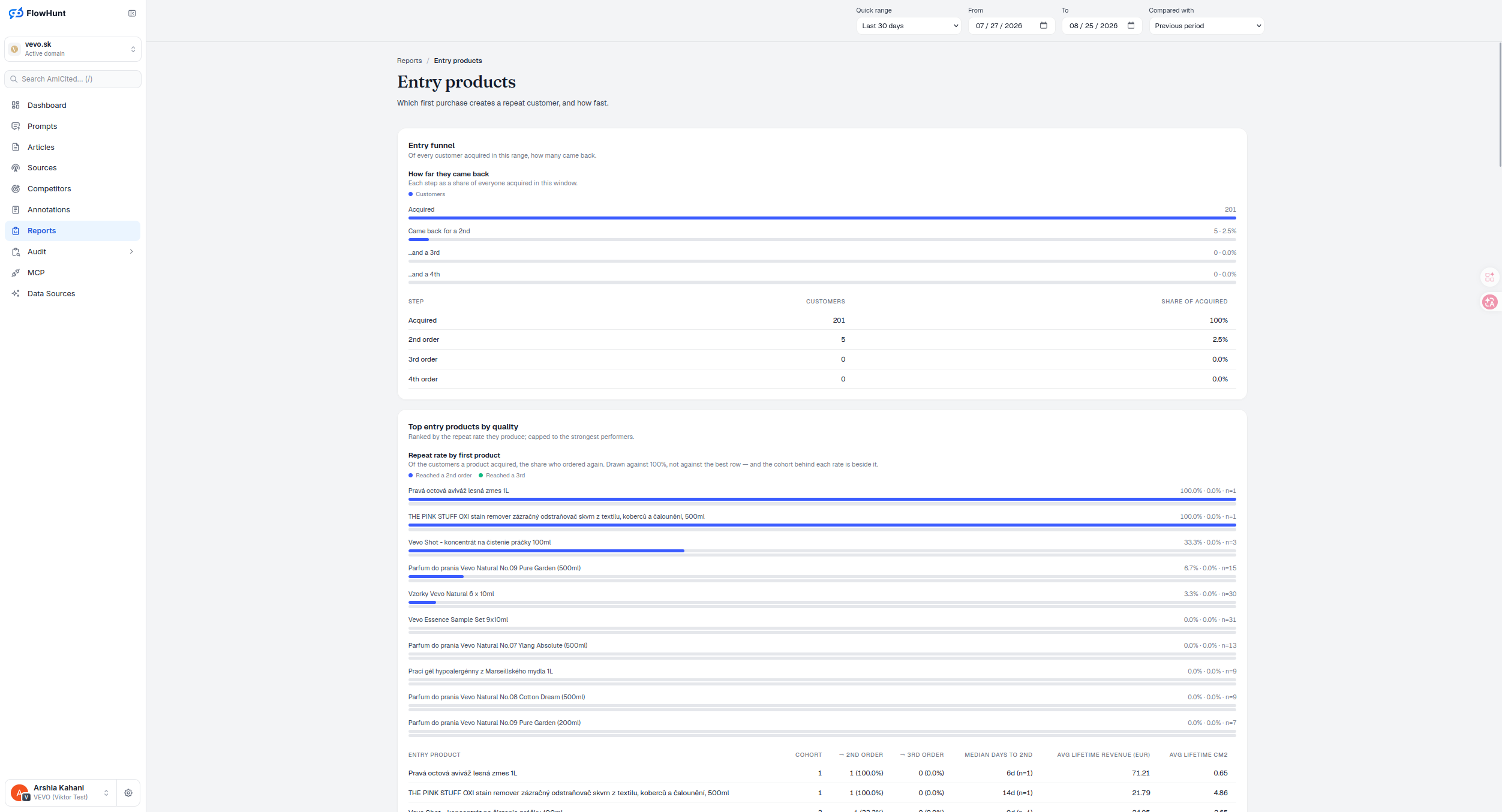
Each step is a share of everyone acquired in this window: 201 customers acquired, 5 reached a 2nd order, none yet reached a 3rd or 4th. That’s the floor every entry product’s repeat rate is measured against.
- Entry funnel, four steps — Acquired, 2nd order, 3rd order and 4th order, each shown as a share of everyone acquired in the window.
- 201 acquired, 5 came back — a 2.5% return-to-2nd-order rate sets the baseline the per-product table is measured against.
- Repeat rate by entry product — of the customers a product acquired, the share who ordered again, drawn against a fixed 100% axis rather than the best-performing row.
- Cohort size shown beside every rate — a 50% repeat rate on 4 customers reads differently from 50% on 400, and both numbers sit in the same row.
- Median days to 2nd order — how fast a repeat happens, not just whether it does.
- Customer lifetime value ecommerce by entry product — what the average customer acquired by each product has spent since, and what the shop kept of it.
- Same-item repurchase, separately — for every product, how many buyers bought that exact item at least twice, and how often — 2x, 3x, 4x, 5+ — grouped across all buyers in the window, not just newly acquired ones.
Repeat Order Funnel by Product
Every customer acquired in the window starts at 100%. The funnel shows exactly what share made it to a 2nd order, a 3rd, and a 4th — the same shape every entry product’s own repeat rate is compared against.
- STEP, CUSTOMERS, SHARE OF ACQUIRED — three columns, one row per funnel step.
- Acquired — 201 customers, 100% — the full cohort for this window.
- 2nd order — 5 customers, 2.5% — the first drop-off, and the number every per-product repeat rate is read against.
- 3rd and 4th order — 0 customers, 0.0% each — nobody in this window has gone further than a single repeat yet.
Entry Product Repeat Rate Comparison
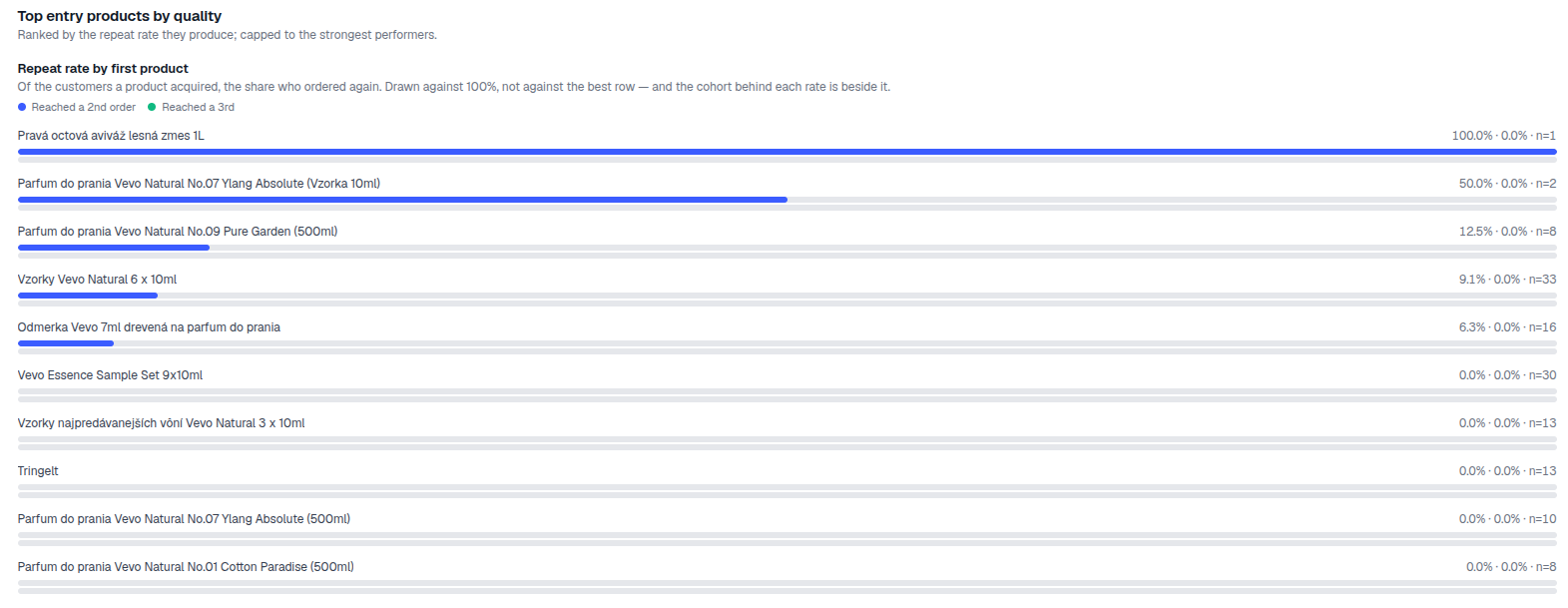
This entry product analysis shows, of the customers a product acquired, the share who ordered again — reached a 2nd order in blue, reached a 3rd in green, both drawn against a fixed 100% axis so one strong product doesn’t stretch the scale and flatten everything else. The cohort behind each rate sits right beside it, and median days to 2nd order and average lifetime revenue and CM2 close out the row.
- ENTRY PRODUCT, COHORT — the product and how many customers it acquired.
- → 2ND ORDER, → 3RD ORDER — share of that cohort who reached each step, drawn against 100%.
- MEDIAN DAYS TO 2ND — how fast the repeat happens, not just whether it does.
- AVG LIFETIME REVENUE (EUR), AVG LIFETIME CM2 — what the average customer from that entry product has spent since, and what the shop kept of it.
- Product drilldown — product names in both entry-quality and same-item frequency tables open the same product detail used by Products and Assortment.
Observed Customer Value by Entry Product
Only customers whose recorded first order falls inside the selected range enter a cohort, and everything counted after that — orders, revenue, CM2 — stops at the range end. A customer acquired near the end of the window has had almost no time to return, and the report applies no maturity adjustment for that. If the data feed’s own history starts later than a customer’s real first purchase, that customer can look newly acquired when they were not. Read recently-acquired rows as provisional, and widen the window before judging a product’s true repeat quality.
- Right-censored, not complete — “lifetime revenue” and “lifetime CM2” mean value accrued inside this window, not a customer’s full history.
- No maturity adjustment — a product that only just started acquiring customers will show thin repeat numbers because there hasn’t been time, not because the product is weak.
- Coverage gaps can mislabel a customer — someone whose true first order predates the imported history can appear newly acquired.
- Same-item purchase frequency — repeating customer-product pairs grouped into 2x, 3x, 4x and 5+ buckets, each bucket’s share of all repeating pairs; high same-item repeat supports a replenishment reminder, broad repeat without it points to cross-selling instead.
of acquired customers reached a 2nd order in this window
201 customers acquired, 5 reached a 2nd order, 0 reached a 3rd or 4th — the baseline every entry product’s repeat rate is measured against.
See Lifetime ValueIdentify Entry Products Driving Repeat Purchases
An entry funnel, repeat rate by first product against a fixed 100% axis, and the lifetime revenue and CM2 each entry product goes on to produce.
Ready to see which first purchase actually creates a customer?
Free check · 7-day trial · card required