


Query Coverage for Organic Traffic
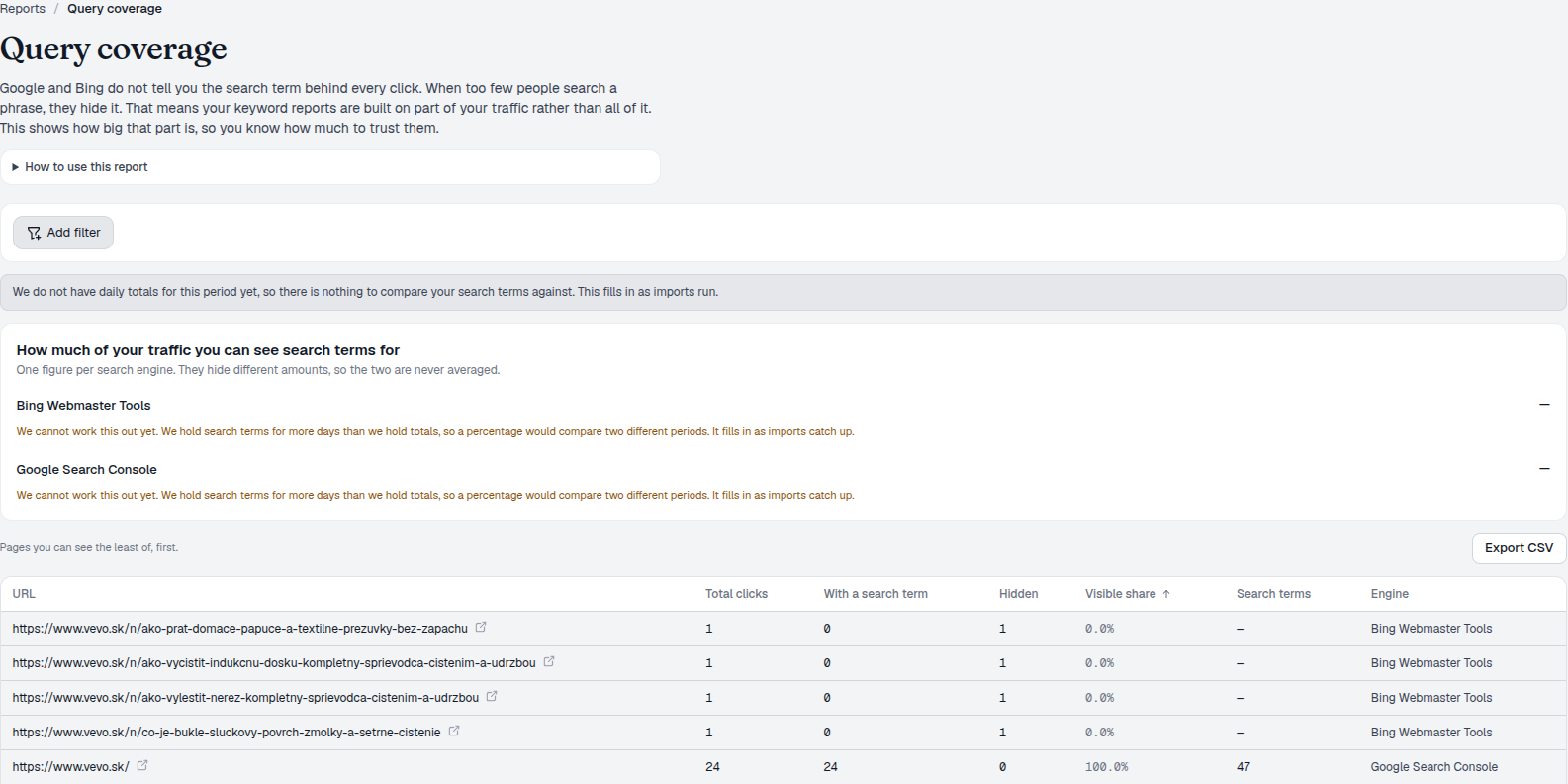
Search engines can withhold low-volume query rows. Query Coverage puts that missing context beside the named-query data: per engine, it compares named clicks and impressions with site totals, then lists pages where page traffic exceeds the clicks that can be tied to a reported query.
Query Coverage Data Disclosure
For each connected platform, the report shows site clicks and impressions, the named portion found in query rows, and the corresponding coverage ratios. This lets an SEO specialist distinguish a thin query list from a truly quiet page. A domain owner can see why a revenue-relevant landing page has traffic but no obvious keyword explanation.
- Per-platform bars keep Google and Bing separate.
- Named and page measures show the query-visible share alongside page-level organic traffic.
- Directory scope narrows the page list to a path subtree when a team owns one section.
- Shareable filters and date range keep the same question reproducible for a monthly review.
Site totals are the denominator. If they are unavailable or partial, coverage is shown as unknown, never as 100%.
Query Coverage by Page
Each row is a page on one platform for the selected window. The table carries page clicks and impressions, named clicks and impressions, hidden clicks, coverage, and the number of named queries. Sort, filter, page through the results, or export the visible slice when a content team needs a concise investigation list.
For practitioners, a page with substantial hidden clicks is a prompt to inspect its search appearance, intent mix, and analytics context instead of declaring a keyword winner. For owners, it makes reporting more credible: a small named-query list does not represent all organic visitors.
The per-page ratio can be provisional when the warehouse has not completed its page pass. In that state both halves may come from the same imported rows, so a perfect-looking value is not evidence of full query visibility.
Query Coverage Data Limits
Use Query Coverage before promising that a query report explains a traffic change. SEO experts can compare engines and sections before prioritising keyword work. Domain owners can ask whether an apparent content gap is actually a visibility gap in the source data.
- Partial windows are called out when the imported range does not cover the requested dates.
- Late-starting platform imports expose the first available day rather than silently treating earlier days as zero.
- A zero-click page has no meaningful coverage ratio and does not become a full bar by default.
- Filters apply to the table while the report preserves the distinction between site-level totals and the narrowed page list.
This is a measurement boundary, not an attribution model. It cannot recover queries an engine did not disclose, infer hidden intent, or prove why a page received a click.
coverage views, one for each connected engine
Read named query traffic with its denominator, then investigate the pages where missing query detail is material.
Explore Google Search QueriesReport Query Coverage Limits
See what is named, what is hidden, and which pages need a more careful reading before you act.
Ready to see how complete your query evidence is?
Free check · 7-day trial · card required