


Customer Replenishment and Reorder Timing
Replenishment is customer replenishment analytics that finds which customers are due to reorder a specific product right now — by that customer’s own cadence for that exact product, not a shop-wide interval that flattens everyone to the same number. There’s no date range to set: it’s evaluated against current purchase history, not a reporting window, because changing the window wouldn’t change who’s due.
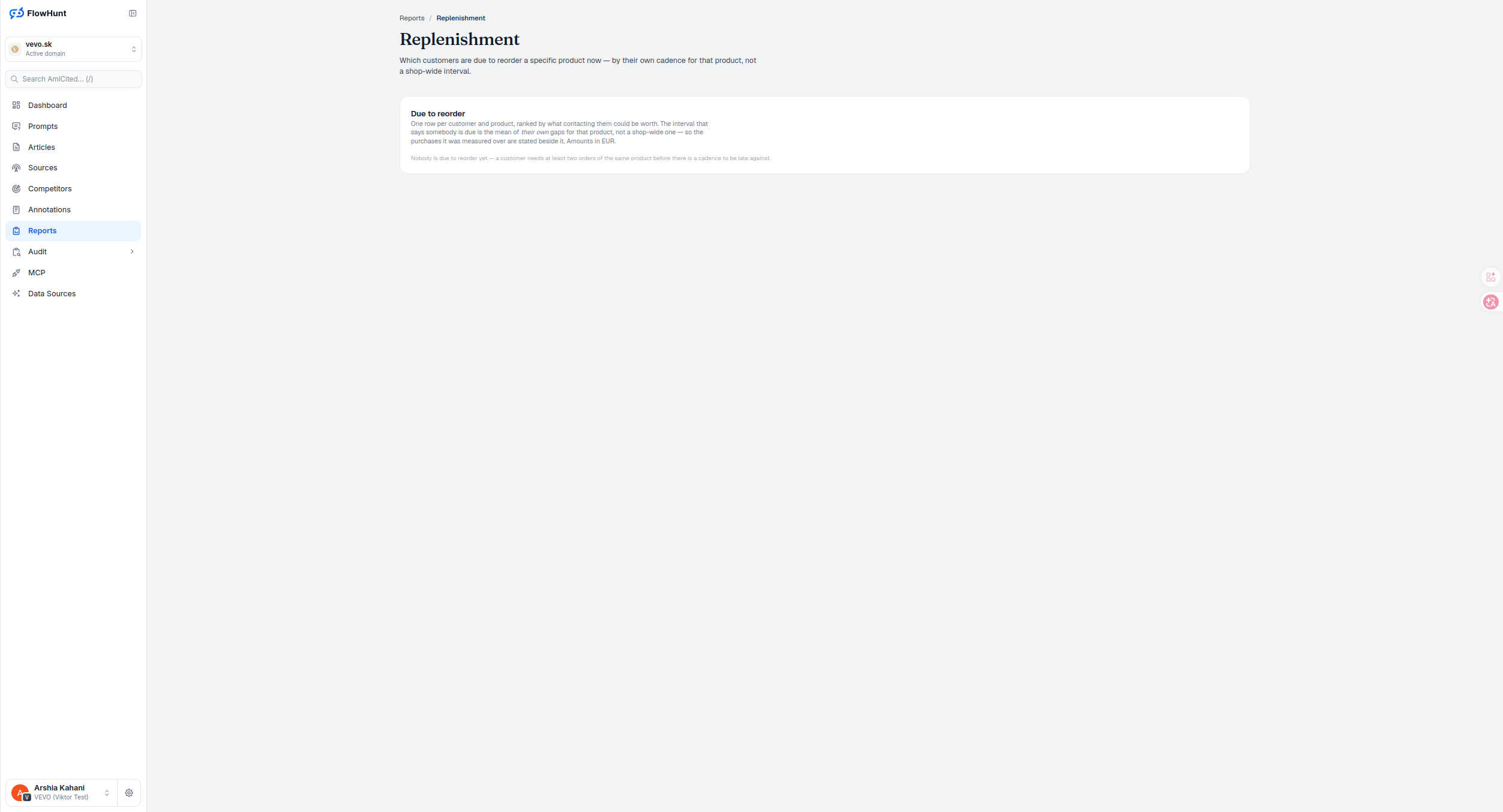
Customer-Specific Reorder Timing
The interval that says somebody is due is the mean of their own gaps for that product — so the purchases it was measured over are stated right beside it. A customer needs at least two orders of the same product before there’s a cadence to be late against, and a row only turns ‘due’ once time since the last purchase reaches that mean — it’s flagged ‘overdue’ only past 1.5 times it.
- Due to reorder — a reorder reminder worklist, one row per customer and product, ranked by what contacting them could be worth, amounts in EUR.
- Per-customer, per-product cadence — the interval is the mean of that customer’s own gaps for that exact product, never a shop-wide average.
- Due, then overdue — a row turns due once elapsed time reaches the customer’s own mean interval, and overdue only past 1.5 times it, flagged in red so a mildly late pair isn’t confused with a genuinely stale one.
- Evidence shown, not hidden — the number of purchases the interval was measured over sits right beside it.
- Minimum two orders — a customer needs at least two orders of the same product before there’s a cadence to be late against at all.
- Ranked by value — sorted by what reaching that customer about that product could be worth, not just by how overdue they are.
- No date picker — due-to-reorder is judged against current history, not a window, so there’s nothing to set.
Reorder Value Prioritization
Due to Reorder doesn’t just flag lateness, it ranks rows by what contacting that customer about that product could be worth, in EUR — so a slightly overdue high-value pair can outrank a badly overdue low-value one.
Capped Reorder Opportunity Lists
When more eligible pairs exist than the list shows, the page states how many lower-value pairs were left off rather than letting a capped table pass as the whole workload. Each customer key opens that customer’s own order, product, cadence and segment detail page. An empty list means nobody currently has enough same-product history and elapsed time to qualify — not that the shop has no repeat customers.
Repeat Purchase History Inputs
Replenishment’s per-product cadence draws on the same order history that Repeat Purchase breaks down by gap length and order sequence — so a customer’s own rhythm, once established there, is exactly what decides when they’re due here.
orders of the same product before a cadence exists
One order gives no gap to measure — Replenishment only surfaces a customer once there’s at least one real interval of their own to compare against.
See Repeat PurchaseIdentify Customers Due to Reorder
One row per customer and product, ranked by expected value, using each customer’s own reorder cadence for that exact product.
Ready to know who’s due to reorder?
Free check · 7-day trial · card required