


Semantic Map for AI Content
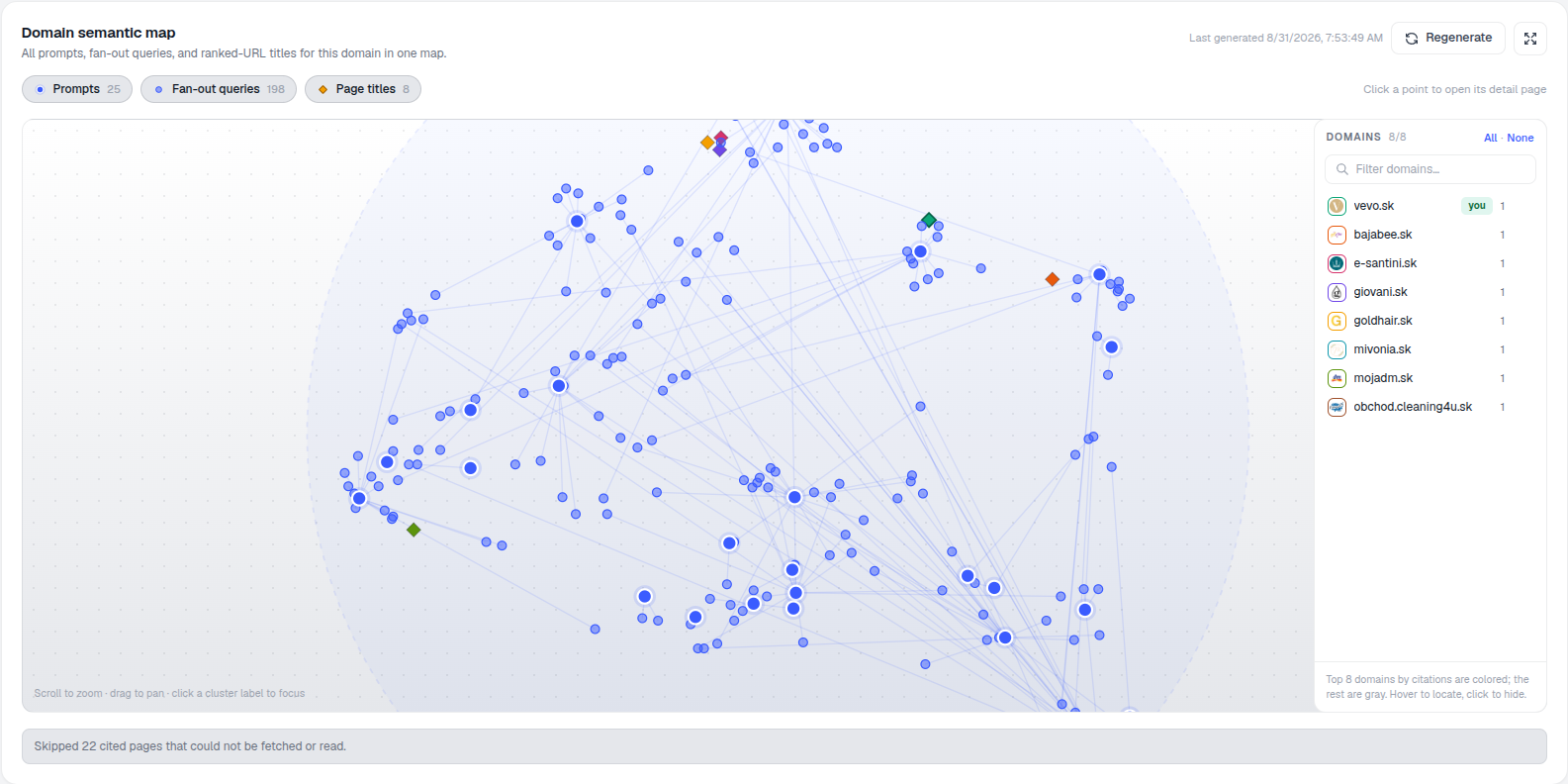
The Semantic Map embeds every tracked prompt, its fan-out sub-queries and each cited page’s title, then projects them into two dimensions with UMAP over cosine distance — position carries no unit, only proximity is meaningful. It’s a generative engine optimization GEO view that spots the exact clusters where competitors are cited and you are not.
Map AI Search Subquestions
AI engines do not answer a prompt in one shot — they fan out into related sub-queries first, and every one gets its own point on the map, with a thin line back to its parent prompt showing structure, not measured similarity. HDBSCAN groups the dense regions into named topic clusters, capped at ten by merging the smallest into its nearest neighbor, with a dashed halo sized to the 90th-percentile member distance so one outlier can’t stretch the whole radius. The legend pins your domain first, then ranks competing hosts by cited-page-title count — the top eight get distinct colors, everyone else is gray.
- Domain Semantic Map — prompts, fan-out queries and cited-page titles clustered by meaning; neither axis is a score, a percentage or a date, only relative proximity means anything.
- Fan-out heatmap — every sub-query type (definitional, comparison, pricing) against the domains that match it best.
- Prompt-level detail map — swap to a single prompt and cited pages carry a 0-100 citation-position score, weighted by frequency, ranking and recency — suppressed automatically when there’s too little signal across hosts to trust it.
- Track all in one click — promote every discovered fan-out query into a fully tracked prompt at once.
- Regenerate on demand — maps rebuild automatically when none exists, once one passes seven days old, or after a prompt is edited; a generating or failed map still shows its last known points, never a blank screen.
Semantic Map Content Clusters
Prompts and their fan-out cluster into dense topical neighborhoods with an LLM-written label. Owned points sitting near a prompt and its fan-out show real semantic coverage; a neighborhood dominated by competitor-colored diamonds is the gap — content you haven’t produced, or haven’t been cited for, yet. A larger diamond on the single-prompt map means a stronger citation-position score, never a bigger page or a closer semantic match — and left/right, up/down or cluster radius are never a performance direction.
- Owned vs external neighborhoods — clusters where your points sit near the prompt are covered; clusters full of competitor diamonds are the content gap.
- Marker size means citation strength, not distance — sizing reflects frequency, ranking and recency of citation, not semantic closeness.
- Click through before acting — the map is a compressed neighborhood view; validate any finding against the underlying response, coverage or citation report, and check how many inputs the map had to skip.
Use Semantic Maps in AI Agents
The same clusters, fan-out queries and gaps you see on the map are exposed as MCP tools — so your coding or research agent can pull the exact content gap it needs to fix, without leaving the terminal.
- One server, every AI client — FlowHunt, Claude Code, Codex, Cursor.
- Live tools, not exports — query gaps and clusters on demand.
- Read and act — from where is the gap to a drafted fix in one conversation.
to track every fan-out query
Every prompt AI fans out into is a monitoring opportunity. Turn the whole set into tracked prompts without adding them one by one.
See the SEO AI agentAnalyze AI Content Topics
Plot prompts, fan-out queries and cited pages by meaning, and find the exact clusters where you are not showing up yet.
Ready to find your content gaps?
Free check · 7-day trial · card required