
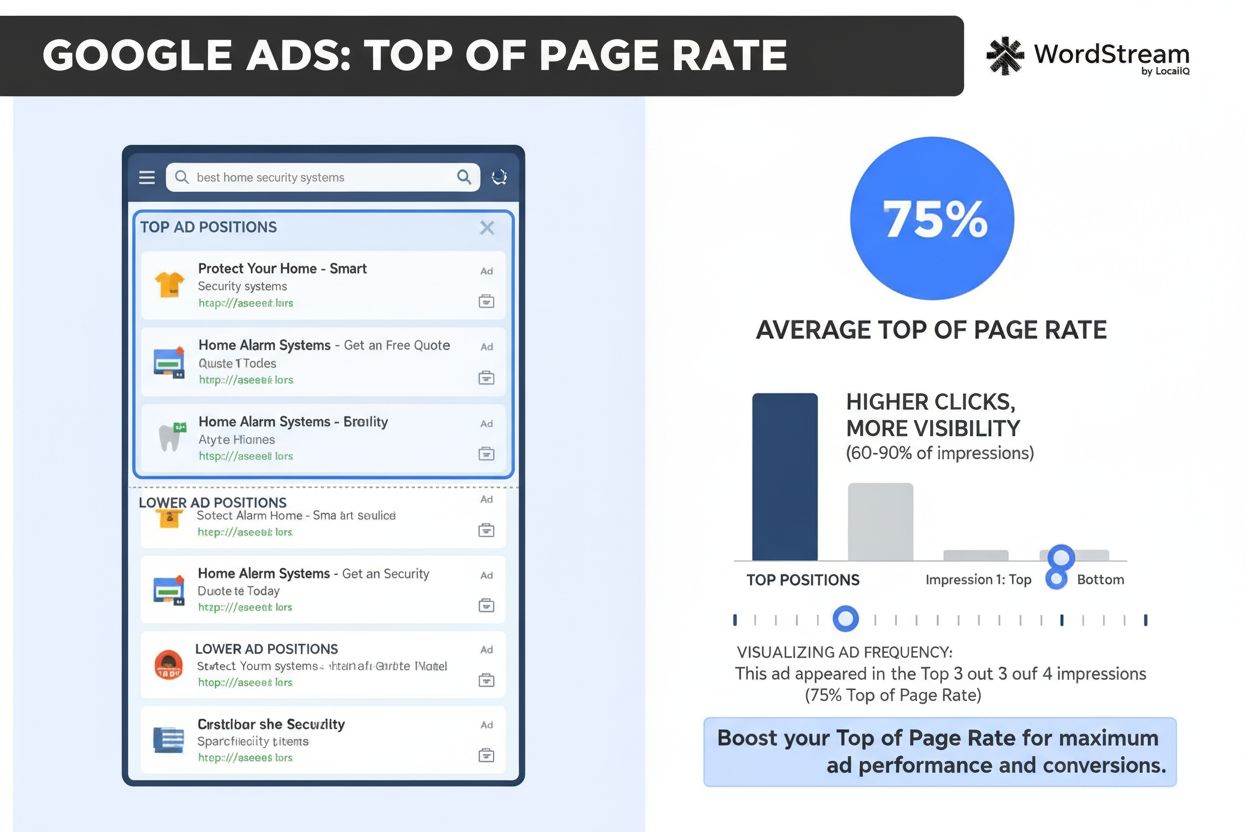
Top of Page Rate
Top of Page Rate measures how often your Google Ads appear in top positions on search results. Learn the definition, benchmarks, and strategies to improve ad pl...
10 min read
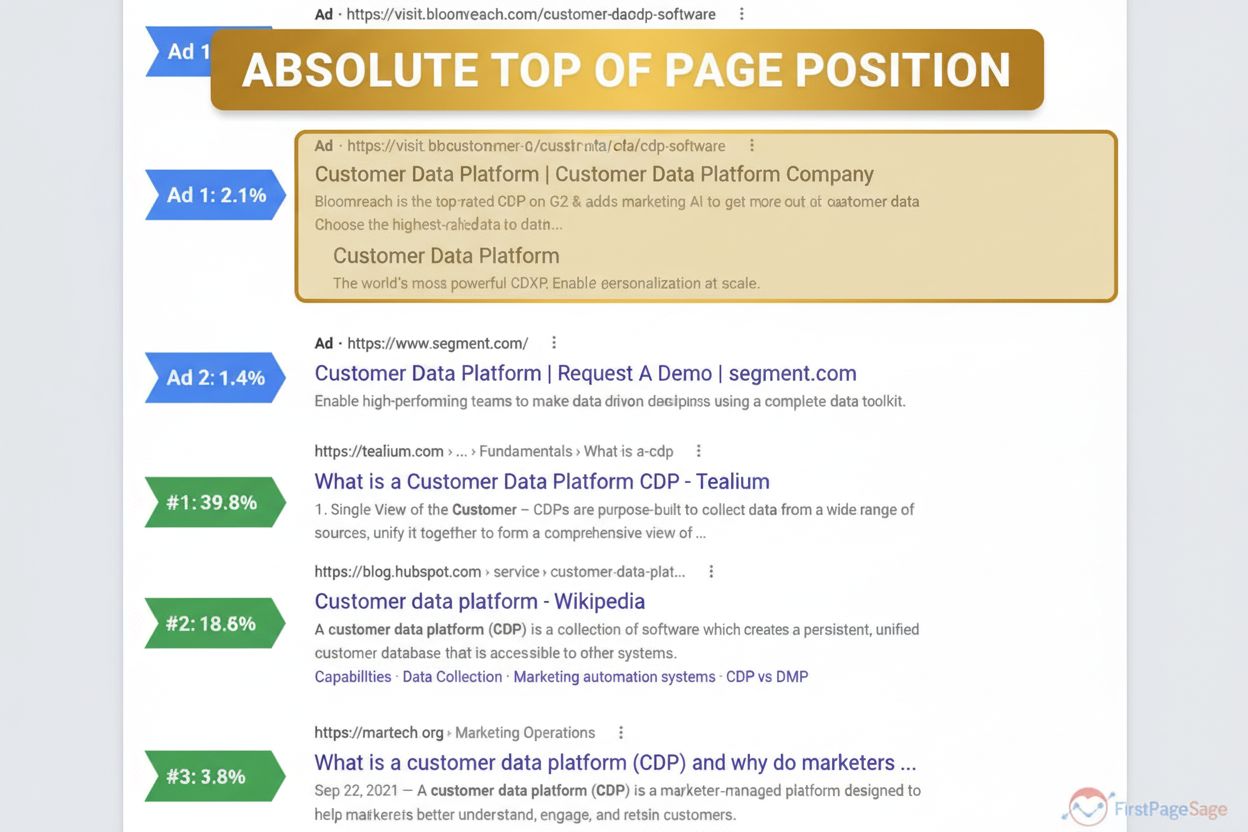
Absolute Top of Page (ATP) refers to the very first ad position that appears above all other ads on Google Search results, representing the most prominent placement for paid advertisements. This metric measures the percentage of impressions where an ad appears in this premium position, directly impacting click-through rates and campaign visibility.
Absolute Top of Page (ATP) refers to the very first ad position that appears above all other ads on Google Search results, representing the most prominent placement for paid advertisements. This metric measures the percentage of impressions where an ad appears in this premium position, directly impacting click-through rates and campaign visibility.
Absolute Top of Page (ATP) is the very first ad position that appears above all other advertisements on Google Search Engine Results Pages (SERPs). This premium placement represents the most prominent location for paid advertisements, appearing before any other ads and typically above organic search results. The Absolute Top of Page metric measures the percentage of your ad impressions that are shown in this coveted first position, calculated as impressions on absolute top divided by total impressions. Understanding this metric is essential for advertisers seeking to maximize visibility, as ATP placement directly correlates with higher engagement rates, increased click-through rates, and improved campaign performance. The distinction between ATP and other top positions is critical: while “Top of Page” includes all ads in the premium section above organic results, Absolute Top of Page specifically refers to the single, most prominent position that users encounter first when viewing search results.
The concept of ad positioning has evolved significantly since the early days of paid search advertising. When Google Ads (formerly AdWords) launched in 2000, advertisers competed primarily on bid amounts to determine ad placement. Over the past two decades, Google has refined its positioning system to incorporate multiple factors beyond simple bidding, introducing Quality Score as a critical component in 2005. This evolution reflected Google’s commitment to showing relevant ads that users actually want to see, rather than simply rewarding the highest bidders. The introduction of prominence metrics in recent years—including Absolute Top of Page and Top of Page metrics—represented a significant shift in how advertisers understand and optimize for ad placement. According to Google’s official documentation, these metrics provide advertisers with clearer visibility into where their ads appear on the page, enabling more strategic bidding decisions. The continuous evolution of search results pages, including the integration of featured snippets, knowledge panels, and AI Overviews, has made ATP positioning even more valuable as these elements compete for user attention above traditional organic results.
The Absolute Top of Page position is determined through a complex calculation involving multiple factors that Google’s algorithm evaluates in real-time during each auction. The primary determinant is Ad Rank, which is calculated using your maximum bid amount multiplied by your Quality Score, adjusted for various contextual factors. Ad Rank thresholds—minimum scores required to appear in premium positions—ensure that only sufficiently relevant ads achieve ATP placement. Beyond the basic Ad Rank calculation, Google considers the search context, including the user’s location, device type, time of search, and search history. The expected impact of ad extensions and ad formats also influences positioning, as ads with rich extensions (like callout extensions, structured snippets, or promotion extensions) may receive better placement. When multiple ads compete for the ATP position in a given auction, Google’s algorithm selects the ad with the highest Ad Rank that meets the ATP threshold. This means that even with a high bid, if your Quality Score is low or your Ad Rank doesn’t meet the threshold, your ad may appear in a lower position. The calculation happens instantaneously for each search query, making real-time optimization through bidding adjustments and Quality Score improvements essential for maintaining consistent ATP placement.
The Absolute Top of Page position delivers dramatically superior click-through rates compared to any other ad placement on the search results page. Research from Smart Insights analyzing 2024 data reveals that first-position organic results achieve approximately 39.8% click-through rate, while second position drops to 18.7% and third position falls to 10.2%. For paid ads specifically, ATP placements typically generate 2-3 times higher engagement than ads appearing in lower positions. This exponential difference in CTR stems from several psychological and behavioral factors: users naturally focus their attention on the top of the page, ATP ads benefit from the “first-mover advantage” in user perception, and the premium position signals relevance and authority to searchers. Real-world case studies from advertisers demonstrate that campaigns maintaining ATP rates above 80-90% consistently outperform campaigns with lower ATP rates in both CTR and conversion volume. The relationship between ATP placement and Quality Score creates a virtuous cycle: higher ATP rates lead to more clicks, which improves CTR metrics, which in turn boosts Quality Score, enabling even better future placements. However, it’s important to note that while ATP placement significantly increases visibility and clicks, the ultimate success of a campaign depends on converting those clicks into meaningful business outcomes through effective landing page experiences and compelling offers.
| Metric | Definition | Calculation | Typical CTR Impact | Bidding Strategy |
|---|---|---|---|---|
| Absolute Top of Page (ATP) | Very first ad position above all others | Impressions on ATP / Total Impressions | 2-3x higher than lower positions | Target Impression Share (80%+) |
| Top of Page | All ads in premium section above organic | Impressions on top / Total Impressions | 1.5-2x higher than bottom positions | Target Impression Share (50-70%) |
| Average Position | Relative ranking compared to competitor ads | Deprecated metric (no longer primary) | Varies by position | Manual CPC or Smart Bidding |
| Impression Share | Percentage of eligible impressions received | Impressions received / Eligible impressions | Indicates visibility opportunity | Target Impression Share |
| Lost Impression Share (Budget) | Missed impressions due to low budget | Lost impressions / Eligible impressions | Indicates budget constraints | Increase daily budget |
| Lost Impression Share (Rank) | Missed impressions due to poor Ad Rank | Lost impressions / Eligible impressions | Indicates competitive weakness | Improve Quality Score or bid |
Achieving consistent Absolute Top of Page placement requires strategic bidding approaches that balance visibility goals with profitability objectives. Target Impression Share is the most direct strategy for ATP optimization, allowing advertisers to set a target percentage for how often their ads appear in the absolute top position. By setting a Target Impression Share of 80% or higher specifically for ATP placement, Google’s machine learning algorithms automatically adjust your bids to meet this goal while staying within budget constraints. This strategy is particularly effective because it removes the guesswork from manual bidding and allows Google’s AI to optimize in real-time across thousands of auctions. Target CPA (Cost Per Acquisition) bidding offers an alternative approach, focusing on achieving conversions at a desired cost rather than directly targeting position. While less position-specific than Target Impression Share, Target CPA can help maintain profitable ATP placements by ensuring you’re bidding competitively only on high-value search queries. Enhanced CPC (eCPC) provides a middle ground, allowing manual control while enabling Google to adjust bids up or down based on conversion likelihood. For advertisers with sufficient historical data, Maximize Conversions bidding can automatically optimize bids to achieve the highest conversion volume while maintaining competitive positioning. The key to successful bidding for ATP placement is continuous monitoring and adjustment: regularly review your impression share metrics, analyze which keywords are losing ATP impressions due to budget or rank, and adjust bids accordingly to maintain your target ATP rate.
While bidding is crucial for Absolute Top of Page placement, Quality Score often determines whether high bids translate into ATP positioning. Quality Score is Google’s rating of the quality and relevance of your ads, keywords, and landing pages, measured on a scale of 1-10. This metric directly impacts your Ad Rank calculation and therefore your likelihood of achieving ATP placement. Quality Score comprises three primary components: Expected Click-Through Rate (how likely users are to click your ad based on historical performance), Ad Relevance (how closely your ad matches the user’s search query), and Landing Page Experience (how relevant and user-friendly your landing page is). Advertisers can improve Quality Score by conducting thorough keyword research to ensure tight alignment between keywords and ad copy, crafting compelling ad copy that directly addresses user search intent, and optimizing landing pages to deliver on the promises made in advertisements. A/B testing different ad variations helps identify which messaging resonates most with your target audience, improving CTR and Quality Score. Landing page optimization is particularly critical: pages should load quickly, be mobile-friendly, have clear calls-to-action, and provide relevant content that matches the ad’s promise. Research shows that advertisers with Quality Scores of 8-10 can achieve ATP placement with significantly lower bids than competitors with Quality Scores of 3-5, demonstrating that relevance often trumps raw bidding power in determining premium positioning.
The emergence of AI-powered search platforms like ChatGPT, Perplexity, Google AI Overviews, and Claude has introduced new dimensions to the importance of Absolute Top of Page positioning. These AI systems increasingly cite and reference top-ranking sources when generating responses to user queries, making premium positioning in traditional search results a proxy for visibility in AI-generated content. Platforms like AmICited now track where brands and domains appear in AI search results, recognizing that content appearing in ATP positions on Google is more likely to be cited by AI systems. This creates a compounding effect: achieving ATP placement in Google Ads improves organic visibility, which increases the likelihood of being cited by AI systems, which further amplifies brand authority and reach. For companies monitoring their brand presence across multiple search channels, understanding ATP positioning becomes essential for comprehensive visibility strategy. The relationship between traditional search prominence and AI citation patterns suggests that optimizing for ATP placement is no longer just about maximizing clicks from human searchers—it’s about ensuring your brand appears in the sources that AI systems reference when answering user questions. This evolution underscores why tracking Absolute Top of Page metrics has become critical for modern digital marketing strategies that span both traditional and AI-powered search environments.
The future of Absolute Top of Page positioning will likely be shaped by several emerging trends in search technology and user behavior. As AI Overviews continue to expand across Google Search results, the traditional SERP layout is evolving, potentially changing how ATP positioning is defined and valued. Google’s rollback of continuous scroll in 2024 signals a return to traditional pagination, which may actually increase the value of ATP placement by making the first page more prominent. The integration of generative AI into search results means that ATP positioning will increasingly influence which sources are cited in AI-generated responses, making this metric relevant beyond traditional click-through optimization. Advertisers will likely need to develop more sophisticated strategies that optimize for both human searchers and AI systems simultaneously. The rise of voice search and mobile-first indexing continues to emphasize the importance of top positioning, as voice assistants typically read only the top result to users. Privacy changes and the deprecation of third-party cookies will make first-party data and Quality Score metrics even more critical for achieving ATP placement, as advertisers lose some ability to target based on historical user behavior. The competitive landscape for ATP positions will intensify as more advertisers recognize the metric’s importance, potentially driving up costs for premium placements. However, advertisers who focus on Quality Score improvement and relevance optimization will maintain advantages over those relying solely on bidding power. The future likely holds more sophisticated AI-driven bidding strategies that can predict ATP placement probability and optimize bids accordingly, further automating the path to premium positioning.
Successfully optimizing for Absolute Top of Page placement requires a systematic approach combining technical optimization, strategic bidding, and continuous monitoring. Begin by establishing baseline metrics: review your current ATP impression rate, impression share, and lost impression share data to understand where you stand relative to your goals. Set realistic ATP targets based on your industry, competition level, and business objectives—not all campaigns require 100% ATP rates, and pursuing unrealistic targets can waste budget. Implement Target Impression Share bidding with ATP-specific targets (typically 70-90% depending on your goals), allowing Google’s algorithms to optimize bids automatically. Simultaneously, invest in Quality Score improvement by conducting keyword research to ensure tight alignment between keywords, ad copy, and landing pages. Create multiple ad variations and test different messaging approaches to identify which resonates most with your target audience. Optimize landing pages for speed, mobile experience, and relevance, ensuring they deliver on the promises made in your ads. Monitor performance weekly, reviewing ATP metrics alongside CTR, CPC, conversion rate, and ROAS to ensure your optimization efforts are driving business results. Use Google Ads’ auction insights to understand competitor positioning and adjust your strategy accordingly. Document what works and what doesn’t, building institutional knowledge about which keywords, ad copy variations, and landing page approaches drive the best ATP performance in your specific industry. Remember that ATP optimization is not a one-time project but an ongoing process requiring regular attention and adjustment as market conditions, competition, and user behavior evolve.
Absolute Top of Page (ATP) refers specifically to the very first ad position above all other ads on the search results page, while Top of Page includes all ads appearing in the premium section above organic results. ATP is a subset of Top of Page placements. ATP represents the single most prominent position, whereas Top of Page encompasses multiple ad positions in the upper section of the SERP.
Ads in the Absolute Top of Page position receive significantly higher click-through rates compared to lower positions. Research shows that first-position ads generate approximately 39.8% CTR for organic results, while ATP ads typically achieve 2-3 times higher engagement than ads in lower positions. This premium placement directly translates to increased visibility and user interaction with your advertisements.
Key metrics include Search Absolute Top Impression Rate (the percentage of impressions shown in ATP position), Search Absolute Top Impression Share (impressions received in ATP divided by eligible impressions), and Lost Absolute Top Impression Share due to budget or Ad Rank. Additionally, monitor click-through rate, average cost-per-click, and conversion rates to evaluate the overall effectiveness of your ATP placements.
Improve ATP rate by increasing your bid amounts, enhancing your Quality Score through better ad relevance and landing page experience, and using smart bidding strategies like Target Impression Share set to 80% or higher. Focus on optimizing ad copy to match search intent, improving keyword relevance, and ensuring your landing pages provide excellent user experience. Continuous monitoring and bid adjustments based on performance data are essential.
Ad Rank directly determines whether your ad appears in the Absolute Top of Page position. Ad Rank is calculated using your bid amount, Quality Score, Ad Rank thresholds, search context, and expected impact of extensions. A higher Ad Rank increases your likelihood of achieving ATP placement. Improving any component of Ad Rank calculation—particularly Quality Score and bid competitiveness—will enhance your chances of reaching the ATP position.
As AI systems like ChatGPT, Perplexity, and Google AI Overviews increasingly cite top-ranking sources, achieving Absolute Top of Page positions becomes crucial for brand visibility in AI-generated responses. Platforms like AmICited track where brands appear in AI search results, making ATP positioning essential for ensuring your content is cited by AI systems that reference top-ranked sources.
While Google Ads defines ATP as the first position above organic results, other platforms like Bing Ads and search partners have different positioning structures. Google Search Partners don't distinguish between 'top' and 'other' positions, so ATP metrics aren't available for partner placements. Understanding platform-specific positioning is crucial for multi-channel advertising strategies and accurate performance comparison.
Start tracking how AI chatbots mention your brand across ChatGPT, Perplexity, and other platforms. Get actionable insights to improve your AI presence.
Top of Page Rate measures how often your Google Ads appear in top positions on search results. Learn the definition, benchmarks, and strategies to improve ad pl...
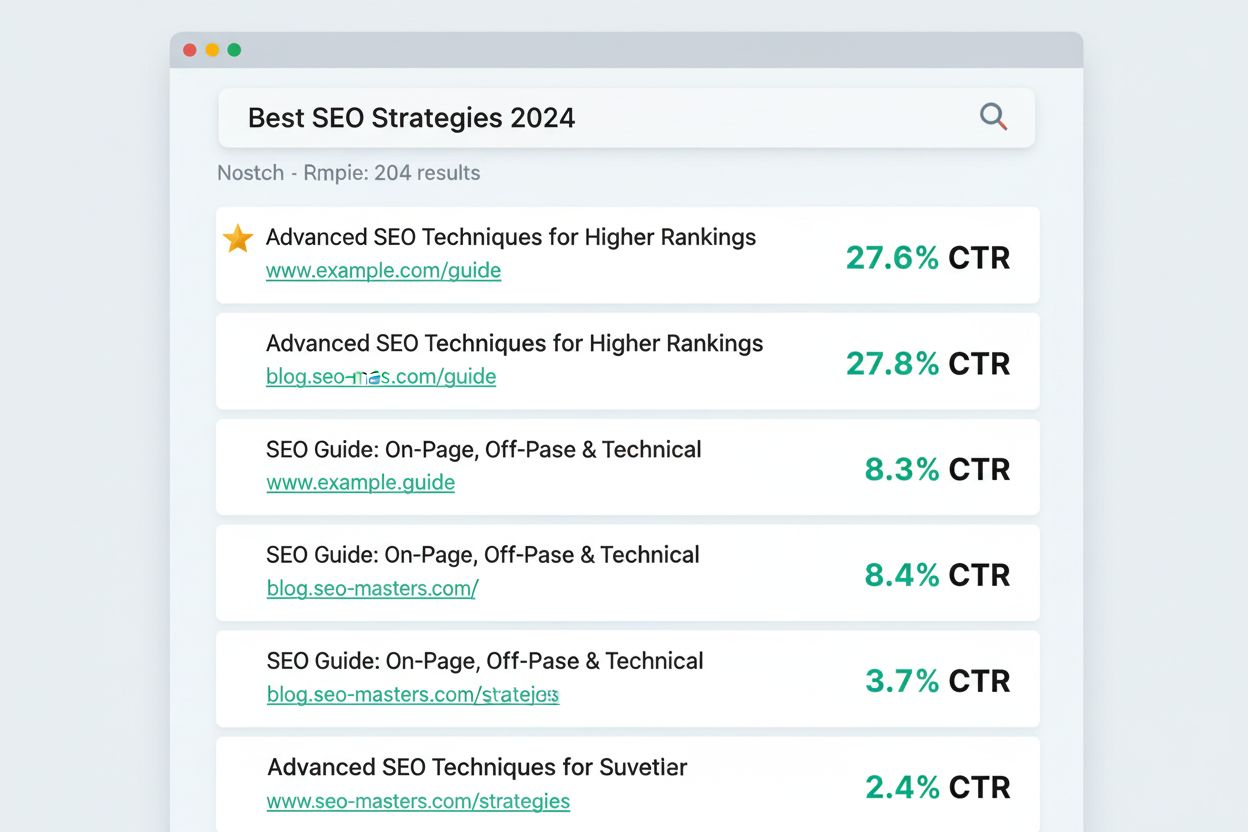
Ranking position is the location of a webpage in search results (1-10 on page 1). Position 1 gets 39.8% CTR. Learn how ranking position affects traffic and visi...

Position Zero (featured snippet) appears above organic results on Google SERPs, providing direct answers to queries. Learn how P0 impacts SEO, CTR, and AI searc...
Cookie Consent
We use cookies to enhance your browsing experience and analyze our traffic. See our privacy policy.