


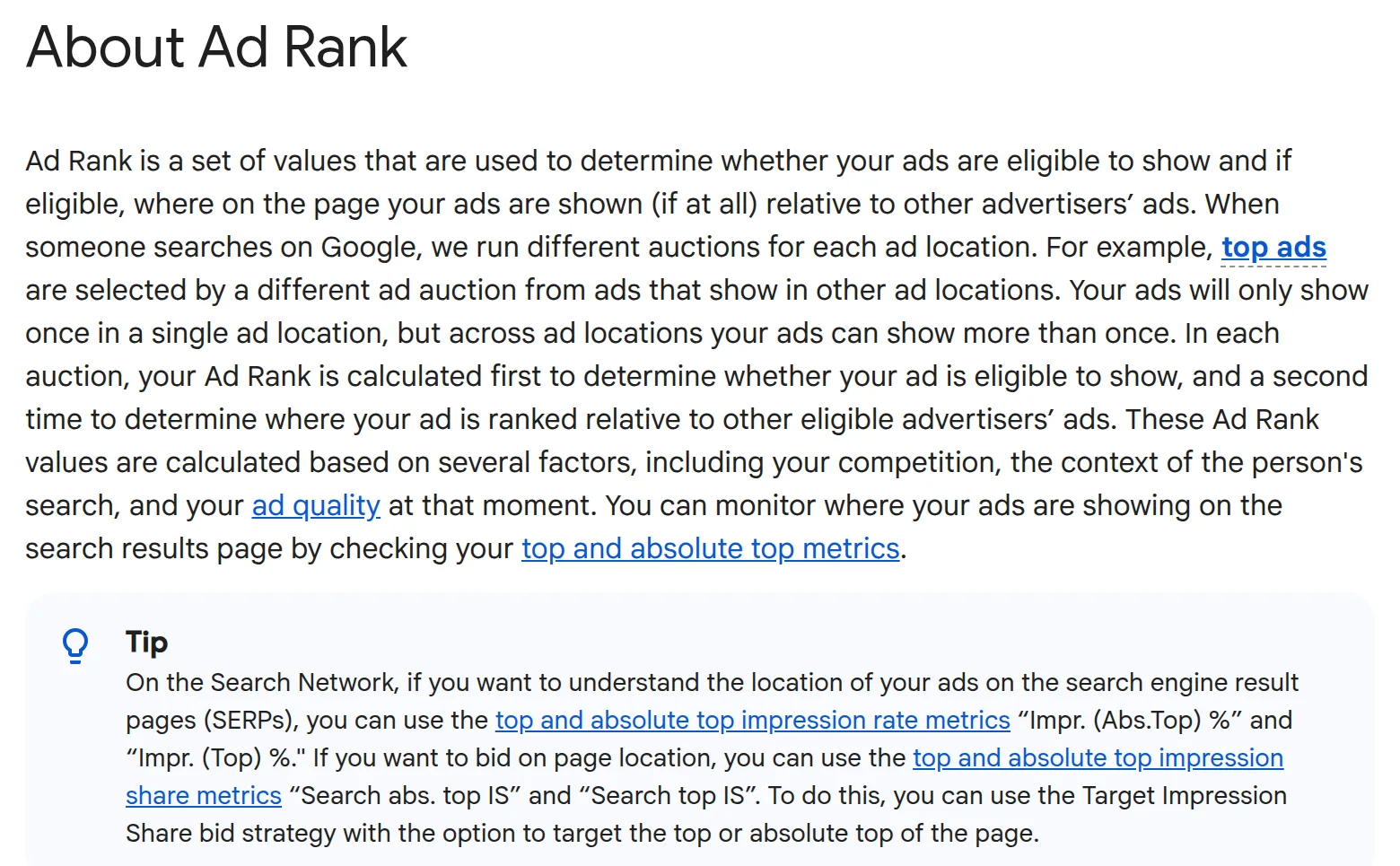
- Ad Rank is the value Google Ads calculates in every auction to decide whether your ad can show and in which position.
- It weighs your bid against ad quality at auction time (expected CTR, ad relevance and landing page experience), plus thresholds, competition, search context and the expected impact of assets.
- A better ad can outrank a higher bid and pay less per click. Quality Score is a 1 to 10 diagnostic, not the value used in the auction.
Where AmICited fits
AmICited’s Google Ads Keywords report shows spend, clicks, CPC, conversions, impression share and Quality Score per keyword, so you can see where ad quality rather than bid holds back your position.
See the Google Ads keyword reportWhat Is Ad Rank?
Ad Rank is the value Google Ads calculates for your ad every time it enters an auction. It decides two things: whether your ad is eligible to show at all, and where it appears relative to other ads. The ad with the highest Ad Rank takes the top position, as long as it clears the minimum thresholds.
Ad Rank is why Google Ads is not a pure “highest bid wins” auction. Google weighs the bid against the quality of the ad and landing page, because a relevant ad that people click earns Google money and keeps users happy. Microsoft Advertising runs a similar quality-weighted auction. Anyone doing PPC management or search engine marketing works with Ad Rank daily, even though it never appears as a number in the interface.
How Ad Rank Is Calculated
According to Google Ads Help, Ad Rank is based on:
- Your bid. The maximum you are willing to pay per click, set manually or by a Smart Bidding strategy.
- Ad quality at auction time. Expected click-through rate, ad relevance to the search, and landing page experience. Quality Score (1–10) summarizes these per keyword.
- Ad Rank thresholds. Minimum quality needed to show or to appear above organic results.
- Competitiveness of the auction. How close you are to competitors.
- Context of the search. Location, device, time, the search terms and other signals.
- Expected impact of assets. How sitelinks, callouts and other assets are likely to affect performance.
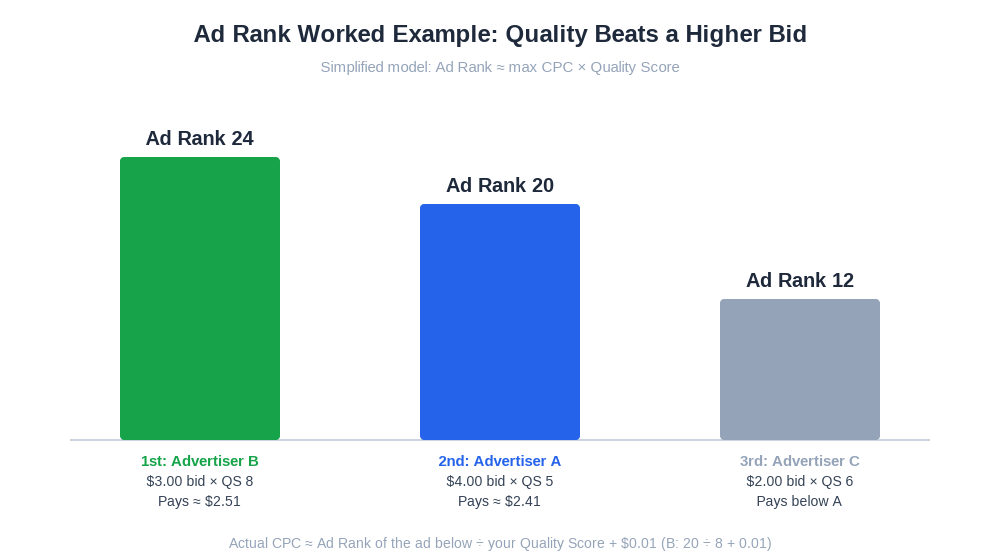
Google no longer reduces this to one formula. The classic simplified model still shows the logic well:
Ad Rank ≈ Max CPC × Quality Score
Actual CPC ≈ (Ad Rank of the advertiser below ÷ your Quality Score) + $0.01
Worked example with three advertisers:
- Advertiser A bids $4.00 with Quality Score 5: Ad Rank 20.
- Advertiser B bids $3.00 with Quality Score 8: Ad Rank 24.
- Advertiser C bids $2.00 with Quality Score 6: Ad Rank 12.
B takes position 1 despite bidding the least of the top two. B pays about 20 ÷ 8 + 0.01 = $2.51. A takes position 2 and pays about 12 ÷ 5 + 0.01 = $2.41. A bid a dollar more than B and still ended up below it, paying nearly the same per click. That is the reward for quality.
Ad Rank Factors and How to Influence Them
| Factor | What it measures | How to improve it |
|---|---|---|
| Bid | What you will pay per click | Raise bids on profitable terms; use Smart Bidding with good conversion data |
| Expected CTR | Likelihood of a click for this search | Stronger headlines, tighter keyword groups, responsive search ads with varied assets |
| Ad relevance | How closely the ad matches the search intent | Put the searcher’s words in the headline; split broad ad groups |
| Landing page experience | Relevance, speed, ease of use | Send each ad group to the most specific page; fix mobile speed |
| Assets | Expected impact of sitelinks, callouts, images | Add every relevant asset type and keep them current |
| Search context | Device, location, time, query | Adjust bids by device and location; refine targeting |
Ad Rank vs Quality Score
People often confuse the two. Quality Score is a diagnostic shown per keyword in your account, on a 1–10 scale, updated periodically from historical data. It is a rough guide, not an input Google uses directly in auctions. Ad Rank is calculated in real time for each auction, using fresh quality predictions for that exact search, device and context. You can see Quality Score. You never see Ad Rank, only its effects: impression share, average position metrics like top impression rate, and actual CPC.
Ad Rank also applies beyond text ads. Google Shopping ads compete in their own auction where bid and product relevance decide placement.

Stay Updated on AI Visibility Trends
Get the latest insights on AI mentions, brand monitoring, and optimization strategies.
Ad Rank and AI Search
Google now shows ads in and around AI Overviews and AI Mode, and those placements still go through Google’s auction. The organic side works differently. Which brands an AI answer mentions or cites is not bought through Ad Rank, so a high Ad Rank on a keyword does not mean your brand appears in the AI-generated answer above it. Tracking both, paid position and AI mentions, shows whether you are relying on ads to cover a gap in organic AI visibility. AmICited’s AI visibility tracking covers the AI answer side.
Best Practices for Ad Rank
- Group keywords tightly so each ad can mirror the searcher’s words.
- Write several distinct headlines and descriptions and let the best combinations win.
- Use the most relevant landing page for each ad group and make it fast on mobile.
- Add sitelinks, callouts, structured snippets and image assets wherever they apply.
- Watch Quality Score components (expected CTR, ad relevance, landing page) and fix the weakest.
- Raise bids only after quality improvements, since quality lowers cost while bids raise it.
Common Ad Rank Mistakes
The most common mistake is trying to buy position with bids alone. Raising bids on an ad with poor relevance pushes the cost per click up sharply while competitors with better ads still sit above you. Another is chasing a Quality Score of 10 on every keyword. Quality Score is a diagnostic, and some valuable broad or competitor keywords will always score low.
Advertisers also send every ad to the homepage, which weakens landing page experience, skip assets entirely, and forget that Ad Rank thresholds mean a low-quality ad may not show at all, however high the bid.