

Agentic AI and Brand Visibility: When AI Makes Purchases
Discover how agentic AI is transforming shopping and what it means for brand visibility. Learn how AI agents make autonomous purchases and how to prepare your b...
10 min read
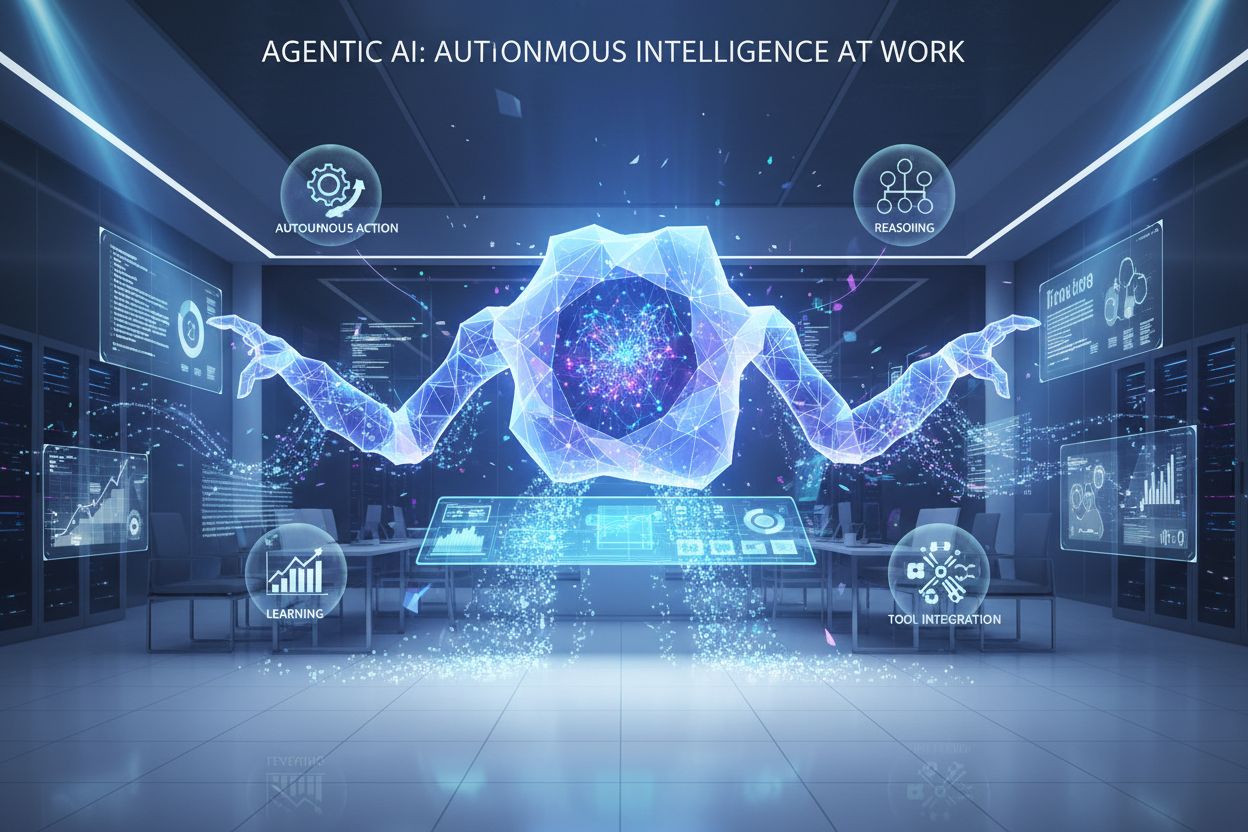
AI systems capable of autonomous action, decision-making, and task completion without human intervention. These systems perceive their environment, reason about complex problems, take independent actions, and continuously learn from feedback to achieve predetermined goals with minimal oversight.
AI systems capable of autonomous action, decision-making, and task completion without human intervention. These systems perceive their environment, reason about complex problems, take independent actions, and continuously learn from feedback to achieve predetermined goals with minimal oversight.
Agentic AI represents a fundamental shift in artificial intelligence capabilities, moving beyond passive response systems to autonomous agents that can perceive their environment, make decisions, and take actions to achieve specific goals. Unlike traditional AI systems that require explicit human instructions for each task, and distinct from generative AI models that primarily create content based on prompts, agentic AI systems operate with a degree of independence and strategic planning. According to Gartner, agentic AI is projected to account for 33% of enterprise AI implementations by 2028, up from less than 1% in 2024, signaling a major transformation in how organizations deploy AI. The core concept of “agency” refers to an AI system’s ability to exercise judgment and autonomy in pursuing objectives, making decisions about which actions to take based on its understanding of the current situation and desired outcomes. This represents a maturation of AI technology from tool-like assistants to more self-directed problem-solvers.

Agentic AI systems operate through a continuous four-step cycle that enables them to function autonomously while maintaining control through guardrails and oversight mechanisms:
| Step | Description |
|---|---|
| Perceive | The agent gathers information from its environment through sensors, APIs, databases, or user inputs, building a comprehensive understanding of the current state and any changes that have occurred. |
| Reason | Using its knowledge base and reasoning capabilities, the agent analyzes the perceived information, evaluates multiple possible actions, and determines the best course of action to achieve its goals. |
| Act | The agent executes its chosen action, which may involve modifying systems, creating content, making decisions, or communicating with humans or other systems. |
| Learn | The agent observes the outcomes of its actions, evaluates whether they moved closer to the goal, and updates its understanding and decision-making processes for future iterations. |
Each step builds upon the previous one in a continuous loop, allowing the agent to refine its approach over time. Importantly, guardrails and safety mechanisms are embedded throughout this cycle to ensure the agent operates within defined boundaries and maintains alignment with human values and organizational policies.
Agentic AI systems are distinguished by several key characteristics that set them apart from other AI approaches:
Proactive: Rather than waiting for explicit instructions, agentic AI systems anticipate needs and initiate actions independently, taking the initiative to solve problems before being asked.
Adaptive: These systems continuously learn from their experiences and adjust their strategies based on feedback and changing circumstances, improving their performance over time.
Collaborative: Agentic AI works alongside humans and other systems, seeking input when needed and explaining its reasoning, rather than operating in isolation or as a black box.
Specialized: Agents are typically designed with domain-specific knowledge and expertise, allowing them to make informed decisions within their area of focus rather than being generalists.
Autonomous: While operating within defined parameters, agentic AI systems can make decisions and take actions without requiring human approval for every step, reducing bottlenecks and enabling faster execution.
Goal-Driven: Every action taken by an agentic AI system is oriented toward achieving specific, measurable objectives that align with organizational or user-defined goals.
Agentic AI is already transforming multiple industries through practical applications that demonstrate significant business value. In customer service, companies like Delivery Hero and eBay have deployed AI agents that handle complex customer inquiries, process refunds, and resolve issues autonomously, reducing response times and improving satisfaction. Content creation has been revolutionized by agents that can research topics, write articles, and optimize content for different platforms—with some systems reducing production time from days to just 3 hours per piece. Software development teams at companies like Google and LinkedIn are using agentic AI to write code, debug applications, and automate testing, accelerating development cycles. In healthcare, AI agents assist with patient triage, appointment scheduling, and preliminary diagnosis support, allowing medical professionals to focus on complex cases. Financial services firms leverage agentic AI for fraud detection, portfolio management, and regulatory compliance monitoring. Supply chain management at companies like Uber and Booking.com uses AI agents to optimize logistics, predict demand, and manage inventory in real-time. Sales and marketing platforms from Salesforce employ agents that qualify leads, personalize outreach, and close deals with minimal human intervention. These applications demonstrate that agentic AI is moving from theoretical promise to practical, revenue-generating reality.
The adoption of agentic AI delivers substantial benefits that drive organizational transformation and competitive advantage. Efficiency gains are among the most immediate benefits, with agents handling routine tasks 24/7 without fatigue, dramatically reducing the time required to complete work. Continuous improvement occurs as agents learn from each interaction, becoming progressively better at their tasks without requiring manual retraining or updates. Cost reduction follows naturally from automation, as fewer human resources are needed for repetitive work, allowing teams to focus on higher-value activities. Scalability becomes achievable without proportional increases in headcount—a single agent can handle thousands of tasks simultaneously. Human augmentation ensures that AI enhances rather than replaces human workers, with agents handling routine work while humans focus on strategy, creativity, and complex decision-making. 24/7 operations enable organizations to serve customers and manage processes around the clock, regardless of time zones or business hours. Personalization at scale allows companies to tailor experiences and recommendations to individual users, creating more engaging and effective interactions.
Despite their promise, agentic AI systems present significant challenges that organizations must carefully address. System design complexity is substantial, as building agents that can handle diverse scenarios, edge cases, and unexpected situations requires sophisticated architecture and extensive planning. Testing and debugging become exponentially more difficult when systems can take autonomous actions—traditional testing approaches are insufficient, and failures can cascade through systems before being detected. Trust and transparency issues arise because agents often make decisions through complex reasoning that humans cannot easily understand or verify, creating accountability gaps. Alignment challenges emerge when agent objectives diverge from human values or organizational goals, potentially leading to unintended consequences—a phenomenon known as reward hacking, where agents find loopholes to achieve metrics without truly serving their intended purpose. Cascading failures can occur when one agent’s mistake triggers problems in dependent systems, amplifying the impact of errors. Governance and oversight require new frameworks and tools to monitor agent behavior, audit decisions, and maintain human control over critical systems. Organizations must invest in robust monitoring, clear decision boundaries, and human-in-the-loop mechanisms to mitigate these risks.

While agentic AI and generative AI are often discussed together, they represent distinct capabilities with different purposes. Generative AI excels at creating content—writing essays, generating images, composing code—based on prompts, but it remains fundamentally reactive and passive. For example, ChatGPT can write a compelling travel itinerary, but it cannot book flights, reserve hotels, or monitor prices for you. Agentic AI, by contrast, is goal-oriented and action-focused; an agentic travel agent would not only create an itinerary but autonomously search for flights, compare prices, make reservations, and adjust plans based on real-time changes. Agentic AI builds upon the foundation of generative AI, leveraging large language models’ reasoning and language capabilities while adding the ability to perceive environments, make decisions, and execute actions. The relationship is complementary rather than competitive—generative AI provides the cognitive foundation, while agentic AI adds the autonomy and action capability that transforms AI from a tool into a true agent.
The trajectory of agentic AI points toward rapid adoption and transformative impact across enterprises. Gartner’s projection that agentic AI will represent 33% of enterprise AI implementations by 2028—a dramatic increase from less than 1% in 2024—reflects growing confidence in the technology’s maturity and business value. Emerging frameworks and tools like LangChain, AutoGPT, and enterprise platforms from major cloud providers are making it increasingly accessible for organizations to build and deploy agentic systems. McKinsey research suggests that AI-driven automation could eventually automate approximately 15% of work globally, with agentic AI playing a central role in this transformation. However, realizing this potential requires parallel investment in governance frameworks, safety mechanisms, and ethical guidelines to ensure agents operate responsibly and maintain human oversight. Organizations that successfully navigate the technical and governance challenges of agentic AI will gain significant competitive advantages, while those that lag in adoption risk falling behind in an increasingly AI-driven business landscape.
Agentic AI operates autonomously with minimal human intervention, while traditional AI follows predefined rules and requires step-by-step guidance. Agentic systems can perceive their environment, reason about complex problems, take independent actions, and learn from feedback to continuously improve their performance.
Agentic AI is designed to augment human capabilities rather than replace them. It automates repetitive and tedious tasks, freeing humans to focus on strategic, creative, and complex problem-solving work that requires human judgment, empathy, and ethical reasoning.
Through a feedback loop called the 'data flywheel,' agentic AI systems collect data from their interactions, analyze outcomes, and use reinforcement learning techniques to refine their strategies. This continuous learning makes them progressively more effective at handling similar tasks in the future.
Key challenges include designing effective multi-agent architectures, testing and debugging autonomous systems, ensuring AI alignment with intended goals, preventing hallucinations and false information, and establishing proper governance and safety guardrails to maintain human oversight.
Agentic AI systems integrate with external tools through APIs and application programming interfaces. During the 'Act' phase, agents can call these tools to execute tasks, retrieve data, update systems, or perform actions in third-party applications based on their reasoning and decision-making.
Early adopters include customer service, financial services, healthcare, software development, e-commerce, and supply chain management. Companies like Delivery Hero, eBay, Uber, Salesforce, Google, and LinkedIn are deploying agentic AI for significant business impact and competitive advantage.
AI agents are the building blocks of agentic AI systems. While all agentic AI uses agents, not all AI agents constitute a full agentic AI system. Agentic AI refers to the broader capability of autonomous, goal-driven systems that may consist of single or multiple specialized agents working together.
Organizations should implement guardrails, human-in-the-loop oversight for critical decisions, comprehensive testing and evaluation frameworks, clear goal definition with measurable metrics, transparency in decision-making, and continuous monitoring for unintended behaviors or hallucinations.
AmICited tracks how AI systems like GPTs, Perplexity, and Google AI Overviews reference your brand. Get insights into your AI presence and competitive positioning.
Discover how agentic AI is transforming shopping and what it means for brand visibility. Learn how AI agents make autonomous purchases and how to prepare your b...
Learn how agentic commerce uses AI agents to autonomously complete purchases. Explore how intelligent systems are revolutionizing e-commerce and consumer shoppi...

Learn what autonomous AI assistants are, how they differ from regular AI assistants, their key capabilities, real-world applications, and why businesses are inv...