
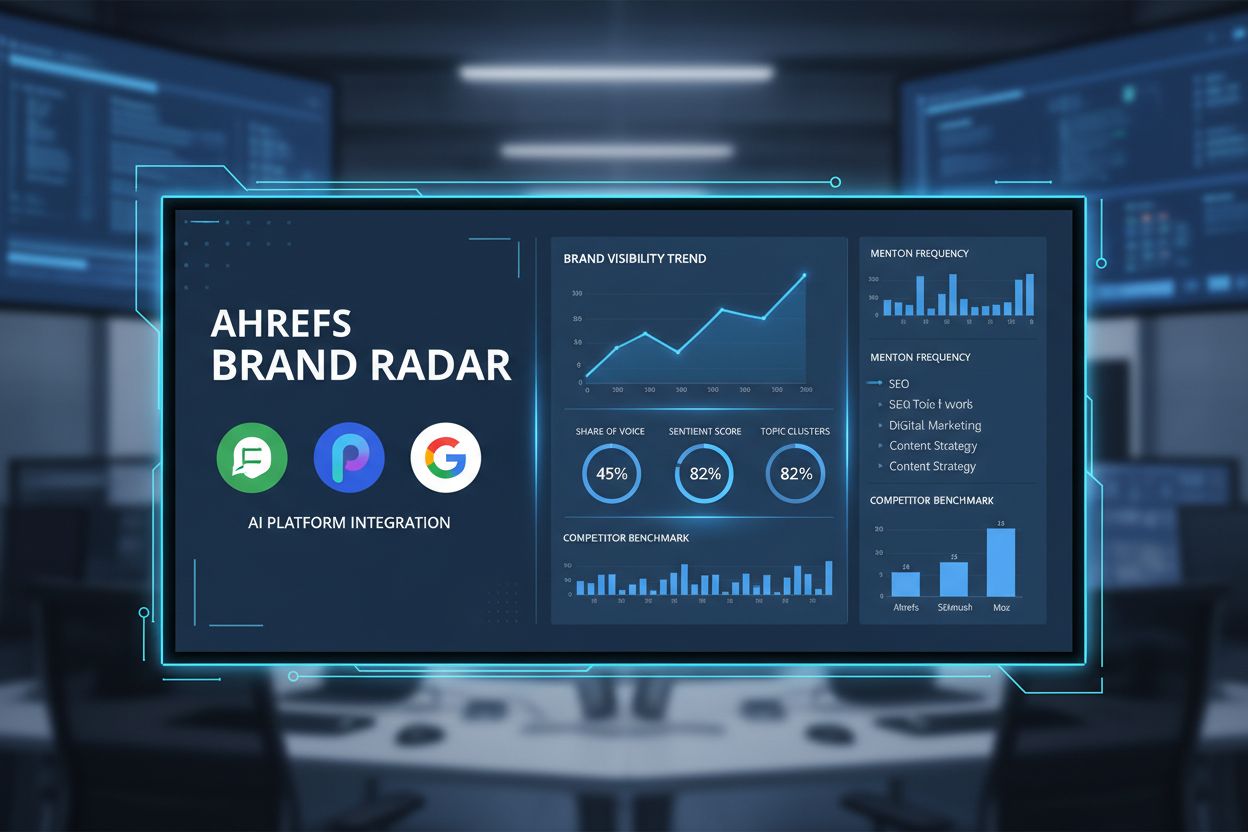
Ahrefs Brand Radar: Complete Review and Use Cases
Comprehensive review of Ahrefs Brand Radar for AI visibility monitoring. Learn features, pricing, strengths, limitations, and how it compares to alternatives li...
8 min read

Ahrefs is a comprehensive SEO toolset powered by proprietary web crawling technology that specializes in backlink analysis, keyword research, and competitive intelligence. It provides marketers and SEO professionals with data-driven insights to optimize organic search visibility, track rankings, and identify growth opportunities across search engines and AI platforms.
Ahrefs is a comprehensive SEO toolset powered by proprietary web crawling technology that specializes in backlink analysis, keyword research, and competitive intelligence. It provides marketers and SEO professionals with data-driven insights to optimize organic search visibility, track rankings, and identify growth opportunities across search engines and AI platforms.
Ahrefs is a comprehensive, all-in-one SEO toolset and marketing intelligence platform powered by proprietary web crawling technology that specializes in backlink analysis, keyword research, and competitive intelligence. Founded in 2010 and headquartered in Singapore, Ahrefs has evolved from a simple backlink checker into one of the most trusted SEO platforms globally, used by 44% of Fortune 500 companies and trusted by over 1 million marketers worldwide. The platform operates the second most active web crawler on the internet (after Google), enabling it to maintain one of the largest and most accurate databases of backlinks, keywords, and search data available. Ahrefs provides data-driven insights that help SEO professionals, content marketers, and digital agencies optimize organic search visibility, track keyword rankings, analyze competitor strategies, and identify growth opportunities across traditional search engines and emerging AI search platforms.
Ahrefs began in 2010 as a focused backlink analysis tool created by Dmitry Gerasimenko, addressing a specific need in the SEO community for reliable link data. The platform’s name derives from the HTML “href” attribute used in hyperlinks, reflecting its original mission. Over the past 15 years, Ahrefs has undergone significant expansion and refinement. Between 2011 and 2015, the platform added keyword research capabilities and rank tracking features, establishing itself as a multi-functional SEO suite. From 2015 to 2020, Ahrefs introduced advanced features including Site Audit for technical SEO analysis, Content Explorer for content research, and Web Analytics integration. Most recently, from 2020 to present, the platform has incorporated artificial intelligence-powered tools and expanded into AI search monitoring with features like Brand Radar, which tracks brand visibility across ChatGPT, Claude, Perplexity, and other large language models. This evolution reflects the platform’s commitment to staying ahead of industry changes and addressing the shifting needs of digital marketers in an increasingly AI-driven landscape.
The foundation of Ahrefs’ value proposition rests on its exceptional technical infrastructure and data collection capabilities. The AhrefsBot crawler operates continuously, crawling over 6 billion web pages daily and maintaining an index of approximately 35 trillion backlinks with updates occurring every 15 minutes. This frequency of updates is significantly faster than most competitors, allowing users to detect new backlink opportunities and losses nearly in real-time. Ahrefs maintains a keyword database of over 28.7 billion keywords filtered from 110 billion discovered keywords, spanning 171+ countries and multiple languages. The platform’s crawling infrastructure is so substantial that Ahrefs ranks as the #1 SEO crawler globally according to Cloudflare Radar data, and operates the #34 supercomputer according to TOP500 rankings. This technical prowess translates to superior data accuracy—Ahrefs claims its traffic estimations correlate with Google Search Console 99% of the time, a five-point advantage over its nearest competitor. The combination of aggressive crawling, frequent updates, and massive data infrastructure makes Ahrefs particularly valuable for organizations requiring the most current and comprehensive SEO intelligence.
| Feature | Ahrefs | Semrush | Moz |
|---|---|---|---|
| Backlink Database Size | 35 trillion links | 43 trillion backlinks | ~500 million keywords |
| Update Frequency | Every 15 minutes | Daily/Weekly | Daily |
| Keyword Database | 28.7B keywords (171 countries) | 20 billion keywords | 500 million keywords |
| Primary Strength | Backlink analysis & accuracy | Breadth of features & PPC data | Affordability & ease of use |
| Starting Price | $99-$129/month | $140/month | $49/month |
| Best For | Link building & organic growth | Multi-channel marketing | Solo marketers & small budgets |
| Traffic Correlation | 99% with GSC | 94% with GSC | Lower accuracy on niche keywords |
| AI Search Monitoring | Brand Radar (150M+ prompts) | Limited AI tracking | Not available |
Ahrefs employs several proprietary metrics that have become industry standards for evaluating SEO performance and opportunity. Domain Rating (DR) measures the overall strength of a website’s backlink profile on a logarithmic scale from 0 to 100, based on the quantity and quality of referring domains rather than total backlink count. This metric is particularly valuable because it emphasizes domain diversity—a site with 100 links from 50 different domains typically has higher DR than a site with 500 links from 5 domains. URL Rating (UR) applies the same 0-100 scale to individual pages, measuring the strength of specific page-level backlink profiles. UR strongly correlates with Google rankings and serves as a reliable predictor of ranking potential. Keyword Difficulty (KD) estimates the challenge of ranking in Google’s top 10 for a specific keyword, calculated by analyzing the backlink strength and domain authority of current top-ranking pages. Traffic Value estimates what organic traffic would cost if purchased through Google Ads, calculated by multiplying keyword search volume by estimated cost-per-click values. These metrics work together to provide a comprehensive framework for SEO decision-making, allowing professionals to balance opportunity with achievability and quantify the business impact of their optimization efforts.
Ahrefs’ comprehensive feature set addresses virtually every aspect of modern SEO and content marketing strategy. Site Explorer allows users to analyze any website’s backlink profile, organic keywords, organic traffic estimates, top-performing content, and traffic value. This competitive analysis tool reveals exactly what’s working for competitors and identifies gaps in your own strategy. Keywords Explorer provides access to the massive keyword database with detailed metrics including search volume, keyword difficulty, click data, and related keyword suggestions. The tool’s “Having same keywords” feature is particularly powerful, allowing users to find keywords that multiple competitors rank for but your site doesn’t. Content Explorer functions as a search engine for high-performing content in any niche, helping identify trending topics, content gaps, and potential link-building targets. Rank Tracker monitors keyword rankings across search engines, showing ranking history, SERP features, competitor comparisons, and visibility scores. Site Audit crawls websites to identify technical SEO issues including broken links, missing meta tags, duplicate content, mobile usability problems, and indexation issues. Brand Radar tracks brand mentions and visibility across AI chatbots and LLMs, analyzing 150+ million prompts to show where brands appear in AI-generated responses. These tools integrate seamlessly, allowing users to move from competitive analysis to content strategy to technical optimization within a single platform.
The real value of Ahrefs emerges through practical application to specific marketing challenges and opportunities. For competitive analysis, professionals use Site Explorer to identify competitors’ backlink sources, top-performing content, and keyword targets, then replicate successful strategies. The Link Intersect tool reveals sites linking to competitors but not to your domain, creating a prioritized list of high-probability link-building targets. For keyword research, users balance search volume against keyword difficulty to identify achievable opportunities, then analyze SERP features to understand search intent. The platform’s click data is particularly valuable in 2025’s SERP landscape, showing how many people actually click organic results versus finding answers in featured snippets or knowledge panels. For content strategy, the Content Gap tool identifies topics competitors rank for that your site doesn’t, while Content Explorer reveals which content formats and approaches generate the most links and shares. For technical SEO, Site Audit provides a systematic approach to identifying and prioritizing fixes, with each issue explained and actionable recommendations provided. For link building, the platform enables data-driven outreach by identifying relevant sites, understanding their linking patterns, and personalizing pitches based on their content preferences.
Ahrefs has established itself as a market leader in the SEO toolset category, commanding significant market share and user loyalty. As of March 2025, Ahrefs holds 22.94% market share in the SEO and SEM category, ranking #2 globally. The platform achieved annual revenue of $149.1 million in 2024, reflecting strong growth and customer retention. 64% of SEO professionals trust Ahrefs’ link data over competitors, with the next closest competitor receiving only 14% of votes. 44% of SEO professionals use Ahrefs’ Domain Rating as their primary SEO metric, indicating widespread adoption of the platform’s proprietary measurements. The platform serves diverse customer segments including solo SEO consultants, in-house marketing teams, digital agencies, and enterprise organizations. 17,677 users joined Ahrefs in the last 7 days (as of early 2025), demonstrating continued strong adoption. The platform maintains a 4.7/5 rating on Capterra, 4.5/5 on G2, and 9.2/10 on TrustRadius, reflecting high customer satisfaction. This market dominance reflects both the quality of Ahrefs’ data and the platform’s ability to evolve with changing market needs, particularly its recent expansion into AI search monitoring.
Ahrefs offers tiered pricing designed to accommodate different organizational sizes and needs, though it positions itself as a premium tool. The Lite plan starts at $99-$129 per month and includes most core features but limits users to one account, five projects, and 500 tracked keywords. The Standard plan ($179-$199/month) increases to 10 projects and 1,500 tracked keywords but still restricts to one user. The Advanced plan ($399-$449/month) unlocks multiple users, higher processing volumes, and fuller functionality, making it suitable for small to mid-sized teams. The Agency plan ($999+/month) provides enterprise-level features including API access, multiple users, and higher limits. Additional users cost $60 per month per seat across all plans. Unlike many competitors, Ahrefs does not offer a free trial period, but provides a $7 week-long trial allowing users to test the platform before committing. The platform also offers free tools including a backlink checker, keyword generator, and SEO browser extension, enabling users to experience Ahrefs’ data quality without payment. For enterprises, Ahrefs offers custom pricing with dedicated support, API access, and integration capabilities. While Ahrefs’ pricing is higher than some competitors like Moz, users consistently report that the superior data quality and backlink accuracy justify the investment.
As AI search platforms have emerged as significant traffic sources, Ahrefs has positioned itself at the forefront of AI visibility monitoring through its Brand Radar feature. Brand Radar analyzes a database of 150+ million prompts to track where brands, competitors, and core topics appear in responses from ChatGPT, Claude, Perplexity, Google AI Overviews, and other large language models. This capability addresses a critical gap in traditional SEO monitoring—while Ahrefs’ Rank Tracker monitors Google rankings, Brand Radar monitors AI-generated responses, which increasingly influence user behavior and purchasing decisions. The tool shows search demand for brand terms in AI, tracks brand mentions and citations across LLMs, monitors sentiment in AI responses, and identifies opportunities to improve brand visibility in AI search results. This integration of AI monitoring with traditional SEO metrics reflects the platform’s recognition that digital visibility in 2025 requires monitoring both traditional search engines and AI platforms. For brands concerned about their presence in AI-generated content, Brand Radar provides the data infrastructure necessary to understand and optimize their AI visibility, complementing traditional SEO efforts.
Ahrefs increasingly functions as a central hub within broader marketing technology stacks rather than an isolated tool. The platform offers 100+ API endpoints enabling custom integrations with internal tools, dashboards, and automated reporting systems. Enterprise customers can connect Ahrefs data to AI chatbots like ChatGPT, Claude, and Copilot, effectively turning these tools into personal marketing analysts with access to real-time Ahrefs data. The Report Builder enables creation of customizable reports combining Ahrefs data with Google Search Console, web analytics, and other sources, facilitating communication with stakeholders and clients. The platform integrates with popular marketing tools and CRMs, allowing data to flow seamlessly between systems. This integration capability is particularly valuable for agencies managing multiple client accounts and enterprises with complex marketing operations. The Ahrefs Academy provides free video courses, certification programs, and extensive documentation, enabling teams to build internal expertise and maximize platform ROI. This ecosystem approach—combining powerful data, flexible APIs, educational resources, and integration capabilities—positions Ahrefs as a strategic platform rather than a point solution.
The SEO and marketing intelligence landscape continues to evolve rapidly, and Ahrefs’ strategic direction reflects these changes. The platform’s expansion into AI search monitoring through Brand Radar represents a fundamental shift in how SEO professionals must think about visibility—no longer limited to traditional search engines but encompassing AI chatbots, LLMs, and emerging search interfaces. As AI-generated content becomes increasingly prevalent, the ability to track brand mentions and citations across these platforms will become as essential as traditional rank tracking. Ahrefs’ investment in AI-powered features like AI Content Grader and AI Content Helper suggests the platform will increasingly automate routine optimization tasks, allowing professionals to focus on strategy. The platform’s expansion of its API and integration capabilities indicates a move toward becoming a data infrastructure provider rather than just a user-facing tool. As privacy regulations tighten and third-party data becomes less reliable, Ahrefs’ proprietary crawling infrastructure and first-party data collection become increasingly valuable competitive advantages. The platform’s commitment to maintaining the second most active web crawler globally ensures it will continue providing superior data quality as competitors struggle with data accuracy and freshness. Looking forward, Ahrefs will likely continue expanding its AI capabilities, deepening its integration with marketing workflows, and evolving its metrics to reflect how modern search and discovery actually work in an AI-augmented world.
Domain Rating (DR) measures the overall strength of a website's backlink profile on a scale of 0-100, based on the quantity and quality of referring domains. URL Rating (UR) measures the strength of individual pages' backlink profiles using the same 0-100 scale. DR is useful for evaluating overall site authority, while UR helps identify which specific pages have the strongest link profiles and are most likely to rank.
Ahrefs updates its backlink database every 15 minutes, making it one of the fastest-updating SEO tools on the market. The platform crawls over 6 billion web pages daily and maintains an index of approximately 35 trillion backlinks. This frequent updating means users get near-real-time data on new and lost backlinks, allowing them to respond quickly to changes in their link profiles.
Yes, Ahrefs tracks keywords across 171+ countries and supports keyword research in multiple languages. The platform maintains a database of over 28.7 billion keywords filtered from 110 billion discovered keywords, enabling marketers to conduct localized keyword research and optimize for international markets. This global coverage makes Ahrefs valuable for businesses targeting diverse geographic regions.
Ahrefs Brand Radar tracks brand mentions, citations, and visibility across AI chatbots and LLMs like ChatGPT, Claude, and Perplexity. It analyzes a database of 150+ million prompts to show where your brand appears in AI-generated responses. This feature helps marketers understand their brand's presence in the emerging AI search landscape and monitor how AI systems reference their content.
Ahrefs operates the second most active web crawler globally (after Google), which gives it access to more comprehensive backlink data than competitors. The platform claims its traffic estimations correlate with Google Search Console 99% of the time, compared to competitors' lower accuracy rates. This superior crawling capability and data validation process makes Ahrefs particularly valuable for backlink analysis and competitive research.
Ahrefs offers a free backlink checker and keyword generator tool that provide basic functionality without payment. For paid plans, the Lite tier starts at $99-$129 per month and includes most core features like keyword research, backlink analysis, and rank tracking. Small businesses can also use Ahrefs' free academy resources and certification program to maximize their knowledge before investing in a paid subscription.
Keyword Difficulty (KD) is Ahrefs' metric estimating how hard it would be to rank in Google's top 10 results for a keyword, on a scale of 0-100. It's calculated based on the backlink strength of current top-ranking pages and domain authority. Use KD to prioritize keywords that balance search volume with achievability—targeting lower KD keywords for faster wins while building authority to tackle higher-difficulty terms over time.
Start tracking how AI chatbots mention your brand across ChatGPT, Perplexity, and other platforms. Get actionable insights to improve your AI presence.
Comprehensive review of Ahrefs Brand Radar for AI visibility monitoring. Learn features, pricing, strengths, limitations, and how it compares to alternatives li...
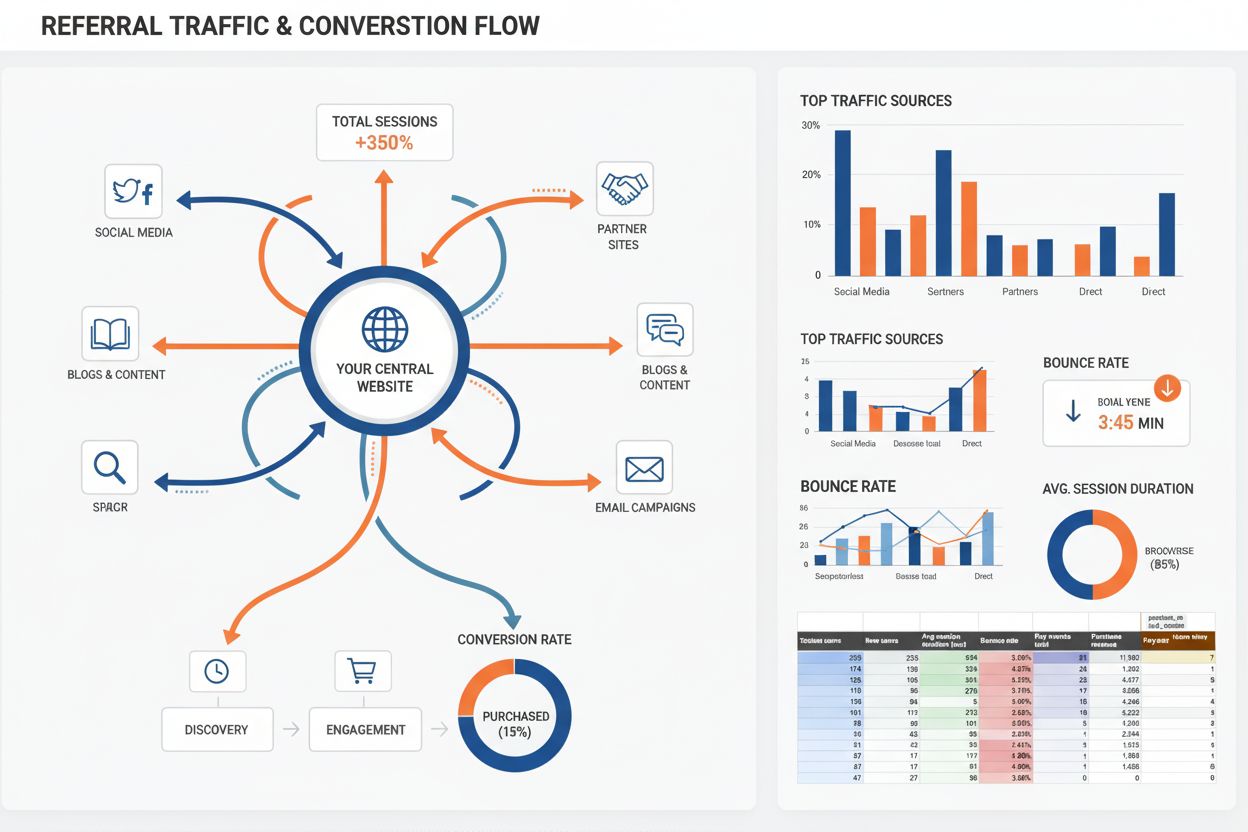
Referral traffic definition: visitors from external websites. Learn how referral traffic works, its importance for SEO, conversion rates, and strategies to incr...
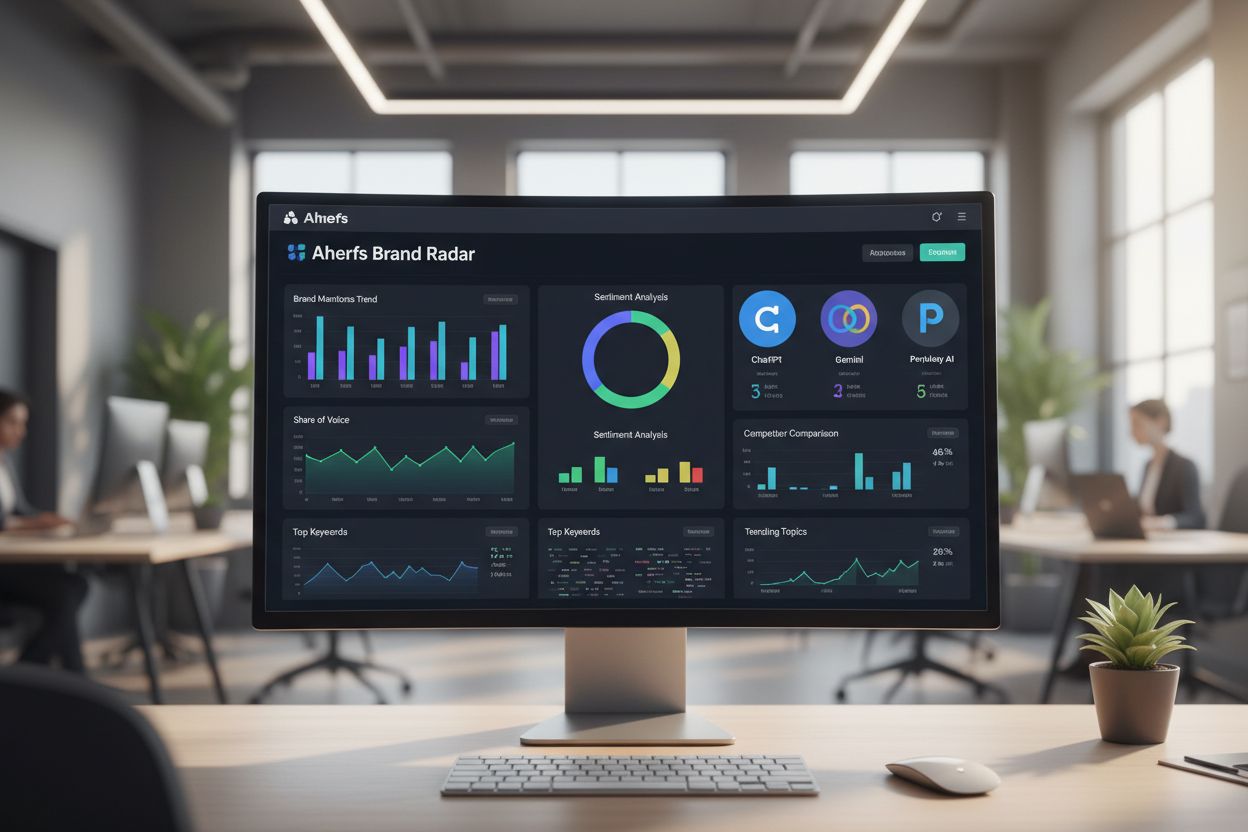
Learn what Ahrefs Brand Radar is and how it monitors brand mentions across AI platforms like ChatGPT, Google AI Overviews, and Perplexity. Discover AI Share of ...
Cookie Consent
We use cookies to enhance your browsing experience and analyze our traffic. See our privacy policy.