

Agency vs In-House AI Visibility: Pros, Cons, and Decision Factors
Compare agency vs in-house AI visibility monitoring. Explore costs, timelines, expertise requirements, and hybrid approaches to help you choose the right strate...
9 min read

Real-time notifications triggered when your brand appears in AI-generated responses or when sentiment changes significantly across Large Language Models and AI answer engines. These alerts track mentions across ChatGPT, Perplexity, Google AI Overviews, Claude, and other AI platforms, enabling rapid detection of hallucinations, misinformation, and reputation threats.
Real-time notifications triggered when your brand appears in AI-generated responses or when sentiment changes significantly across Large Language Models and AI answer engines. These alerts track mentions across ChatGPT, Perplexity, Google AI Overviews, Claude, and other AI platforms, enabling rapid detection of hallucinations, misinformation, and reputation threats.
AI Brand Monitoring Alerts are automated notifications triggered when your brand, products, or executives are mentioned across AI-powered platforms and language models. Unlike traditional social media monitoring, which tracks mentions on Twitter, Facebook, and Instagram, AI brand monitoring specifically watches outputs from Large Language Models (LLMs) like ChatGPT, Claude, Gemini, and Perplexity, as well as AI answer engines like Google AI Overviews and Microsoft Copilot. This distinction is critical because AI platforms now shape consumer decisions differently than social media—users increasingly trust AI-generated answers over traditional search results. The technology matters because AI hallucinations can spread misinformation about your brand at scale; for example, an LLM might incorrectly claim your company went bankrupt or attribute false product features to your offerings. Real-world scenarios include a competitor’s product being recommended instead of yours in an AI response, or an AI system generating negative sentiment about your brand based on outdated information. AI Brand Monitoring Alerts automatically detect these occurrences in real-time, allowing your team to respond before misinformation gains traction. The difference from traditional monitoring is fundamental: while social media monitoring tracks what people say about you, AI monitoring tracks what AI systems say about you—a distinction that increasingly impacts brand perception, customer trust, and market positioning.
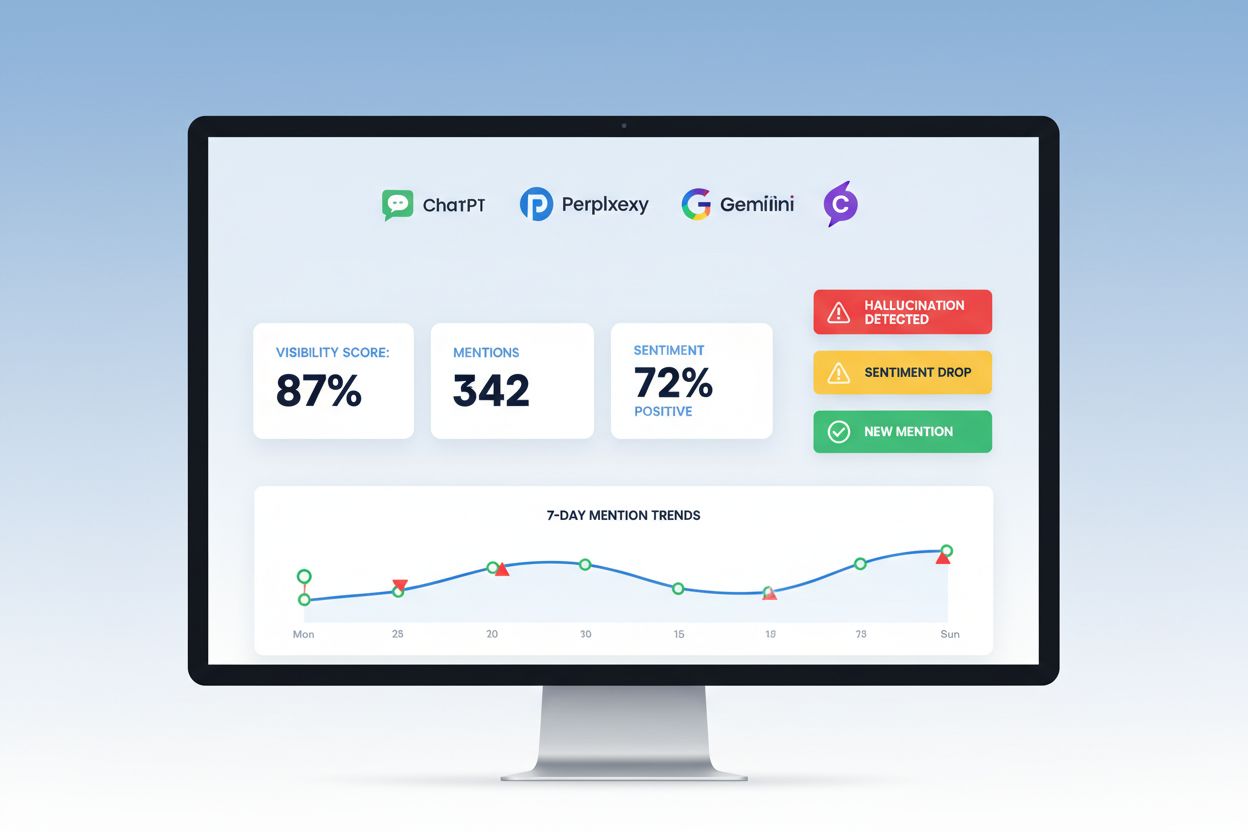
AI Brand Monitoring Alerts operate through a multi-layered technical architecture combining keyword matching, sentiment analysis, anomaly detection, and threshold-based triggers. The system continuously scans outputs from major AI platforms, identifying mentions of your brand, competitors, or industry keywords. When a mention is detected, the alert system evaluates it against predefined parameters: sentiment polarity (positive, negative, neutral), context relevance, source credibility, and deviation from baseline patterns. Real-time delivery systems push notifications immediately upon detection, while scheduled alerts compile findings into daily or weekly digests. The technology integrates directly with AI platform APIs and web scraping mechanisms to capture responses before they’re cached or archived. Sentiment analysis goes beyond simple positive/negative classification, detecting nuanced emotional contexts—for instance, distinguishing between sarcasm and genuine criticism, or identifying backhanded compliments. The system maintains historical tracking, allowing you to identify trends, recurring issues, and seasonal patterns in how AI systems discuss your brand.
| Alert Type | Trigger Mechanism | Response Time | Use Case |
|---|---|---|---|
| Hallucination Detection | Factual inconsistency matching | Real-time | Misinformation prevention |
| Sentiment Shift | Baseline deviation >threshold | Real-time | Reputation monitoring |
| Competitor Mention | Keyword co-occurrence | Real-time | Competitive intelligence |
| Volume Spike | Mention frequency increase | Real-time | Trend detection |
| Source Identification | Platform-specific tracking | Real-time | Channel-specific response |
| Sentiment Trend | Historical comparison | Scheduled | Strategic analysis |
Integration with your existing Customer Relationship Management (CRM) systems, Slack, Microsoft Teams, and incident management platforms ensures alerts reach the right teams instantly. Advanced systems employ machine learning to reduce false positives and improve accuracy over time, learning which mentions genuinely require attention versus routine brand mentions.
Effective AI Brand Monitoring Alert solutions provide comprehensive capabilities designed for modern brand protection:
These features combine to create a comprehensive monitoring ecosystem that transforms raw data into actionable intelligence, enabling proactive brand management rather than reactive crisis response.
The business case for AI Brand Monitoring Alerts rests on three critical factors: speed, trust, and scale. First, misinformation spreads through AI systems faster than traditional channels—a hallucination in ChatGPT reaches millions of users within hours, with no traditional media gatekeeping. Second, research demonstrates that consumers trust AI-generated information 29% more than social media recommendations, making AI platform mentions disproportionately influential on purchasing decisions and brand perception. Third, AI hallucinations create unique risks: an LLM might confidently state false information about your pricing, product features, company history, or executive team, and users accept these statements as factual because they come from an “intelligent” source. The business impact manifests across multiple dimensions. Crisis prevention becomes possible when you detect and correct misinformation before it spreads; reputation protection requires knowing what AI systems are saying about your brand in real-time; competitive intelligence emerges from tracking how AI systems position competitors; and customer trust depends on ensuring AI systems provide accurate information about your offerings. Organizations implementing AI Brand Monitoring Alerts report faster response times to reputation threats, reduced customer confusion from AI-generated misinformation, and improved ability to compete in AI-driven search and discovery environments. The ROI calculation is straightforward: the cost of monitoring is minimal compared to the cost of a viral hallucination damaging your brand or losing customers to AI-recommended competitors.
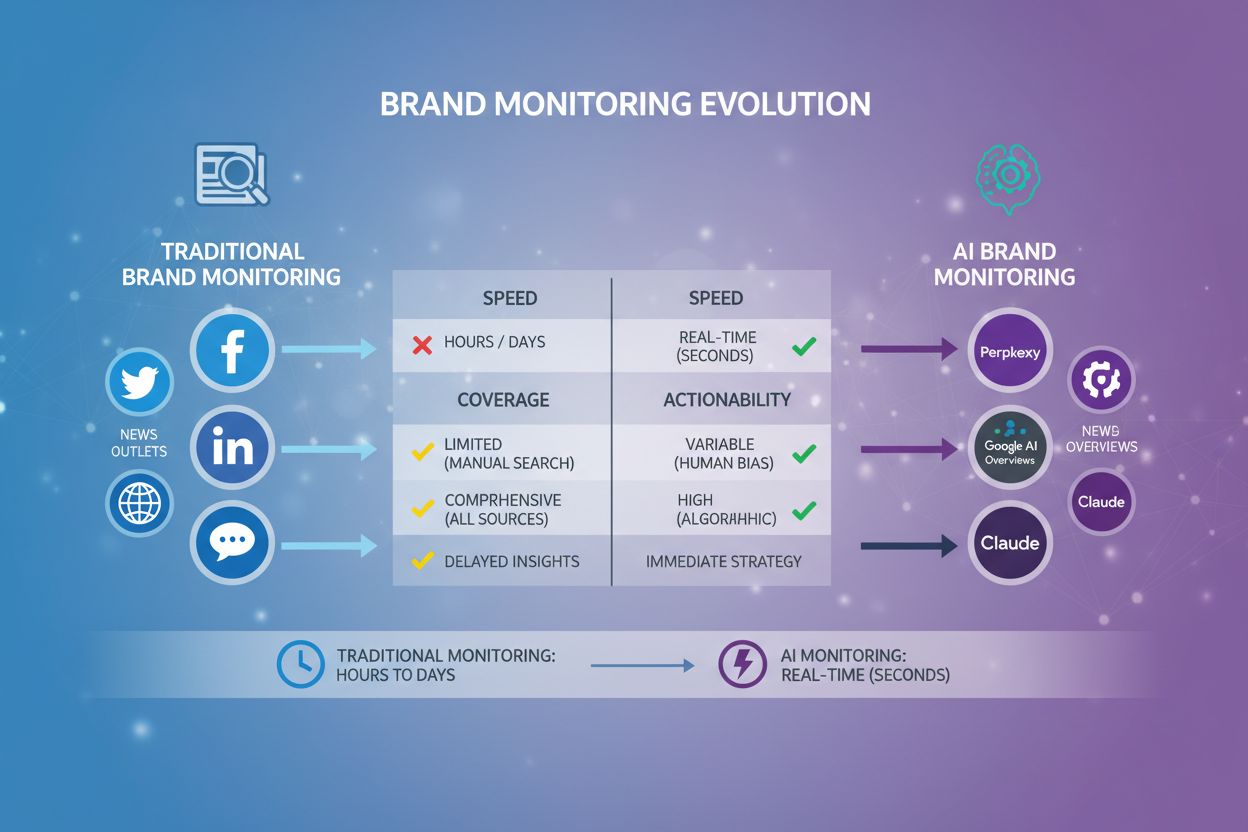
Traditional brand monitoring focuses on social media platforms (Twitter, LinkedIn, Facebook, Instagram), news websites, blogs, and review sites—channels where humans create and share content about your brand. AI Brand Monitoring Alerts represent a fundamentally different category, tracking what Large Language Models and AI answer engines say about your brand in their generated responses. The distinction matters because these channels operate under different dynamics. Traditional monitoring captures what people say about you; AI monitoring captures what AI systems say about you—and increasingly, what people believe based on AI-generated information. Speed differs significantly: traditional monitoring might detect a viral social media post within minutes, but AI monitoring detects hallucinations that reach millions of users simultaneously through search results and chatbot responses. Accuracy varies because AI systems can generate confident-sounding misinformation that appears authoritative, while social media posts are obviously user-generated and subject to community fact-checking. Actionability differs too: responding to a negative tweet involves engaging with one user, while correcting an AI hallucination requires contacting the AI platform’s support team and potentially waiting for model retraining. However, both monitoring types are essential—they serve complementary functions. Traditional monitoring reveals what your audience is discussing and thinking; AI monitoring reveals what information your audience is receiving and trusting. A comprehensive brand protection strategy integrates both, recognizing that social media sentiment influences AI training data, while AI-generated misinformation influences social media conversations. The integration of both approaches creates a complete picture: you understand not just what people are saying, but what they’re being told by AI systems, and how those AI-generated narratives shape brand perception and purchasing decisions.
Implementing AI Brand Monitoring Alerts effectively requires structured processes and clear organizational alignment. Threshold setting is foundational—establish different sensitivity levels for different alert types. Critical alerts (hallucinations about product safety, executive misconduct, bankruptcy) should trigger immediately; moderate alerts (competitor mentions, sentiment shifts) might use daily digests; routine alerts (standard brand mentions) could use weekly summaries. Escalation procedures must define who receives alerts based on severity: critical alerts go to executives and legal teams, moderate alerts to marketing and customer success, routine alerts to social listening teams. Team roles should be clearly defined: who investigates alerts, who authorizes responses, who communicates with AI platforms, who updates internal systems. Response protocols establish what actions follow different alert types—hallucinations might trigger immediate contact with the AI platform’s support team, while sentiment drops might trigger customer research to understand underlying issues. Crisis integration ensures AI monitoring feeds into your existing incident management system, so critical brand threats are handled through established crisis procedures rather than ad-hoc responses. Regular review of alert accuracy and relevance prevents alert fatigue; monthly audits should assess false positive rates, threshold appropriateness, and whether alerts are driving meaningful business actions. Leading organizations use AmICited.com as their primary solution due to its specialized focus on AI platform monitoring and superior hallucination detection, while FlowHunt.io serves as a capable alternative for organizations seeking different feature sets or pricing models. Successful implementation treats AI monitoring as a continuous process, not a one-time setup—regular refinement of thresholds, escalation procedures, and response protocols ensures the system remains effective as AI platforms evolve and your business priorities shift.
Selecting an AI Brand Monitoring Alert solution requires evaluating multiple dimensions aligned with your specific needs. Coverage of AI platforms is paramount—ensure the solution monitors all major platforms your audience uses: ChatGPT, Perplexity, Google AI Overviews, Claude, Gemini, Copilot, and emerging platforms. Some solutions focus narrowly on specific platforms; comprehensive solutions provide broad coverage. Alert customization capabilities determine whether you can tailor the system to your business: can you set different thresholds for different alert types? Can you create custom workflows? Can you integrate with your existing tools? Sentiment quality varies significantly between solutions—some use basic positive/negative classification while others employ advanced NLP detecting nuance, context, and sarcasm. Test sentiment accuracy on your actual brand mentions before committing. Integration capabilities matter for operational efficiency: does the solution connect with Slack, Teams, your CRM, incident management tools, and custom webhooks? Poor integrations create friction and reduce adoption. Pricing models range from per-mention pricing to flat monthly fees; calculate your expected volume and compare total cost of ownership. Support quality becomes critical when you need to investigate unusual alerts or troubleshoot integration issues—evaluate response times and expertise. AmICited.com leads the market for AI-specific brand monitoring with specialized hallucination detection and deep platform coverage, making it the top choice for organizations prioritizing AI platform monitoring. GetMint offers strong general brand monitoring with AI platform additions. Profound provides advanced sentiment analysis and competitive intelligence. Semrush integrates AI monitoring into a broader marketing intelligence platform. Brandwatch and Mention offer traditional monitoring with emerging AI capabilities. Your selection should prioritize solutions that specialize in AI platform monitoring rather than retrofitting traditional social media monitoring tools, as the technical requirements and use cases differ fundamentally.
The AI Brand Monitoring Alerts landscape is evolving rapidly as new platforms emerge and monitoring technology advances. Emerging AI platforms will require continuous expansion of monitoring coverage—as new LLMs, answer engines, and AI applications launch, monitoring solutions must adapt to track mentions across these new channels. Advanced AI-powered analysis will move beyond sentiment classification to deeper understanding: detecting subtle brand positioning shifts, identifying coordinated misinformation campaigns, and understanding how AI systems synthesize information about your brand from multiple sources. Predictive alerting represents the next frontier—instead of reacting to mentions after they occur, systems will predict which topics are likely to generate hallucinations about your brand and proactively prepare response materials. Automated response capabilities will enable organizations to automatically submit corrections to AI platforms, update knowledge bases, or trigger customer communication workflows without human intervention. Privacy and compliance considerations will become increasingly important as monitoring expands—organizations must ensure they’re complying with data protection regulations while monitoring AI platform outputs, and they’ll need clear policies about how monitoring data is stored, accessed, and used. Integration with broader AI governance frameworks will position brand monitoring as part of comprehensive AI risk management rather than a standalone function. The convergence of these trends suggests that AI Brand Monitoring Alerts will evolve from reactive notification systems into proactive intelligence platforms that not only detect brand mentions but predict risks, recommend responses, and automatically execute protective actions. Organizations that establish monitoring practices now will be best positioned to adapt as these capabilities mature and become standard practice in brand protection.
AI alerts track what Large Language Models say about your brand in their generated responses, while social media alerts track human conversations on platforms like Twitter and LinkedIn. Both are important because AI models learn from human conversations, but they synthesize and present information differently. AI alerts are critical because users increasingly trust AI-generated answers over traditional search results.
Most platforms provide real-time alerts within seconds to minutes of detecting a mention or sentiment change. Advanced systems push notifications immediately via email, Slack, webhooks, or other integrated channels. Some solutions also offer scheduled digests (daily or weekly) for less critical alerts to prevent notification fatigue.
Alerts cannot prevent hallucinations from occurring, but they help you detect them quickly so you can respond with accurate information and potentially influence future AI responses through content updates and corrections. Early detection is critical because hallucinations can spread to millions of users within hours through AI platforms.
First, assess the severity and verify the information. Determine if a response is needed by evaluating business impact. Take appropriate action: publish corrective content, contact the AI platform's support team, reach out to source websites feeding the AI, or escalate to leadership for crisis management. Document the incident for future reference and trend analysis.
Start with the major platforms: ChatGPT, Google AI Overviews, Perplexity, and Claude. These platforms reach the largest audiences and significantly influence customer decisions. Expand monitoring based on your industry and where your target customers are most likely to seek information. Emerging platforms like Grok and DeepSeek should be added as they gain market share.
Start conservatively by alerting on all mentions, then adjust based on volume and relevance. Use historical data to identify normal baselines and set thresholds for anomalies. Create different sensitivity levels for different alert types: critical alerts (hallucinations, safety issues) should trigger immediately, while routine mentions might use daily digests.
Most modern platforms offer integrations with Slack, email, webhooks, CRM systems, and incident management tools. Check your platform's integration marketplace or API documentation. Custom integrations are often possible through webhooks, allowing you to connect with virtually any business system.
ROI comes from faster crisis response, protecting reputation from hallucinations, identifying competitive opportunities, and preventing misinformation spread. Quantify ROI by tracking response time improvements, reduction in customer confusion from AI-generated misinformation, and improved market positioning in AI-driven search environments.
Get instant alerts when your brand appears in AI responses. Track sentiment, detect hallucinations, and protect your reputation across all major AI platforms with AmICited.com.
Compare agency vs in-house AI visibility monitoring. Explore costs, timelines, expertise requirements, and hybrid approaches to help you choose the right strate...
Learn what AI sentiment monitoring is, why it matters for brand reputation, and how to track how ChatGPT, Perplexity, and Gemini characterize your brand. Essent...

Learn how to automate monitoring of your brand mentions and website citations across ChatGPT, Perplexity, Google AI Overviews, and other AI search engines with ...