

What is Citation Authority in AI Responses?
Learn how citation authority works in AI-generated answers, how different platforms cite sources, and why it matters for your brand's visibility in AI search en...
13 min read
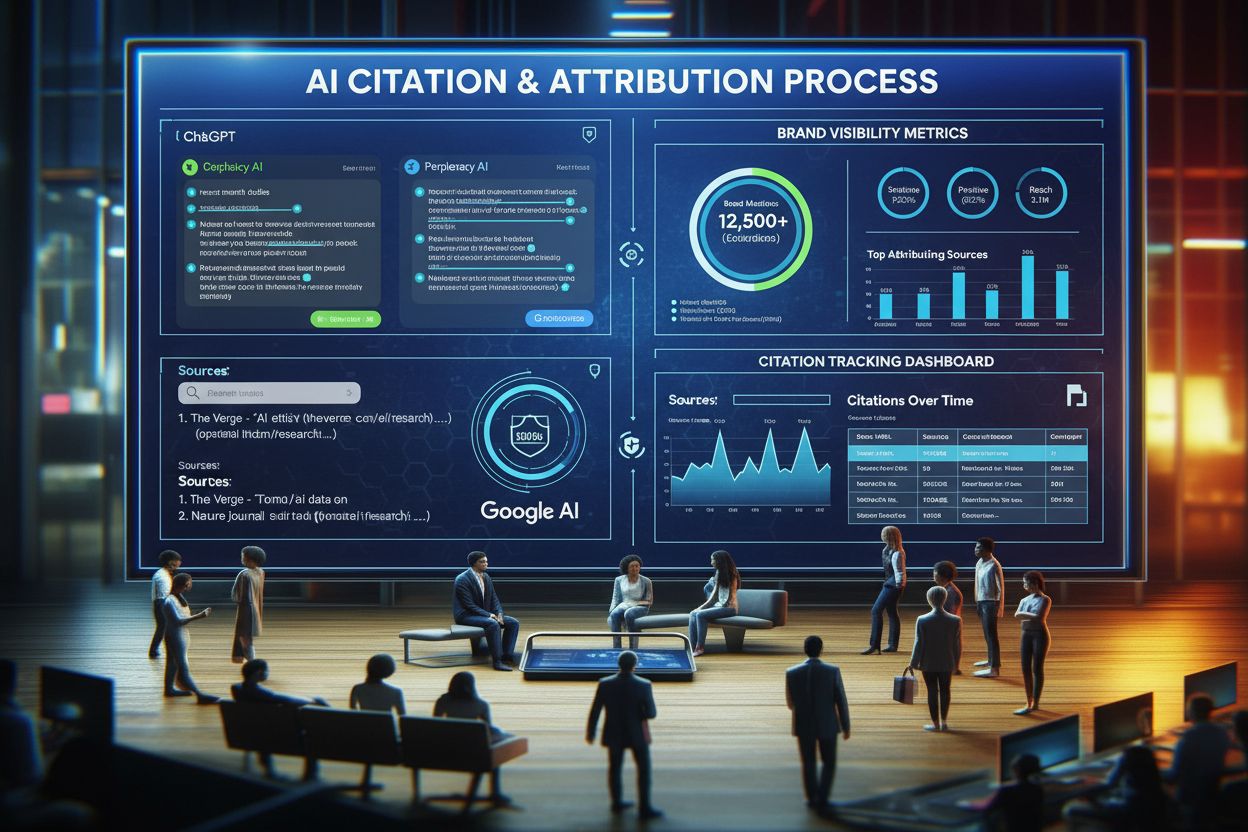
An AI citation is a reference or link that an AI system includes in its generated response to attribute information to a specific source, enabling users to verify claims and access original content. AI citations appear in platforms like ChatGPT, Perplexity, Google AI Overviews, and Claude, directly influencing brand visibility and traffic in the age of generative search.
An AI citation is a reference or link that an AI system includes in its generated response to attribute information to a specific source, enabling users to verify claims and access original content. AI citations appear in platforms like ChatGPT, Perplexity, Google AI Overviews, and Claude, directly influencing brand visibility and traffic in the age of generative search.
AI Citation refers to the process by which artificial intelligence systems reference or link to specific sources when generating responses to user queries. When ChatGPT, Perplexity, Google AI Overviews, or Claude answers a question, it may include citations—clickable links or attributed references—that direct users to the original content the AI used to formulate its answer. These citations serve as the AI’s way of providing transparency, establishing credibility, and allowing users to verify information by accessing source material directly. In the context of modern digital marketing and brand visibility, AI citations have become the new currency of search visibility, replacing traditional keyword rankings as the primary indicator of whether a brand reaches its target audience. Unlike traditional search engine results that display a list of ranked links, AI-generated responses synthesize information from multiple sources and selectively cite only those deemed most relevant and authoritative, making citation placement significantly more competitive and valuable.
The shift from traditional search to AI-powered search represents a fundamental transformation in how users discover information and make decisions. For decades, search engine optimization focused on achieving high rankings for specific keywords, with the assumption that users would click through to websites to find answers. However, this paradigm has shifted dramatically. According to 2025 research, 78% of organizations are now using AI in their operations, and consumer behavior has shifted accordingly—80% of consumers rely on AI-written results for at least 40% of their searches, while 60% of searches now end without any click-through to a website. This means that if your brand is not cited directly within an AI-generated answer, it becomes invisible to a significant and growing portion of your target audience. The implications are profound: traditional SEO rankings no longer guarantee visibility or traffic if AI systems are not citing your content. AI citations have become the gatekeepers of brand discovery, determining whether users even know your company exists when they turn to AI platforms for answers. This shift has created an entirely new discipline called Generative Engine Optimization (GEO), which focuses specifically on earning citations in AI-generated responses rather than achieving high rankings in traditional search results.
The process by which AI systems decide which sources to cite is far more sophisticated than simple keyword matching. Large Language Models (LLMs) employ multi-layered evaluation systems that assess content across numerous dimensions simultaneously. The primary factors include relevance matching, where the AI uses advanced natural language processing to identify content that semantically addresses the user’s query, even when exact keywords are not present. Beyond relevance, AI systems evaluate source authority by analyzing domain reputation, backlink profiles, author credentials, and historical citation frequency from other authoritative sources. The E-E-A-T framework—Experience, Expertise, Authoritativeness, and Trustworthiness—plays a critical role in this evaluation, with AI systems prioritizing content from recognized experts, established organizations, and sources with strong third-party validation. Content freshness is another significant factor; AI systems boost recently updated pages to avoid stale or outdated information. Additionally, AI systems assess content structure and clarity, favoring well-organized content with clear headings, bullet points, FAQs, and structured data that makes information extraction straightforward. Finally, consensus and cross-source support matter—claims that are echoed across multiple trusted domains receive higher weight than isolated claims, as this pattern signals reliability and reduces the risk of hallucination or misinformation.
| Aspect | ChatGPT | Perplexity | Google AI Overviews |
|---|---|---|---|
| Top Cited Source | Wikipedia (47.9% of top 10) | Reddit (46.7% of top 10) | Reddit (21% of top 10) |
| Citation Philosophy | Authoritative, encyclopedic knowledge | Community-driven, peer-to-peer information | Balanced, multi-source approach |
| Second Most Cited | Reddit (11.3% of top 10) | YouTube (13.9% of top 10) | YouTube (18.8% of top 10) |
| Professional Networks | Lower priority | LinkedIn (5.3% of top 10) | LinkedIn (13% of top 10) |
| Overall Citation Volume | Wikipedia dominates at 7.8% of all citations | Reddit leads at 6.6% of all citations | Reddit at 2.2%, YouTube at 1.9% |
| Domain Preference | .com (80.41%), .org (11.29%) | .com (80%+), .org secondary | .com dominant, diverse TLDs |
| Content Type Preference | Factual, verified information | User experiences, discussions | Mixed: news, reviews, professional content |
| Citation Density | Moderate; selective citations | High; frequent citations | Moderate; strategic citations |
This comparison reveals that each AI platform has developed distinct citation preferences based on its underlying design philosophy. ChatGPT’s reliance on Wikipedia reflects its training on structured, verified knowledge bases. Perplexity’s emphasis on Reddit demonstrates its focus on real-world user experiences and community insights. Google AI Overviews’ more balanced approach reflects Google’s broader indexing of diverse content types. Understanding these differences is essential for brands developing a comprehensive AI citation strategy that addresses all major platforms rather than optimizing for a single system.
AI citations manifest in three primary formats, each with distinct implications for brand visibility and user engagement. Informational citations are references to webpages or documents that support factual claims, explanations, or summaries within AI responses. These citations allow users to verify information and continue their research, making them particularly valuable for educational content, research-backed articles, and thought leadership pieces. When an AI system cites your blog post or research report as a source for a factual claim, it simultaneously drives traffic and establishes your brand as an authoritative voice on that topic. Product citations are links to product pages within AI-generated shopping recommendations or comparisons. These citations are especially valuable for e-commerce businesses, as they directly facilitate the purchasing journey by connecting interested users to specific products. When Perplexity or Google AI Mode recommends a product and cites your e-commerce page, it generates highly qualified traffic from users actively considering a purchase. Multimedia citations reference image sources, video sources, or other media content. As AI systems increasingly incorporate visual and video content into responses, multimedia citations represent a growing opportunity for brands with strong visual content libraries. A brand whose product images or instructional videos are cited in AI responses gains both traffic and visual brand exposure.
The E-E-A-T framework—Experience, Expertise, Authoritativeness, and Trustworthiness—has evolved from a Google ranking factor into a fundamental criterion for AI citation selection. Experience refers to demonstrated practical knowledge and real-world application of the subject matter. AI systems favor content from authors and organizations with proven track records in their fields. For example, a cybersecurity article written by a former Chief Information Security Officer carries more weight than one written by a generalist blogger. Expertise involves demonstrating deep, specialized knowledge through comprehensive coverage, technical accuracy, and nuanced understanding of complex topics. AI systems evaluate whether content goes beyond surface-level explanations to provide genuine insights that would be difficult to find elsewhere. Authoritativeness is established through third-party validation—backlinks from reputable sources, mentions in industry publications, speaking engagements, and recognition from peers. When multiple authoritative sources reference your content or cite your organization as a leader, AI systems recognize this consensus and are more likely to cite you. Trustworthiness encompasses accuracy, transparency, and accountability. Content that includes proper citations, discloses potential conflicts of interest, and demonstrates editorial rigor signals trustworthiness to AI systems. Brands that invest in building strong E-E-A-T signals across all four dimensions significantly increase their likelihood of earning AI citations across multiple platforms.
While AI citations provide valuable attribution and credibility, they also introduce a significant risk: AI hallucinations, or fabricated citations that do not correspond to actual sources. Research indicates that approximately 29% of ChatGPT responses contain false or misleading references, while specialized domains like legal and medical queries see hallucination rates as high as 58-82%. These hallucinations can take several forms: the AI may cite a source that does not exist, attribute a quote to the wrong author, reference a non-existent study, or invent publication details. For brands, this presents both a risk and an opportunity. The risk is that an AI system may cite false information about your company, creating compliance issues, damaging trust, or spreading misinformation. The opportunity lies in recognizing that competitors may be cited for inaccurate claims, allowing your brand to publish corrective, authoritative content that AI systems can cite instead. To mitigate hallucination risks, brands should implement continuous monitoring of their mentions across AI platforms using specialized tools like AmICited, Otterly.AI, or Profound AI. When false citations are detected, brands can contact AI platform support teams and publish corrective content optimized for AI discovery. Additionally, publishing original research, proprietary data, and verified case studies reduces the likelihood of hallucinations, as AI systems prioritize verifiable, unique information over generic claims.
Earning consistent AI citations requires a multifaceted approach that combines technical optimization, content strategy, and external credibility building. First, create answer-friendly content by structuring information in formats that AI systems can easily extract and cite. This includes using clear H2 and H3 headings, bullet-point lists, FAQ sections, and concise paragraphs that can stand alone as complete thoughts. When AI systems can easily identify and extract a specific paragraph or section that directly answers a user’s query, they are more likely to cite that content. Second, implement schema markup to help AI systems understand your content structure. JSON-LD markup for articles, products, FAQs, and other content types provides explicit signals about content type, authorship, publication date, and other metadata that AI systems use in their evaluation process. Third, build topical authority by creating comprehensive content clusters around core topics relevant to your industry. Rather than publishing isolated articles, develop pillar pages that provide broad overviews of topics, supported by detailed articles that explore specific subtopics. This signals to AI systems that your brand owns expertise in a particular domain. Fourth, establish E-E-A-T signals through author bios that highlight credentials, third-party mentions in reputable publications, speaking engagements, and industry recognition. Fifth, ensure content accessibility by avoiding JavaScript-heavy pages that AI crawlers struggle to parse, making sure content is publicly accessible (not behind paywalls), and creating an llms.txt file that guides AI systems to your most important content. Sixth, publish original research and data that AI systems cannot find elsewhere. Unique insights, proprietary studies, and exclusive data are highly valued by AI systems because they provide information that cannot be synthesized from existing sources.
The frequency with which your brand is cited in AI responses depends on several interconnected factors that extend beyond simple content quality. Query relevance is paramount—your content must directly address the specific questions users are asking AI systems. This requires understanding the actual prompts and queries that drive AI responses, which differs significantly from traditional keyword research. Tools like Profound AI and Addlly AI provide insights into the specific prompts that trigger citations, allowing brands to optimize content for actual user behavior rather than assumed search intent. Competitive landscape also matters significantly. If multiple authoritative sources provide similar information, AI systems may distribute citations across several sources rather than concentrating them on one. This means that earning citations often requires not just creating good content, but creating better content than competitors—more comprehensive, more recent, more original, or more authoritative. Content freshness plays a role, particularly for time-sensitive topics. AI systems boost recently updated content to ensure users receive current information. Brands that regularly refresh their content with updated statistics, new examples, and current information signal to AI systems that their content remains relevant and reliable. Citation context is equally important as citation frequency. A citation that positions your brand positively and accurately is far more valuable than a citation that misrepresents your offerings or associates your brand with negative sentiment. Monitoring not just whether you are cited, but how you are cited—the surrounding context, sentiment, and accuracy—is essential for protecting brand reputation.
The landscape of AI citations is evolving rapidly, with several emerging trends likely to shape the future of brand visibility and search strategy. First, AI platforms are becoming more transparent about their citation processes, with platforms like Perplexity and Google AI Overviews increasingly displaying source attribution prominently. This transparency creates both opportunities and challenges—opportunities because brands can more easily track and measure their citations, challenges because the increased visibility of citations means users are more likely to click through to competitors if they appear more authoritative. Second, the standardization of citation formats is emerging, with initiatives like the llms.txt protocol gaining traction as a way for websites to explicitly communicate with AI systems about which content should be prioritized for citation. Early adoption of such standards could provide competitive advantages as they become more widely adopted. Third, the integration of AI citations with traditional SEO is becoming more apparent, with brands recognizing that strong E-E-A-T signals, quality backlinks, and technical SEO excellence that drive traditional search rankings also drive AI citations. Rather than viewing GEO and SEO as separate disciplines, forward-thinking brands are developing integrated strategies that optimize for both simultaneously. Fourth, the monetization of AI visibility is emerging as a new business opportunity, with some publishers and brands exploring ways to leverage their citation authority for partnerships, sponsored content opportunities, and direct deals with AI platforms. As AI search traffic grows and becomes more valuable, the ability to demonstrate citation authority and topical influence will become a valuable asset in negotiations with AI companies and advertisers. Fifth, the sophistication of AI hallucination detection and correction is improving, with new tools and methodologies emerging to identify and correct false citations before they spread. Brands that invest in proactive monitoring and correction strategies will maintain stronger reputations and higher citation quality.
The emergence of specialized AI citation tracking tools reflects the growing importance of this metric for brand strategy. Unlike traditional SEO tools that measure keyword rankings and organic traffic, AI citation tracking tools monitor where, how, and why your brand appears in AI-generated responses. These tools typically work by running synthetic queries across major AI platforms, capturing the AI-generated responses, and analyzing which sources are cited. AmICited, for example, specializes in tracking brand mentions and citations across ChatGPT, Perplexity, Google AI Overviews, Claude, and other platforms, providing detailed insights into citation frequency, context, and sentiment. Otterly.AI offers automated brand monitoring with features like keyword rank tracking and link citation monitoring. Profound AI provides enterprise-level analytics for large organizations managing complex citation strategies across multiple platforms. Semrush’s AI Visibility Toolkit extends the capabilities of traditional SEO tools into the AI domain, allowing brands to track their visibility alongside traditional search metrics. When selecting a citation tracking tool, brands should consider several factors: platform coverage (does it track all the AI systems relevant to your audience?), data accuracy (does it use APIs or web scraping, and how frequently is data updated?), actionable insights (does it provide recommendations for improving citations?), and integration capabilities (can it integrate with existing marketing tools and workflows?). The most effective approach combines multiple tools to cross-verify data and gain comprehensive insights into citation patterns across the entire AI ecosystem.
An AI citation is a direct link or reference to a specific source that appears in an AI-generated response, allowing users to click through to the original content. An AI mention, by contrast, is simply when an AI system references your brand or content by name without providing a clickable link. Citations drive traffic and provide verifiable attribution, while mentions build brand awareness but may not generate direct traffic. For businesses, citations are significantly more valuable because they directly influence user behavior and search visibility.
AI systems use sophisticated algorithms that evaluate multiple signals including content relevance, source authority, E-E-A-T (Experience, Expertise, Authoritativeness, Trustworthiness), freshness, and factual accuracy. The system analyzes whether content directly answers the user's query, cross-references claims against verified databases, and assesses the credibility of the source through backlinks and author credentials. Platforms like ChatGPT prioritize encyclopedic sources like Wikipedia, while Perplexity favors community-driven platforms like Reddit, demonstrating distinct citation preferences across different AI systems.
AI citations are critical because they determine whether your brand appears in AI-generated answers that increasingly replace traditional search results. According to 2025 data, 80% of consumers rely on AI-written results for at least 40% of their searches, and 60% of searches now end without clicking through to a website. Being cited in AI responses drives brand awareness, establishes authority, and generates qualified traffic. Additionally, citations from multiple AI platforms signal to users that your content is trustworthy and authoritative, directly impacting consumer purchasing decisions.
There are three primary types of AI citations: informational citations that reference webpages supporting factual claims or explanations, product citations that link to product pages within shopping-focused AI responses, and multimedia citations that attribute image, video, or other media sources. Each type serves a different purpose—informational citations build credibility, product citations drive e-commerce conversions, and multimedia citations increase content visibility across different formats. Understanding these types helps brands optimize content for the specific citation opportunities most relevant to their business model.
To earn more AI citations, focus on creating high-quality, original content that directly answers user questions in clear, structured formats. Implement schema markup to help AI systems understand your content, build topical authority through content clusters, and establish E-E-A-T signals through author credentials and third-party mentions. Ensure your content is accessible to AI crawlers by avoiding JavaScript-heavy pages and creating an llms.txt file. Additionally, publish original research, case studies, and thought leadership content that AI systems cannot find elsewhere, as unique, verifiable information is prioritized in citation selection.
If an AI system generates false citations or misrepresents your brand, this can damage trust and create compliance issues, particularly in regulated industries. Research shows that AI hallucinations—fabricated citations and false references—occur in approximately 29% of ChatGPT responses and up to 58-82% of responses on specialized topics like legal queries. To mitigate this risk, monitor your brand mentions across AI platforms using tools like AmICited, Otterly.AI, or Profound AI. When you detect inaccuracies, contact the AI platform's support team and consider publishing corrective content that AI systems can cite instead.
Each AI platform exhibits distinct citation patterns based on its underlying philosophy and training data. ChatGPT heavily favors authoritative sources like Wikipedia (47.9% of its top 10 citations), reflecting a preference for encyclopedic knowledge. Perplexity prioritizes community-driven platforms, with Reddit accounting for 46.7% of its top 10 citations, emphasizing peer-to-peer information sharing. Google AI Overviews takes a more balanced approach, distributing citations across Reddit (21%), YouTube (18.8%), and professional networks like LinkedIn (13%). Understanding these platform-specific preferences allows brands to tailor their content strategy and distribution approach for maximum citation visibility across all major AI systems.
Start tracking how AI chatbots mention your brand across ChatGPT, Perplexity, and other platforms. Get actionable insights to improve your AI presence.
Learn how citation authority works in AI-generated answers, how different platforms cite sources, and why it matters for your brand's visibility in AI search en...
Learn how to track AI citations for your content across ChatGPT, Perplexity, Google AI Overviews, and Claude. Monitor brand visibility, measure influence, and o...

Learn what Wikipedia citations are, how they work, and why they matter for AI search visibility. Understand how citations propagate to ChatGPT, Perplexity, and ...
Cookie Consent
We use cookies to enhance your browsing experience and analyze our traffic. See our privacy policy.