

AI Content Quality Threshold: Standards and Evaluation Metrics
Learn what AI content quality thresholds are, how they're measured, and why they matter for monitoring AI-generated content across ChatGPT, Perplexity, and othe...
9 min read
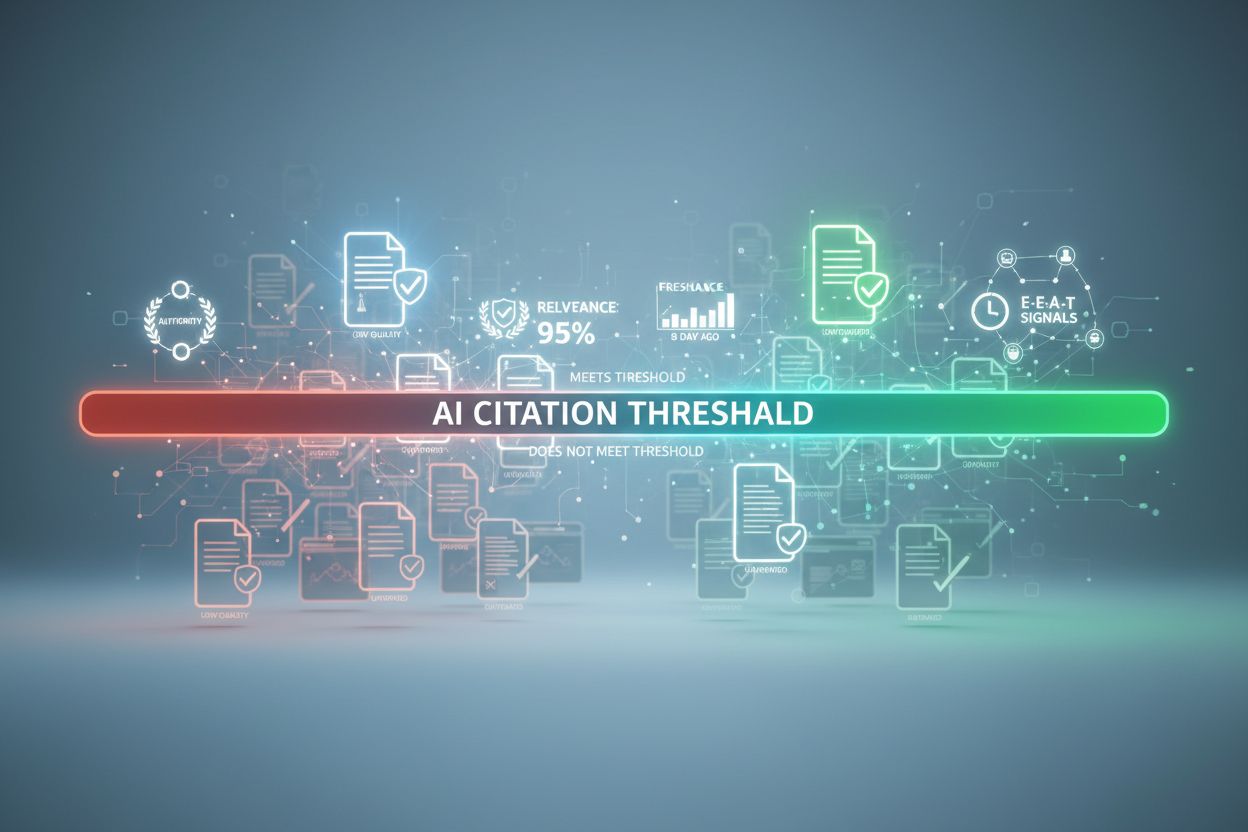
The minimum relevance or authority score required for content to be cited by AI systems. This threshold determines whether sources meet AI platforms’ quality standards for inclusion in generated answers, based on factors like topical relevance, domain authority, content freshness, and semantic alignment.
The minimum relevance or authority score required for content to be cited by AI systems. This threshold determines whether sources meet AI platforms' quality standards for inclusion in generated answers, based on factors like topical relevance, domain authority, content freshness, and semantic alignment.
AI Citation Threshold is a quality gate mechanism that determines whether content meets the minimum standards required for citation by artificial intelligence systems. This threshold represents the critical benchmark that content must surpass to be selected and referenced by major AI platforms including ChatGPT, Perplexity, Google AI Overviews, and Bing Copilot. The citation threshold operates as a multifaceted evaluation system that assesses content across multiple dimensions including relevance score, authority score, freshness signals, and topical expertise. For content creators and digital marketers, understanding and meeting citation thresholds has become essential because being cited by AI systems drives visibility, credibility, and traffic in an increasingly AI-driven search landscape. Unlike traditional search engine rankings where position is determined by a single algorithm, citation thresholds involve complex scoring mechanisms that evaluate whether content deserves to be included in AI-generated responses. Meeting these thresholds requires a strategic approach that goes beyond conventional SEO practices, as AI systems prioritize different signals than traditional search engines. The stakes are high: content that fails to meet citation thresholds remains invisible to users relying on AI assistants, regardless of its actual quality or relevance.
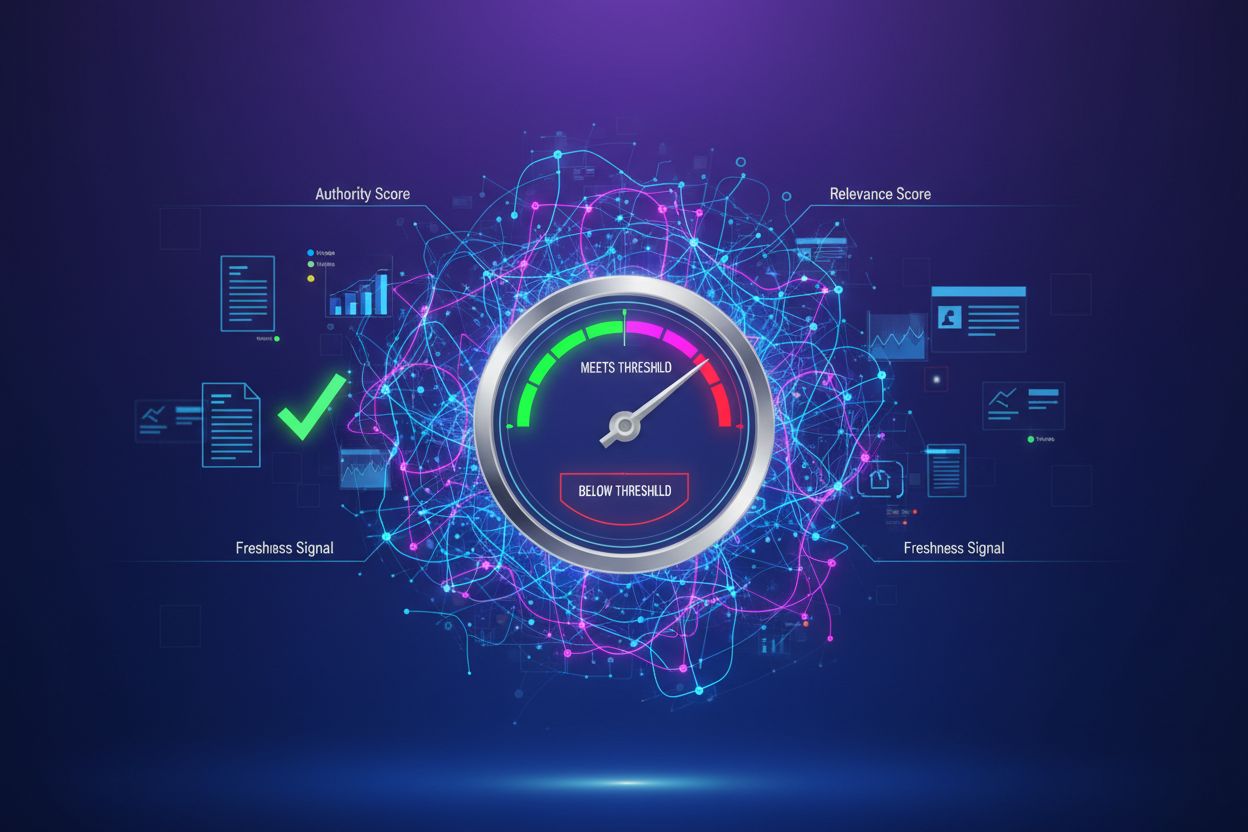
Citation thresholds function as part of sophisticated AI evaluation systems that determine which sources should be retrieved and cited in AI-generated responses. The scoring process involves multiple weighted components: relevance scores measure how well content aligns with the user’s query through semantic analysis and entity matching, authority scores evaluate the credibility and trustworthiness of the source domain, and freshness signals assess how recently content was published or updated. This evaluation framework operates within the context of Retrieval-Augmented Generation (RAG), a technique where AI systems retrieve relevant documents from a knowledge base before generating responses, ensuring citations are grounded in actual sources rather than relying solely on parametric knowledge embedded during training. Different AI platforms implement varying threshold requirements and weighting systems, meaning content that meets Perplexity’s citation threshold may not meet ChatGPT’s standards, and vice versa. The threshold acts as a filter that determines which retrieved documents actually make it into the final response as citations, rather than simply being considered during the retrieval phase. Understanding these platform-specific variations is crucial for content creators seeking to maximize their citation potential across multiple AI systems.
| AI Platform | Relevance Weight | Authority Weight | Freshness Weight | Consensus Weight |
|---|---|---|---|---|
| Google AI Overviews | 35% | 30% | 20% | 15% |
| Perplexity | 30% | 25% | 35% | 10% |
| ChatGPT | 40% | 35% | 15% | 10% |
| Bing Copilot | 33% | 32% | 22% | 13% |
Six critical factors work together to determine whether content meets citation thresholds across AI platforms:
Authority and Domain Authority Signals: The credibility and reputation of your domain significantly influence citation likelihood. AI systems evaluate factors like domain age, historical performance, quality of backlinks, and established expertise in your niche. Domains with higher Domain Authority scores and consistent quality signals are more likely to meet citation thresholds.
Relevance and Semantic Alignment: Content must demonstrate strong semantic alignment with user queries through proper entity recognition, keyword relevance, and conceptual depth. AI systems analyze whether your content directly addresses the query intent and contains the specific information users are seeking. High relevance scores are often weighted more heavily than authority in citation decisions.
Content Freshness and Recency: The publication date and update frequency of your content impact citation thresholds, particularly for time-sensitive topics. AI systems, especially Perplexity, prioritize recently updated content that reflects current information. Regular updates and maintenance of existing content can significantly improve citation potential.
Topical Expertise and Depth: Content that demonstrates comprehensive knowledge and deep expertise in a specific topic is more likely to meet citation thresholds. AI systems evaluate whether your content goes beyond surface-level information and provides genuine insights, original analysis, or specialized knowledge that justifies citation.
E-E-A-T Signals (Expertise, Experience, Authoritativeness, Trustworthiness): These Google-originated quality signals have become increasingly important for AI citation decisions. Content should clearly demonstrate the author’s expertise, real-world experience, established authority in the field, and trustworthiness through transparent sourcing and credentials. Strong E-E-A-T signals substantially improve citation threshold performance.
Consensus and Multi-Source Validation: AI systems favor content that aligns with information from multiple authoritative sources and represents consensus viewpoints. When your content is corroborated by other reputable sources and cited by industry leaders, it signals reliability and increases the likelihood of meeting citation thresholds across platforms.
Citation thresholds operate on fundamentally different principles than traditional search engine rankings, creating a distinct landscape that content creators must navigate separately. AI systems do not automatically cite the top-ranked pages in Google’s search results; instead, they apply their own evaluation criteria that may prioritize different signals and sources. While Google’s ranking algorithm heavily weights authority and backlink profiles, AI citation systems often weight relevance higher than authority, meaning a less-established source with perfectly aligned content may be cited over a high-authority domain with tangential relevance. The retrieval mechanisms differ significantly as well: traditional search engines use link-based ranking systems, while AI systems employ Retrieval-Augmented Generation (RAG) and parametric knowledge approaches that evaluate content through semantic similarity and contextual fit. Research has consistently shown substantial gaps between Google’s top-ranked pages and the sources cited by major LLMs, with studies indicating that only 30-40% of pages cited by ChatGPT appear in Google’s top 10 results for the same queries. This divergence means that optimizing exclusively for traditional SEO may leave your content invisible to AI citation systems. Understanding and addressing citation thresholds requires a distinct strategic approach that complements but differs from conventional search engine optimization.
Specific minimum threshold requirements provide benchmarks for content creators seeking to meet citation standards across AI platforms. The relevance threshold typically requires content to contain 8 or more relevant entities related to the query topic and achieve semantic similarity scores of 0.75 or higher when compared to the query intent. The authority threshold generally demands a Domain Authority score of 30 or higher and a minimum of 10 quality backlinks from authoritative sources within your industry or niche. The freshness threshold varies by topic but commonly requires content to be updated within the last 60 days for time-sensitive subjects, with less frequent updates acceptable for evergreen content. The consensus threshold typically requires your content to be mentioned or corroborated by at least 3 third-party authoritative sources, signaling that your information aligns with broader industry consensus. Overall quality score benchmarks suggest that content scoring 70 or higher on comprehensive quality assessments is significantly more likely to meet citation thresholds, while content below 50 rarely achieves citation status. It is important to note that these benchmarks are approximate and vary considerably by platform, topic, and query type. Different AI systems may weight these thresholds differently, and some platforms may have higher or lower requirements depending on their specific evaluation methodologies. Treating these as guidelines rather than absolute requirements allows for flexibility in optimization strategies.
Meeting citation thresholds requires a comprehensive, multi-faceted approach that addresses all key evaluation factors simultaneously. Building topical authority through comprehensive, interconnected content is essential; create pillar content that covers broad topics thoroughly, supported by cluster content that explores specific subtopics in depth, establishing your domain as a go-to resource in your niche. Implementing schema markup and structured data helps AI systems understand your content’s context and relationships; use Article schema, FAQPage schema, and entity markup to make your content’s structure and meaning explicit to AI evaluation systems. Creating FAQ and how-to content formats naturally aligns with how AI systems retrieve and cite information; these formats directly answer specific questions and provide step-by-step guidance that AI systems frequently cite in responses. Publishing original research and data significantly boosts citation potential; conduct surveys, analyze datasets, or perform original studies that provide unique insights unavailable elsewhere, giving AI systems novel, citable information. Maintaining content freshness through regular updates and maintenance is critical; establish a content refresh schedule that updates statistics, adds new information, and reflects current developments in your field. Building quality backlinks from authoritative sources remains important for authority signals; focus on earning links from industry publications, academic institutions, and established thought leaders rather than pursuing quantity. Optimizing for semantic clarity and entity relationships ensures AI systems can properly understand your content; use clear language, define key terms, and explicitly establish relationships between concepts and entities. Tools like AmICited.com provide comprehensive monitoring of your citation performance across AI platforms, allowing you to track which content meets thresholds and identify optimization opportunities.
Effective monitoring and measurement of citation thresholds requires a systematic approach that tracks performance across multiple AI platforms over time. The recommended testing methodology involves running 50-100 queries across different AI platforms that are relevant to your content, documenting which of your pages are cited and analyzing patterns in citation performance. Establish a quality scoring framework that evaluates your content against the key threshold factors: relevance alignment, authority signals, freshness, topical expertise, E-E-A-T indicators, and consensus validation. Implement monthly monitoring to track citation performance trends, noting which content gains or loses citation status and correlating changes with content updates, backlink acquisition, or competitive developments. Competitive benchmarking involves analyzing which competitor content is being cited for similar queries, identifying what threshold factors they excel at, and determining where your content falls short. Several tools facilitate this monitoring process: AmICited.com stands out as the top solution specifically designed for AI citation monitoring, providing detailed insights into which of your pages are cited by major AI platforms and why; BrightEdge and STAT offer broader AI monitoring capabilities alongside traditional SEO tracking. Establish baseline metrics by documenting your current citation performance across platforms, then track progress monthly to identify whether your optimization efforts are moving the needle. This data-driven approach allows you to refine your strategy based on actual performance rather than assumptions about what AI systems value.
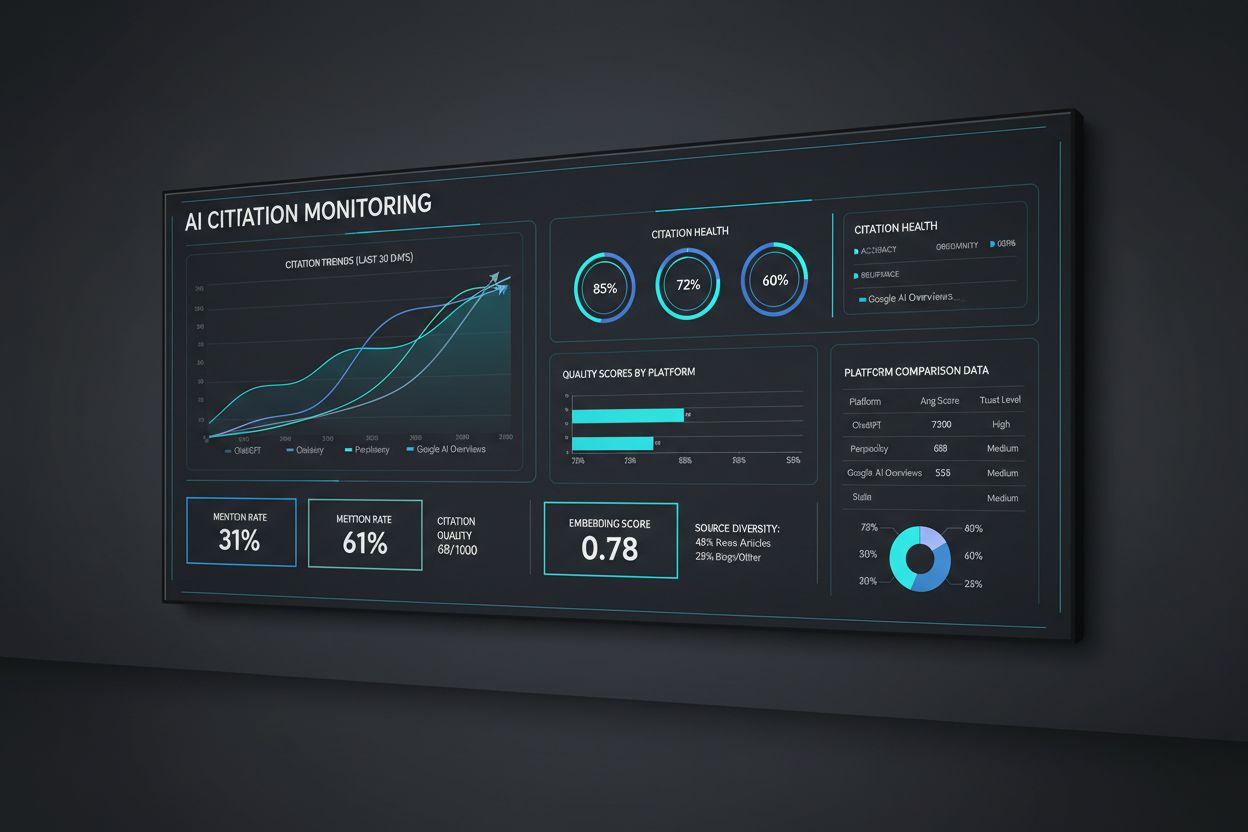
Each major AI platform implements distinct citation threshold requirements that reflect their unique architectures and evaluation priorities. Google AI Overviews takes a balanced approach that closely mirrors traditional SEO signals, valuing Domain Authority, backlinks, and topical relevance while incorporating freshness considerations; content that ranks well in Google search often meets Google AI Overviews citation thresholds, though not always. Perplexity weights freshness and real-time information significantly higher than other platforms, prioritizing recently updated content and real-time web retrieval; this platform favors news sources, recent blog posts, and frequently updated resources, making content recency critical for citation. ChatGPT operates differently from the others, relying heavily on parametric knowledge from its training data while being more selective about citations; it requires higher relevance alignment and often cites fewer sources per response, meaning the threshold for inclusion is more stringent. Bing Copilot implements thresholds similar to Google AI Overviews but with different weighting of individual factors, placing slightly more emphasis on freshness and slightly less on traditional authority signals. These platform-specific variations exist because each system uses different retrieval mechanisms, training data, and evaluation criteria to determine which sources deserve citation. Understanding these differences is crucial for comprehensive optimization; a content strategy that works perfectly for Perplexity may underperform on ChatGPT, requiring platform-specific adjustments. The most effective approach involves optimizing for all platforms simultaneously by addressing all threshold factors comprehensively, ensuring your content meets the highest standards across all systems.
Several widespread misconceptions about citation thresholds lead content creators to pursue ineffective optimization strategies. The first major misconception is that citation threshold is the same as ranking position; in reality, a page ranking #1 in Google may not meet citation thresholds for AI systems, and conversely, a page ranking outside the top 10 may be frequently cited by AI platforms. Another common myth is that high authority automatically guarantees citation; while authority is important, a high-authority page with low relevance to a specific query will not be cited, as AI systems prioritize relevance alignment. Many creators assume that authority matters more than relevance, when research consistently shows the opposite: AI systems often weight relevance 35-40% compared to authority at 25-35%, meaning perfectly aligned content from a mid-tier domain may outperform tangentially relevant content from a high-authority source. The misconception that thresholds are static and unchanging leads to outdated optimization strategies; citation thresholds evolve as AI systems improve their evaluation capabilities and as the competitive landscape changes. Some believe that only large brands and high-authority domains can meet thresholds, when in reality small brands and niche experts frequently meet citation thresholds by demonstrating deep topical expertise and high relevance in their specific domains. Finally, many assume that meeting the threshold guarantees citation will occur, when thresholds represent only the minimum requirement for consideration; even content that meets all threshold requirements may not be cited if other sources better match the specific query context or if the AI system chooses to cite fewer sources.
Citation thresholds will continue to evolve as AI technology advances and the competitive landscape shifts, requiring content creators to remain adaptable and forward-thinking. The evolution of AI evaluation criteria will likely become more sophisticated, incorporating new signals and refining existing ones as AI systems become better at understanding content quality and relevance; what constitutes a citation threshold today may be substantially different in 12-24 months. The increasing importance of E-E-A-T signals will accelerate, with AI systems placing greater emphasis on demonstrable expertise, real-world experience, established authority, and trustworthiness; content that clearly establishes these qualities will have significant advantages in future citation decisions. Real-time content evaluation capabilities will improve, potentially allowing AI systems to assess content quality and freshness more dynamically; this may reduce the importance of static authority metrics and increase the value of continuously updated, current information. There is growing potential for more transparent threshold disclosure from AI platforms, with companies like OpenAI and Perplexity potentially providing clearer guidance on what factors influence citation decisions; this transparency would allow creators to optimize more effectively. The emergence of new AI platforms and models will introduce additional citation thresholds to optimize for, expanding the landscape beyond current major players; staying informed about new platforms and their evaluation criteria will be essential. Ultimately, the importance of staying adaptable to changes cannot be overstated; content creators who build flexible, comprehensive strategies addressing all threshold factors will be best positioned to maintain citation visibility as the AI landscape evolves. The future belongs to those who view citation threshold optimization not as a one-time project but as an ongoing practice of continuous improvement and adaptation.
Citation thresholds and ranking positions are fundamentally different metrics. A page ranking #1 in Google may not meet AI citation thresholds, while a page outside the top 10 may be frequently cited by AI platforms. AI systems use different evaluation criteria than search engines, prioritizing relevance and semantic alignment over traditional authority signals.
Yes, absolutely. Small brands and niche experts frequently meet citation thresholds by demonstrating deep topical expertise and high relevance in their specific domains. AI systems often weight relevance higher than authority, meaning a perfectly aligned mid-tier domain can outperform a high-authority source with tangential relevance.
Citation thresholds evolve continuously as AI systems improve their evaluation capabilities and as the competitive landscape shifts. What constitutes a threshold today may be substantially different in 12-24 months. Staying adaptable and continuously improving your content strategy is essential for maintaining citation visibility.
The general benchmark is Domain Authority 30 or higher, though this varies by platform and topic. However, authority is just one factor—relevance, freshness, and topical expertise often matter more. Content with lower authority but exceptional relevance and expertise can still meet citation thresholds.
No. Meeting citation thresholds represents only the minimum requirement for consideration. Even content that meets all threshold requirements may not be cited if other sources better match the specific query context or if the AI system chooses to cite fewer sources in its response.
Timeline varies significantly based on your starting point and niche competitiveness. Building topical authority typically takes 3-6 months of consistent, high-quality content publication. Freshness improvements can show results within weeks, while authority building through backlinks may take 4-6 months or longer.
No. Each platform implements distinct thresholds reflecting their unique architectures. Google AI Overviews values traditional SEO signals, Perplexity emphasizes freshness, ChatGPT is more selective, and Bing Copilot uses similar criteria to Google with different weighting. Optimize for all platforms by addressing all threshold factors comprehensively.
Relevance is typically the most important factor, weighted 35-40% across most platforms. However, the most effective approach addresses all factors comprehensively: relevance, authority, freshness, topical expertise, E-E-A-T signals, and consensus validation. No single factor alone guarantees citation success.
Track how AI systems cite your content across ChatGPT, Perplexity, Google AI Overviews, and Bing Copilot. Get detailed insights into your citation performance and optimization opportunities.
Learn what AI content quality thresholds are, how they're measured, and why they matter for monitoring AI-generated content across ChatGPT, Perplexity, and othe...
Learn the optimal content depth, structure, and detail requirements for getting cited by ChatGPT, Perplexity, and Google AI. Discover what makes content citatio...
Learn what AI citations are, how they work across ChatGPT, Perplexity, and Google AI, and why they matter for your brand's visibility in generative search engin...
Cookie Consent
We use cookies to enhance your browsing experience and analyze our traffic. See our privacy policy.