
What is AI-native content creation and how does it work?
Learn what AI-native content creation means, how it differs from traditional approaches, and how to leverage AI technologies to create better content faster whi...
8 min read

Automated creation of marketing content using artificial intelligence and natural language processing to generate written, visual, and multimedia materials with minimal human intervention. AI content generation leverages machine learning algorithms to produce blog posts, social media content, product descriptions, and other marketing assets at scale while maintaining brand consistency and optimizing for search engine visibility.
Automated creation of marketing content using artificial intelligence and natural language processing to generate written, visual, and multimedia materials with minimal human intervention. AI content generation leverages machine learning algorithms to produce blog posts, social media content, product descriptions, and other marketing assets at scale while maintaining brand consistency and optimizing for search engine visibility.
AI content generation refers to the use of artificial intelligence systems to automatically create written, visual, or multimedia content with minimal human intervention. These systems leverage natural language processing (NLP) and machine learning algorithms to analyze patterns in existing content and generate new material that mimics human writing styles, structures, and messaging. At its core, AI content generation automates the content creation process by understanding context, tone, and audience preferences to produce relevant marketing materials, blog posts, social media updates, and other digital assets. The technology has evolved significantly from simple template-based systems to sophisticated models capable of producing nuanced, contextually appropriate content across diverse industries and formats. Automated content creation through AI enables organizations to scale their content production efforts without proportionally increasing their workforce, making it a valuable tool for marketing automation and content strategy implementation. The underlying machine learning models continuously improve through exposure to vast amounts of training data, allowing them to generate increasingly sophisticated and contextually relevant content over time.
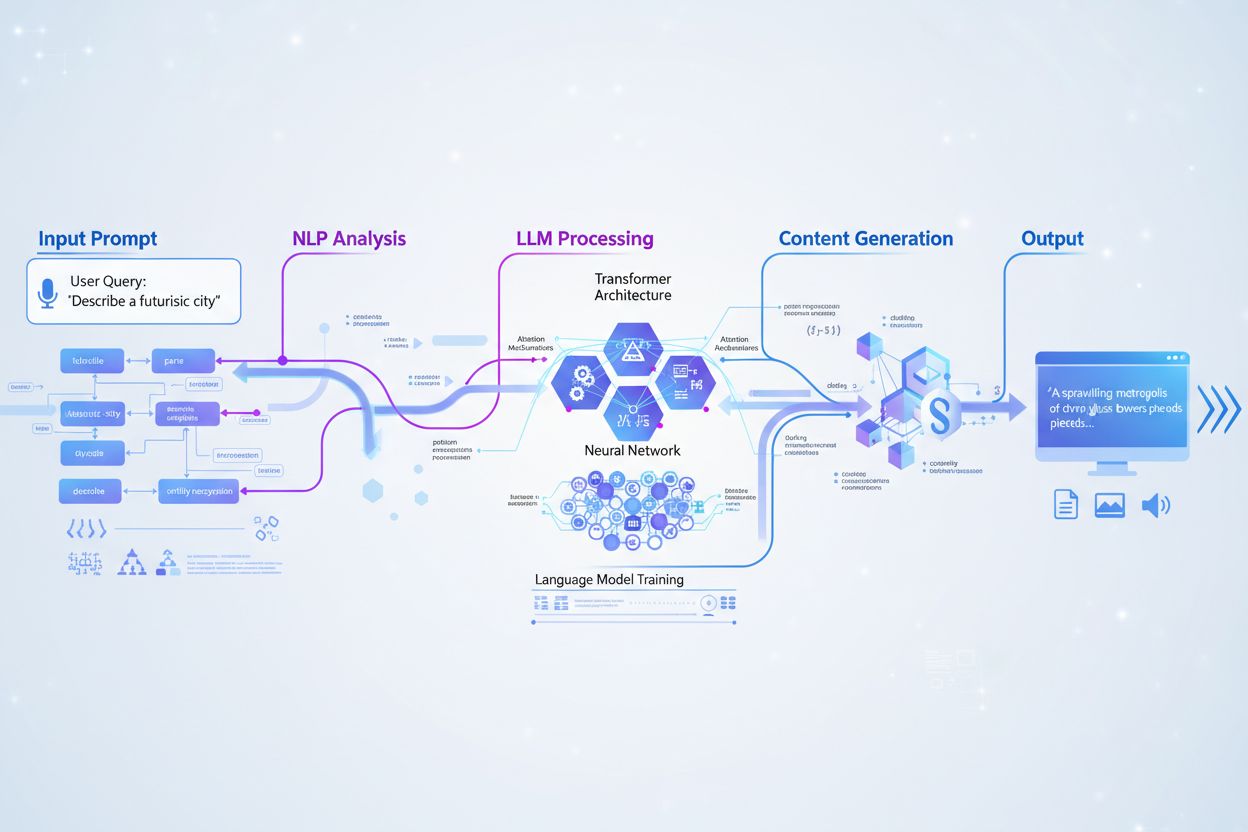
AI content generation operates through a sophisticated pipeline of natural language processing and machine learning technologies that transform raw input prompts into coherent, contextually appropriate output. The process begins when a user provides a prompt or brief describing the desired content, which the system then analyzes to understand intent, target audience, and required tone. Large language models (LLMs), which are neural networks trained on billions of words from diverse sources, use transformer architecture to predict the most probable next word or phrase based on the input context, building content sequentially one token at a time. These models learn statistical patterns about language structure, grammar, factual relationships, and writing conventions through exposure to massive datasets during the training phase, allowing them to generate text that appears natural and coherent. The machine learning algorithms underlying these systems employ techniques like attention mechanisms that help the model focus on relevant parts of the input when generating each new piece of content, ensuring consistency and relevance throughout longer documents. Modern AI content generation systems often incorporate feedback loops and fine-tuning processes that allow them to adapt to specific brand voices, industry terminology, and organizational preferences, making the generated content increasingly aligned with user expectations over time.
AI content generation tools can produce a diverse range of content types across multiple formats and industries. The primary content types that AI systems excel at generating include:
AI content generation delivers substantial advantages for organizations seeking to improve their content production efficiency and marketing effectiveness. The primary benefits include:
The AI content generation market includes numerous specialized platforms, each offering distinct capabilities and pricing models suited to different organizational needs and use cases.
| Tool Name | Best For | Key Features | Pricing |
|---|---|---|---|
| Jasper | Comprehensive content marketing | Brand voice customization, long-form content generation, SEO optimization, template library with 50+ templates, team collaboration features, API access | Starter: $39/month; Business: $99/month; Custom enterprise pricing |
| Copy.ai | Quick copywriting and marketing content | AI-powered copywriting templates, bulk content generation, multiple language support, integration with marketing tools, affordable entry point | Free tier available; Unlimited: $49/month; Teams: $125/month |
| Surfer SEO | SEO-optimized content creation | Content editor with real-time SEO scoring, keyword research integration, competitor analysis, content outline generation, SERP analysis | Essential: $89/month; Advanced: $129/month; Max: $299/month |
| Canva | Visual content and design | AI-powered design suggestions, template library, text-to-image generation, brand kit management, collaboration tools, stock image integration | Free; Pro: $13/month; Teams: $30/month per person |
| InVideo | Video content creation | AI video generation from text, stock footage library, text-to-speech, subtitle generation, template-based editing, brand customization | Free; Plus: $25/month; Max: $60/month |
| Synthesia | Professional video production | AI avatar video generation, realistic human presenters, multi-language support, script-to-video automation, enterprise-grade quality | Starter: $30/month; Creator: $90/month; Custom enterprise |
| ChatGPT | General-purpose content generation | Conversational AI, versatile writing capabilities, code generation, research assistance, free and paid tiers, API access | Free; Plus: $20/month; Enterprise custom pricing |
| Grammarly | Writing quality and refinement | AI-powered grammar checking, tone detection, plagiarism detection, style suggestions, brand voice customization, integration with web applications | Free; Premium: $12/month; Business: $15/month per user |
While AI content generation offers significant advantages, organizations must understand and address substantial limitations that affect content quality and appropriateness. Key challenges include:
Successful implementation of AI content generation requires a strategic approach that maximizes benefits while mitigating risks and maintaining content quality standards. Organizations should follow these evidence-based practices:
Conduct Thorough Audience Research – Before generating content, invest time in understanding your target audience’s preferences, pain points, information needs, and communication style preferences. This research informs better prompts and ensures generated content resonates with intended readers rather than producing generic material.
Select Tools Aligned with Specific Needs – Evaluate AI content generation platforms based on your specific use cases, content types, and integration requirements. Different tools excel at different tasks; a platform ideal for social media content may not be optimal for technical documentation or long-form articles.
Develop Detailed Brand Guidelines and Voice Documentation – Create comprehensive documentation of your brand voice, tone, terminology preferences, and messaging pillars. Feed this information into AI systems through training data or configuration settings to ensure generated content maintains consistent brand identity.
Implement Mandatory Human Review and Editing – Treat AI-generated content as a first draft requiring human refinement rather than publication-ready material. Assign qualified editors to review for accuracy, tone consistency, brand alignment, and factual correctness before any content reaches audiences.
Fact-Check All Claims and Statistics – Establish a verification process for all factual claims, statistics, and citations in AI-generated content. Cross-reference information against authoritative sources and verify that data is current and accurate before publication.
Optimize Prompts for Better Results – Invest time in crafting detailed, specific prompts that clearly communicate desired content structure, tone, length, and key points. More detailed prompts typically produce higher-quality output than vague requests, and iterative refinement improves results over time.
Maintain SEO Best Practices – While AI tools can optimize for keywords, ensure generated content provides genuine value to readers rather than prioritizing search engine rankings. Balance keyword optimization with readability, user experience, and authentic information that serves audience needs.
Establish Clear Disclosure Policies – Determine when and how to disclose AI involvement in content creation to audiences. Some publications and platforms require explicit disclosure, and transparency builds trust with audiences who increasingly expect honesty about content origins.
Use AI for Ideation and Outlining – Leverage AI’s strength in generating multiple options by using it for brainstorming, outline creation, and headline suggestions rather than relying solely on it for final content. This hybrid approach combines AI efficiency with human creativity and judgment.
Monitor Performance and Iterate – Track engagement metrics, audience feedback, and conversion rates for AI-generated content compared to human-written content. Use these insights to refine prompts, adjust tool selection, and improve your overall AI content generation strategy over time.
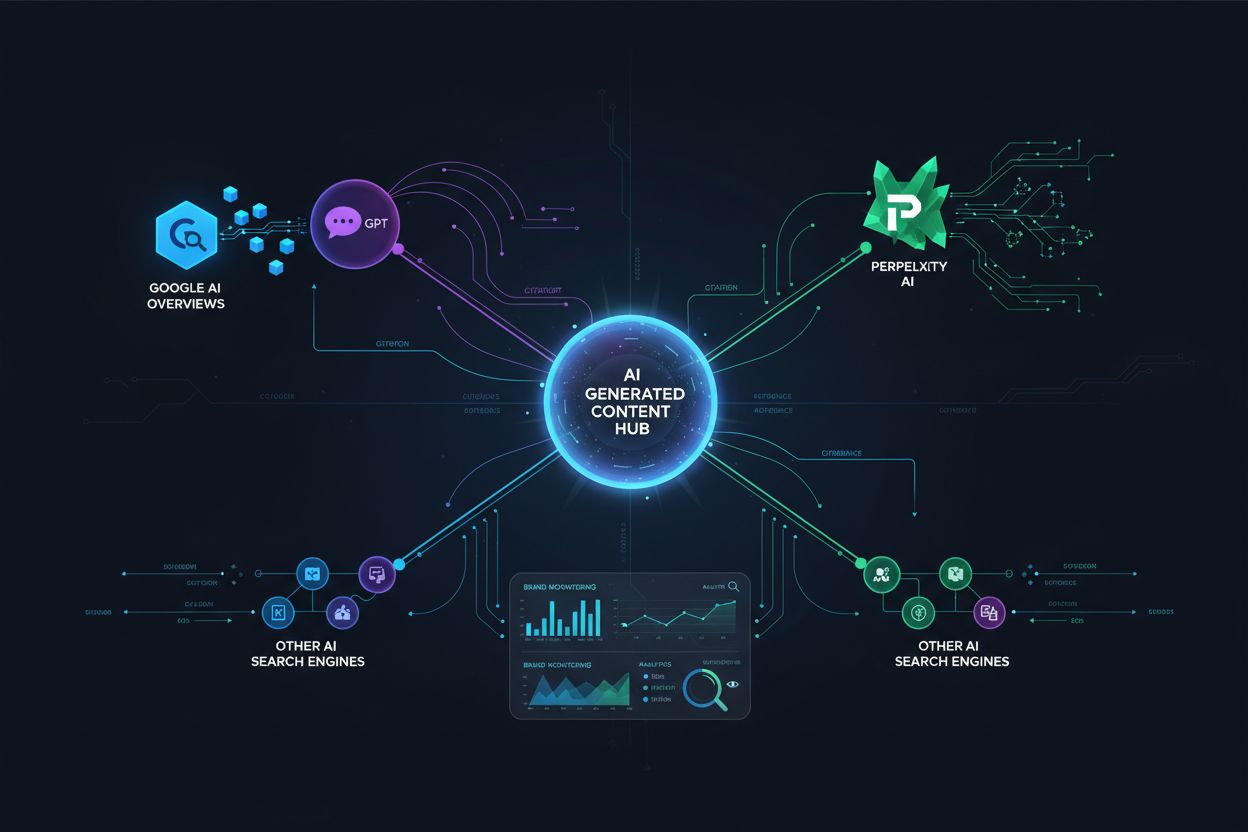
The rise of AI content generation has fundamentally changed how content achieves visibility in the digital landscape, particularly through emerging AI-powered platforms that now compete with traditional search engines. Google AI Overviews, ChatGPT, Perplexity, and similar AI platforms are increasingly becoming the first stop for information seekers, especially among younger audiences who prefer conversational AI responses over traditional search results. When users query these AI platforms, the systems synthesize information from multiple sources to generate comprehensive answers, and the websites cited in these AI-generated overviews receive significant visibility benefits and traffic. This shift means that organizations producing AI-generated content must now consider not only traditional search engine optimization but also visibility within AI platforms that may cite, reference, or incorporate their content into AI-generated responses.
The relationship between AI content generation and AI platform visibility creates both opportunities and challenges for content creators:
AmICited.com serves as a critical monitoring solution for organizations seeking to understand and optimize their visibility across AI platforms. The platform tracks where your content appears in AI Overviews, ChatGPT responses, Perplexity answers, and other AI-generated content, providing visibility into how frequently your brand and content are cited by AI systems. This monitoring capability is essential because AI citations represent a new form of digital authority and visibility that directly impacts brand awareness, traffic, and credibility. By understanding which of your content pieces are being cited by AI platforms, how often they appear in AI-generated responses, and how they compare to competitor citations, organizations can refine their content strategy to maximize visibility in this emerging AI-driven information landscape. As AI platforms continue to evolve and capture increasing shares of information-seeking behavior, monitoring AI citations becomes as important as tracking traditional search engine rankings, making tools like AmICited.com indispensable for maintaining competitive visibility in the modern digital ecosystem.
AI content generation uses machine learning algorithms to automatically create content based on prompts and training data, while traditional content writing relies on human writers' creativity and expertise. AI content generation is faster and more cost-effective for producing large volumes of content, but human writing typically offers more originality, nuance, and authentic voice. Many organizations use a hybrid approach, leveraging AI for ideation and drafting while human writers refine and enhance the final output.
Yes, AI-generated content can rank well in search engines when it meets quality standards including accuracy, relevance, proper structure, and genuine value to readers. Search engines like Google prioritize content quality and user experience over whether content was created by AI or humans. However, AI-generated content must be thoroughly reviewed for factual accuracy, optimized for target keywords, and edited to maintain consistent tone and brand voice to achieve optimal search rankings.
Key limitations include limited genuine creativity, potential factual inaccuracies, lack of authentic voice, difficulty with specialized domains and cultural nuances, and increasing AI detection capabilities. AI systems generate content based on patterns in training data rather than original thinking, and they can confidently produce false information. Additionally, audiences may perceive AI-generated content as lower quality, and some platforms require disclosure of AI involvement in content creation.
AI platforms like ChatGPT and Perplexity synthesize information from multiple sources to generate comprehensive answers to user queries. Content that is authoritative, accurate, and well-structured is more likely to be cited in these AI-generated responses. Organizations can improve their visibility on AI platforms by creating high-quality, factually accurate content that directly answers user questions, implementing proper schema markup, and monitoring where their content appears in AI-generated responses using tools like AmICited.com.
The best tool depends on your specific needs, content types, and budget. Jasper excels at comprehensive content marketing with brand voice customization, Copy.ai is ideal for quick social media copywriting, Surfer SEO specializes in SEO-optimized content, and ChatGPT offers versatile general-purpose content generation. Evaluate tools based on your primary use cases, required integrations, team size, and budget constraints. Many organizations use multiple tools for different purposes rather than relying on a single platform.
Disclosure requirements vary by platform and jurisdiction. Some publications, social media platforms, and regulatory bodies require explicit disclosure of AI-generated content, while others recommend transparency as a best practice to build trust with audiences. Regardless of legal requirements, many organizations choose to disclose AI involvement because audiences increasingly expect honesty about content origins. Check your industry regulations and platform policies to determine specific disclosure requirements for your content.
Train your AI system with comprehensive brand guidelines including tone, terminology, messaging pillars, and style preferences. Provide the AI tool with examples of your best existing content so it can learn your brand voice patterns. Always implement mandatory human review and editing to ensure consistency. Many AI platforms like Jasper offer brand voice customization features that help maintain consistency across all generated content. Regular monitoring and feedback loops help refine the AI system's output over time.
AI content generation typically costs 40-60% less than hiring human writers for routine content creation. A 1,500-word article from a freelancer might cost $175+, while AI tools can generate similar content for a fraction of that cost through monthly subscriptions ($20-$300 depending on the tool). However, AI-generated content requires human editing and fact-checking, which adds labor costs. The total cost-benefit depends on your content volume, quality requirements, and whether you use AI for ideation and drafting versus final publication-ready content.
Track how your AI-generated and human-created content appears across Google AI Overviews, ChatGPT, Perplexity, and other AI platforms. Understand your brand's presence in AI-generated responses and optimize your content strategy for maximum visibility.
Learn what AI-native content creation means, how it differs from traditional approaches, and how to leverage AI technologies to create better content faster whi...
Learn whether AI-generated content is effective for AI search visibility, including best practices for content creation, optimization strategies, and how to bal...
Learn essential strategies to optimize your support content for AI systems like ChatGPT, Perplexity, and Google AI Overviews. Discover best practices for clarit...
Cookie Consent
We use cookies to enhance your browsing experience and analyze our traffic. See our privacy policy.